
THE LOVE IRELAND GUIDE № 002

Every year, more than 100 countries turn green for one day. Landmarks light up, rivers get dyed, and people who have never set foot in Ireland put on a shamrock and mean it. Almost none of them know that for most of Ireland’s history, this was a quiet religious holiday — and that Irish pubs were legally required to stay closed on March 17th until 1970. This is Guide № 002: the real history, the myths worth retiring, a timeline of how one saint’s feast day became a global celebration, and how to actually get it right.
In this guide
- Who St. Patrick actually was
- A timeline: feast day to global phenomenon
- Why the day was quiet in Ireland for so long
- How New York, not Dublin, built the modern celebration
- Why the colour was originally blue, not green
- The shamrock, the snakes, and the myths worth retiring
- How Dublin caught up — and overtook everyone
- How the world celebrates today
- A short glossary
- How to celebrate it properly
- Frequently asked questions
- Help us reach One Million Irish Hearts
Get the collectible PDF edition
The Love Ireland Guide № 002 — history, myths, timeline and more, laid out as a keepable booklet.
Who St. Patrick actually was
Patrick was not Irish. He was born in Roman Britain in the late 4th century, and as a teenager he was kidnapped by Irish raiders and brought to Ireland as a slave, where he spent six years herding sheep. He escaped, made his way home, then trained as a priest — and chose to go back to the country that had enslaved him, this time as a missionary. He spent decades converting communities across Ireland before his death, traditionally dated to the 17th of March, 461 AD. That date became his feast day, and eventually gave the whole occasion its name.
A timeline: feast day to global phenomenon
- 461 AD — Traditional date of St. Patrick’s death, later observed as his feast day.
- 1631 — The Catholic Church formally places St. Patrick’s Day on the liturgical calendar.
- 1762 — The first recorded St. Patrick’s Day parade takes place not in Ireland, but in New York City, led by Irish soldiers in the British Army.
- 18th century — Green becomes politically tied to Irish identity through the United Irishmen movement, overtaking the earlier “St. Patrick’s blue.”
- 1903 — St. Patrick’s Day becomes an official public holiday in Ireland.
- 1962 — Chicago dyes its river green for the first time, a tradition that continues every year since.
- 1970 — Irish law requiring pubs to close on March 17th is finally repealed.
- 1996 — Dublin launches its first official multi-day St. Patrick’s Festival.
- Today — Celebrated in some form in over 100 countries.
Why the day was quiet in Ireland for so long
For most of its history, the 17th of March in Ireland was a solemn religious observance, not a party. It falls during Lent, and for centuries it meant Mass in the morning and not much else. Here is the detail that surprises almost everyone: Irish law required pubs to close on St. Patrick’s Day, every year, until 1970. The one official exception was the Royal Dublin Dog Show, which somehow kept its bar open throughout. While Irish emigrants abroad were building parades and parties, Ireland itself was, quite literally, closed.
How New York, not Dublin, built the modern celebration
The first recorded St. Patrick’s Day parade didn’t happen in Ireland at all — it happened in New York City, in 1762, fourteen years before the Declaration of Independence. Irish soldiers serving in the British Army, homesick and far from home, marched through Lower Manhattan playing Irish music and speaking Irish in public — freedoms that were restricted back in Ireland at the time. That single parade is the direct ancestor of the huge diaspora celebrations that followed: Irish immigrant communities in America turned the day into a public assertion of identity, at a time when being openly Irish in Ireland carried real restrictions.
Why the colour was originally blue, not green
The colour most closely tied to St. Patrick in early tradition was actually a shade now known as “St. Patrick’s blue,” visible on some old Irish flags and royal orders. Green’s association came later, tied to the shamrock and to 18th-century Irish nationalism — the United Irishmen movement adopted green as a symbol of Irish identity, and “the wearing of the green” became a defiant political statement before it ever became a global party colour.
The shamrock, the snakes, and the myths worth retiring
Tradition holds that Patrick used the three-leafed shamrock to explain the Christian Holy Trinity to a pagan audience — three leaves, one plant. It’s a lovely story, and it isn’t confirmed by any writing from Patrick’s own lifetime; it appears in accounts written centuries later. The same goes for the famous claim that he drove all the snakes out of Ireland: Ireland never had native snakes in the first place, the seas having cut it off from mainland Europe since the last Ice Age. The “snakes” are now generally read as a symbol for paganism itself, driven out by the arrival of Christianity — not a literal reptile removal.
One more distinction worth keeping straight: a shamrock has three leaves and is the real symbol tied to St. Patrick; a four-leaf clover is a separate, much rarer genetic variant tied to luck, not to the saint at all. The two get conflated constantly, but they’re not the same symbol.
How Dublin caught up — and overtook everyone
Ireland’s own celebrations only really took their modern shape from the 1990s onward. Dublin launched its first official St. Patrick’s Festival in 1996, deliberately expanding a single parade day into a multi-day city-wide festival — partly as a tourism strategy, drawing on exactly the global goodwill that generations of the diaspora had already built. It worked: Dublin’s festival now draws hundreds of thousands of visitors, and the city that once legally closed its pubs on the day now hosts one of the largest celebrations of it anywhere on Earth.
How the world celebrates today
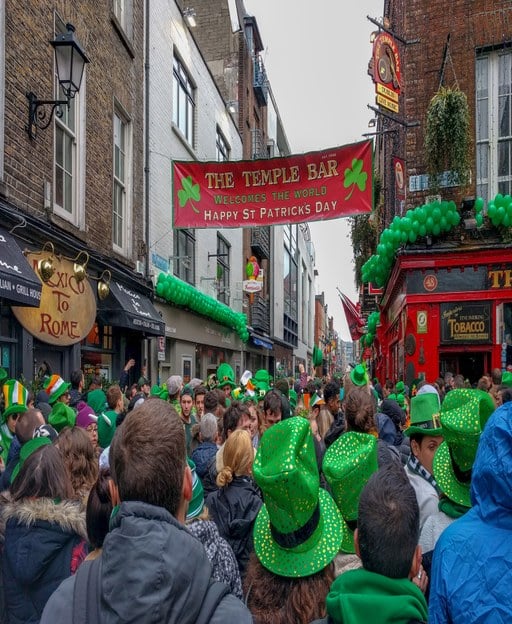
More than 100 countries now mark the day in some form. Chicago has dyed its river green every year since 1962. Landmarks from the Sydney Opera House to the Colosseum in Rome turn green for the night. Parades run from Tokyo to Buenos Aires. What started as one homesick parade in colonial New York is now one of the most widely celebrated cultural days in the world — bigger, in scale, than almost any single celebration held inside Ireland itself.
*Was this forwarded to you? Subscribe free and never miss the next Love Ireland Guide → loveireland.substack.com*
A short glossary
- Shamrock — a three-leafed plant tied to St. Patrick’s teaching of the Holy Trinity; not the same as a four-leaf clover.
- “The wearing of the green” — an 18th-century phrase for openly displaying green as a symbol of Irish identity, originally a political statement.
- “Drowning the shamrock” — an old tradition of placing a sprig of shamrock worn during the day into the last drink of the night before it’s finished.
- St. Patrick’s blue — the colour originally associated with St. Patrick, seen on older Irish royal and civic imagery, before green took over.
- St. Patrick’s Festival — Dublin’s official multi-day celebration, launched in 1996, expanding well beyond the single parade day.
How to celebrate it properly
If you want to mark the day the way it’s actually rooted in Irish tradition rather than the loudest stereotype: wear a real shamrock rather than a plastic four-leaf clover if you can get one, learn one genuine fact about St. Patrick to share instead of the snake myth, and if you’re raising a glass, do it for a real Irish stout or whiskey rather than dyed green beer, which has no real link to Ireland at all. Best of all — read up on the actual history, so at least one person in the room this year knows the pubs used to be closed.
Frequently asked questions
Was St. Patrick actually Irish?
No. He was born in Roman Britain and was brought to Ireland as a slave as a teenager, before later returning voluntarily as a missionary.
Did St. Patrick really drive snakes out of Ireland?
Not literally — Ireland never had native snakes. The story is now read as a symbol for the displacement of paganism by Christianity, not an actual event. For the full story, see our deep dive: St. Patrick and Snakes: Unravelling the Myth.
Why is the colour green associated with the day if St. Patrick’s colour was blue?
Green’s association grew out of the shamrock and 18th-century Irish nationalist symbolism, overtaking the earlier “St. Patrick’s blue” well before the modern global celebration took shape.
Where was the first St. Patrick’s Day parade held?
New York City, in 1762 — held by Irish soldiers serving in the British Army, more than a century before Dublin had anything comparable.
Is a shamrock the same as a four-leaf clover?
No. A shamrock has three leaves and is the traditional symbol tied to St. Patrick; a four-leaf clover is a separate, rarer variant associated with luck, unrelated to the saint.
Help us reach One Million Irish Hearts
Every year, this community grows a little closer to a real milestone: one million people who love Ireland, joined together by St. Patrick’s Day 2027. Our live One Million Irish Hearts map fills in, heart by heart, as more people join the free Love Ireland newsletter — an interactive map of Ireland that grows greener with every single subscriber. Go take a look, see how close we are right now, and add your own heart to the map.
More Love Ireland Guides
The Love Ireland Guide is a numbered series — one tightly focused subject at a time, each with its own downloadable collectible edition. Guide № 001 is Irish Soda Bread. This is Guide № 002.
Sources: historical accounts of St. Patrick’s life and the 1762 New York parade per established Irish-American historical record; St. Patrick’s Day pub-closure law and the 1996 Dublin festival launch per Irish civic history.
Secure Your Dream Irish Experience Before It’s Gone!
Planning a trip to Ireland? Don’t let sold-out tours or packed attractions spoil your journey. Iconic experiences like visiting the Cliffs of Moher, exploring the Rock of Cashel, or enjoying a guided walk through Ireland’s ancient past often sell out quickly—especially during peak travel seasons.

Booking in advance guarantees your place and ensures you can fully immerse yourself in the rich culture and breathtaking scenery without stress or disappointment. You’ll also free up time to explore Ireland’s hidden gems and savour those authentic moments that make your trip truly special.
Make the most of your journey—start planning today and secure those must-do experiences before they’re gone!


