
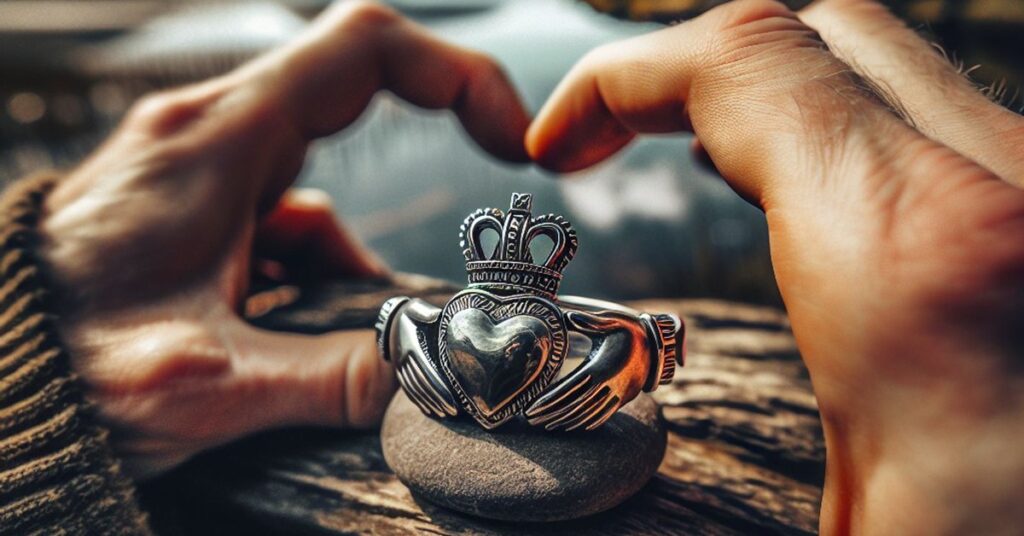
Before it was a piece of jewellery sold in airport gift shops, the Claddagh ring was a signet passed down inside a handful of fishing families in one small village outside Galway’s walls. Two hands. One heart. A crown above it. Every element means something specific, and the way you wear it once told every stranger on the street exactly where your heart stood — a silent code that predates dating apps by roughly three hundred years.
Get the Full Collectible Guide (Free PDF)
Everything below, plus the authentication marks to check before you buy, a full hallmark glossary, and the exact wording used for engraving — in a beautifully designed, printable booklet. The Love Ireland Guide № 003.
The Village Before the Ring
Long before the ring existed, the Claddagh existed — a thatched fishing village on the west bank of the River Corrib, right where it meets Galway Bay. It stood entirely outside Galway city’s walls, spoke Irish while the walled town spoke English and Norman French, and governed itself under its own elected “King of the Claddagh” into the 20th century — the last true king, Eoin Concannon, died in 1954, one of the last such elected folk-kings recognised in Ireland. The fishermen there had their own fleet design (the Galway hooker), their own dialect, and their own strict marriage customs. We’ve told the fuller story of that vanished village here — it’s worth reading in full, because almost nothing of the physical village survived past the 1930s slum clearances. The ring is, in a real sense, the last thing that did.
The Richard Joyce Story
The design is credited to Richard Joyce, a Claddagh goldsmith with one of the more remarkable biographies in Irish craft history. Around 1675, Joyce was sailing to the West Indies when Algerian corsairs captured his ship. He spent the next fourteen years enslaved in Algiers, apprenticed against his will to a Moorish goldsmith who taught him the trade. When William III’s peace negotiations with Algiers finally secured his release in 1689, his former master reportedly offered him his daughter’s hand and half his fortune to stay. Joyce refused, and sailed home to Galway — and, the story goes, to the woman who had waited for him. He set up as a goldsmith on Claddagh, and the ring he is credited with designing carries the exact message of everything he’d just lived through: two hands (the friendship that gets you through it), a heart (the love worth returning to), a crown (loyalty, to a promise kept over fourteen years).
Whether every detail of the captivity story is period-accurate or embellished by later retelling, Joyce himself is real and documented — his hallmark, an anchor with the letters “RI”, appears on surviving 17th-century Claddagh rings and is one of the marks collectors and museums still use to authenticate the earliest examples. We’ve covered the origin story from the village’s side here.
What Every Part Actually Means
- The hands — friendship. Specifically, the kind that holds you up, not the casual kind. In the original Claddagh community, friendship carried near-family weight.
- The heart — love. Positioned at the centre, held rather than worn on a chain around the neck — the ring puts the symbol directly on the hand that acts.
- The crown — loyalty, and by most accounts a nod to a specific loyalty: fidelity maintained through absence, hardship, or temptation, exactly as in Joyce’s own life.
The traditional motto that goes with it, in Irish: Lig dó ghrá agus cairdeas a rialú — “Let love and friendship reign.” It’s the line most commonly engraved inside a genuine ring’s band.
How You Wear It Changes What It Says
This is the part almost every visitor gets backwards at least once, and it’s the single most-asked question about the ring. The rule concerns two things: which hand, and which way the heart faces.
- Right hand, heart facing outward (crown and hands visible, heart pointing to your fingertips): your heart is open. Single, and available.
- Right hand, heart facing inward (heart pointing back toward your wrist): your heart has been claimed. In a relationship.
- Left hand, heart facing outward: engaged — your heart has been captured, but the vow isn’t sealed yet.
- Left hand, heart facing inward: married. The classic wedding-ring position, worn exactly where a Western wedding band sits.
We’ve built a full visual breakdown of this exact convention, including how strictly it’s actually still observed in Ireland today (less strictly than tourist guides suggest, more strictly than you’d think in Galway itself), in this article.
Real Authentication Marks
Because “Claddagh ring” isn’t a protected design — any jeweller anywhere can stamp out the shape — genuine Galway-made rings carry specific hallmarks that separate an heirloom from a souvenir-shop casting:
- The Fáinne Cladaigh (Claddagh Ring) trademark — registered by Dillon’s, the oldest continuously operating jeweller in Galway (est. 1750s, still trading on Quay Street), one of the few marks that can be traced to an unbroken Claddagh-based goldsmithing lineage.
- Irish hallmarking at the Dublin Assay Office — a genuine Irish-made gold or silver ring should carry the Hibernia mark (a seated harp figure) plus a fineness mark, the same hallmarking system used on all Irish precious-metal jewellery, not specific to Claddagh rings but a reliable sign the ring was actually made and assayed in Ireland rather than imported.
- Maker’s initials — historic Galway makers (Joyce’s own “RI” anchor mark being the most sought by collectors, alongside later 19th-century makers Dillon and Faller) stamped their initials inside the band, the jewellery equivalent of a signature.
None of this means a mass-produced version isn’t a real, meaningful gift — most people wearing one today own exactly that, and there’s nothing wrong with it. But if you’re buying an “antique” or “heirloom” Claddagh ring at a premium price, these are the actual things to check, not just the seller’s say-so.
Buying and Giving Etiquette
Tradition holds that you don’t buy a Claddagh ring for yourself — it’s meant to be given, and who gives it carries its own weight:
- From a mother to a daughter, as the ring is traditionally passed down through the maternal line as a family heirloom.
- From a partner, as an engagement or commitment gift — the most common reason it’s bought today.
- From a close friend, entirely platonically — the “friendship” reading of the ring is not a modern softening; it was always one of the three legitimate meanings, not merely a fallback for the unattached.
Myths Worth Retiring
“It’s only a wedding ring.” No — friendship and family gifting are equally traditional uses, not modern marketing add-ons.
“You have to be Irish to wear one.” There’s no rule, historic or otherwise, restricting the ring by ancestry — it’s a gift and a symbol, and Irish jewellers have sold them to visitors since at least the Victorian souvenir trade. We’ve answered this exact question directly here.
“It’s ancient, pre-Christian Celtic design.” The hands-heart-crown “fede ring” format the Claddagh belongs to is a European Renaissance jewellery tradition, and Joyce’s Galway version dates to the late 1600s — old, and genuinely Irish, but a few thousand years younger than the Celtic-mythology framing some shops use to sell it.
A Presidential Footnote
At least one US president wore a Claddagh ring — a detail that surprises most people who assume it’s a purely tourist-facing symbol. We cover exactly who, and the Irish-American connection behind it, in this piece.
Frequently Asked Questions
Can I wear a Claddagh ring on any finger?
Traditionally the ring finger of either hand, since the hand-and-direction convention is what carries the meaning. Worn elsewhere it’s still a beautiful piece of jewellery, just outside the traditional signalling system.
Is a Claddagh necklace the same thing?
Same symbol, different object — and without a hand or direction to read, a necklace version carries the general meaning (love, loyalty, friendship) without the specific relationship-status code. We go into this here.
Where can I see real historic Claddagh rings in Ireland?
Dillon’s Jewellers on Quay Street, Galway, maintains a small in-house museum of antique Claddagh rings alongside its working shop — it’s free to visit and worth the stop if you’re in Galway city.
More Love Ireland Guides in this series are linked below. See you in the next edition.
Secure Your Dream Irish Experience Before It’s Gone!
Planning a trip to Ireland? Don’t let sold-out tours or packed attractions spoil your journey. Iconic experiences like visiting the Cliffs of Moher, exploring the Rock of Cashel, or enjoying a guided walk through Ireland’s ancient past often sell out quickly—especially during peak travel seasons.

Booking in advance guarantees your place and ensures you can fully immerse yourself in the rich culture and breathtaking scenery without stress or disappointment. You’ll also free up time to explore Ireland’s hidden gems and savour those authentic moments that make your trip truly special.
Make the most of your journey—start planning today and secure those must-do experiences before they’re gone!


