
📱 The Love Ireland app is here — now on iPhoneDownload Love Ireland on the App Store
Skip to Content

The Love Ireland Guide № 004: Guinness — The Pour, The Pint, The Ritual

Sharing is caring!

The Love Ireland Guide № 004: Guinness — The Pour, The Pint, The Ritual
Photo: Gnangcomapp via Wikimedia Commons (CC BY-SA 4.0)

Try the Guinness Timer ⏱️

A perfect pour takes 119.5 seconds — the rest, two minutes, gives the stout time to settle. Time your own pint and see if you wait long enough.

It takes 119.53 seconds to pour a proper pint of Guinness — not a marketing round number, an actual measured claim the brand has stood behind for decades. There’s a reason it takes that long, a reason the harp on the glass faces the “wrong” way compared to Ireland’s own national emblem, and a reason more Guinness is sold in Nigeria than in most of Europe. None of it is what most visitors assume.

Get the Full Collectible Guide (Free PDF)

The real pour method, the science behind the head, pub-ordering etiquette, and the full Guinness World Records origin story — in a beautifully designed, printable booklet. The Love Ireland Guide № 004.

Arthur Guinness and the 9,000-Year Lease

In 1759, a 34-year-old brewer named Arthur Guinness signed a lease on a disused, four-acre brewery at St. James’s Gate, Dublin — annual rent, £45. The term of the lease: 9,000 years. It wasn’t a joke or a marketing flourish; it was a genuinely unusual real-estate arrangement, and it’s why the brewery has occupied the exact same site, uninterrupted, for over 265 years.

Guinness initially brewed ale, like everyone else in Dublin. The switch to the dark “porter” style — named for its popularity with London street and river porters — came later, and Arthur’s stronger version of it eventually became what the world now just calls Guinness.

The Harp That Faces the Wrong Way

The Guinness harp logo is based on the Brian Boru harp, a real 14th-15th century instrument on display in Trinity College Dublin, and also the model for Ireland’s own official state harp emblem. Guinness trademarked its harp in 1862 — decades before the Irish Free State existed and adopted the harp as its national symbol.

Because Guinness registered it first, the Irish government legally had to face its own state harp emblem in the opposite direction to Guinness’s version, to avoid a trademark clash. A private company’s beer logo shaped which way a nation’s official emblem points — on the currency, the passport, the Áras an Uachtaráin gates.

For the full story of the two harps — and the harpers who nearly took the tradition down with them — see our deep dive on why the harp on your pint faces a different direction than your passport.

The 119.53-Second Pour

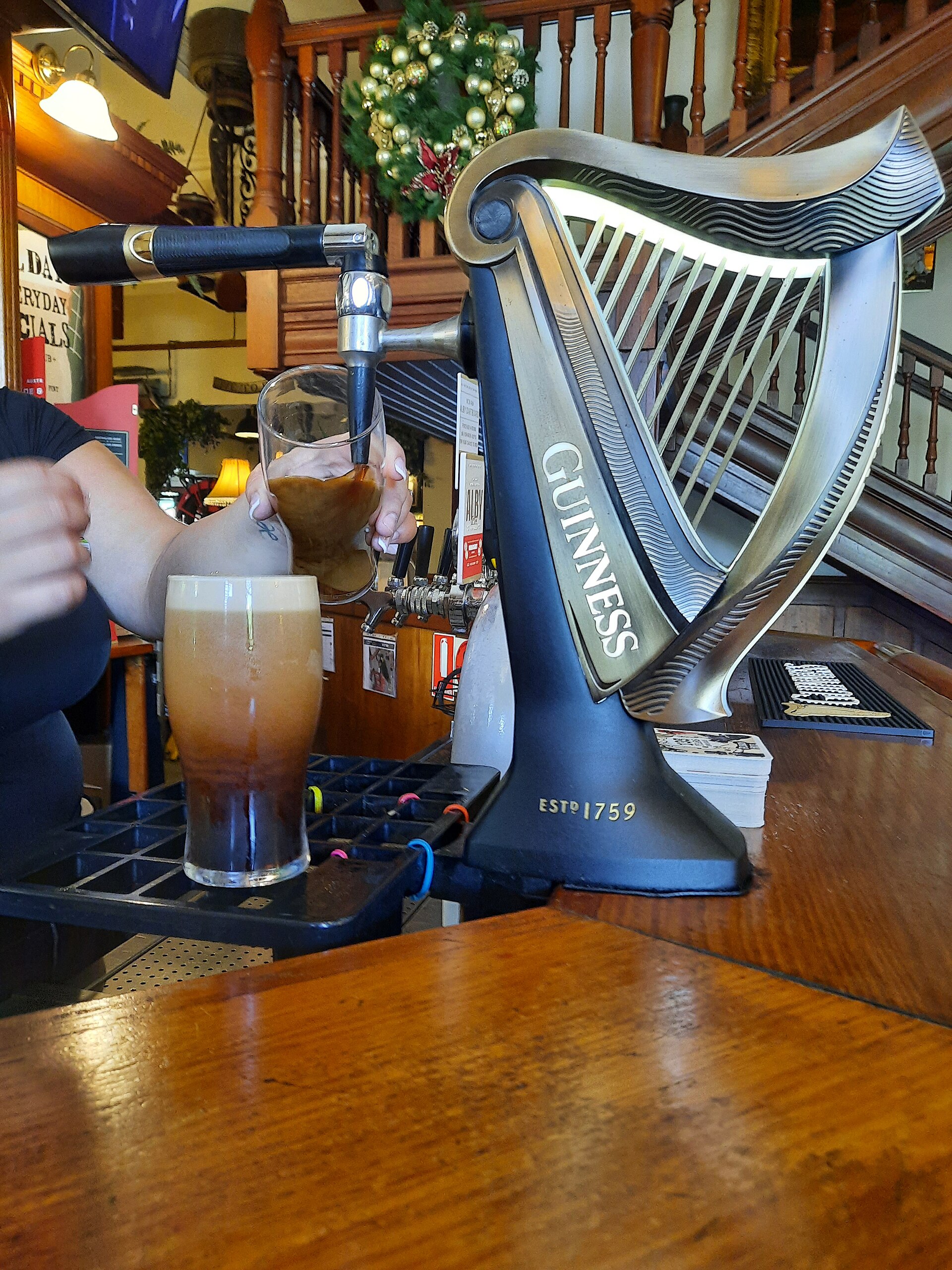
The “perfect pint” is poured in two stages, and the pause in between is the entire point:

  • Stage one: the glass is held at a 45-degree angle beneath the tap and filled to about three-quarters, straight down the side.
  • The settle: the glass is set down and left alone for around 100 seconds while the nitrogen bubbles cascade and settle into the tight, creamy head.
  • Stage two: the glass is topped off, straight this time, until the head domes slightly above the rim.

Rushing this — asking for it “quick” — is exactly the mistake that produces a flat, thin, badly-settled pint. A good bartender ignoring you for two minutes mid-pour isn’t being slow. It’s the actual process.

Why the Head Behaves Like That

Most beers are carbonated with carbon dioxide alone. Guinness uses a mix of nitrogen and CO2. Nitrogen bubbles are far smaller and dissolve less readily, which is what produces the dense, tight, long-lasting head and the visible “cascade” — bubbles appear to drift downward inside the glass as it settles, an optical effect of the nitrogen bubbles near the glass wall moving down as larger, faster-rising bubbles push up through the centre.

The plastic “widget” found inside cans of Guinness — developed by Guinness brewers in the late 1960s and patented in 1969, but not commercially introduced in cans until 1988 — is a small nitrogen-charged capsule that recreates the same cascade effect at home. It won Guinness a Queen’s Award for Technological Achievement in 1991 — a genuinely significant piece of food-engineering, not just packaging.

Does It Really Taste Different in Ireland?

The claim is nearly universal among visitors and it isn’t really about the water. Modern Guinness sold internationally is largely brewed to the same recipe and standard wherever it’s produced under license. What actually differs is freshness (a keg poured within days of leaving the brewery versus one that’s travelled and sat), correct cellar temperature and line-cleaning at the pub, and the two-part pour itself — three variables a badly-run pub anywhere can get wrong, Ireland included. A well-kept pint in Chicago can beat a badly-kept one in Dublin.

Ordering Etiquette

  • Don’t ask for it fast. A rushed Guinness is a bad Guinness — see above.
  • Rounds are real. In a group, buying rounds in turn is a genuine social expectation in most Irish pubs, not just a nicety.
  • Tipping isn’t the norm at the bar the way it is in North America — rounding up or leaving loose change is appreciated, not required.
  • A “pint of plain” is old Dublin slang for a pint of Guinness, from the older name “porter” — occasionally still heard from older locals.

The Guinness World Records Connection

In 1951, Sir Hugh Beaver, then managing director of the Guinness Brewery, got into an argument on a shooting party in County Wexford over which was Europe’s fastest game bird — the golden plover or the red grouse. No reference book of the day could settle it. Beaver realised a book that settled exactly this kind of pub argument would sell, commissioned one, and the first edition of The Guinness Book of Records was published in 1955. It’s now one of the best-selling books in publishing history, and it exists purely because of an argument that started over a pint.

A Global Drink, Not Just an Irish One

Guinness is brewed under license in around 49 countries, and more of it is consumed outside Ireland than inside it. Nigeria in particular has been one of Guinness’s largest markets for decades, with its own dedicated Guinness Foreign Extra Stout — a stronger variant brewed specifically for markets outside Ireland and Britain. Walking into a pub anywhere from Lagos to Kuala Lumpur and finding Guinness on tap isn’t a novelty; it’s closer to the norm than the exception.

Myths Worth Retiring

“It’s basically a meal — full of calories.” A pint of Guinness has fewer calories than most lagers and many soft drinks — roughly 210 calories per pint, lower than a lot of alternatives on the same bar.

“The water from the Liffey is the secret.” Guinness has never used water from the River Liffey — brewing water is drawn from the Wicklow Mountains, same as it long has been.

“It’s stronger than regular beer.” At roughly 4.2% ABV, draught Guinness is actually weaker than many standard lagers — the dark colour and thick head create an impression of strength the actual alcohol content doesn’t match.

Frequently Asked Questions

Why does the head look like it’s falling instead of rising?

An optical effect of nitrogen bubbles: bubbles near the glass wall appear to drift downward as larger bubbles rise faster through the centre of the pint.

Is Guinness Irish-owned?

Guinness has been part of the multinational drinks group Diageo since 1997, though brewing remains centred at St. James’s Gate, Dublin, where it began in 1759.

What’s the difference between draught and bottled/canned Guinness?

Draught uses a nitrogen tap system; cans use the internal nitrogen widget to replicate the same effect. Extra Stout (common in bottles) is a stronger, more heavily hopped variant, closer to the original 18th-century recipe than the smoother modern draught version.

Help us reach One Million Irish Hearts

Every year, this community grows a little closer to a real milestone: one million people who love Ireland, joined together by St. Patrick’s Day 2027. Our live One Million Irish Hearts map fills in, heart by heart, as more people join the free Love Ireland newsletter — an interactive map of Ireland that grows greener with every single subscriber. Go take a look, see how close we are right now, and add your own heart to the map.

More Love Ireland Guides

The Love Ireland Guide is a numbered series — one tightly focused subject at a time, each with its own downloadable collectible edition. Guide № 001 is Irish Soda Bread, Guide № 002 is St. Patrick’s Day, and Guide № 003 is The Claddagh Ring. This is Guide № 004.

Tours & experiences you might love

Dublin LGBTQ Pride Historical and Cultural Walking Tour
From $29 · Selling fast
Book now →
Authentic Dublin private car tour Top Ranked Dubliner guide Éamon
From $549 · Selling fast
Book now →
Private Tour of Ring of Kerry & Valentia Island
From $1,190 · Selling fast
Book now →
Dunmore East Sea Safari to Hook Lighthouse
From $83 · Selling fast
Book now →

Powered by Viator. Some links are affiliate links — we may earn a small commission at no extra cost to you.

Other newsletters you might like

Love Spain

Love Spain — in your inbox. Iconic cities, hidden pueblos and the best places to visit in Spain. One short email, every day.

Subscribe

My Local Dublin

The Dublin you don't see from a tour bus — local stories, hidden gems, food, events and the best of the city, by locals for locals.

Subscribe

One Two Three Send

The newsletter for newsletters

Subscribe

Irish Rugby Fans

The best Irish rugby updates, straight to your inbox — Six Nations, the Nations Championship and the provinces. Only when there's something worth reading.

Subscribe

Newsletters via the One Two Three Send network.  ·  Want your newsletter featured here? Click here

Secure Your Dream Irish Experience Before It’s Gone!

Planning a trip to Ireland? Don’t let sold-out tours or packed attractions spoil your journey. Iconic experiences like visiting the Cliffs of Moher, exploring the Rock of Cashel, or enjoying a guided walk through Ireland’s ancient past often sell out quickly—especially during peak travel seasons.

Booking in advance guarantees your place and ensures you can fully immerse yourself in the rich culture and breathtaking scenery without stress or disappointment. You’ll also free up time to explore Ireland’s hidden gems and savour those authentic moments that make your trip truly special.

Make the most of your journey—start planning today and secure those must-do experiences before they’re gone!

Sharing is caring!

DISCLAIMER

Last updated May 29, 2023


WEBSITE DISCLAIMER

The information provided by Love to Visit LLC ('we', 'us', or 'our') on https://lovetovisitireland.com (the 'Site') is for general informational purposes only. All information on the Site is provided in good faith, however we make no representation or warranty of any kind, express or implied, regarding the accuracy, adequacy, validity, reliability, availability, or completeness of any information on the Site. UNDER NO CIRCUMSTANCE SHALL WE HAVE ANY LIABILITY TO YOU FOR ANY LOSS OR DAMAGE OF ANY KIND INCURRED AS A RESULT OF THE USE OF THE SITE OR RELIANCE ON ANY INFORMATION PROVIDED ON THE SITE. YOUR USE OF THE SITE AND YOUR RELIANCE ON ANY INFORMATION ON THE SITE IS SOLELY AT YOUR OWN RISK.

EXTERNAL LINKS DISCLAIMER

The Site may contain (or you may be sent through the Site) links to other websites or content belonging to or originating from third parties or links to websites and features in banners or other advertising. Such external links are not investigated, monitored, or checked for accuracy, adequacy, validity, reliability, availability, or completeness by us. WE DO NOT WARRANT, ENDORSE, GUARANTEE, OR ASSUME RESPONSIBILITY FOR THE ACCURACY OR RELIABILITY OF ANY INFORMATION OFFERED BY THIRD-PARTY WEBSITES LINKED THROUGH THE SITE OR ANY WEBSITE OR FEATURE LINKED IN ANY BANNER OR OTHER ADVERTISING. WE WILL NOT BE A PARTY TO OR IN ANY WAY BE RESPONSIBLE FOR MONITORING ANY TRANSACTION BETWEEN YOU AND THIRD-PARTY PROVIDERS OF PRODUCTS OR SERVICES.

AFFILIATES DISCLAIMER

The Site may contain links to affiliate websites, and we receive an affiliate commission for any purchases made by you on the affiliate website using such links. Our affiliates include the following:
  • Viator

We are a participant in the Amazon Services LLC Associates Program, an affiliate advertising program designed to provide a means for us to earn advertising fees by linking to Amazon.com and affiliated websites.

This disclaimer was created using Termly's Disclaimer Generator.