

Why Does Dublin Ban Tall Buildings When Other European Capitals Don’t
In March 2018, An Bord Pleanála — Ireland’s national planning appeals board — had an unusual problem on its hands. A developer named Johnny Ronan had submitted plans for an 88-metre tower on George’s Quay, along the south bank of the Liffey near Tara Street station. The board’s own senior inspector, Gillian Kane, had reviewed the application, produced an 82-page report, and concluded that the case for a taller building on that site was one that “can be solidly defended.” She called the proposed building “beautiful.”
The board overruled her.
In its formal decision, An Bord Pleanála found that the 22-storey tower would “seriously detract from the setting and character of the Custom House and environs,” “seriously injure the urban character and visual amenities of the historic city core,” and create “significant and detrimental visual impact” along protected view corridors — from College Green, from the Trinity College campus, from Henrietta Street, Kildare Street, and Harcourt Street. A beautiful building, in the wrong city.
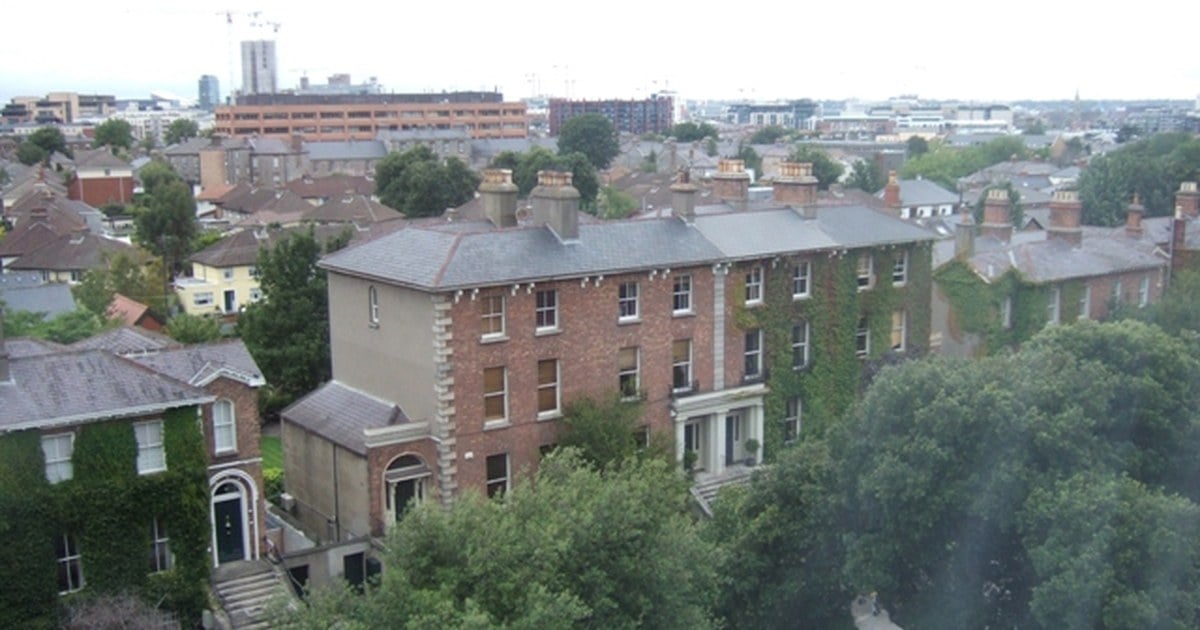
If you have ever stood on O’Connell Bridge and wondered why Dublin’s skyline looks like a spreadsheet someone forgot to finish — neat, horizontal, almost eerily flat for a capital city of its weight — this is where the answer lives. Not in some quirk of Irish geology or the result of simple poverty, but in a deliberate, contested, hard-fought civic choice that has been made again and again for sixty years, usually by a planning system willing to overrule its own experts to enforce it.
What the Rules Actually Say
Dublin’s height restrictions are not a single hard number you can point to on a map. That is part of what makes them so formidable. The Dublin City Development Plan 2022–2028 — the current governing document — states its spatial strategy plainly: to “protect the vast majority of the city as a predominantly low-rise city, including established residential areas and conservation areas within the historic core.” It defines “locally higher buildings” as typically up to 50 metres. Buildings that are “substantially taller than their surroundings and causing a significant change to the skyline” are categorised separately, as “landmark buildings” — a category that, in practice, is understood to mean buildings the city has not yet decided whether to want.
The plan’s language about the historic core is direct. “All new proposals in the inner city must demonstrate sensitivity to the historic city centre, the River Liffey and quays, Trinity College, the cathedrals, Dublin Castle, the historic squares and the city canals, and to established residential areas and civic spaces of local and citywide importance.” That list covers, in effect, most of the areas where tall buildings would otherwise make financial and urban planning sense.
The plan that preceded this one — covering 2016 to 2022 — was even more restrictive. Most city centre areas were capped at 8 storeys for apartments, raised modestly from a previous 6-storey limit. Only four zones — the Docklands, George’s Quay, Connolly Station, and Heuston Station — were designated to permit buildings exceeding 50 metres. When Dublin City Council was debating that plan, the city’s chief executive, Owen Keegan, pushed for higher limits. Green Party councillor Ciarán Cuffe proposed capping buildings at 20 to 24 metres, explicitly opposing Keegan’s position. The council approved the modest 8-storey limit. Keegan’s proposal was rejected.
This is not an accident of bureaucracy. It is a policy with roots — roots sunk in a single street, on a single afternoon in 1965.
The Sixteen Houses
☘️ Join 64,000+ Ireland Lovers
Every weekday morning, get Ireland’s hidden gems, local secrets, and travel inspiration — the kind you won’t find in any guidebook.
Subscribe free — enter your email:
📲 Know someone who’d love this? Share on WhatsApp →
Love more? Join 43,000 Scotland lovers → · Join 29,000 Italy lovers → · Join 7,000 France lovers →
Free forever · Unsubscribe anytime
Fitzwilliam Street Lower, in the south inner city, was once part of what the Irish Times described as “the longest and arguably the finest Georgian streetscape in the world.” The Georgian Mile — a near mile-long sequence of Fitzwilliam Place, Fitzwilliam Square East, Fitzwilliam Street, and Merrion Square East — had been built between the 1780s and the 1830s, mostly as merchant and professional housing, the brick and granite language of a confident Anglo-Irish city. The repetition of the doorways, the proportions of the windows, the regularity of the ironwork: it was urban design by accumulation, a form of architecture that only works because hundreds of individual decisions happened to rhyme.
By the 1950s, that world was fraying. Irish government development policy was actively threatening Georgian buildings across the city. Whole sections of Fitzwilliam Street and St Stephen’s Green were demolished. The 1963 Planning Act, which was meant to bring order to Irish development, instead resulted in over 900 buildings being condemned within twelve months of its passage. It was in that atmosphere that Desmond Guinness and his wife Mariga founded the Irish Georgian Society in 1958 — a direct response to what they were watching happen to the fabric of the city.
Then came the ESB.
The Electricity Supply Board, Ireland’s state electricity company, decided it needed a new headquarters and had settled on a site on Fitzwilliam Street Lower. The new building — designed by Sam Stephenson and Arthur Gibney — required the demolition of 16 Georgian houses. They came down in 1965. The interruption to the streetscape was not huge in physical terms — 16 houses in a long terrace — but the symbolic damage was enormous. The ESB had taken the thing everyone said was irreplaceable and proved it was replaceable, if you had enough institutional authority and indifference. The Irish Georgian Society, and a generation of newly politicised Dubliners, never forgot it.
It is hard to overstate how much that moment still echoes through Dublin’s planning culture. Every time An Bord Pleanála has cited the “character” of the Georgian core in a refusal decision — and they have cited it many times — the ghost of Fitzwilliam Street Lower is somewhere in the room.
The System Meets the Developer
Johnny Ronan is not a figure who generates neutral reactions in Irish property. A developer who built significant chunks of Celtic Tiger Dublin — and who lost most of it during the crash — he came back in the 2010s with ambitions that had not notably contracted. In 2018, his George’s Quay tower was the test case everyone was watching. It was the highest-profile tall building application in Dublin in years. The site was close to the city’s designated Docklands zone. The inspector recommended approval. And still the board said no.
The stated grounds were about views — from College Green, from Kildare Street, from Harcourt Street — but the underlying grammar was consistent with every major refusal Dublin’s planning system has issued for decades: that a building which changes the skyline changes the city, and that changing the city requires a level of justification that tall-building applications have consistently failed to meet.
That refusal did not hold. Ronan appealed again, and in April 2019 — after two rejections from Dublin City Council and one from the board itself — An Bord Pleanála reversed course and granted permission for the tower, now built as the Aqua Vetro on the corner of Tara Street and George’s Quay. It went on to become the tallest building in the state, overtaking Liberty Hall. It is the one clear exception in this pattern: the case where persistence, rather than preservation, eventually won.
Ronan was not finished. In 2025, An Coimisiún Pleanála — the body that replaced An Bord Pleanála following the Planning and Development Act 2024 — upheld Dublin City Council’s rejection of a separate Ronan scheme, a 17-storey tower at 1 North Wall Quay. Planning Commissioner Mary Henchy found the building to be “overly dominant.” A revised, much shorter scheme — 7 to 12 storeys — subsequently received council approval in June 2026.
The pattern held, and the developer adapted to it.
The Tallest Building That Wasn’t
The case that best illustrates how the system works came in May 2024, when An Bord Pleanála rejected a proposal for what would have been Dublin’s tallest building: a 24-storey, 108-metre tower on the former City Arts Centre site on City Quay, proposed by Ventaway, a company headed by David Kennan and Barry English. Dublin City Council had already rejected the scheme in October 2022. The developers appealed, and the board’s own inspector again recommended approval. Again, the board overruled its inspector.
The board’s language was almost word-for-word familiar: the tower would “seriously detract from the setting and character of the Custom House and environs” and would “stand apart as an overly assertive solo building.” The Custom House — James Gandon’s 1791 masterpiece on the north quays — has become something close to a legal instrument. Its view corridor functions like a force field.
The City Quay saga did not end there. A High Court ruling in July 2025 quashed that 2024 refusal, and a fresh application was lodged. It fared no better: in July 2026, An Coimisiún Pleanála refused the scheme again, this time citing an overbearing impact on the neighbouring protected structures at City Quay as well as the same “overly assertive solo building” language used in 2024. As of August 2026, the site remains undeveloped.
The Case for Going Up
Not everyone in Irish public life is comfortable with a city that has decided horizontal is a permanent condition. The argument for height in Dublin is not primarily aesthetic — it is mathematical.
John O’Hara, Dublin City Council’s City Planning Officer, made this case explicitly when the draft 2022–2028 Development Plan was under debate. His argument was stated in terms of climate and urban form: “if we’re to pursue the principle of a more compact city, of reducing urban sprawl, of doing our bit for climate change, there’s got to be a quality densification of development.” He described the draft plan as one that expected landmark buildings to be between 20 and 25 storeys, and said that a “wonderfully designed 30-storey” building would be assessed on criteria rather than rejected by a blanket cap.
The framing matters. The case for tall buildings in Dublin is not, from its proponents, primarily a case for towers as objects of prestige or developer profit. It is a case for towers as a substitute for sprawl. Dublin is a city that has, for decades, grown by spreading rather than rising — suburbs extending further into Meath and Kildare, long commutes, car dependency, all the pathologies of a horizontal city that refuses to compress. The housing crisis, arguably the defining Irish political issue of the past decade, is partly a story about what happens when a growing city cannot build upward and will not stop growing.
But the counterargument — the Ciarán Cuffe argument, the An Bord Pleanála argument, the argument of sixty years of preservation politics — is that what was lost in 1965 on Fitzwilliam Street Lower cannot be rebuilt. That the Georgian core is not a negotiating position. That once the skyline changes it stays changed, and that the Custom House looks different from Kildare Street the morning after a 108-metre tower goes up on the quays, and it will look different that way permanently.
Both arguments are correct, in their own terms. That is what makes Dublin’s height debate genuinely irresolvable by any single planning document or any single election cycle. It is a conflict between two legitimate civic values — compactness and preservation — and the planning system has, consistently, found for preservation.
Where It Stands
Dublin’s skyline, in 2026, is a document of this argument. The Liberty Hall tower — just over 59 metres, built 1965 — was, for decades, the tallest building in the state, and was famously called, at the time of its construction, an insult to the city. That title has since passed to Ronan’s Aqua Vetro tower at Tara Street, 88 metres, completed after the board reversed its 2018 refusal on appeal — the one clear break in an otherwise consistent pattern. Beyond that single case, the Docklands has grown only modestly taller, with a handful of other buildings in the 50–80 metre range near the water. The Georgian core remains, in the main, the height of a Georgian terrace.
What is striking, looking at the pattern of decisions, is not the existence of the height restrictions — many European cities with historic cores have some version of them — but the consistency with which Dublin’s planning bodies have been willing to overrule their own expert inspectors to enforce them. The Ronan refusals, the Ventaway refusal, the accumulation of cases in which inspectors called buildings defensible or beautiful and boards found them injurious: this is a system that does not trust itself to decide case by case. It has encoded a value, and it enforces it regardless of the merits of any individual application.
That is either a mark of institutional seriousness or institutional inflexibility, depending on where you stand. What it is not is accidental. Dublin looks the way it looks because people — in planning offices, in council chambers, in appeals board hearings — decided, and keep deciding, that it should look this way.
The 16 houses on Fitzwilliam Street Lower are still gone. The ESB headquarters is still there. And the city is still, half a century later, working out what it thinks that means.
There is no simple resolution to this, and we are not sure one is coming soon. But understanding the argument — who is making it, what it is actually about, and how deep it runs — is at least a start. Dublin’s flatness is not a failure of ambition. It is ambition of a specific and determined kind, pointed in a direction that is not always visible from the street.
☘️ Join 64,000+ Ireland Lovers
Every weekday morning, get Ireland’s hidden gems, local secrets, and travel inspiration — the kind you won’t find in any guidebook.
Subscribe free — enter your email:
📲 Know someone who’d love this? Share on WhatsApp →
Love more? Join 43,000 Scotland lovers → · Join 29,000 Italy lovers → · Join 7,000 France lovers →
Free forever · Unsubscribe anytime
Tours & experiences you might love


Powered by Viator. Some links are affiliate links — we may earn a small commission at no extra cost to you.
Secure Your Dream Irish Experience Before It’s Gone!
Planning a trip to Ireland? Don’t let sold-out tours or packed attractions spoil your journey. Iconic experiences like visiting the Cliffs of Moher, exploring the Rock of Cashel, or enjoying a guided walk through Ireland’s ancient past often sell out quickly—especially during peak travel seasons.

Booking in advance guarantees your place and ensures you can fully immerse yourself in the rich culture and breathtaking scenery without stress or disappointment. You’ll also free up time to explore Ireland’s hidden gems and savour those authentic moments that make your trip truly special.
Make the most of your journey—start planning today and secure those must-do experiences before they’re gone!