

Cobh (pronounced “Cove”) sits at the mouth of Cork Harbour in County Cork. For much of the 19th century, it was the last piece of Irish soil that millions of emigrants ever saw. Today it ranks among the most historically significant towns in Ireland — a place where the past presses on every view across the water.
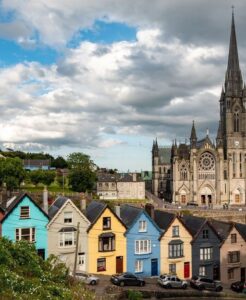
At the centre of Cobh stands St Colman’s Cathedral, a Gothic Revival structure that rises dramatically above the harbour front. Its 47-bell carillon ranks as the largest in Ireland. Below it, rows of brightly coloured terraced houses cascade down the hillside in a scene known the world over. Yet the real story of Cobh has little to do with the colours. It belongs to the people who left from these quays, and to what they left behind. If you have Irish roots, it helps to plan a heritage trip to your ancestral county before you arrive.
Ireland has 5,000 years of stories — and we are still finding new ones to tell. Our free weekly newsletter brings history, heritage and hidden places straight to your inbox. Join 64,000 readers who love what Ireland is made of →
The Great Famine and Cobh’s Role in Irish Emigration
Between 1845 and 1852, the Great Famine killed roughly one million people in Ireland. It forced another million to emigrate. Cobh — then called Queenstown — served as the main departure point for anyone who could find the fare. From here, ships sailed for America, Canada and Australia.
Conditions aboard the emigrant ships turned brutal. Overcrowding ran rife. Disease spread fast in the confined holds. Many passengers died before they reached land. People called these vessels “coffin ships”, and the name fitted. Mortality rates during the crossing could climb to shocking levels.
By the close of the Famine period, an estimated 1.5 million people had sailed from Cobh alone. Emigration carried on long after the Famine ended. Between 1848 and 1950, roughly six million people left Ireland through this one harbour. That figure tops the whole population of the island today.
Words struggle to capture the emotional weight of this history. Most of those who sailed never made the return journey. Families left on the quay, in most cases, said goodbye for good. Letters and money might follow, yet the emigrants themselves rarely came back. Their children and grandchildren grew up as Irish-American, Irish-Australian and Irish-Canadian — proud of the link to Ireland, though separated from it by generations and an ocean.
The Annie Moore Memorial on Cobh’s waterfront marks this history in a direct, human way. Annie Moore became the first emigrant to pass through Ellis Island in New York, in January 1892. She had sailed from Cobh with her two brothers. She was just 17 years old when she reached America. Her bronze statue in Cobh, and its twin at Ellis Island, offer a small but powerful reminder of the human scale of what happened here.
This piece focuses on Cobh through the lens of ancestry — the cathedral, the heritage sites and the genealogy trail that helps descendants trace their own family’s departure. For the fuller narrative of the Famine crossings and the six million who left through this one harbour, read Cobh: Where Six Million Irish Said Their Last Goodbye.
St Colman’s Cathedral: History and Architecture
☘️ Your Irish family has a story waiting to be found.
Discover where your Irish ancestors came from — their county, their name, their story. Our free step-by-step guide walks you through every record, DNA tool, and ancestry archive. No experience needed.
Claim Your Free Irish Ancestry Guide →Work on St Colman’s Cathedral began in 1868 and ran on until 1915 — a span of 47 years. The architects Pugin and Ashlin designed the building in the French Gothic style. Its spire climbs to 91 metres (300 feet), which makes it one of the most prominent landmarks on the Cork Harbour skyline.
The cathedral honours Saint Colman of Cloyne, a 6th-century bishop, poet and musician who served as patron of the Diocese of Cloyne. Builders raised it from local limestone. Over time the stone has darkened, giving the cathedral a sombre weight that suits its setting above the waterfront.
Inside you will find fine stained glass windows, intricate stone carvings and a series of side chapels. The nave feels broad and well-proportioned. A quiet visit on a weekday reveals the scale and care that went into the work — and the community that funded and sustained it through some of the hardest decades in Irish history.
The cathedral’s best-known feature is its carillon of 47 bells, installed in 1916. This carillon ranks as the largest in Ireland and among the largest in the British Isles. Bell-ringers play it on regular occasions throughout the year, and on a still evening the sound carries across the harbour. Entry to the cathedral costs nothing. Doors generally stay open through the day, and guided tours run during the summer months.
To understand how much painstaking effort restoration like this demands, it is worth reading about the researchers uncovering Ireland’s hidden history across the country.
Want more Irish history, heritage and hidden gems every week? Our newsletter covers the places and stories that guidebooks miss. Subscribe free — 64,000 readers already do →
The Cobh Heritage Centre
The Cobh Heritage Centre occupies the restored Victorian railway station at the waterfront. Its exhibition covers the history of Irish emigration. It puts particular focus on Cobh’s role during the Famine years and beyond.
Highlights include a recreation of an emigrant ship cabin, first-person accounts from passengers, and maps and statistics that trace emigrant routes and destinations. You can also learn about the later emigrant ships, including the Titanic. A genealogy research service helps visitors with Irish roots trace their family’s own emigration history through Cobh.
The centre opens year-round, with slightly reduced hours in winter. Adult admission costs roughly €9.50, and concessions cover students and seniors. Allow between 90 minutes and two hours for a thorough visit. A short walk links the building to both the train station and the town centre, so you can easily combine it with the cathedral and time on the waterfront.
What to see in Cobh
If your time is short, focus on the landmarks that tell the emigration story most vividly.
- St Colman’s Cathedral and its 47-bell carillon high above the harbour.
- The Annie Moore Memorial on the waterfront quay.
- A recreation of emigrant life at the Cobh Heritage Centre in the old railway station.
- The Titanic Experience on White Star Line Street.
- Old Church Cemetery, resting place of many Lusitania victims.
- Colourful terraced houses along the famous “Deck of Cards” row.
Just a short ferry ride from Cobh’s waterfront, Spike Island — once a monastery, later a Victorian-era prison fortress — makes an easy half-day extension to your visit.
The Titanic and Lusitania Connections
Cobh served as the final port of call for the RMS Titanic in April 1912. The ship stopped here to collect mail and 123 extra passengers — most of them Irish emigrants bound for America. One of them, Jeremiah Burke from County Cork, threw a sealed bottle into the sea before the ship departed. Inside sat a note written in Irish. The bottle washed up on the Cork coastline the following year.
Three years later, Cobh received many of the bodies recovered after the sinking of the RMS Lusitania. A German submarine torpedoed the ship off the Old Head of Kinsale in May 1915, killing 1,198 of the 1,959 people on board. Rescuers brought the dead to Cobh’s harbour, and many now rest in the Old Church Cemetery on the hillside above the town. A memorial on the waterfront marks this event.
Heritage sites throughout the town tell both stories in depth. The Titanic Experience on White Star Line Street occupies the original ticketing offices from 1912 and runs guided tours throughout the week. For anyone drawn to maritime history, Cobh ranks among the richest destinations in Ireland. Castle-lovers can pair a visit with nearby heritage sites such as Kilkenny Castle, a short drive to the north-east.
Getting to Cobh and Practical Visitor Information
Cobh lies around 24 kilometres from Cork City, and the train makes it easy to reach. A trip from Cork Kent Station to Cobh Station takes roughly 24 minutes, with services running about every hour through the day. The station sits right on the waterfront, so all the main sights fall within an easy walk from the moment you step off the train.
Drivers should note that parking in the town centre can grow tight during summer, especially at weekends. Arriving by train often proves the simpler option, and it spares you the town’s steep, hilly streets.
Most visitors spend a half day in Cobh. A full day fills easily if you add the Heritage Centre, St Colman’s Cathedral, the Titanic Experience and time at the waterfront. The quay area offers a solid choice of cafes and pubs at fair prices. Cobh welcomes visitors year-round, though late spring to early autumn brings the longest days and the best chance of hearing the cathedral carillon drift across the harbour breeze.
Why Cobh Is Worth the Journey
Ireland holds many beautiful places. Far fewer marry beauty and history into something that genuinely stops you in your tracks. Cobh belongs to that rare group.
The people of Cobh did not raise St Colman’s Cathedral in spite of the suffering on the quays below. Survivors of that suffering chose to create something extraordinary. That choice says something important about resilience — and about what Ireland, at its core, has always stood for.
Perhaps your Irish ancestry passed through Cobh, or perhaps you simply want to grasp the full story of Ireland and its people. Either way, this harbour town in County Cork will give you something lasting. Very few places carry history this close to the surface. Cobh does.
Frequently Asked Questions
How do I get to Cobh from Cork City?
Take the train from Cork Kent Station. The trip lasts roughly 24 minutes, with services about every hour. The station sits on the waterfront, so you reach the main sights on foot within minutes of arriving.
How much does the Cobh Heritage Centre cost?
Adult admission costs roughly €9.50, and concessions cover students and seniors. Set aside between 90 minutes and two hours to explore the exhibition properly. The centre opens year-round, with slightly reduced hours in winter.
Why is Cobh important to Irish emigration history?
Cobh, once called Queenstown, served as the main departure point during and after the Great Famine. Between 1848 and 1950, roughly six million people left Ireland through this single harbour, which makes it one of the most significant emigration sites in the world.
Can I trace my Irish ancestors at Cobh?
Yes. The Cobh Heritage Centre runs a genealogy research service for visitors with Irish roots. Staff there can help you trace your family’s own emigration story through the port before you explore your ancestral county.
If stories like Cobh move you, you will love our free weekly newsletter. Every week, 64,000 readers get the best of Ireland’s history, culture and places to visit — straight to their inbox. Subscribe here — completely free →
Thinking about it seriously?
If you’ve started actually planning a move, our complete the full Move to Ireland guide walks through every step, every cost, and the paperwork that catches most people out.
Tours & experiences you might love


Powered by Viator. Some links are affiliate links — we may earn a small commission at no extra cost to you.
Secure Your Dream Irish Experience Before It’s Gone!
Planning a trip to Ireland? Don’t let sold-out tours or packed attractions spoil your journey. Iconic experiences like visiting the Cliffs of Moher, exploring the Rock of Cashel, or enjoying a guided walk through Ireland’s ancient past often sell out quickly—especially during peak travel seasons.

Booking in advance guarantees your place and ensures you can fully immerse yourself in the rich culture and breathtaking scenery without stress or disappointment. You’ll also free up time to explore Ireland’s hidden gems and savour those authentic moments that make your trip truly special.
Make the most of your journey—start planning today and secure those must-do experiences before they’re gone!