

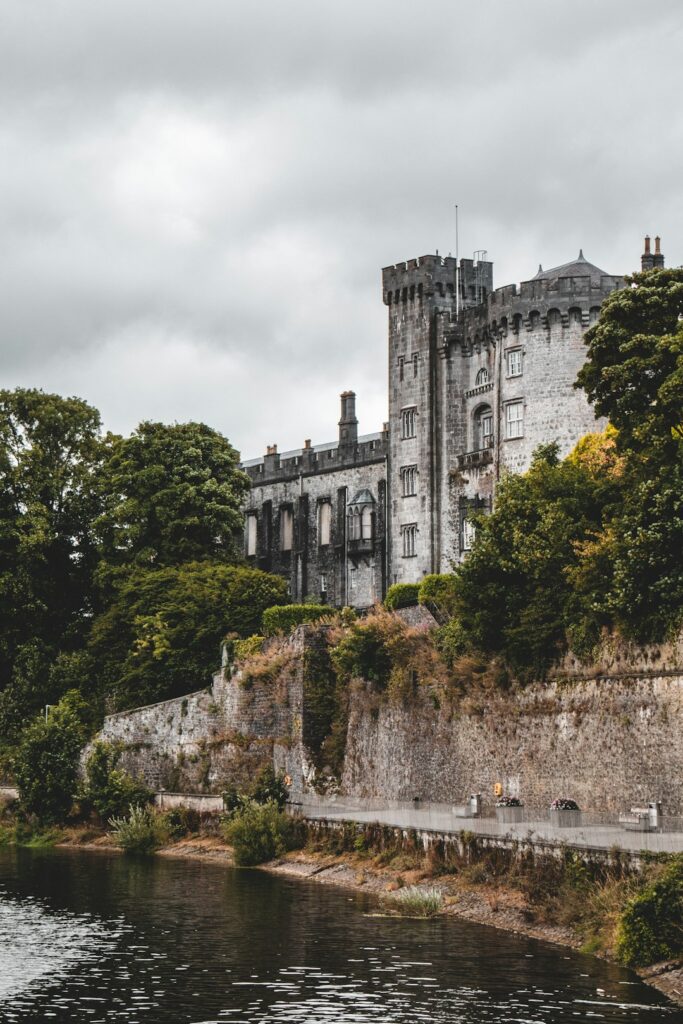
Kilkenny Castle has stood on the banks of the River Nore for more than 800 years. It was built in 1195, passed to one of the most powerful families in Irish history in 1391, and eventually sold to the Irish State in 1967 for the sum of £50. Today it draws hundreds of thousands of visitors each year and sits at the heart of one of Ireland’s best-preserved medieval cities. If you have never stood inside its walls, it is worth understanding what you are looking at — and why it matters.
The Norman Origins of the Castle
The original structure on this site was a motte-and-bailey fortification, built shortly after the Norman invasion of Ireland in the late 12th century. The stone castle that replaced it was commissioned by William Marshal, one of the most formidable military figures in medieval Europe. Marshal was Earl of Pembroke and a key figure in the Norman consolidation of power in Ireland. He chose the site deliberately — the River Nore provided a natural defensive barrier, and the elevated ground gave commanding views over the surrounding area.
The castle’s three round towers date from this original Norman construction. They were built to last, and they have. Two of the original four towers still stand, along with the massive curtain walls that connected them. For a structure built in the 12th century using hand-cut stone, the level of preservation is remarkable.
Throughout the 13th and 14th centuries, the castle changed hands several times, passing between English nobles and the Anglo-Norman lords who controlled much of Leinster. Control of the castle meant control of the crossing point on the Nore, and by extension, control of movement through the south-east of Ireland.
The Butler Dynasty: 600 Years in One Family
In 1391, Kilkenny Castle passed to James Butler, the 3rd Earl of Ormond, and with that transfer began one of the longest associations between a building and a family in Irish history. The Butlers — Earls and later Dukes of Ormond — held the castle for nearly six centuries. They were among the most powerful Anglo-Norman families in Ireland, with influence stretching across Leinster and beyond.
At the height of their power in the 15th and 16th centuries, the Butlers were significant players in the politics of both Ireland and England. Several members of the family served as Lord Lieutenant of Ireland, effectively governing the country on behalf of the English Crown. Their seat at Kilkenny was not simply a home — it was a centre of political authority.
The castle was substantially rebuilt and extended during the 17th century, when it took on much of the appearance it has today. The long south-east wing, which now houses the famous Long Gallery (also called the Picture Gallery), dates from this period. The Butlers filled the rooms with portraits, furniture, and art that reflected their wealth and ambition.
By the 19th century, however, the family’s fortunes had declined significantly. Parts of the castle fell into disrepair. In 1935, the 6th Marquess of Ormond auctioned off the contents — furniture, paintings, fittings — and the building was left largely empty. It sat unused for over three decades.
Love Irish history? Get weekly articles on Ireland’s heritage, culture, and hidden stories — delivered straight to your inbox. Subscribe to Love Ireland here.
The £50 Sale and the Road to Restoration
In 1967, Arthur Butler — the 6th Marquess of Ormond — sold Kilkenny Castle to the Castle Restoration Committee for the symbolic price of £50. It was a deliberate act of generosity toward the people of Kilkenny and the Irish nation. The castle was subsequently handed over to the State, and the Office of Public Works (OPW) took responsibility for its restoration.
The restoration programme was extensive. It took decades and significant public investment to return the castle to a condition fit for public access. Structural repairs were carried out on the towers and walls, the Long Gallery was restored and rehung with period-appropriate paintings, and the formal gardens were rebuilt. The work was completed in phases, with the castle opening to visitors progressively from the 1970s onwards.
The fact that the castle survived at all — and that it now stands in reasonable condition — is partly the result of the quality of the original Norman construction, and partly the result of that 1967 decision. Without the transfer to the State, the building might well have continued to deteriorate beyond recovery.
What to See Inside the Castle
The castle is open to the public and guided tours run throughout the day. The highlight for most visitors is the Long Gallery — a 30-metre corridor on the upper floor of the south-east wing. The barrel-vaulted ceiling is decorated with Celtic motifs, and the walls are lined with portraits of the Butler family spanning several centuries. It gives a strong sense of the scale of the family’s presence in Irish life over those 600 years.
The basement includes a well-presented exhibition on the history of the castle and the Butler family, with artefacts recovered during the restoration works. The great hall and drawing rooms on the main floors contain period furniture and paintings that reflect how the castle would have appeared during the 18th and 19th centuries.
The 12th-century towers are accessible and offer views over the city and the River Nore. From the top, you can see the outline of Kilkenny’s medieval street pattern — the narrow lanes and the close proximity of the castle to St Canice’s Cathedral, the Black Abbey, and the other medieval structures that make up what is now called the Medieval Mile.
The Grounds and Parkland
The castle grounds cover approximately 50 acres and are free to enter. The parkland stretches from the castle walls down to the river and includes formal gardens, wooded areas, a pond, and open lawns. It is used daily by Kilkenny residents for walking and recreation, which gives it a different atmosphere from purely tourist-facing heritage sites.
The rose garden near the castle’s main entrance was restored as part of the OPW programme and is planted with varieties that would have been in fashion during the Victorian period. The stable yard beside the main castle building has been converted into a craft and design centre, with a café that is a practical stop if you are spending a few hours in the grounds.
Exploring Ireland this year? Our weekly newsletter covers heritage sites, local history, and travel tips across the island. Join thousands of Ireland lovers — subscribe here.
Planning Your Visit
Kilkenny Castle is located on The Parade in the centre of Kilkenny city — the heart of County Kilkenny’s Marble City — approximately 120 kilometres south of Dublin. It is easily reached by car or by Bus Éireann from Dublin, Cork, or Waterford. The city itself is compact and walkable — the castle sits roughly five minutes on foot from the city’s main shopping and dining streets.
The castle is managed by the OPW and admission is charged for the interior tour. The grounds and parkland are free at all times. Tours typically run every 30 to 40 minutes during peak season. It is advisable to book in advance during summer, particularly in July and August when visitor numbers are highest. The castle is open year-round, though hours are reduced in winter.
If you are combining the castle with a broader visit to Kilkenny, allow at least half a day — see our guide to the best things to do in Kilkenny for the full list. The Medieval Mile Museum, Rothe House, St Canice’s Cathedral, and the Black Abbey are all within easy walking distance and together they make for a full day of heritage visits. Kilkenny also has a strong food scene concentrated around High Street and Parliament Street, with a number of restaurants and pubs that have been trading in the same buildings for generations — including several of the best pubs in County Kilkenny.
Kilkenny Castle in Context
Ireland has hundreds of castles, in various states of preservation. What sets Kilkenny apart is the combination of scale, accessibility, and documented history. You can walk through the same corridors where Butler earls made decisions that shaped Irish politics, stand in front of portraits painted 300 years ago, and then step out into a working public park used by the same city the Butlers once controlled.
The £50 sale price has become something of a talking point — a gesture that acknowledged the castle belonged, in a meaningful sense, to the people rather than the family. Whether or not you find that sentiment compelling, the result is that one of Ireland’s finest medieval structures is now in public hands, properly maintained, and open to anyone who wants to visit.
For anyone with an interest in Irish history, Norman architecture, or the long arc of Anglo-Irish relations, Kilkenny Castle is a straightforward and well-presented place to spend a few hours. The history is genuinely significant, the building is still standing, and the parkland is free.
Never miss a story like this. Every week we cover Ireland’s most fascinating history, landscapes, and places to visit. Subscribe to the Love Ireland newsletter — it’s free.
Image Credit: PP Archive
Thinking about it for retirement?
If you’ve started thinking seriously about retiring there, our complete our full Retire in Ireland guide covers the visa, healthcare, cost-of-living, and the regions worth shortlisting.
Tours & experiences you might love


Powered by Viator. Some links are affiliate links — we may earn a small commission at no extra cost to you.
Secure Your Dream Irish Experience Before It’s Gone!
Planning a trip to Ireland? Don’t let sold-out tours or packed attractions spoil your journey. Iconic experiences like visiting the Cliffs of Moher, exploring the Rock of Cashel, or enjoying a guided walk through Ireland’s ancient past often sell out quickly—especially during peak travel seasons.

Booking in advance guarantees your place and ensures you can fully immerse yourself in the rich culture and breathtaking scenery without stress or disappointment. You’ll also free up time to explore Ireland’s hidden gems and savour those authentic moments that make your trip truly special.
Make the most of your journey—start planning today and secure those must-do experiences before they’re gone!