

Glendalough — which translates from Irish as “Valley of Two Lakes” — is one of the most significant early Christian monastic sites in Ireland. Tucked into a glacial valley in the Wicklow Mountains, the site draws hundreds of thousands of visitors every year. At its heart is a cemetery that has been in use for over a thousand years. Stone crosses, roofless churches, and ancient graves cover the ground in a way that tells the full story of early medieval Ireland.
This article covers the history of the site, what you’ll find when you walk through the cemetery gate, and the practical information you need to plan a visit.
Want more guides to Ireland’s ancient sites and hidden history? Subscribe to our free newsletter at loveireland.substack.com/subscribe and we’ll send the best ones straight to your inbox.
The History of Glendalough
The monastic city of Glendalough was founded by St Kevin, an Irish monk who sought solitude in the Wicklow Mountains in the late sixth century. According to tradition, Kevin first lived as a hermit beside the Upper Lake before his reputation for holiness attracted followers. A community grew around him, and over time it became one of the most important religious centres in early medieval Ireland.
By the ninth century, the monastery had grown into a substantial settlement with churches, a round tower, and a large monastic enclosure. It functioned as a centre of learning, trade, and pilgrimage. The site attracted pilgrims from across Ireland and Britain, and it was said that three visits to Glendalough was the spiritual equivalent of one visit to Rome.
The monastery suffered repeated Viking raids from 836 AD onwards. The raiders targeted church settlements for their wealth, and Glendalough was attacked at least four times. Despite this, the community rebuilt each time and continued to function as a major religious and scholarly centre through the ninth and tenth centuries.
After the Norman invasion of Ireland in the twelfth century, the political importance of Glendalough declined. The diocese of Glendalough was eventually merged with Dublin in 1214. The settlement continued in a reduced form through the medieval period, but was burned by English forces in 1398 and never fully recovered. By the sixteenth century it had been largely abandoned.
What remains today is protected as a National Monument under Irish law and managed by the Office of Public Works (OPW). The site sits within Wicklow Mountains National Park.
The Round Tower
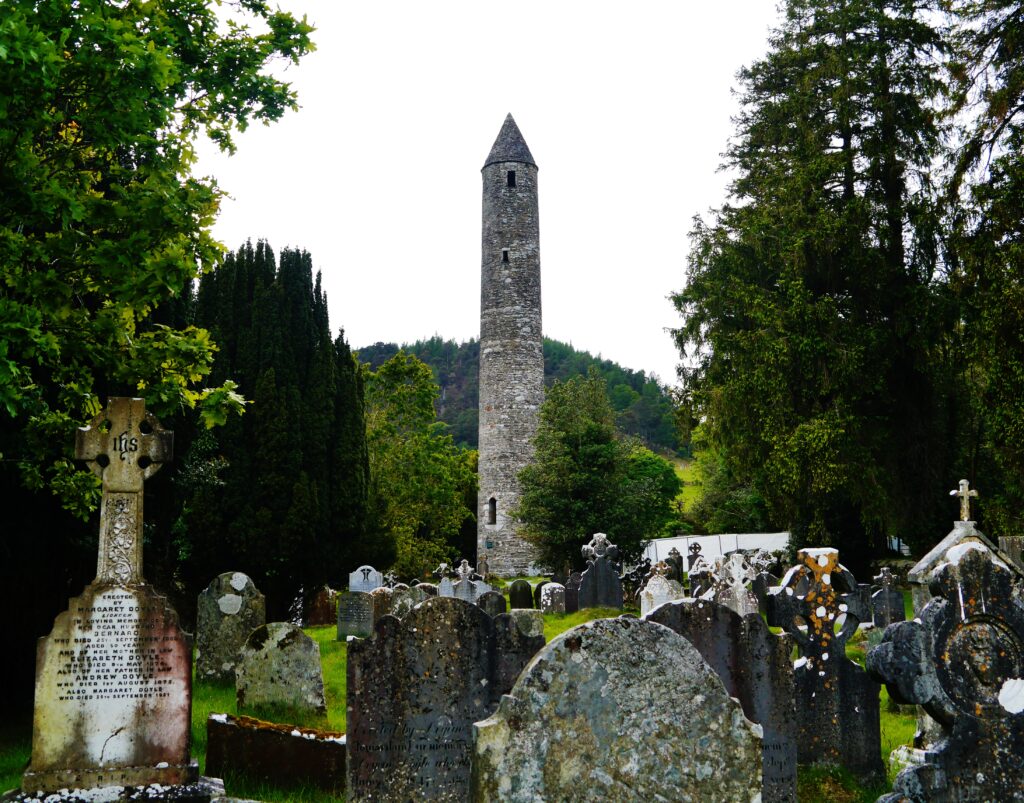
The round tower at Glendalough is one of the best-preserved examples in Ireland. It stands approximately 30 metres tall and dates from the tenth or eleventh century. Round towers were built across early Christian Ireland for a combination of purposes: as bell towers, as markers visible from a distance, and as places of refuge during raids. The doorway is positioned several metres above ground level, which meant it could only be accessed by ladder — a useful defence against attack.
The tower’s conical stone cap is a relatively modern restoration, but the main structure is original. It has survived largely intact for over a thousand years, which is a testament to the quality of the early medieval stonework. The tower is the most immediately recognisable feature of Glendalough and appears on countless photographs of the site.
The Cemetery and Celtic Crosses
The cemetery at Glendalough is the main reason many visitors make the journey to Wicklow. It contains a large number of ancient grave markers, including decorated Celtic crosses that date back to the early Christian period. These crosses display the distinctive circular ring that connects the arms — a feature that is closely associated with Irish Christianity and that spread from here across the island and beyond.
Many of the graves are unmarked or carry inscriptions that are now illegible due to weathering. Others bear simple incised crosses or ogham markings. The cemetery was used continuously for many centuries, meaning layers of history are literally underfoot as you walk through it.
The atmosphere inside the cemetery is striking regardless of the season. In autumn, the surrounding beech trees turn copper and gold, and low cloud frequently moves through the valley. In summer, the site is busy with visitors. The quietest time to experience the cemetery properly is early in the morning, before tour coaches arrive, or during the winter months when footfall drops significantly.
The Priest’s House, a small Romanesque church located within the cemetery enclosure, was traditionally used for the burial of local clergy. It dates from the twelfth century and shows the influence of the Romanesque architectural style that arrived in Ireland during this period.
Enjoying Ireland’s history? Our weekly newsletter covers heritage sites, travel guides, and local stories from across the island. Subscribe free at loveireland.substack.com/subscribe — no spam, unsubscribe any time.
St Kevin’s Kitchen and the Cathedral
St Kevin’s Kitchen is one of the most photographed buildings on the site. Despite its name, it was never a kitchen — the name comes from a misidentification of the small stone chimney-like feature on the roof, which is actually the base of a round tower built into the roof structure. The building is an early Irish oratory, probably dating from the ninth or tenth century. It is one of the finest surviving examples of this type of early medieval church architecture in the country.
The Cathedral of St Peter and St Paul is the largest building at Glendalough. Construction began in the tenth century, with additions made through the Romanesque and later medieval periods. The nave, chancel, and sacristy each reflect different phases of building work. The cathedral was the main place of worship for the monastic community and would have been a significant building even by the standards of the time.
Also worth noting is the Gateway, the only surviving example of a monastic gateway arch in Ireland. Visitors entering the main monastic enclosure pass through this arch, which dates from the medieval period. It gives a real sense of the scale and organisation of the original settlement.
Planning Your Visit to Glendalough
Glendalough is located in County Wicklow, approximately 50 kilometres south of Dublin. The drive from the city centre takes around one hour via the N11 and R755/R756, depending on traffic. The site is well signposted and there is a large car park near the Visitor Centre.
The Glendalough Visitor Centre is operated by the OPW and offers an exhibition on the history of the monastic city. There is an admission charge to the centre, but entry to the outdoor monastic site and cemetery is free at all times. The Visitor Centre is open daily except for a small number of public holidays — check the OPW website for current opening times and admission prices before you travel.
For those travelling without a car, several coach tour operators run day trips from Dublin to Glendalough, typically combined with stops in the Wicklow Mountains or at Powerscourt Estate. Bus Éireann also operates a seasonal service to the valley.
Tips for Making the Most of Your Visit
Arrive early. The site is popular with tour groups, particularly between 10am and 3pm. Getting there before 9am makes a real difference to the experience. The morning light in the valley is also particularly good for photography.
Wear suitable footwear. The ground around the cemetery and older buildings can be uneven. Trainers are fine in dry conditions, but in wet weather the grass paths become slippery. Walking boots are recommended if you plan to explore beyond the main monastic enclosure.
Allow at least two hours. The main monastic site can be covered in 45 minutes, but most visitors also walk to the Upper Lake, which adds considerable time and reward. The Upper Lake is where St Kevin originally settled as a hermit, and the scenery at this end of the valley is exceptional.
Respect the site. Glendalough is an active place of pilgrimage as well as a heritage site. Many of the graves within the cemetery are relatively recent, and families still visit to pay their respects. Climbing on the ruins or moving any stones is prohibited.
Consider visiting in late autumn or winter. The crowds thin out significantly from October onwards. The trees in the valley are a mix of deciduous and evergreen species, and the autumn colour can be outstanding. Winter visits offer a quieter and often more atmospheric experience of the site.
What Else Is Nearby
The Wicklow Mountains National Park surrounds Glendalough and offers extensive walking routes. The Wicklow Way, Ireland’s oldest waymarked walking trail, passes close to the valley. Powerscourt Estate and Waterfall is about 25 kilometres to the north and makes a natural second stop on a day trip from Dublin.
Laragh village, just a short drive from the Glendalough car park, has a small selection of cafés and pubs. It is a good option for lunch before or after visiting the site.
For those interested in further heritage sites, the Baltinglass Abbey ruins are a reasonable drive south in County Wicklow and offer similar early medieval history without the crowds. The Hill of Tara in County Meath is worth a visit too, though it’s roughly two hours away by road and better suited to a separate Dublin-based day trip than a detour from Glendalough.
Glendalough is not simply a scenic stop. It is one of the most important archaeological and historical sites in Ireland, and a place where the early Christian story of the island can be read directly from the landscape. The cemetery at its heart has been in continuous use for over fourteen centuries. Very few places in Europe offer that kind of unbroken connection to the past.
Get Ireland guides like this delivered to your inbox every week. Subscribe free at loveireland.substack.com/subscribe — from heritage sites to local festivals, we cover the Ireland that most tourists never find.
Thinking about it for retirement?
If you’ve started thinking seriously about retiring there, our complete our full Retire in Ireland guide covers the visa, healthcare, cost-of-living, and the regions worth shortlisting.
Tours & experiences you might love


Powered by Viator. Some links are affiliate links — we may earn a small commission at no extra cost to you.
Secure Your Dream Irish Experience Before It’s Gone!
Planning a trip to Ireland? Don’t let sold-out tours or packed attractions spoil your journey. Iconic experiences like visiting the Cliffs of Moher, exploring the Rock of Cashel, or enjoying a guided walk through Ireland’s ancient past often sell out quickly—especially during peak travel seasons.

Booking in advance guarantees your place and ensures you can fully immerse yourself in the rich culture and breathtaking scenery without stress or disappointment. You’ll also free up time to explore Ireland’s hidden gems and savour those authentic moments that make your trip truly special.
Make the most of your journey—start planning today and secure those must-do experiences before they’re gone!