

When the Continental Army faced its darkest hours in the American Revolution, Irish soldiers kept it standing. From the naval captains who built America’s first fleet to the generals who fell leading charges, the Irish contribution to American independence runs deeper than most history books record. These men didn’t fight from the sidelines. They shaped the outcome.
Historians estimate that roughly one-third of Washington’s officer corps had Irish roots. That figure reflects something real — a wave of men who had already crossed one ocean, who carried military experience from European campaigns, and who had every reason to believe in the promise of a republic free from British rule.
This is their story.
The Wild Geese Carry Their Skills to a New Continent
To understand why Ireland produced so many capable military men in 1776, you have to understand what came before.
After the Williamite Wars ended in 1691, tens of thousands of Irish soldiers left Ireland rather than submit to British authority. They joined the armies of France, Spain, and Austria — fighting across Europe for the next century. History calls them the Wild Geese.
The Irish Brigade in the French Army was legendary. At the Battle of Fontenoy in 1745, they broke a British line that had held firm against repeated French assaults. Their reputation spread across Europe.
When the American Revolution began, some of those battle-hardened soldiers — and their descendants — were already in the colonies. Others crossed from Europe specifically to join the cause. They brought something the Continental Army desperately needed: proper military training and command experience.
John Barry: The Father of the American Navy
John Barry was born in 1745 in Tacumshane, a small village on the coast of County Wexford. His family were tenant farmers. By his mid-twenties, he had crossed to America and built a reputation as one of the finest merchant captains in Philadelphia.
When war came, Barry didn’t hesitate. He was among the very first officers commissioned in the Continental Navy, taking command of the USS Lexington in 1776. He captured the first British warship taken by a regularly commissioned American officer — the HMS Edward — that same year.
Barry didn’t just fight one battle and retire. He served through the entire war. In March 1783, he commanded the Alliance in the last naval battle of the Revolutionary War, fighting off the British frigate HMS Sybil in a fierce 40-minute engagement near Cape Canaveral — even as peace negotiations were already under way in Paris.
After the war, President Washington personally selected Barry as the first officer in the newly formed United States Navy — giving him the title of Commodore. He is remembered today as the Father of the American Navy.
A bronze statue of Barry stands outside the State Department in Washington DC. Another stands in Philadelphia’s Independence Hall area, feet from where the Declaration was signed. Both mark a man from a County Wexford farm who helped build a nation.
If you’re planning a visit to County Wexford, the village of Tacumshane is a quiet but moving stop. You can read more in our guide to the best things to do in Wexford.
Richard Montgomery: The First General to Fall
Richard Montgomery was born in 1738 in Swords, a town just north of Dublin. He trained as a British Army officer and served in the Seven Years’ War, fighting in Canada and the Caribbean. He knew North America well.
In 1772, disillusioned with the British Army’s promotion system, Montgomery resigned his commission and moved to New York. He married well, bought a farm, and became an American.
When the Revolution began, the Continental Congress appointed him a Brigadier General. He proved himself quickly. In the summer of 1775, he led the Continental forces north and captured the British-held city of Montreal in November.
Then came Quebec.
On the last night of 1775, in a blizzard, Montgomery led a charge through the lower town of Quebec. A British cannon fired through the darkness. Montgomery died instantly, struck down by grapeshot. He was 37 years old.
He became the first general officer killed in the American Revolution. Congress voted to erect a monument in his honour — the first monument the American government ever commissioned for a military figure. That monument stands today at St Paul’s Chapel in New York City, directly across from the site of the World Trade Centre.
The man from Swords, County Dublin, is still there — in stone — on the streets of Manhattan.
Stephen Moylan: Washington’s Right Hand from Cork
Not every Irish contribution came at the tip of a bayonet. Stephen Moylan, born in Cork City around 1737, served Washington in a different way — as one of his most trusted personal aides.
Moylan came to Philadelphia as a merchant and became a well-connected figure in the city’s Irish community. When the war began, he joined Washington’s staff. He served as Secretary to the Commander in Chief and then as Muster-Master General — responsible for managing the army’s manpower and logistics.
Washington trusted him. In letters, he referred to Moylan as one of his most reliable officers.
Moylan later commanded the 4th Continental Light Dragoons — known informally as Moylan’s Dragoons. The regiment saw action across Pennsylvania and New Jersey. He rose to the rank of Brigadier General by the war’s end.
Away from the battlefield, Moylan served as the first president of the Friendly Sons of St Patrick in Philadelphia, an organisation formed by Irish-born men to support the revolutionary cause and each other.
☘️ Enjoying this? 64,000+ Ireland lovers get stories like this every week.
Thinking about it for retirement? If you’ve started thinking seriously about retiring there, our complete our full Retire in Ireland guide covers the visa, healthcare, cost-of-living, and the regions worth shortlisting.
The Scots-Irish: Ireland’s Largest Military Contribution
The men named above were just the most prominent. Behind them stood a far larger force.
Between 1717 and 1775, roughly a quarter of a million Ulster Presbyterians — known as the Scots-Irish or Ulster-Scots — emigrated to America. They came from counties Antrim, Derry, Down, Tyrone, Armagh, and Fermanagh, driven out by rack-renting landlords and trade restrictions imposed by the British Parliament.
They settled across Pennsylvania, Virginia, the Carolinas, and Georgia. They were farmers, traders, and craftsmen. They were also fighting men.
When the Revolution came, the Scots-Irish joined in disproportionate numbers. Some historians argue they formed the backbone of the Continental Army in the southern campaigns. Their experience on the frontier — where they had fought for survival — made them formidable soldiers who needed little formal training.
County Derry’s Contribution: Charles Thomson
Not all the Irish served on battlefields. Charles Thomson, born in Maghera, County Derry in 1729, orphaned during the crossing to America, rose to become one of the most important administrators of the Revolution.
Thomson served as Secretary of the Continental Congress for its entire 15-year existence — from 1774 to 1789. He kept the records. He authenticated the documents. He was present when every major vote was taken.
It was Charles Thomson who, on 4 July 1776, authenticated the Declaration of Independence alongside President John Hancock. Two signatures are on the official copy signed that day: Hancock’s and Thomson’s. The man from Maghera is literally written into the founding document.
Thomson also worked on the design of the Great Seal of the United States — the eagle, the shield, the thirteen stars. His influence is there in the national symbols that America still uses today.
The Port They Left From
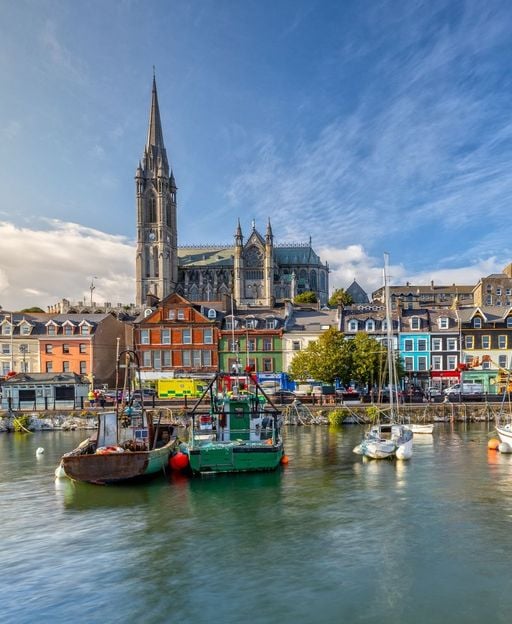
Many of the Irish men who fought in the Revolution left from ports along Ireland’s southern and eastern coasts. Cobh in County Cork — then known as Cove — was already an important departure point for ships crossing to America.
Cobh later became synonymous with the Great Famine emigration of the 1840s. But the Irish had been leaving for America long before that. The harbour town that stands today, with its colourful terraced houses rising up the hillside and St Colman’s Cathedral watching over the water, is the same harbour those revolutionary-era emigrants knew.
Standing on the Cobh waterfront and looking out across Cork Harbour, you feel the weight of what those crossings meant. Every man who sailed for America in the 1700s was leaving everything they knew for a cause — or a chance — they could only imagine.
You can read more about the Irish emigration story in our article on why the night before emigrating was called a wake in old Ireland. For the broader story of Irish-American heritage sites you can visit today, see our guide to visiting the Irish roots of America’s Founding Fathers.
Why This History Still Matters
As the 250th anniversary of American independence approaches in 2026, this history takes on fresh meaning. The story of Irish involvement in the American Revolution is not just a footnote. It is a central thread.
John Barry built the navy. Richard Montgomery led the first invasion of Canada and gave his life at Quebec. Stephen Moylan sat at Washington’s right hand. Charles Thomson signed the Declaration. Hundreds of thousands of Scots-Irish filled the ranks.
Ireland did not simply send emigrants to America. It sent the people who would help win a war and build a republic.
If you have Irish ancestry, there is a strong chance someone in your family line was part of this story — whether they fought, organised, or simply supported neighbours who did. The best way to connect with that history is to visit the places where it began.
Start with our Ireland travel planning guide and build your heritage itinerary from there.
Frequently Asked Questions
How many Irish soldiers fought in the American Revolution?
Historians estimate that between one-third and two-fifths of Washington’s officer corps had Irish roots. The broader Scots-Irish population — Ulster Presbyterians who had emigrated between 1717 and 1775 — contributed large numbers of ordinary soldiers, particularly in the southern campaigns.
Who was the most important Irish soldier in the American Revolution?
Commodore John Barry from County Wexford is widely regarded as the most significant Irish figure. Washington personally appointed him as the first officer of the new United States Navy, earning him the title “Father of the American Navy.” General Richard Montgomery from County Dublin was the first general officer to die in the Revolution.
Where can I visit Irish Revolutionary War heritage in Ireland?
County Wexford is the best starting point — it was John Barry’s birthplace and has strong Irish-American heritage connections. Cobh in County Cork is the historic emigration port where many Irish men and women began their Atlantic crossings. The Ulster American Folk Park in Omagh, County Tyrone, tells the Scots-Irish emigration story in detail.
What were the Wild Geese and how did they help in the Revolution?
The Wild Geese were Irish soldiers who left Ireland after 1691 and served in European armies — mainly French and Spanish — for the following century. Their military training and battlefield experience meant that Irish-born officers who came to America in the 1770s often had professional skills that Washington’s forces badly needed.
☘️ Join 64,000+ Ireland Lovers
Every Friday, get Ireland’s hidden gems, local secrets, and travel inspiration — the kind you won’t find in any guidebook.
Subscribe free — enter your email:
Already subscribed? Download your free Ireland guide (PDF)
📲 Know someone who’d love this? Share on WhatsApp →
Love more? Join 43,000 Scotland lovers → · Join 30,000 Italy lovers → · Join 7,000 France lovers →
Free forever · · Unsubscribe anytime
Tours & experiences you might love


Powered by Viator. Some links are affiliate links — we may earn a small commission at no extra cost to you.
Secure Your Dream Irish Experience Before It’s Gone!
Planning a trip to Ireland? Don’t let sold-out tours or packed attractions spoil your journey. Iconic experiences like visiting the Cliffs of Moher, exploring the Rock of Cashel, or enjoying a guided walk through Ireland’s ancient past often sell out quickly—especially during peak travel seasons.

Booking in advance guarantees your place and ensures you can fully immerse yourself in the rich culture and breathtaking scenery without stress or disappointment. You’ll also free up time to explore Ireland’s hidden gems and savour those authentic moments that make your trip truly special.
Make the most of your journey—start planning today and secure those must-do experiences before they’re gone!
Subscribe Free