

Nearly 39 million Americans claim Irish ancestry — more than one in ten people in the United States. On the 4th of July, when fireworks light the sky and the Stars and Stripes fly from every porch, a vast number of those celebrations carry an Irish heartbeat. The connection between Irish Americans and Independence Day runs far deeper than shamrocks on a Boston bar or a Kennedy quote on a fridge magnet. It is woven into the founding of the country itself.
How Irish are you, really? ☘️
How Irish Are You? — a short identity quiz that scores your answers across the small Irish habits, sayings, and instincts that give you away.
How Many Irish Americans Are There?
The 2020 Census recorded 38.6 million Americans identifying as Irish, alone or in combination with other ancestries — the third-largest ancestry group in the country, after English and German. In states like Massachusetts, New Hampshire, and Connecticut, Irish heritage is the single most common ancestry. Cities such as Boston, Chicago, Philadelphia, and New York built entire neighbourhoods — and entire political machines — around the Irish immigrant experience.
Watch: Do You Qualify for an Irish Passport?
Tracing your Irish family? If one of your grandparents was born in Ireland, you may be able to become an Irish citizen. This 14-minute guide explains who qualifies, what it costs and how long it takes. Thinking of making the move? Get the free Moving to Ireland checklist.
Most of those families trace their roots to the waves of emigration that peaked between 1845 and 1920. The Great Famine alone drove more than one million people to America. Many left from Cobh, County Cork — then called Queenstown — the last piece of Irish land millions of emigrants ever stood on. That departure point is now a museum and a pilgrimage site for Irish Americans reconnecting with their past.
To understand Irish Americans and the 4th of July, you have to understand that story. The people who built America were, in enormous numbers, people who had lost Ireland. Independence Day, for many Irish American families, is not just a national holiday. It is proof that the gamble their ancestors took — on a boat, with nothing — paid off.
Presidents With Irish Ancestry: The Oval Office’s Irish Roots
At least 23 US presidents have documented Irish ancestry, including some of the most significant figures in American history. This is not a coincidence — it reflects how thoroughly the Irish embedded themselves in the political and civic life of the United States across two centuries.
John F. Kennedy is the most celebrated. His great-grandfather, Patrick Kennedy, emigrated from Dunganstown, County Wexford, in 1848. In 1963, Kennedy visited Ireland and stood in that same village, meeting distant cousins in a moment that moved an entire nation to tears. He told a crowd in Dublin: “This is not the land of my birth, but it is the land for which I hold the greatest affection.”
Ronald Reagan traced his family to Ballyporeen, County Tipperary. His great-grandfather Michael Reagan emigrated in the 1850s. When Reagan visited Ballyporeen in 1984, the entire village turned out and a pub was renamed “The Ronald Reagan” in his honour. In his farewell address, he spoke of America as a place built by people “who had fled the bogs of Ireland” — a phrase that resonated with millions.
Joe Biden has Irish roots on both sides of his family. His maternal ancestors came from County Louth and County Mayo. Biden visited Ireland in April 2023 and addressed the Oireachtas — Ireland’s parliament — becoming the fourth American president to do so, after Kennedy in 1963, Reagan in 1984, and Clinton in 1995. He quoted Seamus Heaney throughout the visit and described his Irish identity as central to who he is.
Barack Obama discovered an Irish connection through genealogical research — his great-great-great-grandfather Falmouth Kearney emigrated from Moneygall, County Offaly, in 1850. Obama visited Moneygall in 2011, pulled a pint of Guinness, and declared himself “home.” The entire village of 300 people turned out to greet him.
☘️ Enjoying this? 64,000+ Ireland lovers get stories like this every week.
Thinking about it for retirement? If you’ve started thinking seriously about retiring there, our complete Retire in Ireland guide covers the visa, healthcare, cost-of-living, and the regions worth shortlisting.
Reagan’s Irish Heritage: A Speech That Defined a Generation
No single moment better captures the Irish American 4th of July spirit than Ronald Reagan’s connection to Irish identity and American ideals. Speaking in 1984 at Ballyporeen, Reagan said: “The Irish brought to America a determination to succeed and a love of freedom. These qualities became the bedrock of the American character.”
Reagan also frequently used Irish blessings in his speeches — “May the road rise up to meet you” became almost a second national text for Irish Americans. His ability to draw a direct line from the Irish immigrant experience to the American dream gave millions of families a way to hold both identities at once: proudly Irish, proudly American.
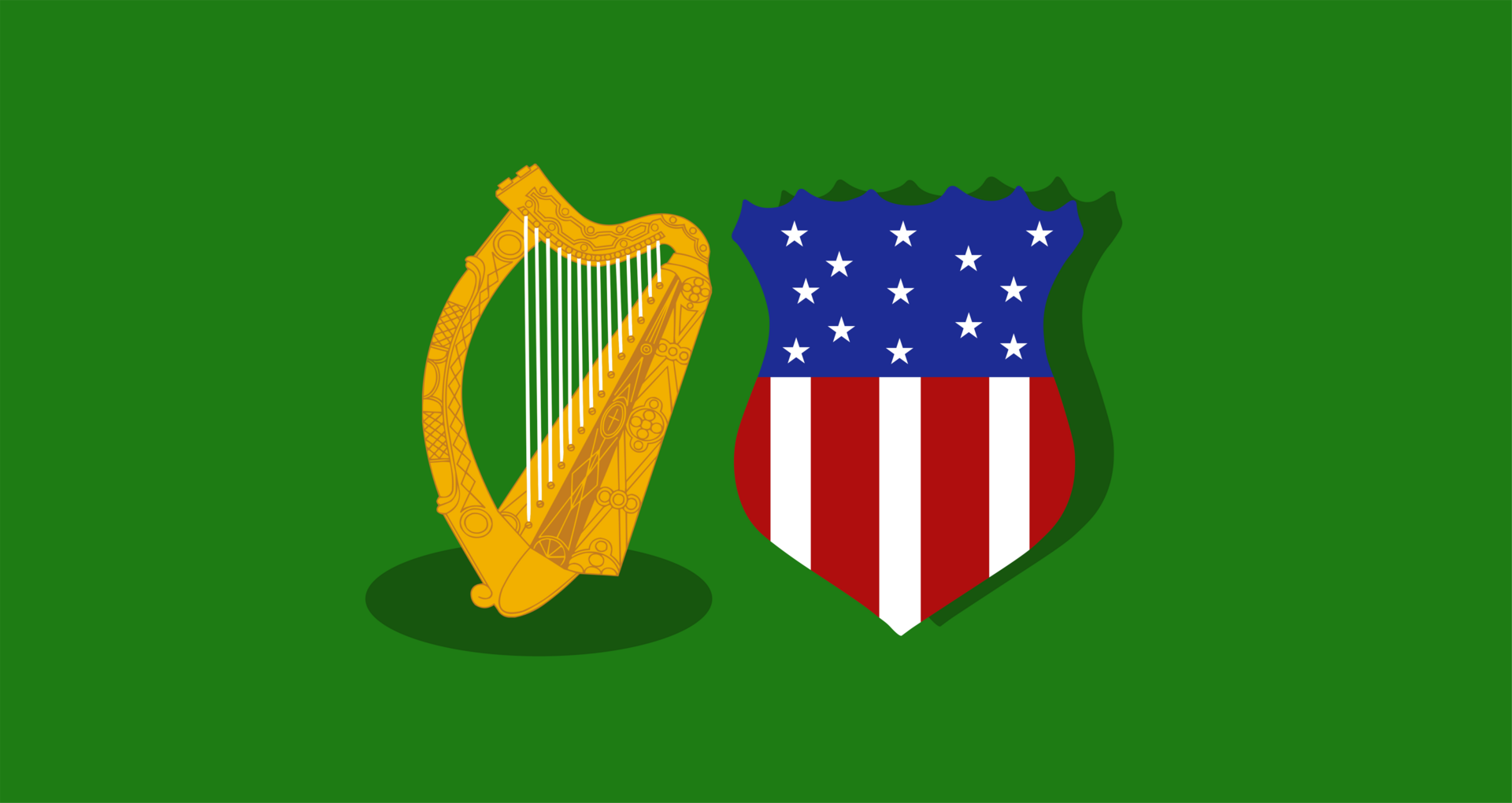
That dual identity is what makes the 4th of July particularly meaningful for Irish American families. At Irish American community events across the country, you will find both the Stars and Stripes and the Irish tricolour flying side by side on Independence Day.
How Irish Americans Celebrate Independence Day
Irish American communities have their own traditions that make Independence Day distinctive. In Boston, South Boston — known locally as “Southie” — has one of the most famous 4th of July celebrations in the country. The neighbourhood, historically one of the most Irish communities in America, stages a fireworks display over the Charles River that draws hundreds of thousands of people each year.
In Chicago, where an estimated 1.3 million residents claim Irish ancestry, Independence Day celebrations often include Irish music sessions at neighbourhood pubs, particularly in areas like Beverly and Morgan Park — both historically Irish working-class communities. The Irish American Heritage Centre in Chicago holds events that blend both celebrations throughout the summer.
In New York, the Ancient Order of Hibernians — founded in 1836 and still active — holds Independence Day events that draw together Irish American families who have been meeting in the same halls for five generations. Similar organisations exist in Philadelphia, San Francisco, and across the South and Midwest, where Scots-Irish settlement patterns of the 18th century left a deep cultural imprint.
The Scots-Irish and the Birth of American Independence
The connection between Ireland and American Independence predates the Great Famine by a century. The Scots-Irish — Presbyterians who settled Ulster in the 17th century and then emigrated en masse to America’s frontier regions in the 1700s — were among the most fiercely revolutionary groups in the colonies. Historians estimate that between 200,000 and 400,000 Scots-Irish emigrants arrived in America between 1717 and 1775.
They settled the Appalachian backcountry, from Pennsylvania through Virginia and the Carolinas into Georgia. Isolated from British authority and instinctively distrustful of it, they became the backbone of the Patriot movement. Generals like Andrew Jackson — whose parents came from Carrickfergus, County Antrim — and John Stark carried that Ulster spirit onto the battlefield.
King George III, reportedly exasperated by colonial resistance, is said to have complained: “America is lost! We might as well give it up. The Scotch-Irish have made it their own.” The remark captures how thoroughly the Ulster Irish shaped the revolutionary spirit of the new nation.
You can explore this history in person at the Ulster American Folk Park near Omagh in County Tyrone — a remarkable open-air museum that tells the story of those emigration waves, from thatched Ulster cottages to reconstructed Pennsylvania farmsteads, all on one walkable site.
Tracing Your Irish Roots: A Practical Guide for Irish Americans
For millions of Irish Americans, the deepest connection to the 4th of July comes through understanding where their ancestors came from. Ancestry DNA testing has made Irish heritage research more accessible than ever — approximately 3.2 million Americans took an ancestry DNA test in 2024 alone, with Ireland consistently among the top results for those with Atlantic coast heritage.
Ireland itself has invested heavily in heritage tourism for the diaspora. The Genealogy Centre at Ennis in County Clare, the Irish Family History Centre at the Irish Heritage Trust, and the National Archives in Dublin all offer resources for tracing Irish roots. Many county councils now have dedicated genealogy officers who can help narrow down a family’s home county from a surname and a rough emigration date.
If you know your ancestors left from Cork, a visit to the Cobh Heritage Centre — built inside the original White Star Line terminal where Titanic passengers boarded in 1912 — is one of the most moving experiences an Irish American can have. Standing on the same quay your great-grandparents stood on, looking back at the town they were leaving forever, makes the 4th of July celebration feel like something they earned on your behalf.
For help planning a heritage trip, start with our complete Ireland planning guide. We also have a full guide to the Irish contribution to American independence and a piece on where to visit the Irish roots of America’s founding fathers — both ideal reading before a heritage visit.
Why the 4th of July Feels Personal for Irish Americans
There is a phrase heard often in Irish American families: “We didn’t come to America — we survived to America.” It captures the difference between Irish emigration and the experience of many other immigrant groups. The Irish largely did not leave for opportunity. They left because staying meant death.
That history — of loss, of crossing, of rebuilding — gives Independence Day a particular resonance for families who carry it. The 4th of July is not just the birthday of the United States. For Irish Americans, it is the day that their ancestors’ gamble is most visibly, loudly, triumphantly vindicated.
When the fireworks go up over Boston Harbour or Chicago’s lakefront, many of the people watching them are the descendants of people who once watched the lights of Cork or Kerry disappear behind the horizon, wondering if they would ever see Ireland again. The 4th of July is for them too — and it always has been.
Frequently Asked Questions
How many US presidents have Irish ancestry?
At least 23 US presidents have documented Irish ancestry, including John F. Kennedy (County Wexford), Ronald Reagan (County Tipperary), Joe Biden (County Louth and County Mayo), and Barack Obama (County Offaly). Ireland’s influence on the American presidency is unmatched by any other country of similar size.
Why is Irish American history connected to the 4th of July?
Irish immigrants and their descendants played a central role in both the founding and the building of the United States. The Scots-Irish were among the most revolutionary groups in the 1770s, and later waves of Irish immigration — particularly after the Great Famine — helped build American cities, industries, and political institutions. Independence Day celebrates the country that Irish emigrants helped create and that gave their descendants a new home.
Where can Irish Americans trace their heritage in Ireland?
The best starting points for genealogy research are the National Archives in Dublin, the General Register Office, and the county genealogy centres throughout Ireland. The Cobh Heritage Centre in County Cork is particularly moving for those whose ancestors emigrated through that port. The Ulster American Folk Park in County Tyrone tells the story of Scots-Irish emigration in vivid, walkable detail.
Is the 4th of July celebrated in Ireland?
The 4th of July is not a public holiday in Ireland, but it is acknowledged — particularly in areas with strong connections to Irish America. The US Embassy in Dublin typically holds a reception, and some pubs in tourist areas mark the occasion. The Irish people are genuinely proud of the role their ancestors played in American independence and tend to view the day warmly.
☘️ Join 64,000+ Ireland Lovers
Every Friday, get Ireland’s hidden gems, local secrets, and travel inspiration — the kind you won’t find in any guidebook.
Subscribe free — enter your email:
📲 Know someone who’d love this? Share on WhatsApp →
Love more? Join 43,000 Scotland lovers → · Join 29,000 Italy lovers → · Join 7,000 France lovers →
Free forever · · Unsubscribe anytime
Tours & experiences you might love


.png)
Powered by Viator. Some links are affiliate links — we may earn a small commission at no extra cost to you.
Secure Your Dream Irish Experience Before It’s Gone!
Planning a trip to Ireland? Don’t let sold-out tours or packed attractions spoil your journey. Iconic experiences like visiting the Cliffs of Moher, exploring the Rock of Cashel, or enjoying a guided walk through Ireland’s ancient past often sell out quickly—especially during peak travel seasons.

Booking in advance guarantees your place and ensures you can fully immerse yourself in the rich culture and breathtaking scenery without stress or disappointment. You’ll also free up time to explore Ireland’s hidden gems and savour those authentic moments that make your trip truly special.
Make the most of your journey—start planning today and secure those must-do experiences before they’re gone!
Subscribe Free