

Some people book therapists. Others book flights to Ireland. There’s a quiet truth that millions feel but rarely say aloud: that sitting in a quiet Irish village — rain tapping the window, steam rising from a mug of tea, not a notification in sight — does something to the nervous system that no amount of self-help books ever quite manages. It resets something. It reminds you of who you are before the world told you to be someone busier.
This isn’t nostalgia. It’s not marketing. It’s one of the best-kept secrets in the world: Ireland’s quiet villages are genuinely, soulfully, irreplaceably good for you.
The Quiet Irish Village: Nature’s Oldest Remedy
Ireland has been offering this kind of healing long before “wellness” became an industry. Before the apps, the retreats, the curated self-care routines — there were just small villages where time moved differently, where strangers said hello on the street, and where the rain felt like permission to stop rushing.
What makes an Irish village different from any other quiet place? It’s a combination of things: the human scale of the streets, the absence of urgency in the air, the sense that nothing particularly pressing needs to happen today. The Irish have always understood this intuitively, even if they’d never call it mindfulness.
Why Rain Is Actually Good for the Soul
Let’s address the obvious. Yes, it rains in Ireland. Frequently. Sometimes sideways. And yet — and this is the part that surprises visitors most — the rain is part of the appeal.
Rain in Ireland isn’t something you fight. It’s something you accept. You watch it from a warm window. You listen to it drum on a tin roof. You feel it on your face on a cliff walk — that cold Atlantic mist that makes you feel more alive than any gym session ever has. There’s a reason petrichor, the scent of rain on earth, is one of the most universally calming smells in the world. In Ireland, you get it in abundance, accompanied by the greenest fields you’ve ever seen and a sky that changes colour every fifteen minutes.
The Cup of Tea: Ireland’s Most Powerful Medicine
No discussion of the quiet Irish village is complete without the cup of tea. Not the artisan single-origin pour-over in a reusable cup. The cup of tea. Strong. Hot. Poured without being asked, because you clearly need one.
In Ireland, tea is not a beverage — it is a social contract. It means: sit down, I’m here, nothing is pressing. It is offered in moments of joy, grief, celebration, crisis, and perfectly ordinary Tuesday afternoons. It is, without irony, one of the most genuinely comforting rituals in the Irish cultural toolkit. In a quiet Irish village, a cup of tea means an hour by the window — and an hour by the window in Ireland is worth three weeks of productivity hacks.
Four Irish Villages That Do Something to the Soul
Not all villages offer the same experience. Here are four that do something quietly remarkable.
Adare, County Limerick — Ireland’s Prettiest Village
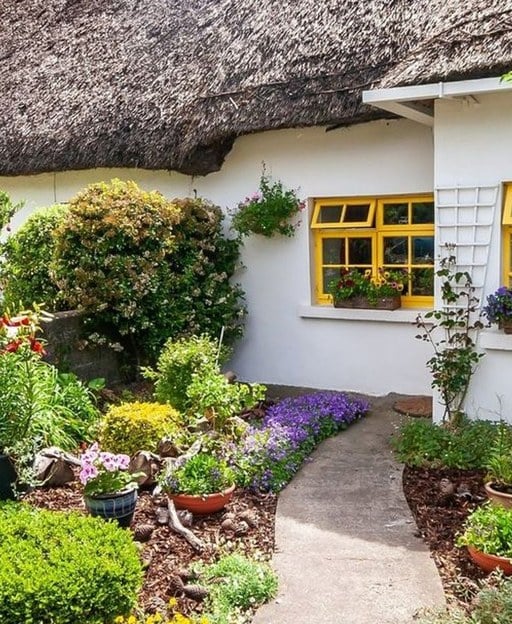
Adare is almost absurdly beautiful. Thatched cottages line the main street, each one whitewashed and garden-fronted, looking like a scene from a storybook that nobody has updated because nothing needs changing. The River Maigue winds past medieval ruins, herons stand motionless in the shallows, and the whole place moves at the pace of somewhere that has decided contentment is enough.
Come mid-week, come in autumn when the tourists thin out, and Adare will give you something rare: the feeling that beauty is ordinary, that loveliness is just the baseline.
Roundstone, County Galway — Atlantic Solitude
Roundstone sits at the edge of Connemara on the shore of a small harbour, with the Twelve Bens mountains behind and the open Atlantic ahead. It is quiet in the bone-deep way that only coastal places manage — that particular silence made of wind and water and nothing else. There are a handful of pubs, a couple of restaurants, and the sea. That is, genuinely, enough. For anyone exploring County Galway, Roundstone deserves a day or two of its own.
Dingle, County Kerry — Where the World Slows Down
Dingle is the kind of place that makes people do sums. Could I live here? What would I give up? Would I miss the city? It’s a thought experiment Ireland plays on you without warning.
The streets are narrow and colourful, the pubs have turf fires and trad sessions on Wednesday evenings, and the peninsula around it offers some of the most dramatic scenery in Western Europe. The warmth of the Dingle people is legendary, and entirely earned. It is also one of the last places in Ireland where you might hear Irish spoken on the street — something explored beautifully in our piece on the corners of Ireland where you can spend a whole day without speaking English.
Ardara, County Donegal — Off the Beaten Track Entirely
Ardara doesn’t make most tourism lists. That is precisely why it should make yours. This small Donegal town is the heartland of Irish tweed weaving — you can still visit working weavers whose families have been at the loom for generations. The surrounding landscape of bog, mountain, and coast is spectacular in a raw, unapologetic way. Because Donegal is further from Dublin than the other options, the pace here is genuinely different. Time works differently in Ardara.
The Art of Doing Nothing, Irish Style
Here is something you’ll notice quickly in Irish villages: people are not embarrassed by stillness. An older man on a bench watching the square. A conversation that has been going on for forty minutes about nothing and everything. A dog stretched across a doorstep, completely committed to the enterprise.
The Irish have, without naming it, developed a sophisticated cultural tolerance for unscheduled time. This is not laziness. It is, in contemporary terminology, radical presence.
Walking the Boreens
A boreen — from the Irish bóithrín, meaning small road — is the Irish version of a country lane: narrow, grass-growing-down-the-middle, hedged with fuchsia and hawthorn, going approximately nowhere in particular. Walking a boreen is what slowing down actually feels like in practice. No destination, no route optimisation, no podcast. Just the sound of your feet, the smell of gorse and damp earth, and the occasional startled pheasant.
The Pub as Sanctuary
The Irish pub in a quiet village is not the same animal as the themed tourist pub in a city centre. It is genuinely local — the same faces, the same corner seats, the same barman who knows your name by your second visit. Walk in for one pint. Stay for three. Talk to the person next to you. They will have an opinion on something, and it will be interesting. This is guaranteed.
Planning Your Quiet Irish Village Escape
If you’re ready to let an Irish village do its work on you, the planning is simpler than you’d think. Start with our Ireland trip planning guide, which covers the best time to visit, how to get around, and which regions suit different types of traveller.
Looking for more quiet villages beyond these four? Our guide to Ireland’s Most Peaceful Villages in Connemara & Donegal rounds up further escapes, and if wellness and slow travel is the specific goal, see our companion piece on Irish Villages for Wellness and Slow Travel.
For a slow-travel experience, the rural west and northwest — Connemara, Donegal, the Dingle Peninsula, the Beara — consistently deliver. Book accommodation in the village itself rather than outside it. Wake up already there. Take no more than two scheduled activities per day. Leave at least one afternoon completely unplanned.
The village will take care of the rest. And somewhere between the second cup of tea and the rain on the window, you’ll feel it: whatever needed resetting, resetting.
Thinking about it for retirement?
If you’ve started thinking seriously about retiring there, our full Retire in Ireland guide covers the visa, healthcare, cost-of-living, and the regions worth shortlisting.
Tours & experiences you might love


Powered by Viator. Some links are affiliate links — we may earn a small commission at no extra cost to you.
Secure Your Dream Irish Experience Before It’s Gone!
Planning a trip to Ireland? Don’t let sold-out tours or packed attractions spoil your journey. Iconic experiences like visiting the Cliffs of Moher, exploring the Rock of Cashel, or enjoying a guided walk through Ireland’s ancient past often sell out quickly—especially during peak travel seasons.

Booking in advance guarantees your place and ensures you can fully immerse yourself in the rich culture and breathtaking scenery without stress or disappointment. You’ll also free up time to explore Ireland’s hidden gems and savour those authentic moments that make your trip truly special.
Make the most of your journey—start planning today and secure those must-do experiences before they’re gone!
Subscribe Free