

Under Brehon Law, the ancient legal code that governed Ireland for over a thousand years, hospitality was not a courtesy — it was a legal obligation. A wealthy landowner who refused food and shelter to a traveller in genuine need faced a formal legal process that could end with their cattle being taken in broad daylight, and the law was entirely on the traveller’s side. The same code gave Ireland’s poets the power to compose a satire that courts recognised as the equivalent of a physical attack on the person who had refused to share.
What Was Brehon Law?
Brehon Law — from the Old Irish word breitheamh, meaning judge or arbitrator — was the native legal system of Gaelic Ireland. Its written origins trace back to at least the 7th century CE, though scholars believe the underlying traditions stretch several centuries further into the pre-Christian era.
The laws were not imposed by a king or central authority. Instead, they were maintained and interpreted by a specialised class of judges — the Brehons — who memorised vast tracts of legal text and served as arbitrators in disputes. Unlike the Norman and English legal systems that would eventually replace them, Brehon Laws operated through negotiation, compensation, and social pressure rather than imprisonment or execution.
The earliest surviving written legal texts — most notably the Críth Gablach and the Senchas Már — date to around 700 CE, though both draw on older oral traditions. The Senchas Már alone runs to approximately 140,000 words in its complete form, covering everything from inheritance rights to the proper compensation for injuring a dog. The laws remained in active use for roughly 1,000 years. It was only after the Flight of the Earls in 1607 — when the last Gaelic lords fled following their defeat — that English Common Law was finally imposed across the whole island.
The Obligation That Wealth Carried
In the Brehon system, every person held what was called a lóg n-enech — their honour price, literally translated as “the price of their face”. This was not metaphorical. A person’s honour price determined what compensation was owed to them if they were wronged, what contracts they could enter, and critically, what social obligations they were expected to fulfil.
The wealthier the person, the higher their honour price — and the heavier their legal duty to provide for those with less. A king was required to maintain a household that never turned anyone away hungry. A prosperous farmer was expected to share his harvest with travellers crossing his land. This was not discretionary generosity. It was a codified legal requirement, with formal penalties for those who failed to meet it.
Refusing that obligation was treated like any other debt under the law — something that could be pursued through formal legal channels, with enforceable consequences for the party in the wrong.
The Briugu: Ireland’s Professional Hosts
Among the most respected figures in early Irish society was the briugu — the professional hospitality keeper. A briugu maintained a public guesthouse that was, by law, open to any traveller at any time, day or night. Three conditions defined a legitimate briugu:
- A cauldron that was never empty
- A household that was never without company
- A river or stream that ran beside the house, never dry
In return, the briugu received land grants and legal privileges equivalent to those of a minor lord. Their household was, in a practical sense, a public institution — funded through a combination of land income and the social expectation of reciprocal generosity from those who benefited from their hospitality. Closing the doors of a briugu’s house, or sending a traveller away hungry, was not merely inhospitable. It was a breach of public law.
☘️ Enjoying this? 64,000+ Ireland lovers get stories like this every week.
Thinking about it for retirement?
If you’ve started thinking seriously about retiring there, our complete our full Retire in Ireland guide covers the visa, healthcare, cost-of-living, and the regions worth shortlisting.
Subscribe free →
Fasting on the Doorstep: How to Force a Miser’s Hand
The most remarkable legal mechanism available to a person who had been refused their rights was called troscadh — fasting on the doorstep of the person who had wronged them.
If a wealthy person refused to honour their hospitality obligation, the wronged party had the right to appear at the host’s door, sit down, and begin a formal fast — openly, with witnesses. This was not a symbolic protest. Under Brehon Law, it was a legally recognised claim, the equivalent of filing a formal suit.
The host was now caught in an inescapable legal bind. If the fasting person died on their doorstep, the full weight of legal liability — and a substantial financial penalty calculated against the deceased’s honour price — fell on the host. The host’s own honour price could be dramatically reduced, effectively stripping them of their legal standing in the community.
In practise, troscadh rarely reached that point. The social shame of having someone die while fasting at your door was catastrophic and permanent. Witnesses were required by law, meaning the entire community would know what had happened. A wealthy man seen to have chosen his stored grain over a neighbour’s life became, in legal and social terms, almost irredeemably disgraced. Most disputes were resolved at the first sight of someone sitting down to fast at the gate.
The Poet’s Weapon: A Satire That Could Destroy a Reputation
If troscadh was an individual’s legal tool, the poet’s satire was something closer to a weapon of mass social destruction — and it was entirely available against a miser who refused his obligations.
Ireland’s poets, the filid, occupied an extraordinary position in Brehon society. A poet of the highest rank — the ollamh — held the same legal status as a petty king. They could travel between kingdoms with immunity, and their words carried the force of a court finding.
The most feared weapon in a poet’s arsenal was the glam dícenn — a formal satirical poem composed in a precise legal format and performed at dawn at the target’s gate, in front of witnesses, invoking all seven grades of poetic craft simultaneously. The Brehon texts describe the effects in striking terms: blisters appearing on the face, crops failing, livestock sickening. Whether this was literal belief or a powerful cultural metaphor for total public humiliation is debated among modern scholars. What is not debated is that a successful glam dícenn was legally recognised as the equivalent of a physical assault.
The target of such a satire could pursue legal remedy — but only if the satire was demonstrably false. A poet who composed a satire that was found accurate faced no penalty whatsoever. A miser who had genuinely refused his legal obligations had no ground on which to stand.
How Legal Distraint Actually Worked
The formal legal mechanism for enforcing debts — including the debt of withheld hospitality — was called athgabhál, or legal distraint. After completing the required legal steps, a creditor or wronged party could, with witnesses, walk onto a debtor’s land and physically take cattle or goods to the value of what was owed.
The process had prescribed stages. A formal demand had to be made first. A waiting period had to be observed, giving the debtor the opportunity to comply. If the debtor continued to refuse, fasting (troscadh) could be used to escalate the claim. If the debt remained unpaid after all stages, distraint was lawful. The taking was not theft — it was a court-recognised transfer of property, executed according to a documented procedure, with witnesses who could testify to the legality of every step.
The host had no legal recourse if the process had been followed correctly. The cattle or goods taken were, in the eyes of the law, no longer his. He had forfeited them by refusing his obligation.
The Laws That Never Entirely Disappeared
English common law had been in theoretical conflict with Brehon Law since the Norman arrival in Ireland in the 12th century. The Statutes of Kilkenny, passed in 1366, explicitly forbade English settlers from following Brehon customs — but in practise, the laws continued to operate throughout Gaelic Ireland for another two and a half centuries.
It was the Flight of the Earls in 1607 that finally ended the Gaelic legal order. The last professional Brehons died out during the 17th century. Their texts, largely unread for three hundred years, were preserved in Irish monasteries and eventually collected by scholars. The Royal Irish Academy in Dublin now holds more than 1,400 Irish manuscripts, including many of the core Brehon legal texts.
What persisted long after the formal system vanished was the ethic behind it. In Irish rural culture well into the 20th century, turning a traveller from your door was understood as a serious moral failing — not a private matter but something the whole community would judge. The obligation of welcome, the sense that hospitality was owed rather than chosen, is one of the most distinctive threads running through Irish cultural identity. It was, once, the law.
If you’re planning a trip to Ireland and want to explore the heritage behind these ancient traditions, the Love Ireland planning guide covers everything you need for your visit. For those interested in early Christian and medieval sites where Brehon Law was once practised and recorded, see our guides to County Offaly — home to Clonmacnoise, one of the great monastic centres of early Christian Ireland — and County Meath, where some of the oldest ceremonial sites on the island still stand.
Frequently Asked Questions About Brehon Law
What is Brehon Law?
Brehon Law (from the Old Irish breitheamh, meaning judge) was the native legal code of Gaelic Ireland, in use from at least the 7th century CE until its replacement by English Common Law following the Flight of the Earls in 1607. The laws were interpreted by a specialist class of jurists — the Brehons — and covered everything from land rights and inheritance to hospitality obligations and the legal powers of poets.
How long was Brehon Law in use in Ireland?
Brehon Law was in active use for approximately 1,000 years. The earliest surviving written texts date to around 700 CE, though the oral traditions behind them are older. The laws remained in force in Gaelic territories until 1607, when the Flight of the Earls ended the last Gaelic lordships and English Common Law was imposed across the island.
What happened if someone refused hospitality under Brehon Law?
Refusing hospitality to someone in genuine need was a legal offence under Brehon Law. The wronged person could engage in troscadh — formally fasting on the host’s doorstep — which created a legal claim. If the host failed to resolve the matter, they faced financial penalties, a substantial reduction in their honour price, and potentially the legal distraint of their cattle or goods.
Where can I explore Irish heritage related to the Brehon Law era?
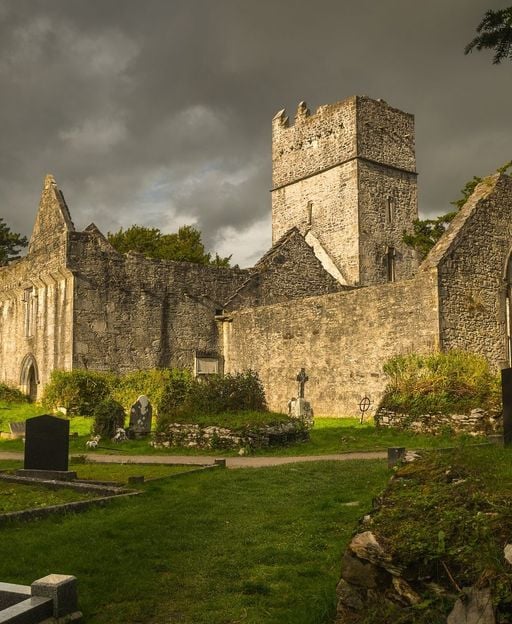
Clonmacnoise in County Offaly, founded in 544 CE, is one of Ireland’s most important early Christian sites and was a centre of learning and manuscript production during the Brehon Law era. Muckross Abbey in County Kerry (founded in 1448 CE) and numerous other monastic ruins across Ireland preserve the physical landscape of that world. The Ireland travel planning guide can help you build an itinerary around these heritage sites.
☘️ Your Irish family has a story waiting to be found.
Discover where your Irish ancestors came from — their county, their name, their story. Our free step-by-step guide walks you through every record, DNA tool, and ancestry archive. No experience needed.
Get the free guide
Enter your email and we will send you straight to the download.
📲 Know someone who’d love this? Share on WhatsApp →
Love more? Join 43,000 Scotland lovers → · Join 29,000 Italy lovers → · Join 7,000 France lovers →
Free forever · Unsubscribe anytime
Tours & experiences you might love


Powered by Viator. Some links are affiliate links — we may earn a small commission at no extra cost to you.
Secure Your Dream Irish Experience Before It’s Gone!
Planning a trip to Ireland? Don’t let sold-out tours or packed attractions spoil your journey. Iconic experiences like visiting the Cliffs of Moher, exploring the Rock of Cashel, or enjoying a guided walk through Ireland’s ancient past often sell out quickly—especially during peak travel seasons.

Booking in advance guarantees your place and ensures you can fully immerse yourself in the rich culture and breathtaking scenery without stress or disappointment. You’ll also free up time to explore Ireland’s hidden gems and savour those authentic moments that make your trip truly special.
Make the most of your journey—start planning today and secure those must-do experiences before they’re gone!
Subscribe Free