

In the heart of Kildare town, a flame burns that was first kindled by St. Brigid herself more than fifteen centuries ago. For approximately 700 years it never went out. Then it was extinguished — twice — by men who did not understand what it meant. And then, in 1993, a small group of Brigidine Sisters walked into the Market Square of Kildare and lit it again.
This is the story of that fire: what it meant, why it mattered, and where you can stand beside it today.
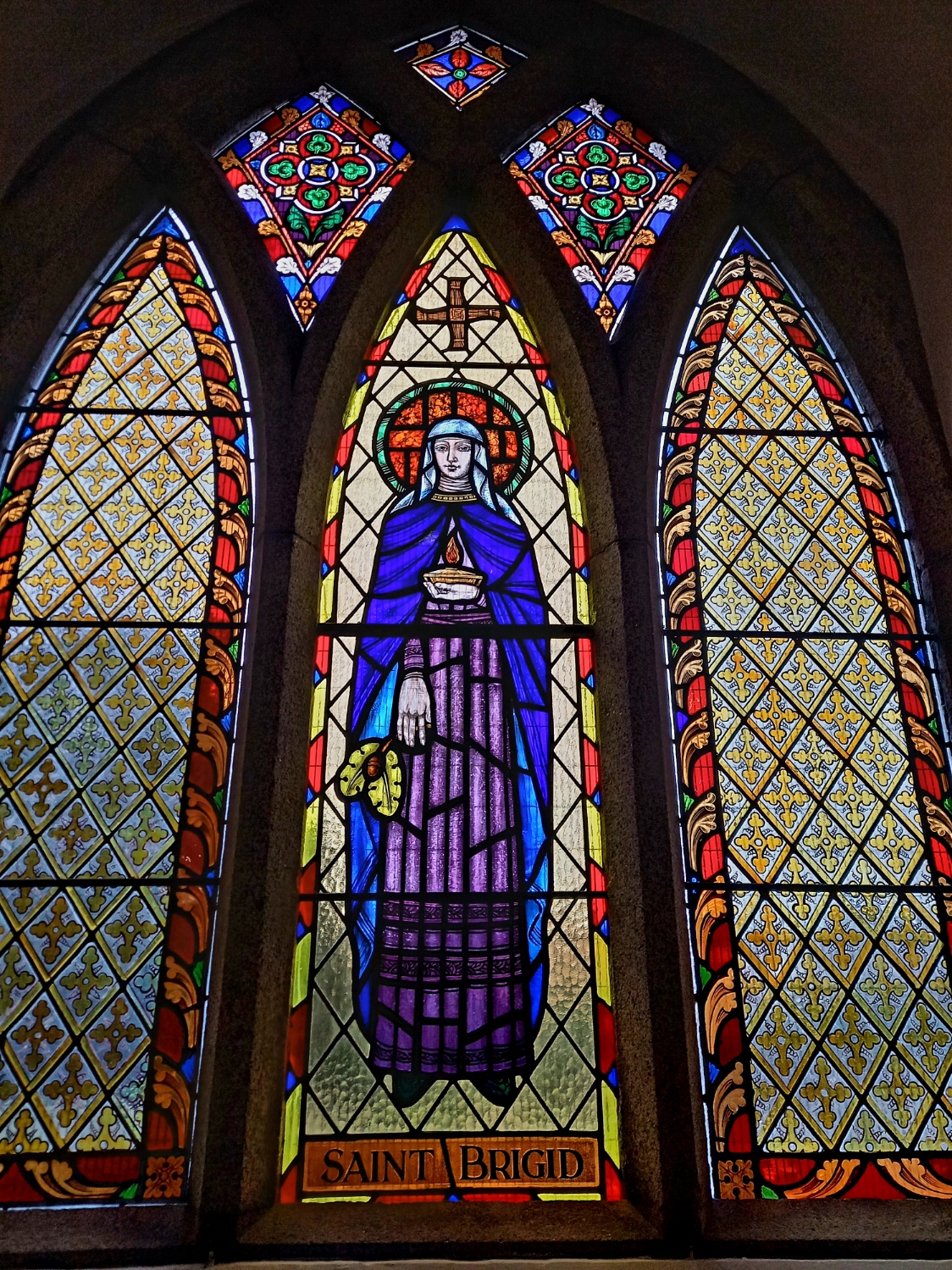
Who Was St. Brigid of Kildare?
St. Brigid (c. 451–525 AD) is one of Ireland’s three patron saints, alongside St. Patrick and St. Columba. She was born in Faughart, County Louth, and from an early age was associated with acts of extraordinary generosity — giving away her father’s goods to the poor, healing the sick, and tending animals with a care that passed into legend.
Around 480 AD, she founded a monastery at a place called Cill Dára — the Church of the Oak — on the edge of the Curragh plain in what is now County Kildare. It became one of the most important religious centres in early medieval Ireland, a double monastery for both monks and nuns, and Brigid’s influence spread across the country and into Europe.
Her name itself carries an ancient weight. Brigid comes from the Old Irish Brig, meaning exalted one or high goddess. Before the Christian saint, there was a goddess Brigid in Irish mythology, patron of poetry, healing, and craft. The two figures became so intertwined that it is sometimes impossible — and perhaps unnecessary — to separate them.
The Eternal Flame — A Fire Tended by Nineteen Nuns
At the heart of Brigid’s monastery in Kildare, a fire burned continuously. According to the twelfth-century account of Gerald of Wales (Giraldus Cambrensis), nineteen nuns took turns tending the flame, one each night in a twenty-night rotation. On the twentieth night, the nun on duty would place logs beside the hearth and say: “Brigid, guard your fire. This is your night.” By morning, the wood was burned and the flame still alight — Brigid herself was believed to have returned to tend it.
It was not merely a religious symbol. In early Irish society, fire meant life: warmth through winter, cooked food, the protection of the homestead. The hearth was the sacred centre of Irish domestic life, and a fire that never died was an expression of divine permanence. Brigid’s flame embodied the continuity of community, of faith, and of the land itself.
The flame burned at Kildare for approximately 700 years — from the late fifth century through to the early thirteenth.
How the Flame Was Extinguished
In 1220, Henry de Londres, the Norman Archbishop of Dublin, ordered the fire extinguished. The nuns of Kildare had refused to allow male clergy to inspect the abbey. De Londres declared the flame a pagan custom and had it put out. It was, even by the standards of the time, an act of deliberate cultural destruction.
The Brigidine community relit the flame after de Londres’s death. It continued to burn — though with less security than before — until the Dissolution of the Monasteries under Henry VIII in the 1530s and 1540s finally ended it for good. The monasteries were suppressed, the religious communities scattered, and the fire that had burned for seven centuries went out.
It would not burn again for more than 450 years.
The Flame Returns: 1993 and Beyond
On 1 February 1993 — St. Brigid’s Day — Sr. Mary Teresa Cullen, then congregational leader of the Brigidine Sisters, stood in the Market Square of Kildare town and relit the flame. The occasion was the opening of a justice and peace conference titled “Brigid: Prophetess, Earthwoman, Peacemaker,” organised by Afri (Action from Ireland).
The relighting was not a grand state ceremony. It was a quiet, deliberate act by a community of women who had been keeping Brigid’s memory alive for centuries. That act has continued every St. Brigid’s Day since.
In 2006, President Mary McAleese presided at the lighting of a permanent Perpetual Flame sculpture in Kildare’s Town Square — a public flame lit from the Brigidine Sisters’ fire at Solas Bhíride. The flame that de Londres extinguished in 1220 now burns permanently in the centre of the town, in full view of anyone who walks past.
Where to See the Flame Today
There are two places in Kildare where you can encounter the eternal flame.
The Perpetual Flame sculpture in Kildare Town Square is always accessible — a public artwork you can visit at any hour, free of charge, in the heart of the town. It sits close to St. Brigid’s Cathedral and is a natural anchor for any visit to Kildare.
Solas Bhíride (Brigid’s Light) is the Brigidine Sisters’ centre on Tully Road, Kildare Town — the place where the flame is tended by the community that relit it. The centre offers a quiet, contemplative space for visitors: a garden, a small hermitage, an opportunity to sit with the flame in a setting that genuinely reflects Brigid’s spirit of hospitality and peace.
- Address: Tully Road, Brallistown Little, Kildare Town, Co. Kildare, R51 Y281
- Opening hours: Monday to Friday, 10am–5pm. Saturday and Sunday by appointment.
- Admission: Free (donations welcome)
- Contact: +353 (0)45 522890 / [email protected]
Weekend visits require advance booking. If you are travelling specifically to see the flame, it is worth emailing or calling ahead to confirm access.
Ireland’s stories, every week.
Sacred sites, hidden history, and practical travel guides — free to your inbox.
Thinking about it seriously? If you’ve started actually planning a move, our complete the full Move to Ireland guide walks through every step, every cost, and the paperwork that catches most people out.
St. Brigid’s Cathedral and the Round Tower
A short walk from the Town Square, St. Brigid’s Cathedral stands on the original site of her monastery. The present cathedral is a medieval structure, largely thirteenth-century Norman, with significant later restorations — but the ground beneath it has been a sacred site since Brigid herself walked it fifteen centuries ago.
Beside the cathedral stands one of Ireland’s finest round towers — 108 feet (approximately 33 metres) high, with its entrance doorway set several metres above the ground in the characteristic fashion of Irish early Christian towers. The tower is open to visitors in summer and you can climb to the top for panoramic views across the Curragh plain. Entry to the tower costs approximately €7; access depends on the groundskeeper being present, so it is worth confirming on arrival.
The cathedral’s summer opening hours are Monday to Saturday, 10am–1pm and 2pm–5pm, and Sunday 2pm–5pm (May to September). Outside summer months, visits are by appointment. Admission is approximately €2.
Just outside the cathedral grounds, you will find St. Brigid’s Well — a healing well that has been a site of pilgrimage for centuries. It sits near the Curragh racecourse and is freely accessible year-round.
St. Brigid’s Day — Ireland’s Newest Public Holiday
Since 2023, St. Brigid’s Day has been an official public holiday in Ireland — the first new public holiday since 1977 and the first to honour a woman. The holiday falls on the first Monday of February (or on 1 February itself, if that date falls on a Friday).
The date corresponds to Imbolc, the ancient Celtic festival marking the beginning of spring — the moment when the land stirs back to life after winter. Brigid presides over both: the Christian feast day and the older, deeper turning of the year. Ireland’s fire festivals have always marked the transitions between seasons, and Imbolc — with its central symbol of a flame — is perhaps the oldest of them.
If you visit Kildare on St. Brigid’s Day, you will find it busy in the best way: ceremonies at the cathedral, community events, and the annual relighting of the flame in the Market Square. It is one of the most genuinely Irish public holidays on the calendar.
Getting to Kildare
Kildare town is one of the easiest day-trips from Dublin you can make.
By train: Irish Rail runs frequent services from Dublin Heuston to Kildare, with the journey taking approximately 30–40 minutes. Services run roughly hourly throughout the day. Kildare station is a short walk from the town centre.
By car: Kildare is approximately 50 kilometres from Dublin city centre via the M7 motorway. Allow around 45 minutes in normal traffic.
If you have a car, the Irish National Stud and Japanese Gardens — one of the finest gardens in Ireland — are worth combining with a visit to the cathedral and Solas Bhíride. They sit just outside the town and can easily fill a full afternoon.
Why the Flame Still Matters
The flame that burns in Kildare today is not a museum exhibit or a tourist attraction in any conventional sense. It is a living practice maintained by a community that has kept faith with Brigid across centuries, through suppressions and dissolutions and changes that would have ended lesser traditions entirely.
What makes it worth visiting is exactly that continuity. You are not looking at a reconstruction or a commemorative gesture. You are standing beside a fire that connects — directly and deliberately — to the one that nineteen nuns kept burning in the fifth century. The women who tend it now are doing what women in Kildare have always done.
That is what makes Kildare worth the journey.
Ireland’s best stories, every week.
Hidden history, sacred sites, and practical travel guides — delivered free to your inbox.
Tours & experiences you might love


Powered by Viator. Some links are affiliate links — we may earn a small commission at no extra cost to you.
Secure Your Dream Irish Experience Before It’s Gone!
Planning a trip to Ireland? Don’t let sold-out tours or packed attractions spoil your journey. Iconic experiences like visiting the Cliffs of Moher, exploring the Rock of Cashel, or enjoying a guided walk through Ireland’s ancient past often sell out quickly—especially during peak travel seasons.

Booking in advance guarantees your place and ensures you can fully immerse yourself in the rich culture and breathtaking scenery without stress or disappointment. You’ll also free up time to explore Ireland’s hidden gems and savour those authentic moments that make your trip truly special.
Make the most of your journey—start planning today and secure those must-do experiences before they’re gone!