

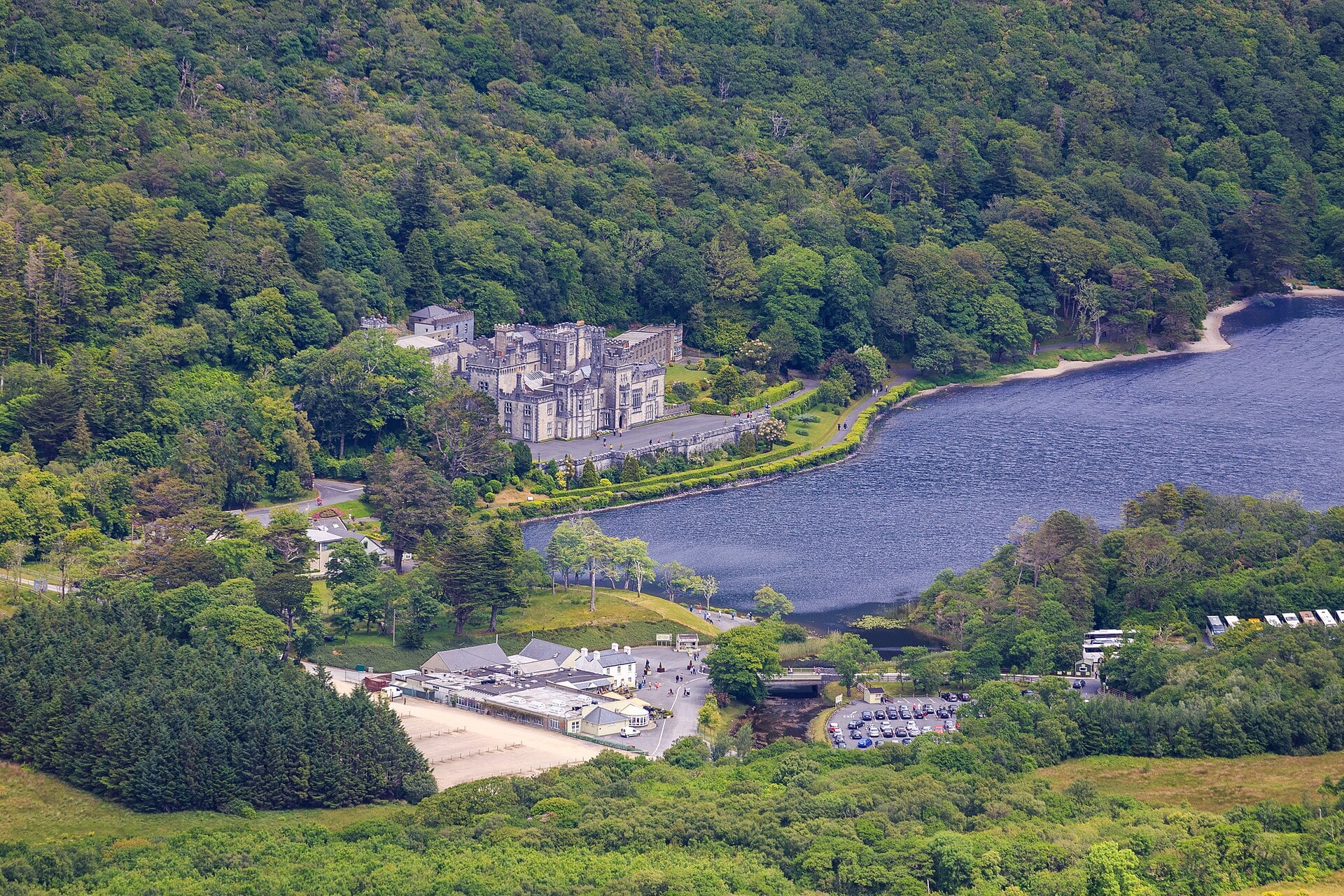
Standing on the shore of Lough Pollacapall, with dark Connemara mountains rising behind it, Kylemore Abbey looks like it belongs to another century. The grey stone turrets, the arching windows, the perfect reflection in still water — it has the air of something ancient and inevitable. It wasn’t. It was built by one man, for one woman, in a rush of love that ended in grief.
The man who moved a mountain
Mitchell Henry was a Manchester surgeon turned Member of Parliament. When he married Margaret Vaughan in the early 1850s, the couple spent their honeymoon travelling through Connemara. Margaret was captivated by the landscape — the vast sky, the dark lakes, the silence that went on for miles.
Mitchell never forgot that moment. When his wealth allowed it, he bought more than 9,000 acres of wild Connemara land and began building the most extraordinary gift he could imagine: a castle on the lake’s edge, designed entirely around the woman he loved.
Construction began in the late 1860s. He employed hundreds of local workers and built not just the castle, but an entire working estate — a farm, glasshouses filled with exotic plants, a model village for workers’ families, and a walled garden that would become one of the finest in Ireland. Mitchell wanted Kylemore to be a whole world for Margaret. For a while, it was.
The chapel built for grief
Margaret moved in and thrived. She raised nine children at Kylemore, oversaw the gardens, and became a fixture in local life. Mitchell divided his time between the estate and his political work, returning always to the place his wife had made home.
Then, in the mid-1870s, Margaret died suddenly while the family was travelling in Egypt. She was in her mid-forties.
Mitchell was devastated. He commissioned a small Gothic church to be built on the grounds — not as a parish church, but as a private memorial to Margaret. That church, with its soaring vaulted stone ceiling, carved pillars, and delicate stained glass, is still considered one of the most beautiful small churches in the country.
He had Margaret buried in a mausoleum on the estate, with their daughter Geraldine beside her. The castle he had built as a celebration of love became a monument to its loss.
☘️ Enjoying this? 64,000+ Ireland lovers get stories like this every week. Subscribe free →
When the nuns arrived
Mitchell eventually sold Kylemore and left Connemara for good. He could not stay in a place built so entirely around someone who was no longer there. The estate passed through several hands over the following decades.
Then, in 1920, it found its next community.
A group of Benedictine nuns from Ypres in Belgium had been forced to flee during the First World War, when their centuries-old abbey was destroyed by bombardment. After years in exile, moving between temporary homes, they came to Ireland and found Kylemore available for purchase.
They recognised it immediately as a place where something sacred had once lived. They bought the castle, established a school for girls, and set about turning Kylemore into a working abbey. Their presence — quiet, steady, purposeful — gave the estate a second life that Mitchell Henry could never have imagined.
The school welcomed generations of students before closing in 2010. A small community of Benedictine nuns still lives at Kylemore today, continuing the contemplative life that has defined the abbey for over a century.
The Victorian walled garden
One of Kylemore’s hidden treasures is the Victorian Walled Garden — six acres that Mitchell created alongside the castle in the 1860s.
The original garden included a kitchen section for fruit and vegetables, ornamental flower beds, a fernery, and the head gardener’s cottage. When the nuns took over, they had more pressing concerns than maintaining a grand garden, and it fell gradually into ruin over the following decades.
In the 1990s, a major restoration project brought it back to life. Teams worked from old photographs and original planting records to rebuild the beds and structures as closely as possible to Mitchell’s original design. Today the walled garden is one of the most atmospheric places in the west of Ireland, and particularly beautiful from late spring through summer.
Planning your visit to Kylemore Abbey
Kylemore Abbey sits near the village of Letterfrack in the heart of Connemara, on the N59 between Clifden and Westport. A full visit covers the abbey grounds, the Gothic memorial church, and the walled garden. There is a lakeside café, a craft shop selling Kylemore pottery and preserves made by the nuns, and several walking paths around the lough.
For those without a car, day trips from Galway city typically combine Kylemore with Connemara National Park and the Twelve Bens mountain range — a full day in one of Europe’s most dramatic landscapes.
If you are planning a broader trip, our complete guide to County Galway and Connemara covers driving routes, the best places to stay, and everything else worth seeing in the region. You can also use our free Ireland travel planner to build your full itinerary.
Mitchell Henry spent years trying to fill the Connemara hills with something worthy of the woman he loved. He built the chapel, the garden, the glasshouses — an entire world. And then she was gone.
What he left behind is still here. Still reflected in the still water of Lough Pollacapall. Still drawing visitors from across the world who feel, without quite knowing why, that something real happened here — and that it still matters.
☘️ Join 64,000+ Ireland Lovers
Every Friday, get Ireland’s hidden gems, local secrets, and travel inspiration — the kind you won’t find in any guidebook.
Subscribe free — enter your email:
Already subscribed?
Thinking about it seriously?
If you’ve started actually planning a move, our complete the full Move to Ireland guide walks through every step, every cost, and the paperwork that catches most people out.
Free forever · One email per week · Unsubscribe anytime
Tours & experiences you might love


Powered by Viator. Some links are affiliate links — we may earn a small commission at no extra cost to you.
Secure Your Dream Irish Experience Before It’s Gone!
Planning a trip to Ireland? Don’t let sold-out tours or packed attractions spoil your journey. Iconic experiences like visiting the Cliffs of Moher, exploring the Rock of Cashel, or enjoying a guided walk through Ireland’s ancient past often sell out quickly—especially during peak travel seasons.

Booking in advance guarantees your place and ensures you can fully immerse yourself in the rich culture and breathtaking scenery without stress or disappointment. You’ll also free up time to explore Ireland’s hidden gems and savour those authentic moments that make your trip truly special.
Make the most of your journey—start planning today and secure those must-do experiences before they’re gone!