

County Galway is the place where Ireland decides to show off. It has the most celebrated city on the Wild Atlantic Way, a landscape — Connemara — that painters have been trying to capture for centuries without ever quite managing it, a chain of islands where people still live as their ancestors did for two thousand years, and a bay famous for oysters, a castle on the water’s edge, and swans that seem to know they own the place. Galway is difficult to summarise because it contains so many Irelands at once.
It is the second largest county in Ireland by area — 5,940 square kilometres — and the most linguistically diverse, with the largest continuous Irish-speaking community (the Connemara Gaeltacht) in the country. In Galway city’s pubs on a Tuesday night in November you will hear live trad music. In Connemara, the signposts are in Irish first. On Inis Mór, the largest of the Aran Islands, the past is not past — it is simply geology. Galway asks you to go slow, and it rewards you when you do.
Galway City: The Heart of the West
Galway city is the beating cultural heart of the west of Ireland, and it has been since the Normans founded it in the thirteenth century. The narrow, pastel-painted streets of the Latin Quarter fill with music every evening — not for the tourists (though the tourists arrive in force) but because this is simply how Galway works. Buskers on Shop Street give way to sessions in Tigh Coilí, Monroe’s, or Tig Cóilí. The atmosphere is unlike anywhere else in Ireland: young, confident, cosmopolitan, and yet deeply rooted in Irish tradition.
The Spanish Arch, on the west bank of the Corrib where it meets Galway Bay, is one of the city’s oldest remaining structures — a remnant of the medieval walls, where Spanish wine merchants once unloaded their cargo. Today it looks out onto a riverside promenade where, on a fine evening in summer, half of Galway seems to gather. The cathedral, finished in 1965 and the last great cathedral built in Ireland, sits across the river — Romanesque in style, enormous, and strangely moving inside for something so recently built.
Galway’s food scene punches well above the city’s size of 80,000 people. The Saturday morning market beside St Nicholas’s Collegiate Church is a feast: local cheeses, sourdough bread, smoked fish from Connemara, and crêpes that have been feeding students and tourists alike for decades. And in September, the Galway International Oyster and Seafood Festival brings the bay’s most famous product to the centre of the city — native Galway oysters, ice-cold, with a glass of Guinness. The combination is not negotiable.
Connemara: Where the Landscape Does the Talking
Connemara is not a county, not a parish, not a precise geographical entity — it is more of a state of mind. Roughly speaking, it covers the area west of Galway city and north of the bay: a vast, boggy, mountain-backed landscape of extraordinary beauty and melancholy. The Twelve Bens mountain range rises abruptly from the flat bog. Loughs scatter across the terrain like dropped mirrors. The Atlantic arrives at small beaches of white sand and impossibly turquoise water that looks more Caribbean than Irish — until the wind arrives, at which point there is no confusion at all.
Clifden is Connemara’s capital, a small market town with good restaurants and a September Arts Festival that draws artists from across Ireland. But Connemara rewards wandering off the main roads: the Sky Road out of Clifden, with its views of Clifden Bay and the Atlantic beyond; Roundstone, a harbour village where traditional Bodhrán drums are still made by hand; Kylemore Abbey, a Victorian castle-turned-Benedictine monastery reflected in its own lake at the foot of a mountain.
The Connemara Gaeltacht is one of the last places where Irish is genuinely the community’s first language. You will hear it in the shops, on the roads, and in the pubs. TG4, Ireland’s Irish-language television channel, is based at Baile na hAbhann nearby. The language here is not a heritage performance — it is simply how people talk.
The Aran Islands: Three Islands at the Edge of Time
Twelve kilometres off the Galway coast, three islands rise from the Atlantic: Inis Mór, Inis Meáin, and Inis Oírr. All three are Irish-speaking. All three contain some of the oldest human structures in Ireland. And all three manage to feel, even in summer, as if the modern world is a rumour that hasn’t quite arrived yet.
Inis Mór is the largest and most visited, home to Dún Aonghasa — a Bronze Age stone fort perched on the edge of a 100-metre cliff above the Atlantic. You can walk to the very edge and look straight down. The drop is unprotected. The effect is profound. The fort was built perhaps three thousand years ago by people we know almost nothing about, which makes standing inside its walls one of the more humbling experiences Ireland offers.
Ferries run from Rossaveel (west of Galway city) and a fast ferry from Galway city docks. Day trips are possible, but a night on any of the islands — particularly Inis Meáin, where the limestone landscape is otherworldly and the accommodation exceptional — is worth the extra planning.
Dunguaire Castle and the Clare-Galway Border
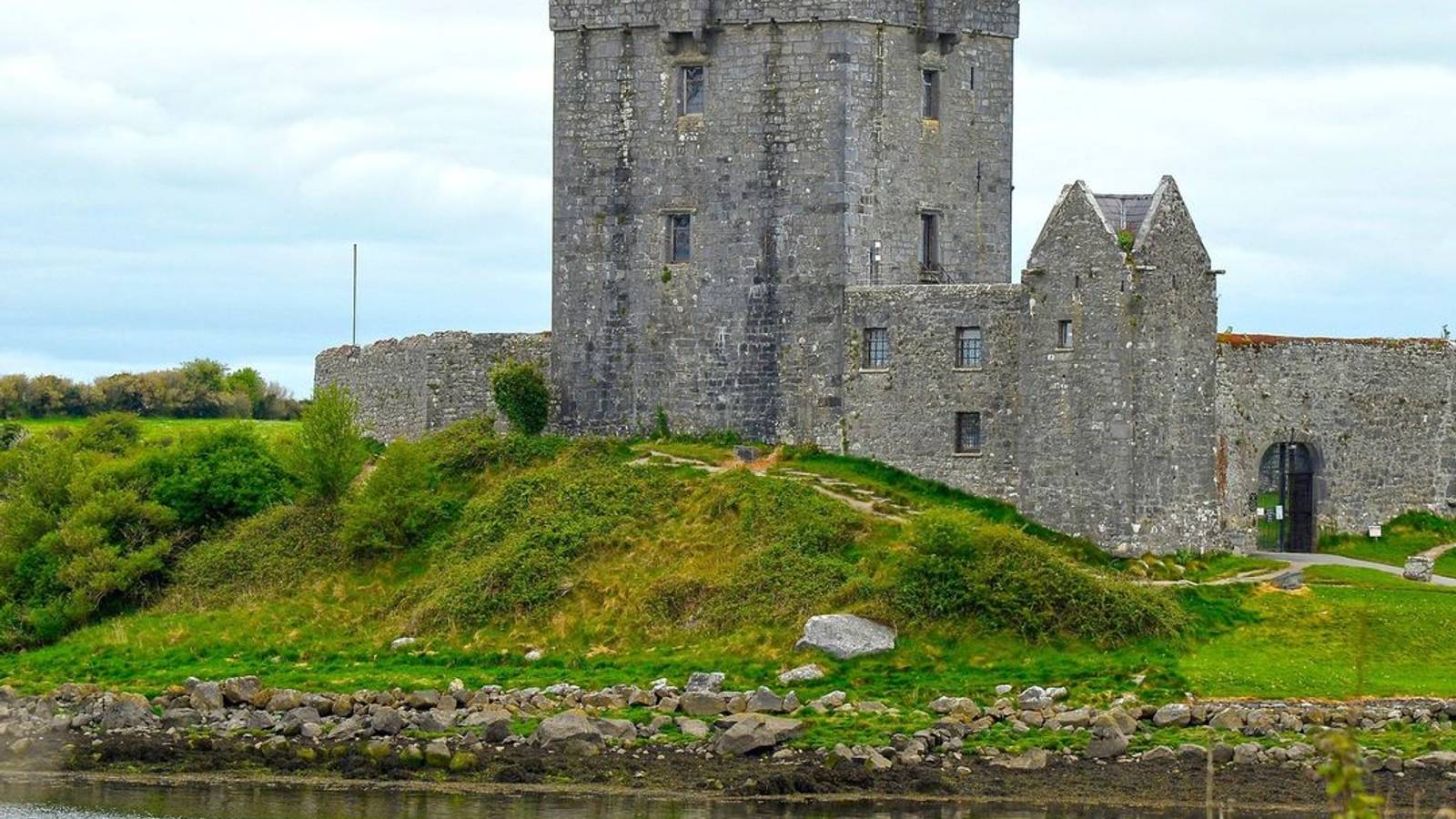
On the shores of Galway Bay near Kinvara, Dunguaire Castle rises from the water on its own small headland — a sixteenth-century tower house that appears in an extraordinary number of Ireland photographs without most people knowing its name. It is one of the most photogenic castles in Ireland, particularly at dusk when the light catches the stone and the water stills. Medieval banquets are held inside in summer. The surrounding Burren landscape, which spills across the border into County Clare, is one of the most unusual ecosystems in Europe.
Planning Your Visit to County Galway
Galway city deserves at least two nights — one to get orientated, one to stay out later than you planned. Connemara adds two or three more days easily. The Aran Islands warrant at least one overnight if you can manage it. A week in Galway barely scratches the surface.
The Galway Arts Festival in July and the Oyster Festival in September are the city’s biggest events — both excellent, both very busy. Outside those weeks, May, June, and early October offer good weather odds with significantly smaller crowds. The Connemara roads in shoulder season have a quality to them — light on vehicles, dramatic skies, soft colours — that makes driving feel like a privilege.
☘️ Planning a Trip to Ireland?
Our Free Ireland Travel Planner 2026 covers every county — from Galway’s Wild Atlantic Way to Connemara’s hidden beaches — with week-by-week weather guides, festival calendars, and insider tips.
Galway’s Hidden Corners
Lettermore and the islands connected by causeway south of Galway city are known to almost nobody outside Connemara. The Gaeltacht villages here have a quiet intensity — boats pulled up on rocky shores, grey stone walls dividing tiny fields that slope into the sea, and the sound of Irish carried on the wind. Lough Corrib, the second largest lake in Ireland, divides east and west Galway and offers exceptional fishing, particularly for wild brown trout in season. And Athenry — the source of the famous song — is a small medieval town with the most complete town walls surviving in Ireland. It is easy to visit, easy to underestimate, and worth an afternoon entirely.
☘️ Get Ireland Stories in Your Inbox
Join over 64,000 Ireland lovers who receive our free daily newsletter — hidden gems, heritage stories, and travel inspiration, every morning.
Tours & experiences you might love


Powered by Viator. Some links are affiliate links — we may earn a small commission at no extra cost to you.
Secure Your Dream Irish Experience Before It’s Gone!
Planning a trip to Ireland? Don’t let sold-out tours or packed attractions spoil your journey. Iconic experiences like visiting the Cliffs of Moher, exploring the Rock of Cashel, or enjoying a guided walk through Ireland’s ancient past often sell out quickly—especially during peak travel seasons.

Booking in advance guarantees your place and ensures you can fully immerse yourself in the rich culture and breathtaking scenery without stress or disappointment. You’ll also free up time to explore Ireland’s hidden gems and savour those authentic moments that make your trip truly special.
Make the most of your journey—start planning today and secure those must-do experiences before they’re gone!