

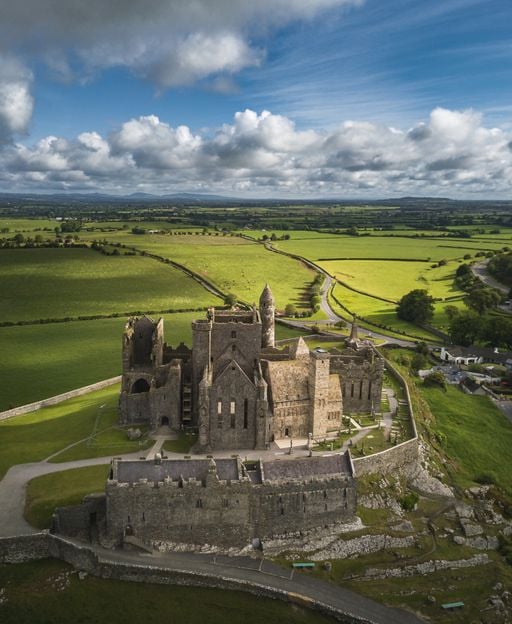
The Rock of Cashel stands on a limestone outcrop rising 60 metres above the Tipperary plain, and for three centuries it was the seat of Ireland’s Munster kings — the dynasty that produced Brian Boru, the man who reunited Ireland and ended the Viking military threat forever. On 23 April 1014, Brian’s armies won the Battle of Clontarf in the most dramatic fashion imaginable. Over 7,000 men died on the beach. The Viking-Leinster coalition collapsed. Ireland was free. But Brian Boru, 73 years old and praying in a tent near the battlefield, was already dead — killed by a fleeing Viking soldier moments after his armies won.
It is one of the great ironies of Irish history. The man who spent forty years uniting Ireland, defying the Norse settlements, and building a kingdom from Munster to Ulster died on the very day of his greatest triumph — without ever knowing it. The Rock of Cashel is where his story began. This is where it ended.
What Is the Rock of Cashel?
The Rock of Cashel — known in Irish as Carraig Phádraig, meaning Patrick’s Rock — is a natural limestone outcrop that rises dramatically from the Golden Vale in County Tipperary. For at least three centuries before the Norman invasion, it served as the seat of the Munster kings, the ancient rulers of Ireland’s southern province.
The complex visible today includes Cormac’s Chapel (consecrated 1134), a 12th-century round tower, a Gothic cathedral, and the Hall of the Vicars Choral. These structures postdate Brian Boru’s time. But the rock itself — the hill, the site, the position of power — was already ancient when he ruled from it in the late 10th century.
Adult entry costs €8, with reduced rates for students and seniors. The site is managed by Heritage Ireland and opens year-round, with extended hours from April to October.
Who Was Brian Boru?
Brian mac Cennétig was born around 941 CE in Killaloe, County Clare, on the banks of the River Shannon. He came from the Dal Cais, a Munster dynasty that had spent generations in the shadow of more powerful kingdoms. Nobody expected much from them.
Brian’s life changed when Viking raiders killed his father and brother while he was still a teenager. He and a small band of survivors waged a guerrilla war against Norse settlements in Munster. For years, they raided Viking supply lines, attacked Norse camps at night, and lived off the land in the forests of Clare. Brian learned early that patience and strategy beat brute force.
By 976 CE, Brian was King of Munster — and with it, lord of the Rock of Cashel. He ruled from Kincora at Killaloe for campaigns and administration, but Cashel represented his lineage’s claim to Munster’s ancient kingship. By 1002 CE, he had achieved something no Irish king had managed in centuries: the other kings of Ireland acknowledged him as High King.
He called himself Imperator Scottorum — Emperor of the Irish. He had that title inscribed in the Book of Armagh. For a boy who had once been a guerrilla fighter hiding in Clare’s forests, it was an extraordinary transformation.
How the Vikings Had Changed Ireland
The first Viking raid on Ireland struck Rathlin Island in 795 CE — more than 200 years before Clontarf. Within decades, Norse settlers had established fortified harbours around the entire coastline.
Dublin, called Dyflin by the Norse, became one of the largest Viking trading cities in Western Europe. By the 10th century, Limerick, Waterford, Wexford, and Cork were also Norse settlements. The Vikings brought silver coins, international trade, and advanced shipbuilding. They also brought raids on monasteries, the destruction of ancient libraries, and constant pressure on Irish kingdoms.
For two centuries, Irish kings fought each other almost as much as they fought the Vikings. The Norse exploited every division. Brian Boru understood that a united Ireland could not only resist Viking power but could absorb it — trading with Norse settlers, intermarrying with their families, and eventually making them Irish. He had largely achieved that vision by the time Clontarf arrived. But not everyone accepted his authority.
The Alliance That Would Challenge Brian
Brian’s grip on Ireland was always contested. The kings of Leinster resented paying tribute to a Munster man. The Norse kings of Dublin — Christian by now, but powerful in their own right — watched Brian’s expansion with growing alarm.
In 1013, Máel Mórda mac Murchada, King of Leinster, broke openly with Brian and allied with Sigtrygg Silkbeard, the Viking King of Dublin. Sigtrygg sent envoys to Scandinavia, Orkney, and the Isle of Man, recruiting mercenary warlords with the promise of land and power.
Sigurd the Stout, Earl of Orkney, agreed to come. So did Brodir of Man, a feared commander with a fleet of around 1,000 men. Both were promised the High Kingship of Ireland if Brian fell.
Brian mustered his forces from Munster, Connacht, and the midlands. He was 73 years old and wise enough not to lead the charge himself. That role went to his son Murchad, a formidable warrior who had spent his life in his father’s campaigns.
To plan a journey through the landscapes where this story unfolded, our Ireland travel planning guide covers the best routes from Cashel through the ancient kingdoms of Munster and on to Dublin.
Good Friday, 1014: The Battle of Clontarf
Brian Boru chose not to fight on Good Friday. As a deeply devout Christian who had funded monasteries, commissioned translations of sacred texts, and built churches across Munster, he considered it a day for prayer alone.
He set up his tent on the shore near the mouth of the Tolka river, north of Dublin, attended by a small personal bodyguard and his priests. From that position, he could hear the sounds of the battle. He would not see it.
Murchad and Brian’s generals deployed approximately 20,000 men along the coastline of Clontarf. The Viking-Leinster force numbered similarly. The battlefield stretched across roughly 3 kilometres of shoreline.
The fighting began at dawn and lasted until the tide came in at dusk — nearly twelve hours of close combat with swords, battle axes, and spears. By any measure, it was one of the largest and bloodiest battles ever fought on Irish soil.
How the Battle Unfolded
By mid-afternoon, the Viking-Leinster coalition was breaking. Sigurd the Stout was dead, killed in the fighting. Máel Mórda, King of Leinster, was also dead. Brian’s son Murchad had personally killed dozens of men before taking a mortal wound himself.
As the tide came in, the retreating Vikings found their escape cut off. Many drowned trying to reach their ships. The Norse force that had seemed unstoppable that morning had collapsed entirely by evening.
Brian’s armies had won. Decisively. The Viking military threat to Irish kingship was finished.
☘️ Enjoying this? 64,000+ Ireland lovers get stories like this every week. Subscribe free →
The Death of Brian Boru
Brodir of Man fled into the woods as the battle around him collapsed. He had lost most of his men. The day was over. He ran for his ships.
Somehow, through the chaos of a retreating army and thousands of men streaming in every direction, Brodir found Brian’s tent. The bodyguard was minimal. The battle had drawn men away. Brian knelt in prayer inside.
Brodir burst in and killed him with an axe.
Irish sources record that Brodir cried out, “Let men know that Brodir felled Brian.” He wanted his name attached to the deed. He wanted to be remembered as the man who killed the High King of Ireland.
He was caught within minutes. The accounts of what happened to Brodir after capture differ between sources. What every account agrees on is that he did not survive the day.
Brian Boru’s body was transported under guard to Armagh, over 160 kilometres from Clontarf. The monks of Armagh prayed over him for twelve days. He was buried at St Patrick’s Cathedral — in the city that had served as the spiritual capital of Ireland since the 5th century.
Why Clontarf Changed Ireland Forever
Clontarf did not end the Norse presence in Ireland. Dublin remained a Viking-influenced city for another century, and Norse words, place names, and trade practices persisted across Irish coastal communities.
But Clontarf ended organised Scandinavian military ambition in Ireland. No Scandinavian ruler ever again mounted a credible campaign to control Irish kingdoms. The alliance of Orkney, Man, and Dublin that had threatened Brian’s heirs never reformed.
Brian’s dynasty, the Uí Briain, remained among the most powerful families in Ireland for centuries after him. His surname spread across Clare, Limerick, and Tipperary through his descendants. Through emigration during the Great Famine and beyond, O’Brien became one of the most common Irish surnames in the United States, Australia, and Britain. Millions of people today carry his family name — most without knowing the story behind it, including the O’Briens for whom O’Brien’s Tower at the Cliffs of Moher is named.
Visiting the Rock of Cashel and Brian Boru’s Ireland
Brian Boru left a physical legacy across Ireland. These three sites connect most directly to his life and the events of 1014.
Rock of Cashel, County Tipperary
The Rock of Cashel was the traditional seat of the Munster kings and the symbolic home of Brian Boru’s dynasty. Cormac’s Chapel (built 1127–1134) is one of the finest examples of Romanesque architecture in Ireland, built just a century after Brian’s death by his descendants. The Round Tower, standing over 28 metres tall, dates from the same era. Adult entry costs €8. Visit Heritage Ireland for current opening times and seasonal events.
Killaloe, County Clare
Killaloe was Brian Boru’s home territory. His royal seat at Kincora stood here, overlooking the Shannon at the point where Lough Derg narrows. The Brian Boru Heritage Centre, which once told the story of his rise from guerrilla fighter to High King, has closed permanently — but walking the riverside still gives a clear sense of the landscape he knew from childhood.
Clontarf, Dublin
The battle site is now a quiet coastal suburb north of Dublin city centre. A walk along Clontarf Road follows roughly the ground where the fighting took place on 23 April 1014. The name comes from the Irish Cluain Tarbh — the meadow of the bull. There is no large monument, but the shoreline still carries the weight of what happened there a thousand years ago. Nearby stands Clontarf Castle — the current building dates to 1837, but a castle has stood on the site since the 12th century, close to where the battle was fought.
To plan a journey through Brian Boru’s Ireland — from Cashel to Killaloe to Dublin — our free 7-day road trip itinerary connects these sites in a single circular route through the ancient kingdoms of Munster.
Frequently Asked Questions About the Rock of Cashel and Brian Boru
What is the Rock of Cashel and why is it important?
The Rock of Cashel is a natural limestone outcrop in County Tipperary, standing 60 metres above the surrounding plain. It served as the seat of the Munster kings for at least three centuries, including Brian Boru, who became High King of all Ireland in 1002 CE. Today it holds some of Ireland’s finest medieval architecture, including Cormac’s Chapel (1134), a 12th-century round tower, and a Gothic cathedral. Adult entry costs €8.
What happened at the Battle of Clontarf in 1014?
On 23 April 1014, Brian Boru’s forces defeated a coalition of Vikings from Orkney, the Isle of Man, and Norse Dublin, allied with the King of Leinster. The battle lasted approximately twelve hours along the shores of Dublin Bay. Brian’s armies won decisively, with over 7,000 men killed in total, ending organised Scandinavian military campaigns against Irish kingdoms — though Brian himself died in his prayer tent shortly before anyone could reach him with the news.
Why did Brian Boru not fight in the Battle of Clontarf?
Brian Boru refused to fight because the battle fell on Good Friday. As a devout Christian, he considered it wrong to wage war on that day. He remained in a prayer tent near the shoreline while his son Murchad commanded the Irish forces. This decision left him vulnerable — a fleeing Viking named Brodir found his tent after the battle was won and killed him there.
How do I get to the Rock of Cashel from Dublin?
The Rock of Cashel is approximately 160 kilometres south-west of Dublin, making it a comfortable two-hour drive via the M8 motorway. It is also reachable by Bus Éireann from Dublin’s Busáras station, with services running to Cashel town. The rock itself is a short walk from the town centre. Most visitors combine it with a stop in Kilkenny or the Tipperary Heritage Way.
☘️ Join 64,000+ Ireland Lovers
Every weekday morning, get Ireland’s hidden gems, local secrets, and travel inspiration — the kind you won’t find in any guidebook.
Subscribe free — enter your email:
Already subscribed?
Thinking about it for retirement?
If you’ve started thinking seriously about retiring there, our complete our full Retire in Ireland guide covers the visa, healthcare, cost-of-living, and the regions worth shortlisting.
Get the free guide
Enter your email and we will send you straight to the download.
📲 Know someone who’d love this? Share on WhatsApp →
Love more? Join 43,000 Scotland lovers → · Join 29,000 Italy lovers → · Join 7,000 France lovers →
Free forever · Unsubscribe anytime
Tours & experiences you might love


Powered by Viator. Some links are affiliate links — we may earn a small commission at no extra cost to you.
Secure Your Dream Irish Experience Before It’s Gone!
Planning a trip to Ireland? Don’t let sold-out tours or packed attractions spoil your journey. Iconic experiences like visiting the Cliffs of Moher, exploring the Rock of Cashel, or enjoying a guided walk through Ireland’s ancient past often sell out quickly—especially during peak travel seasons.

Booking in advance guarantees your place and ensures you can fully immerse yourself in the rich culture and breathtaking scenery without stress or disappointment. You’ll also free up time to explore Ireland’s hidden gems and savour those authentic moments that make your trip truly special.
Make the most of your journey—start planning today and secure those must-do experiences before they’re gone!
Subscribe Free