

Every year, around one million people make their way to the base of Croagh Patrick in County Mayo. Some come for the spiritual connection — this is Ireland’s holiest mountain, where Saint Patrick is said to have fasted for 40 days in 441 AD. Others come for the climb, the views, and the satisfaction of reaching a summit that has drawn people for more than 5,000 years. Whatever your reason, Croagh Patrick is a serious mountain that deserves serious preparation.
This guide covers the history, the route, and the practical details you need to make the most of a visit.
The History Behind the Mountain
Croagh Patrick, known in Irish as Cruach Phádraig, rises 764 metres (2,507 feet) above Clew Bay on the west coast of Ireland. It is named after Ireland’s patron saint, though the mountain was considered sacred long before Christianity arrived on the island.
Archaeological evidence shows that people gathered on Croagh Patrick as far back as 3000 BC, during the Neolithic period. The site may have been used for solar observations — the summit aligns with the setting sun during the weeks around Lughnasa, an ancient Celtic harvest festival held at the start of August.
Saint Patrick’s connection to the mountain dates from the fifth century. According to tradition, he climbed to the summit in 441 AD and spent 40 days fasting and praying there. He is said to have rung his bell and driven all the snakes out of Ireland from the top — a symbolic story, since there were likely never snakes in Ireland after the last Ice Age. The tradition of pilgrimage to the summit has continued without interruption since those early Christian centuries.
Today, a small white chapel sits at the summit. It was built in 1905 and holds around 30 people. Mass is said at the chapel throughout the year, and the structure is visible from miles away on a clear day.
Want more stories about Ireland’s sacred sites and hidden history? Subscribe to our free weekly newsletter: loveireland.substack.com/subscribe
The Pilgrimage Tradition
The major pilgrimage day on Croagh Patrick is Reek Sunday, which falls on the last Sunday of July. In recent years, around 25,000 to 30,000 people have climbed the mountain on that single day, making it one of the largest outdoor religious gatherings in Europe.
Traditionally, many pilgrims climbed barefoot — a practice still observed by some visitors today. This is entirely a personal choice, but the rocky upper section of the mountain makes it a genuinely demanding one. Walking poles and proper footwear are far more practical for most people.
On Reek Sunday, there are guided Mass services at the summit, and the path is busy from early morning. If you want a quieter experience, mid-week visits in spring or autumn offer the same views with far fewer crowds.
What the Climb Involves
The standard route begins at the village of Murrisk, roughly 8 kilometres west of Westport on the R335 road. There is a car park at the trailhead, staffed by volunteers on busy days.
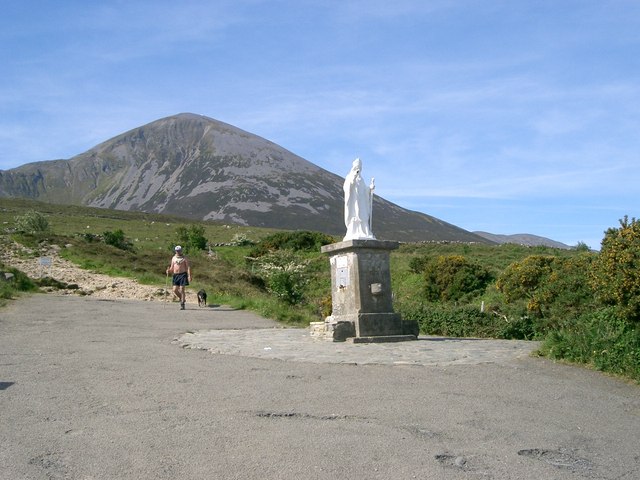
The path starts gently. From the car park, a well-maintained gravel track climbs through lower ground, passing a bronze statue of Saint Patrick near the base of the mountain. This section takes around 30 to 45 minutes at a steady pace.
The middle section steepens considerably. This stretch covers the main shoulder of the mountain and can be boggy in wet weather. A wooden boardwalk helps in places, but expect soft ground after rain.
The upper section — the cone — is the hardest part. It is made of loose quartzite scree, and the path rises steeply to the summit. Trekking poles are highly recommended here. The gradient eases only as you reach the summit plateau and the chapel.
- Total distance (round trip): approximately 7.5 kilometres
- Average time: 3 to 4 hours for a reasonably fit adult
- Summit elevation: 764 metres
The descent requires care. The loose scree on the upper cone is harder going down than up. Take your time, use poles if you have them, and step diagonally across the slope if conditions are slippery.
Discover more of Ireland’s great walking routes and what to expect on arrival. Sign up free at loveireland.substack.com/subscribe
Practical Tips for Visiting
What to wear: Waterproofs are essential, even in summer. West Mayo weather changes quickly, and the summit is significantly cooler and windier than the base. Wear sturdy, ankle-supporting hiking boots. Avoid trail runners unless you are an experienced hill walker — the scree demands grip and stability.
What to bring: Water (at least 1.5 litres), snacks, a map or downloaded offline route, and sun protection if the weather is clear. There is no café or water point on the mountain itself.
What footwear to avoid: Sandals, trainers, and wellies are all unsuitable for the upper section. Each year, mountain rescue is called out to assist people who have underestimated the terrain.
Trekking poles: Not mandatory but they make a meaningful difference, particularly on the descent. They can be hired from the Croagh Patrick visitor centre in Murrisk.
Dogs: Dogs are permitted on the mountain but should be kept on a lead at all times. The summit area is not suitable for dogs unused to exposed, rocky ground.
Accessibility: The lower gravel track is suitable for most visitors, but the upper mountain is inaccessible for wheelchairs and pushchairs.
The Best Time to Go
Croagh Patrick can be climbed year-round, but conditions vary significantly by season.
Late spring and summer (May–August): The most popular window. Long daylight hours give plenty of time for a comfortable ascent and descent. Reek Sunday in late July brings the largest crowds of the year, so plan accordingly if you want to visit on that day.
Autumn (September–October): Quieter than summer, with excellent visibility on clear days. The morning light during this period is particularly good for photography.
Winter (November–March): Possible for experienced hill walkers, but conditions can be severe. Ice and snow on the upper cone require crampons and full winter kit. This is not a beginner winter route.
The mountain is occasionally closed during severe weather. Check local conditions before setting out and never attempt the summit in lightning, high winds, or low visibility without appropriate experience.
Getting There
The nearest town is Westport, which is well-served by Bus Éireann from Dublin and Galway. Westport is approximately three hours from Dublin by road and around 1.5 hours from Galway.
From Westport, buses run to Murrisk during the summer season. Outside peak season, a taxi or car is the most practical option for reaching the trailhead. Murrisk itself has a car park, a visitor centre, and a café. It is also home to the National Famine Memorial — a striking bronze sculpture by John Behan depicting a coffin ship with skeletal figures in its rigging, worth seeing whether or not you are climbing.
There is a train service from Dublin Heuston to Westport, operated by Irish Rail, taking approximately 3.5 hours. This is one of the most scenic rail routes in Ireland, passing through the Midlands and into Connacht.
Before You Go
Croagh Patrick is not a technical climb, but it is a genuine mountain. The number of callouts to mountain rescue on the Reek each year is a reminder that preparation matters. Proper footwear, waterproofs, water, and a realistic assessment of your fitness level are all you need to have a safe and enjoyable day.
The views from the summit — across Clew Bay and its 365 islands, and west towards Achill — are worth every step. On a clear day, you can see as far as the Twelve Bens in Connemara and south to Clare Island.
Whether you come for the history, the spiritual tradition, the physical challenge, or simple curiosity about one of Ireland’s most iconic landmarks, Croagh Patrick delivers.
For more guides to Ireland’s best walks, heritage sites, and must-visit places, join thousands of readers at loveireland.substack.com/subscribe
Thinking about it seriously?
If you’ve started actually planning a move, our complete the full Move to Ireland guide walks through every step, every cost, and the paperwork that catches most people out.
Tours & experiences you might love


Powered by Viator. Some links are affiliate links — we may earn a small commission at no extra cost to you.
Secure Your Dream Irish Experience Before It’s Gone!
Planning a trip to Ireland? Don’t let sold-out tours or packed attractions spoil your journey. Iconic experiences like visiting the Cliffs of Moher, exploring the Rock of Cashel, or enjoying a guided walk through Ireland’s ancient past often sell out quickly—especially during peak travel seasons.

Booking in advance guarantees your place and ensures you can fully immerse yourself in the rich culture and breathtaking scenery without stress or disappointment. You’ll also free up time to explore Ireland’s hidden gems and savour those authentic moments that make your trip truly special.
Make the most of your journey—start planning today and secure those must-do experiences before they’re gone!
Subscribe Free