

Ireland has more options for a new start than most people realise. Whether you’re drawn to the buzz of a big city, the calm of the coast, or a small town that doesn’t appear on most tourist itineraries, there’s a version of Irish life that suits nearly every kind of person. But the choice matters — costs, job markets, transport, and community life vary a great deal between places.
Here’s a practical breakdown of Ireland’s main options, from the obvious to the overlooked.
Dublin: The Capital’s Upsides and Trade-Offs
Dublin is the obvious starting point for a reason. It’s home to Ireland’s largest job market, with a concentration of tech, finance, pharma, and public sector roles that dwarfs any other Irish city. If your priority is career opportunity — especially in international companies — Dublin is the most practical choice.
The downside is well known: housing costs. As of 2025, average monthly rent for a one-bedroom flat in Dublin city centre sits around €2,000. That’s not far off London or Amsterdam. If you’re willing to commute from neighbouring counties — Meath, Kildare, or Wicklow — you can bring that figure down, but travel times into the city can stretch to 90 minutes each way during peak hours.
On the upside, Dublin has an extensive cultural scene, genuine diversity, a thriving food culture, and some of the best live music in Europe. The city’s coastal setting — beaches at Dollymount, Portmarnock, and Killiney are within an hour — means it doesn’t feel entirely urban even when you’re in the thick of it.
Suits: Career-focused movers, those relocating from large cities, people who want maximum services and connectivity.
Thinking of making Ireland home? Sign up to our free newsletter for guides, insider tips, and local knowledge delivered straight to your inbox — subscribe here.
Galway: The Alternative That Keeps Growing
☘️ Your Irish family has a story waiting to be found.
Discover where your Irish ancestors came from — their county, their name, their story. Our free step-by-step guide walks you through every record, DNA tool, and ancestry archive. No experience needed.
Galway sits on the west coast and has developed a reputation as Ireland’s most liveable city — a claim that has some data behind it. It’s consistently ranked in the top tier of Irish cities for quality of life, combining a genuine arts and culture scene with a more relaxed pace than Dublin.
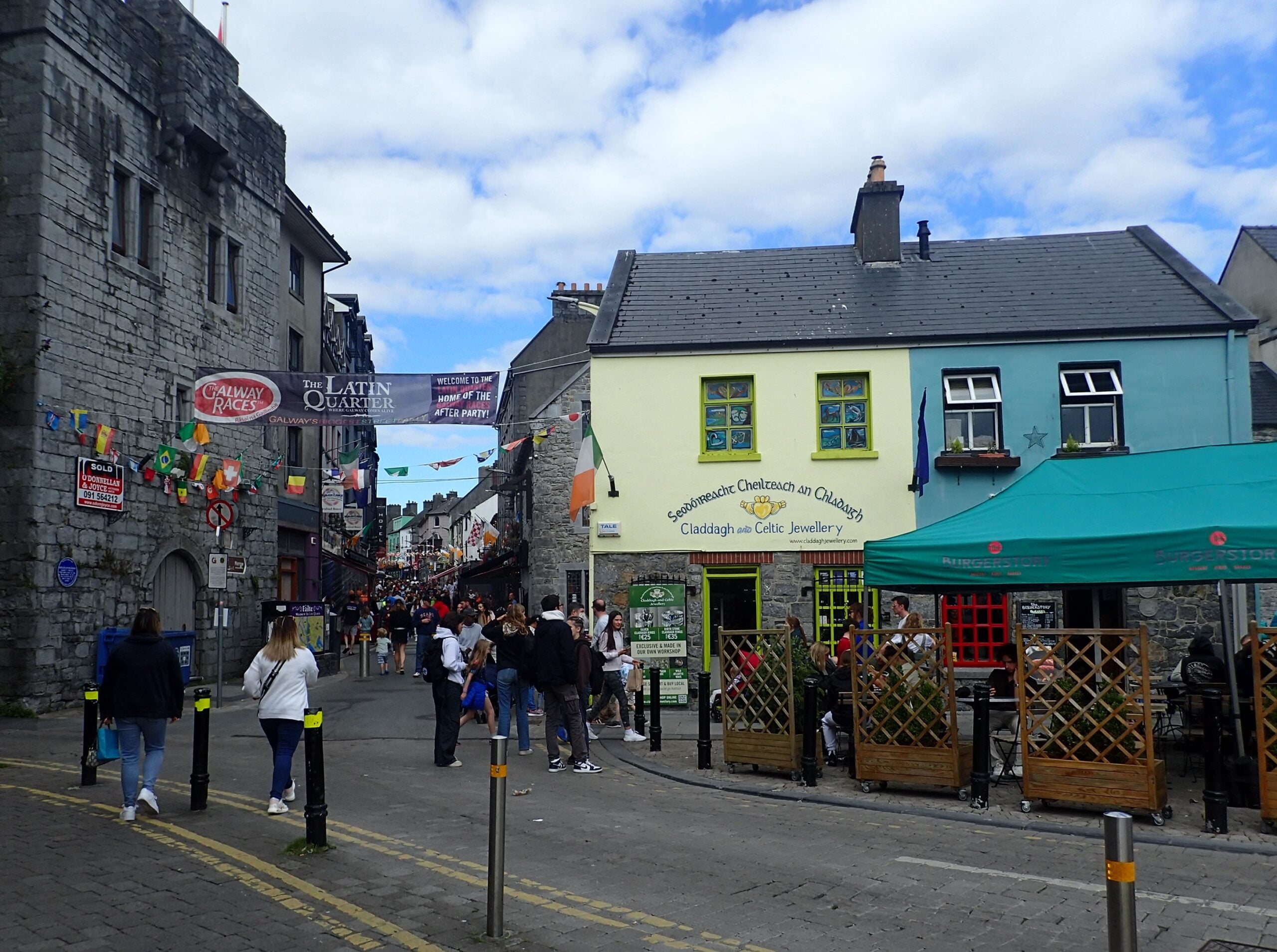
The city itself is compact. You can walk most of it in under 20 minutes. The Latin Quarter is the social hub, with a concentration of pubs, restaurants, and independent shops that punches well above its size. Salthill, just minutes from the centre, gives you sea views and a proper promenade along the bay.
Galway has also grown as an employment base, particularly in medtech, software, and tourism. It’s home to the University of Galway, which brings a consistent youthful energy and a strong research sector. However, it’s not Dublin — the job market is smaller, and certain industries have little to no presence here.
Housing in Galway has become expensive relative to wages, though it remains cheaper than Dublin. Expect to pay €1,400–€1,700 per month for a one-bedroom flat in or near the city centre.
Suits: Those who want city amenities without the Dublin scale, people drawn to the west of Ireland’s landscape, creatives and academics.
Cork: Ireland’s Second City, on Its Own Terms
Cork has a distinct identity — and Cork people are quick to tell you so. It’s Ireland’s second city, but it operates with an independence of spirit that makes it feel more self-contained than Dublin’s satellite towns.
The city benefits from a strong economy anchored by Apple’s European headquarters, several major pharmaceutical companies, and a growing tech cluster. Employment prospects are genuine, particularly in life sciences and IT. The Port of Cork also supports a sizeable logistics and maritime sector.
Cork’s food scene is well earned. The English Market is a working covered market, not a tourist attraction dressed up to look like one, and it reflects a genuine food culture that extends into the restaurants and cafés across the city. House prices in Cork are significantly lower than Dublin — you can rent a one-bedroom city-centre flat for around €1,400–€1,600 per month.
The city has decent public transport within its boundaries, though like much of Ireland, a car becomes useful once you move into the surrounding county.
Suits: Those who want a real city with genuine character, people working in pharma, tech, or food industries, anyone who finds Dublin’s pace too relentless.
Want more honest guides to living and visiting Ireland? Our newsletter covers the places that matter and the practical things worth knowing — subscribe here.
Somewhere Nobody’s Heard Of: The Case for Going Small
Not everyone wants a city, and Ireland rewards those willing to look beyond the obvious. Smaller towns and rural areas can offer a quality of life that’s simply not available in Cork, Galway, or Dublin — but they come with trade-offs worth thinking through honestly.
Westport, County Mayo has become a genuine success story. It’s a planned Georgian town with a marina, a busy main street, and a growing remote-working population. Property prices remain significantly lower than the cities, and the surrounding landscape — Clew Bay, Croagh Patrick, the Nephin mountains — is some of the finest in Ireland.
Kilkenny is a medieval city of around 27,000 people that punches well above its size. It has a strong arts scene, a walkable layout, and housing costs that compare very favourably with Dublin. It’s roughly 90 minutes to the capital by road, which makes it viable for hybrid workers who commute a few days a week.
Sligo is attracting a wave of remote workers and returning emigrants drawn by affordable housing, a genuine music and arts culture, and proximity to Benbulben and the Sligo coast. Broadband infrastructure has improved significantly across much of Connacht in recent years, making remote work far more practical than it once was.
Towns like Tralee, Kenmare, Carrick-on-Shannon, Athlone, and Tullamore don’t appear on most people’s Ireland radar but have real communities, practical amenities, and a pace that city life simply cannot replicate. Property in these areas can be a fraction of what you’d pay in Dublin or Galway for the same space.
The honest trade-off: smaller places offer fewer jobs (unless you work remotely), and healthcare, schooling, and transport links can be more limited. But if your career allows flexibility, the value proposition has shifted meaningfully since the pandemic changed where people can work from.
Suits: Remote workers, retirees, those returning to Ireland from abroad, anyone who wants space, community, and lower costs over urban convenience.
What Actually Decides the Choice?
Most people narrow it down to two factors: work and cost.
If your employer is office-based and located in Ireland, that will likely determine your city. If you work remotely, the whole country is genuinely open — and that’s not an empty phrase. Remote working has shifted the population distribution in many Irish counties, with places like Leitrim, Roscommon, and Clare attracting people who would previously have defaulted to Dublin simply because they had to.
Cost of living follows this pattern closely. Dublin is the most expensive by a significant margin. Galway and Cork sit in the middle. Smaller towns can be remarkably affordable by comparison — particularly for buying property, where the price difference between Dublin and rural Connacht remains dramatic. A three-bedroom home that costs €500,000 in Dublin 6 might be €180,000 in Roscommon town.
One thing that doesn’t vary much across Ireland: the sense of community. The social infrastructure in Irish towns — the GAA club, the local pub, the community events, the neighbours who actually introduce themselves — is remarkably consistent whether you’re in a Cork suburb or a Roscommon village. That’s not something you can put a number on, but it’s one of the most commonly cited reasons people say they’re glad they moved here.
Making the Decision
Ireland has something for every kind of new start. The city person who needs a career and a crowd will find it in Dublin or Cork. The person who wants space, sea air, and a slower pace will find it in Sligo or Kerry. The person who wants a bit of both has real options in Galway, Kilkenny, or Westport.
The question worth asking isn’t which place sounds best — it’s which place fits how you actually live. What do you need on a Tuesday morning? A short commute to an office, a fast broadband connection, a school run that doesn’t take an hour, or a walk to the beach? Your answer will tell you more than any list of rankings.
If you’re exploring a move to Ireland and want honest, local knowledge that goes beyond what appears in travel guides, our newsletter is a good place to start. We cover the places, the practicalities, and the stories that make Ireland make sense.
Subscribe to our free Ireland newsletter at loveireland.substack.com/subscribe — delivered straight to your inbox, no fuss.
☘️ Join 64,000+ Ireland Lovers
Every weekday morning, get Ireland’s hidden gems, local secrets, and travel inspiration — the kind you won’t find in any guidebook.
Subscribe free — enter your email:
Get the free guide
Enter your email and we will send you straight to the download.
📲 Know someone who’d love this? Share on WhatsApp →
Love more? Join 43,000 Scotland lovers → · Join 29,000 Italy lovers → · Join 7,000 France lovers →
Free forever · Unsubscribe anytime
Tours & experiences you might love


Powered by Viator. Some links are affiliate links — we may earn a small commission at no extra cost to you.
Secure Your Dream Irish Experience Before It’s Gone!
Planning a trip to Ireland? Don’t let sold-out tours or packed attractions spoil your journey. Iconic experiences like visiting the Cliffs of Moher, exploring the Rock of Cashel, or enjoying a guided walk through Ireland’s ancient past often sell out quickly—especially during peak travel seasons.

Booking in advance guarantees your place and ensures you can fully immerse yourself in the rich culture and breathtaking scenery without stress or disappointment. You’ll also free up time to explore Ireland’s hidden gems and savour those authentic moments that make your trip truly special.
Make the most of your journey—start planning today and secure those must-do experiences before they’re gone!