

Kilkenny sits in the south-east of Ireland, just over an hour by car from Dublin, or around 1 hour 40 minutes by bus. It is one of the best-preserved medieval cities in the country, and it rewards visitors who take the time to explore it properly. Known as the “Marble City” — a nickname earned from the black limestone quarried locally for centuries — Kilkenny has a character unlike anywhere else in Ireland.
If you have not been, or if you have only passed through on a day trip, this guide gives you a practical look at what makes Kilkenny worth your time.
Love Irish history and hidden gems?
We send a free weekly newsletter covering Ireland’s best towns, heritage sites, and travel stories — straight to your inbox. Subscribe free here.
A City Built on Medieval Foundations
Kilkenny’s recorded history stretches back to the 6th century, when St Canice founded a monastery on the hill now occupied by St Canice’s Cathedral. The town that grew around it became one of the most important settlements in medieval Ireland.
By the 13th century, Kilkenny was a centre of political and commercial power. The Statutes of Kilkenny — enacted in 1366 — were passed here, making the city a key administrative hub for the Anglo-Norman ruling class. You can still walk streets that were laid out in that era, passing buildings and churches that have stood for 700 years or more.
That medieval fabric is genuinely intact. Kilkenny is not a recreation or a heritage attraction built around a single old building. The city itself is the attraction — its alleyways, its walls, its castle, its cathedrals, its ancient pubs. Walk far enough in any direction from the centre and you will find something that connects to the past.
Kilkenny Castle: The Centrepiece of the City
Kilkenny Castle stands at the southern end of the High Street, overlooking the River Nore. It was first built around 1195 by William Marshal, one of the most powerful Anglo-Norman lords of his time, and it remained a major seat of power for the Butler family — one of Ireland’s most influential dynasties — for nearly 500 years.
The castle was handed over to the people of Kilkenny in 1967 for the symbolic sum of £50. It is now managed by the Office of Public Works and open to the public year-round.
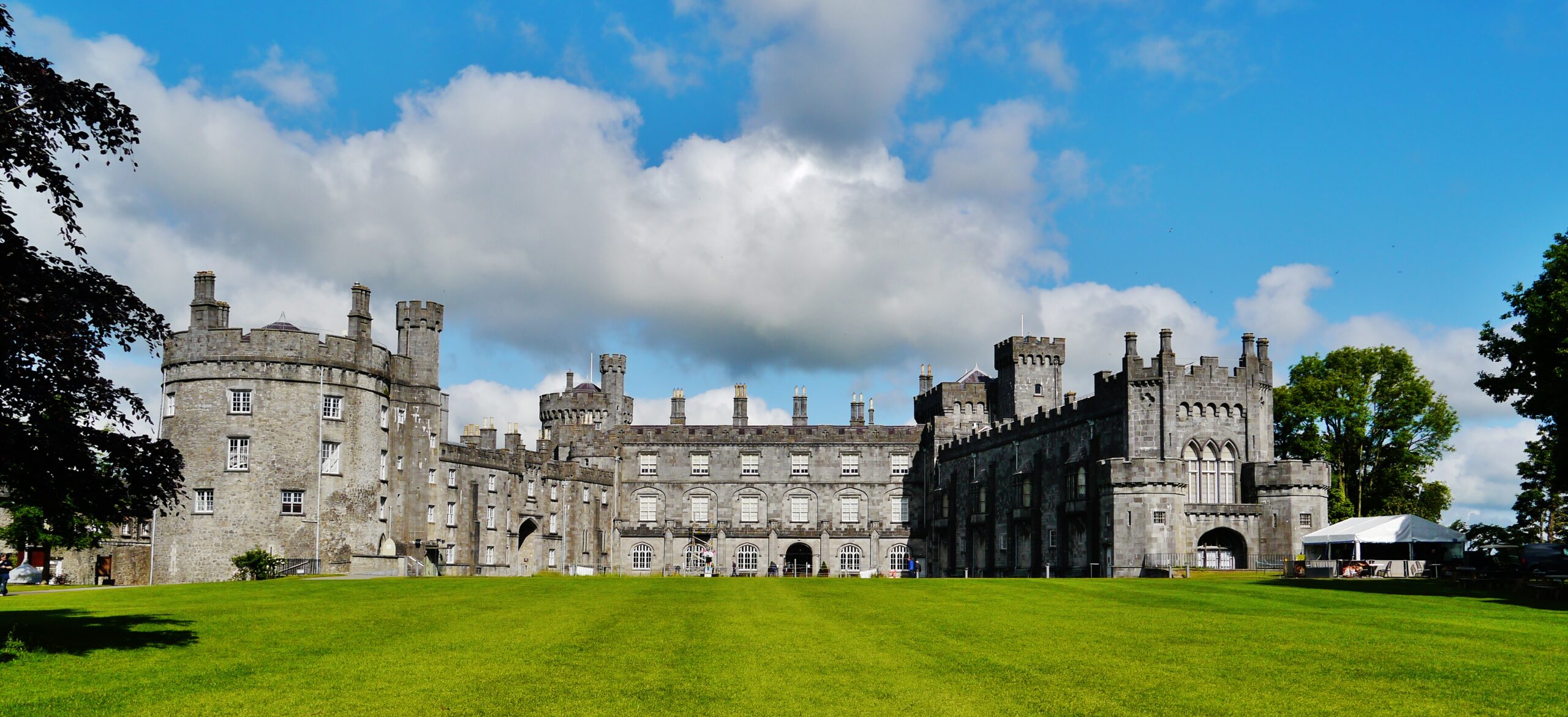
Inside, the Long Gallery is the highlight — a stunning room with a painted timber ceiling and a collection of Butler family portraits stretching back generations. The castle has been extensively restored, and the visitor experience is well-organised and informative.
The grounds include formal gardens and parkland open for free. The Rose Garden and the butler-era parkland give you space to walk and take in the castle from different angles. Entry to the castle is €8 for adults on a self-guided visit of the State Apartments (€12 for a guided tour), with discounted rates for seniors and students and free entry for children under 12 — check the Kilkenny Castle website for current pricing and opening hours before you visit.
St Canice’s Cathedral and the Round Tower
At the northern end of the city, St Canice’s Cathedral is one of the finest medieval churches in Ireland. The current building dates from the 13th century, built on the site of the original monastery. Inside, you will find an exceptional collection of medieval tomb sculptures — carved effigies of knights and noblemen that give a direct connection to the people who shaped this city.
Beside the cathedral stands a round tower dating from the 9th century. It is 30 metres tall, and for those willing to climb the internal ladder-like stairs, the view from the top across Kilkenny is worth every step. You can see the castle, the rooftops, the river, and the surrounding countryside.
The round tower is one of only two in Ireland that you can still climb. That alone makes it a practical reason to visit Kilkenny.
The Medieval Mile: Walking the City’s Core
The “Medieval Mile” is the stretch between the castle and St Canice’s Cathedral, running roughly along Parliament Street and High Street. It covers about a kilometre and passes through the heart of the old city.
Along the way, you will find the Medieval Mile Museum, which is housed inside the 13th-century St Mary’s Church — one of the best museum settings in Ireland. The exhibits trace the city’s history from its early medieval origins through to the modern era, with particular focus on the Black Death, the Butler dynasty, and the city’s commercial past.
Off the main streets, there are narrow laneways — called “slips” locally — that give the city its particular character. Butter Slip, off High Street, is the most famous: a narrow medieval passageway once used by butter sellers. These slips were the original back routes between the main streets, and several survive today.
Enjoying this? There’s more where it came from.
Every week we share stories, travel guides, and local discoveries from across Ireland — completely free. Join the Love Ireland newsletter here.
The Marble City’s Pubs and Food Scene
Kilkenny has one of the highest densities of pubs per head of population in Ireland. That is not just a statistic — it shapes the energy of the city, particularly in the evenings. The pub scene here is genuine. Many of the bars in the centre have been trading for over a century, and several occupy buildings that predate that by generations.
Kyteler’s Inn on St Kieran’s Street is one of the oldest surviving inns in Ireland, with origins in the 14th century. It is associated with Dame Alice Kyteler, Ireland’s first documented person accused of witchcraft. The story is grimly fascinating, and the building still operates as a pub and restaurant today.
Kilkenny is also home to the Smithwick’s Brewery, which has been producing ale in the city since 1710. While the original brewery is no longer active in the same location, the Smithwick’s Experience on Parliament Street offers tours and tastings — a worthwhile stop if you are interested in the history of Irish brewing.
The food scene has grown considerably in recent years. The city has a strong market culture — the Thursday Farmers’ Market at the castle car park is well worth a morning visit — and a number of independent restaurants that use local Kilkenny produce.
Kilkenny Arts Festival and the Cats Laughing Comedy Festival
Kilkenny hosts two of the most respected festivals in Ireland. The Kilkenny Arts Festival, held every August, has been running since 1974. It spans theatre, music, literature, and visual art, and it draws performers and audiences from across Ireland and beyond.
The Cat Laughs Comedy Festival — “the Cats” to locals — takes place in late May or early June each year. It is one of the premier comedy festivals in Europe, attracting international headliners to venues across the city. If you are planning a visit in the summer, checking the dates of both festivals is worth doing in advance, as accommodation fills up quickly.
The nickname “Cats” is also shorthand for Kilkenny itself and its GAA hurling team — one of the most successful in the country. Kilkenny people are called Cats, and hurling is taken seriously here. If there is a match on during your visit, the atmosphere in the city is electric.
Day Trips From Kilkenny
Kilkenny makes a good base for exploring the surrounding area — see our full guide to the best things to do in Kilkenny for more. Within 30 minutes, you can also reach:
- Jerpoint Abbey — a 12th-century Cistercian monastery in impressive ruin, with some of the finest Romanesque carvings in Ireland. Entry is charged; guided tours available.
- Thomastown — a quiet market town on the River Nore with strong Norman heritage.
- Dunmore Cave — a limestone cave with a dark Viking-era history. The cave is one of Ireland’s most significant archaeological sites and is managed by the OPW.
- Graiguenamanagh — a riverside village with Duiske Abbey, one of the largest Cistercian abbeys in Ireland.
The Nore Valley provides excellent walking and cycling routes, and the countryside around Kilkenny is gentle and accessible. The Kilkenny Cycling app and local tourist offices have route maps if you want to explore under your own steam.
Practical Information for Visiting Kilkenny
Getting there: Bus Éireann and JJ Kavanagh operate regular services from Dublin, Cork, and Waterford. Journey time from Dublin is approximately 1 hour 40 minutes by bus. Kilkenny has a train station with connections to Dublin Heuston (about 1 hour 35 minutes). If you are driving, parking is available at the castle car park and several multi-storeys in the city centre.
When to go: Kilkenny is worth visiting year-round. Summer brings the festivals, but spring and autumn are quieter, and the city’s medieval character comes through more clearly when it is not at peak capacity. Winter weekends can be surprisingly lively, particularly around Christmas.
How long to allow: A full day gets you through the main sights. Two days lets you explore properly, including a day trip. If you are interested in the arts festival or comedy festival, three days is the minimum to make the most of the programme.
Where to stay: The city centre has a good range of options — from smaller guesthouses on the residential streets to larger hotels near the castle. Booking ahead is essential during festival periods.
Plan your Ireland visit with us.
The Love Ireland newsletter is free and goes out every week — covering towns, heritage, local stories, and hidden corners of Ireland you won’t find in the guidebooks. Sign up here, no charge.
Why Kilkenny Stands Apart
Many Irish towns have a castle, a cathedral, or a medieval street or two. Kilkenny has all of these things, still intact, still in use, still part of a living city. The medieval heritage here is not preserved behind glass — it is woven into the everyday fabric of the place.
That is what makes Kilkenny different. You can walk into a pub that has been serving drinks since the 1800s, stand on a street that was laid out in the 1300s, and look up at a castle that has been watching over the city for 800 years. The history is not presented to you — you simply walk into it.
For anyone visiting Ireland who wants to understand what this country looked like before modernity took hold, Kilkenny is an essential stop.
☘️ Join 64,000+ Ireland Lovers
Every weekday morning, get Ireland’s hidden gems, local secrets, and travel inspiration — the kind you won’t find in any guidebook.
Subscribe free — enter your email:
📲 Know someone who’d love this? Share on WhatsApp →
Free forever · Unsubscribe anytime
Tours & experiences you might love


Powered by Viator. Some links are affiliate links — we may earn a small commission at no extra cost to you.
Secure Your Dream Irish Experience Before It’s Gone!
Planning a trip to Ireland? Don’t let sold-out tours or packed attractions spoil your journey. Iconic experiences like visiting the Cliffs of Moher, exploring the Rock of Cashel, or enjoying a guided walk through Ireland’s ancient past often sell out quickly—especially during peak travel seasons.

Booking in advance guarantees your place and ensures you can fully immerse yourself in the rich culture and breathtaking scenery without stress or disappointment. You’ll also free up time to explore Ireland’s hidden gems and savour those authentic moments that make your trip truly special.
Make the most of your journey—start planning today and secure those must-do experiences before they’re gone!