

The 30-Year Engineering Problem Inside Every Can of Guinness
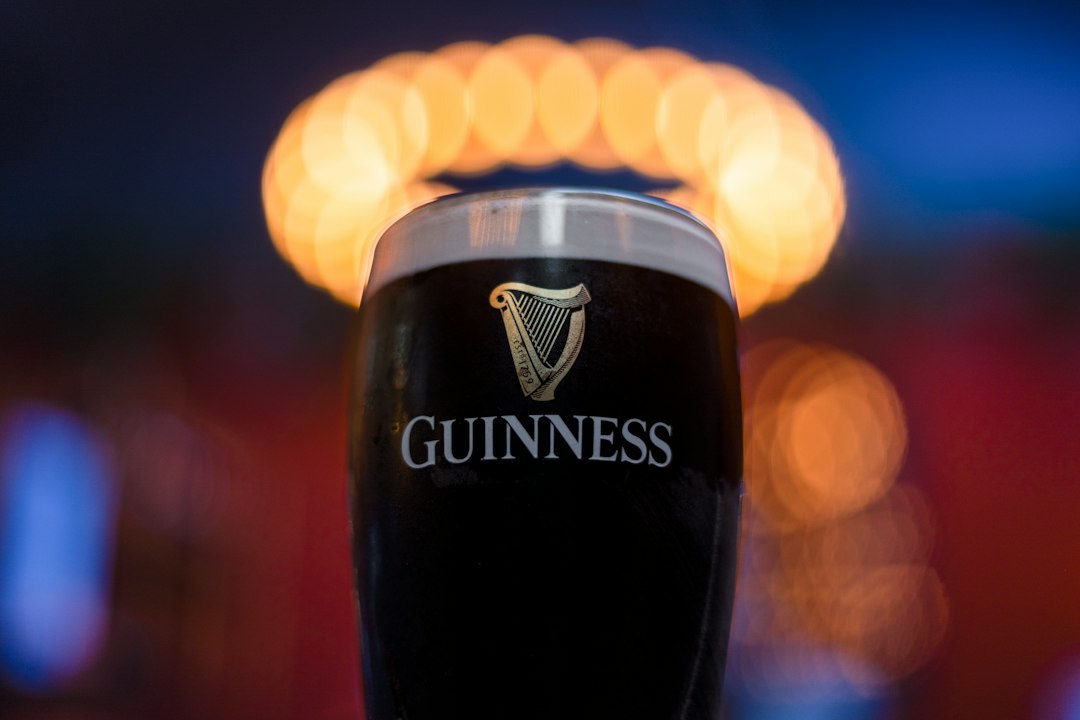
When you crack open a can of Guinness, something happens that doesn’t happen with any other drink. There’s the familiar hiss, then a low churning sound from inside the can — not from the beer, exactly, but from something sitting in it. By the time you’ve poured, a dense cascade of tiny bubbles is rolling downward from the top of the glass, settling slowly into a creamy off-white head that can hold its shape for several minutes — the same cascade at the heart of the ritual of pouring a proper pint. This is not an accident. It took Guinness the better part of three decades, a Cambridge mathematician who had to teach himself to brew, at least two abandoned patents, and a small plastic ball to make it happen.
The Problem That Embarrassed a Brewery
To understand why the widget exists at all, you have to understand what made Guinness technically difficult to serve in the first place. By the 1950s, Britain was a draft-beer country. Pubs across the UK were serving cold, quick-poured lager, and Guinness — which required a slow, theatrical two-part pour with a long wait for the nitrogen surge to settle — was losing ground. The company held only about 5% of the British beer market.
The traditional Irish pub method was a logistical headache. Publicans blended beer from two separate casks: one highly conditioned, one nearly flat and aged. Get the blend wrong and you got a pint that was either all foam or no life at all. The system couldn’t scale. Guinness had been aware of what they called “the Draught Problem” since 1932, and for more than 20 years, nobody inside the brewery had managed to fix it.
Then, in 1955, a mathematician walked into the Sample Room at the Park Royal brewery in London and was handed the problem.
The Man Who Wasn’t a Brewer
Michael Ash had earned a Senior Wrangler at Trinity College, Cambridge in 1948 — the title given to the top-scoring mathematics student of the year. After a few years lecturing at Bedford College for Women, he joined Guinness in January 1951, becoming the first non-brewer the company had ever hired. He trained across the Brewing and Forwarding departments, then in 1955 was put in charge of the Sample Room with a 20-person team and, effectively, a brief to solve the unsolvable.
What followed was four years of systematic experimentation. Ash approached the draught problem not through brewing intuition but through the kind of reductive logic a mathematician brings to any system: what, precisely, is the mechanism failing, and what would fix it? His answer was nitrogen. Not carbon dioxide alone — which was too lively, too soluble, too prone to producing the wrong kind of foam — but a blend of nitrogen and CO₂ that created fundamentally different behavior in the glass.
“It’s completely inert,” Ash later explained of his choice, “and it’s three-quarters of what we breathe.” He had also concluded, by something close to aesthetic reasoning, that the perfect Guinness head was three-eighths of an inch high. Working with keg designer Eric Lewis, Ash developed a two-chamber keg — initially nicknamed the “Ash Can” — with beer in one chamber and a pressurized gas mixture in the other, forcing beer through tiny apertures to generate the characteristic surge and cascade.
In 1959, the year of Guinness’s 200th anniversary, the Easy Serve system went into pubs. By the beginning of 1960, the old method was gone. Ash left Guinness in 1962 to run a pharmaceutical subsidiary. He died on April 30, 2016, just six weeks after Guinness honored him at a ceremony.
Why Nitrogen Does Something CO₂ Cannot
The physics underneath all of this is worth dwelling on, because it’s genuinely counterintuitive. Nitrogen gas (N₂) has a molecular weight of 28, compared to carbon dioxide’s 44. More importantly, nitrogen is far less soluble in liquid than CO₂. This combination produces a different bubble behavior entirely.
When a CO₂-carbonated beer is opened, the gas comes out of solution quickly and forms large bubbles — typically around a millimeter or more in diameter. The foam is coarse, fast-rising, and collapses quickly. Nitrogen bubbles, by contrast, form more slowly and measure on average roughly one-tenth of a millimeter across. They’re about ten times smaller, which means they pack together more densely, interact differently with light, and produce a head that is smoother in texture and far more durable.
There’s a deeper physics principle operating here. Smaller bubbles require higher internal pressure to balance surface tension — pressure that is inversely proportional to bubble radius. Achieving the pressure needed for nitrogen’s tiny bubbles would be impossible using CO₂ alone; because CO₂ is so much more soluble, matching the same pressure would produce an unmanageably large foam. Nitrogen’s very inertness — the fact that it resists dissolving — is what makes it work. The result, under magnification, is a foam structure closer to mousse than to the loose aggregation of bubbles in a standard lager head. One estimate puts the bubble count in a properly poured pint at something in the range of three million.
Solved in the Pub, Still Broken in the Can
The Easy Serve system transformed how Guinness was served on tap. What it did not solve was the can. For the next three decades, canned Guinness remained a significantly inferior product — still flat, still missing the surge and settle that defined the draught experience. The gas behavior that Ash had engineered into a keg simply did not translate to a sealed aluminum container. Open a can, and there was no mechanism to reproduce the pressure dynamics that created the nitrogen cascade.
In 1969, two brewers at St James’s Gate Brewery in Dublin — Tony Carey and Sammy Hildebrand — filed a British patent for a device that would sit inside a beverage container and release gas through an internal compartment on opening. British Patent No. 1266351 was filed on January 27, 1969, and published in full on March 8, 1972. It was a genuine conceptual breakthrough. Guinness then allowed the patent to lapse without commercializing it.
This was, in retrospect, an extraordinary missed opportunity — though not an unusual one in corporate R&D. The engineering gap between having a working concept and having a device that could survive industrial canning at scale was enormous. Nobody in the company had yet figured out how to make it manufacturable.
The Widget, Properly Engineered
In 1984, Guinness centralized its research and development under the direction of Ernest Saunders, and work on the dormant can problem restarted. A team led by Alan Forage, working with William Byrne, began the design work in 1984-85 that would finally produce a commercially viable device.
The engineering problem they faced was specific: how to create a small pressurized chamber inside a sealed can that would survive being filled with beer, survive the canning process, and then discharge its contents with enough force and precision — through an aperture measuring approximately 0.061 centimeters — to create the characteristic nitrogen cascade when the can was opened. The device needed to attach to the inside of the can bottom via flexible tabs that gripped the interior walls. It needed to fill with liquid nitrogen vapor during sealing and hold it under pressure until the moment the ring-pull was pulled.
The first commercial widget was a flat plastic disc, and it mostly worked — with one significant flaw. It was temperature-sensitive. If the beer wasn’t served cold enough, the can overflowed on opening. Commissioning began in January 1988. The national launch happened in March 1989. A U.S. patent — number 4,832,968, titled “Beverage package and a method of packaging a beverage containing gas in solution” — was issued the same year, listing Alan J. Forage and William J. Byrne as inventors.
In 1991, the Guinness widget was awarded the Queen’s Award for Technological Achievement. In a 2004 survey by the Irish technology publication T3, readers were asked to name the greatest technological advance of the preceding 40 years. The Guinness widget won by a landslide. Second place went to the internet. Third was the mobile phone.
The Floating Ball
The temperature problem with the flat disc persisted, and Guinness went looking for a solution. They found it in John Lunn, an engineer who had founded a company called McLennons in 1980, manufacturing parts for bottling plants. Guinness approached Lunn in the late 1980s to help develop a widget that wouldn’t flood the kitchen counter if the beer was served slightly warm.
Lunn’s solution was the floating widget — a hollow polypropylene sphere roughly 3 centimeters in diameter that sits loose in the can rather than fixed to the bottom. Because it floats, it doesn’t depend on precise positioning relative to the can opening. Its single tiny aperture creates the same nitrogen jet on opening, but the design proved far more tolerant of serving temperature. Guinness launched the floating widget — officially called the Smoothifier — in 1997. By 1994, John Smith’s had already begun including widgets in their cans, and the technology spread rapidly across the category.
The story of who ultimately owned what became complicated. Lunn had created versions of his floating widget for competitors after his initial work for Guinness, which led to litigation. He eventually sold the floating widget design to Whitbread and Heineken rather than Guinness. The underlying patent dispute was, in its own way, a testament to how genuinely valuable the invention had turned out to be.
A Small Ball Doing Serious Work
There’s something quietly remarkable about the engineering chain that connects a Senior Wrangler at Trinity College in the 1940s to a 3-centimeter polypropylene sphere floating in a can in a supermarket fridge today. Michael Ash didn’t set out to invent a device — he set out to understand why nitrogen behaved differently in a glass. The device came later, built on that understanding by other engineers who spent years translating a physical principle into something that could be stamped out of plastic and sealed into a can at industrial speed.
Like the harp on the can itself, the widget doesn’t do anything you’d notice if you pulled it out and examined it. It’s a small featureless ball with a hole too tiny to see clearly with the naked eye. What it’s actually doing, in the half-second after you open a can, is creating several million bubbles of exactly the right size, in exactly the right concentration, to reproduce the specific texture that a mathematician once decided — with some mathematical precision — should be three-eighths of an inch deep.
That’s the sort of specification that only makes sense if someone took the trouble to understand why it mattered in the first place.
Tours & experiences you might love


Powered by Viator. Some links are affiliate links — we may earn a small commission at no extra cost to you.
Secure Your Dream Irish Experience Before It’s Gone!
Planning a trip to Ireland? Don’t let sold-out tours or packed attractions spoil your journey. Iconic experiences like visiting the Cliffs of Moher, exploring the Rock of Cashel, or enjoying a guided walk through Ireland’s ancient past often sell out quickly—especially during peak travel seasons.

Booking in advance guarantees your place and ensures you can fully immerse yourself in the rich culture and breathtaking scenery without stress or disappointment. You’ll also free up time to explore Ireland’s hidden gems and savour those authentic moments that make your trip truly special.
Make the most of your journey—start planning today and secure those must-do experiences before they’re gone!