

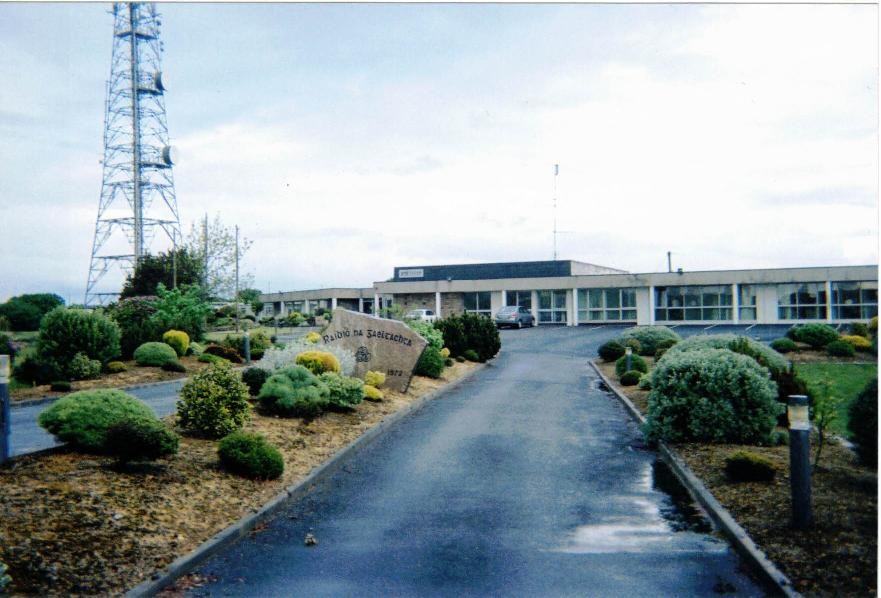
Raidió na Gaeltachta: How Ireland’s First National Irish-Language Radio Station Started in a Connemara Caravan
Saturday, March 28, 1970. In a caravan parked in the boggy countryside of Ros Muc, deep in the Connemara Gaeltacht, a group of young Irish-language activists flicked a switch on a transmitter they had bought for roughly £50 and began to broadcast. No licence. No legal standing. No certainty that anyone was tuned in at all.
The signal reached maybe twenty miles. It crackled out over the Atlantic edge, reached the Aran Islands, touched An Spidéal. For nine days, Saor-Raidió Chonamara — Free Radio Connemara — ran music, chat, and news entirely in Irish. On the final night, they broadcast a live open-air céilí. Then they packed up the transmitter, loaded it onto a Honda 50 motorcycle to stay ahead of the authorities, and disappeared.
Two years later, on Easter Sunday 1972, RTÉ Raidió na Gaeltachta went on air as Ireland’s first national Irish-language radio service. The caravan had worked.
What happened between those two Easters is one of the stranger and more consequential stories in modern Irish cultural history — a tale about a forty-six-year broken government promise, a civil rights movement that took real tactical inspiration from both Derry and Alabama, and a radio station that ended up reshaping not just the airwaves but what it meant to live in Irish.
A Promise Made in 1926
The Irish Free State launched its first radio service, 2RN, in 1926 — the same year that JJ Walsh, the Minister for Posts and Telegraphs, stood up and announced that an Irish-language station would follow. It would not, he said reassuringly, “cost a great lot of money.”
It cost nothing, because it never happened.
For four decades, the promise sat on the shelf while Irish-language communities in Connemara, Donegal, Kerry, and scattered enclaves elsewhere watched their numbers decline and their economic situation deteriorate. RTÉ, the national broadcaster, was under constant pressure to chase audiences — which meant English-language programming won the scheduling argument almost every time. Irish appeared in slots, not as a service. It was a token presence in a broadcast culture that operated as though the Gaeltacht was a heritage exhibit rather than a living, working set of communities.
By the late 1960s, emigration from Gaeltacht areas was severe. The Irish language was not merely struggling — in some regions it was losing speakers faster than it could produce them. The political response had been decades of studied inaction dressed up as reverence.
The Movement That Changed the Calculation
☘️ Join 64,000+ Ireland Lovers
Every weekday morning, get Ireland’s hidden gems, local secrets, and travel inspiration — the kind you won’t find in any guidebook.
Subscribe free — enter your email:
Already subscribed? Download your free Ireland guide (PDF)
📲 Know someone who’d love this? Share on WhatsApp →
Love more? Join 43,000 Scotland lovers → · Join 29,000 Italy lovers → · Join 7,000 France lovers →
Free forever · Unsubscribe anytime
The Gluaiseacht Chearta Sibhialta na Gaeltachta — the Gaeltacht Civil Rights Movement — was founded in Connemara in 1969. Its three key founders were Seósamh Ó Cuaig, Seán Ó Cionnaith, and the writer and Trinity College lecturer Máirtín Ó Cadhain, who had been agitating for the language’s survival for decades and who would die early in the movement’s life in 1970, without seeing what he had helped set in motion.
The movement drew directly from the civil rights movements it was watching elsewhere. Northern Ireland’s civil rights marches had begun in 1968. The American movement had demonstrated what organised, visible protest could achieve against institutional indifference. The Gaeltacht activists were paying attention.
Their tactics had a similar mixture of the symbolic and the serious. In 1969, Peadar Mac An Iomaire polled over six percent of the vote in the Galway West constituency while running on a Gaeltacht platform — enough to rattle the establishment. During that same election campaign, the movement placed nails under Taoiseach Jack Lynch’s car. When RTÉ travelled to the Connemara Gaeltacht to film a segment of the English-language quiz show Quicksilver at Teach Furbo, four activists disrupted the filming from inside the audience while simultaneous protests were held outside the GPO in Dublin and at RTÉ’s Donnybrook headquarters. The point was unmistakable: the national broadcaster was using the Gaeltacht as scenery while giving its communities nothing back.
The movement’s demands were not limited to broadcasting — they pushed for economic development, jobs, and eventually an elected Gaeltacht assembly. But the radio demand was the one that crystallised fastest, because radio was something they could demonstrate themselves.
The Caravan, the £50 Transmitter, and Radio Free Derry
On October 17, 1969, Seósamh Ó Cuaig published a notice in the Connacht Tribune announcing that a fully Irish-language pirate radio station was being planned. The inspiration, he acknowledged later, was Radio Free Derry, established during the onset of the Troubles. The transmitter, he noted publicly, could be acquired for about £50.
He found his engineer in Micheál Ó hÉalaithe, an engineering student at University College Cork who provided the technical knowledge to make it work. On March 28, 1970, the station launched from its caravan in Ros Muc, broadcasting on 1484 kHz. The secrecy surrounding the equipment’s location — moved by motorcycle when the authorities came looking — gave the whole operation a faintly theatrical quality, but the underlying message was serious: here was what Irish-language radio could sound like. Here was proof that people wanted it, made it, and would listen to it.
“We thought that it would give the Gaeltacht a voice,” Ó Cuaig said later, “and that we could reach Irish speakers across the country. We hoped it would encourage dialogue between Gaeltacht communities and that it would encourage and inspire the community, that it would be something that they could be proud of.”
In November 1970, the station ran a second broadcast during the Oireachtas na nGael festival. By that same month, the government had moved. Minister for Finance George Colley announced that a proper service was coming — one that would provide “a full broadcasting service embracing news coverage and a comprehensive schedule of features reflecting all aspects of the social, cultural and economic life of the Gaeltacht.” In February 1971, Minister Gerry Collins confirmed the details in the Dáil. The forty-six-year-old promise, it seemed, was finally being kept.
Easter Sunday, 1972
The main studio in Casla, Connemara was still under construction when the launch date arrived, so Raidió na Gaeltachta went on air for the first time from RTÉ’s Galway studios, using what broadcaster Breandán Feiriteár would later describe as “an old Telefunken tape deck the size of a big trunk.”
At 3pm on Easter Sunday, April 2, 1972, the station’s first head, Pádraig Ó Raghallaigh, opened with “Raidió na Gaeltachta anseo agaibh!” — Raidió na Gaeltachta here for you. A pre-recorded message from President Éamon de Valera welcomed the new service. Mass was broadcast from Seipéal Mhic Dara in Carraroe. Six hours of programming followed, and the first two and a half hours ran simultaneously on RTÉ Radio 1, exposing the new station’s existence to the widest possible audience.
The founding staff numbered eight: Ó Raghallaigh and seven broadcasters — Breandán Feiriteár, Timlín Ó Cearnaigh, Máirtín Ó Fátharta, Seán Ó Tuairisg, Maidhc P Ó Conaola, Mícheál Ó Sé, and Feardorcha Ó Colla. Six of the seven were former teachers. To mark the occasion, the poet Máirtín Ó Direáin composed “Toirtín Cásca” — A Gift at Easter — which was published in the RTÉ Guide on March 31, 1972, just days before the launch.
The initial broadcast schedule was a long way from the round-the-clock service it would eventually become: just two hours each evening, available only in or near the three largest Gaeltacht districts. The main transmitters at Casla, Na Doirí Beaga in Donegal, and Corca Dhuibhne in Kerry meant that large parts of Ireland’s Irish-speaking population were still not covered. But the principle had been established. After forty-six years, the state had made good on its promise.
What It Actually Did
A radio station for a minority-language community is easy to frame as a political concession — a gift to a cultural lobby, tossed in to quiet agitation. What happened with Raidió na Gaeltachta was considerably more interesting than that.
The early broadcasters did something that felt genuinely unusual in the context of Irish radio at the time: they put ordinary Gaeltacht people on air. “It was revolutionary,” one of the founding broadcasters recalled, “as we were interviewing people who had nothing to sell” — not politicians, not celebrities, not publicists. Farmers, fishermen, traditional musicians, people who had never been asked to speak on radio before and whose voices had never been treated as worth amplifying.
Among those early voices was a ten-year-old girl from Gweedore named Mairéad Ní Mhaonaigh, recorded performing with her family. She went on to become the lead singer of Altan. Clannad — another Donegal band from the Irish-speaking area around Gaoth Dobhair — also got their early exposure through Raidió na Gaeltachta’s programming. Both acts would sell millions of records internationally during the 1980s. The pipeline was not incidental: the station gave Irish-language music a platform where none had existed, and the music found an audience that extended far beyond Gaeltacht communities.
The cultural function went deeper than discovering artists. What the station did, day after day, was perform something that had never reliably been done before: it treated Irish as a complete, functional, modern language. Not a subject to be taught. Not a relic to be preserved under glass. A language in which you could hear the news, follow a sports match, get the weather, hear someone argue about local politics or tell a story about their grandmother. The legitimising effect of that — of hearing your language on the radio when you switched it on, just as you might hear English — was not something that could be easily quantified but that residents of Gaeltacht communities have described in consistent terms over decades.
“I fully believe that the Gaeltacht that we have now would not exist without Raidió na Gaeltachta,” presenter Gormfhlaith Ní Thuairisg said in 2022. “It legitimised and gave status.” Dr John Walsh of NUI Galway has described the station as having “forged a deep connection with Gaeltacht communities” that “strengthened the sense of Gaeltacht identity.”
The movement that created the station also had broader consequences. Údarás na Gaeltachta, a state development authority for Irish-speaking areas, was created in 1980. TG4, the Irish-language television service, launched in 1996 and drew on much of the same political energy that had produced the radio station a quarter-century earlier. None of those victories were guaranteed, and none of them arrived without the Gaeltacht Civil Rights Movement demonstrating that organised pressure produced results.
The Station Today
Raidió na Gaeltachta expanded to twenty-four-hour broadcasting on October 1, 2001, following the installation of a fourth RTÉ national radio transmitter network. In May 2005 came a small but symbolically charged moment: the “Anocht FM” strand, running from 9pm to 1am, introduced English-language music for the first time in the station’s history. The public voted on which track should go out first; they chose “Blister in the Sun” by the Violent Femmes.
The station began carrying advertising for the first time in its history in 2024, restricted to Irish-language ads. In JNLR listenership surveys through 2025 and into 2026, its weekly reach has held steady in the 96,000-to-103,000 range. In 2020 it received approximately €8.14 million in licence fee funding. It currently employs around seventy people across its headquarters in Casla and studios in Gaoth Dobhair in Donegal, Ballydavid in Kerry, and several other locations — a physical geography that mirrors the scattered, coastal shape of the Gaeltacht communities it serves.
In July 2024 — more than fifty years after the station’s founding — its staff won pay parity with English-language journalists at RTÉ, ending a situation in which certain Irish-language job grades had been paid up to 25 percent less than their English-speaking counterparts. It was, in its way, a footnote to the same argument the movement had been making since 1969: that Irish is not a lesser language, and that the people who work in it should not be treated as though it is.
The Longer Story
The thing that stays with us about Raidió na Gaeltachta is the gap — that extraordinary forty-six-year distance between the government promise of 1926 and the Easter Sunday broadcast of 1972. The Irish state had declared the Irish language its first official language in the Constitution. It had made Irish-language education compulsory. It had named government ministries in Irish and put Irish on its stamps and its coins. And for nearly half a century, it had not found it possible to put together a radio service that let people actually live in the language.
What eventually forced the issue was not further political goodwill. It was a civil rights movement that understood pressure, a pirate radio station built for £50 in a caravan in Ros Muc, and a group of people who decided that demonstration was more effective than petition. The broadcast range was twenty miles. The legacy has been considerably wider than that.
If you are ever driving through Connemara and you tune the radio to 92-94 FM, you will hear what fifty years of that argument sounds like: news, music, debate, sport, all of it in Irish, all of it unhurried, all of it entirely at home.
Tours & experiences you might love


Powered by Viator. Some links are affiliate links — we may earn a small commission at no extra cost to you.
Secure Your Dream Irish Experience Before It’s Gone!
Planning a trip to Ireland? Don’t let sold-out tours or packed attractions spoil your journey. Iconic experiences like visiting the Cliffs of Moher, exploring the Rock of Cashel, or enjoying a guided walk through Ireland’s ancient past often sell out quickly—especially during peak travel seasons.

Booking in advance guarantees your place and ensures you can fully immerse yourself in the rich culture and breathtaking scenery without stress or disappointment. You’ll also free up time to explore Ireland’s hidden gems and savour those authentic moments that make your trip truly special.
Make the most of your journey—start planning today and secure those must-do experiences before they’re gone!