

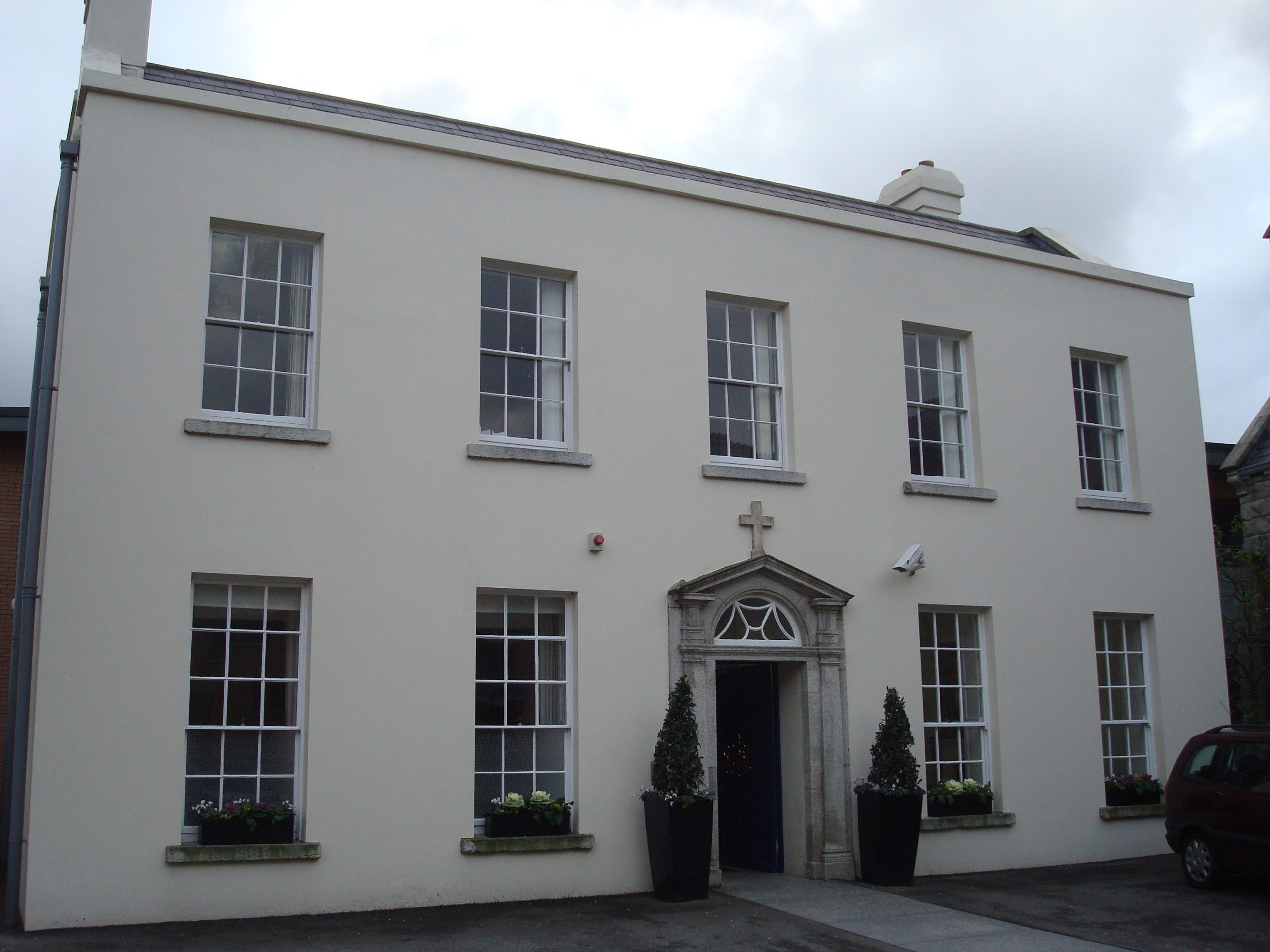
On 9 December 1879, a woman named Anna Gaynor — known in religion as Mother Mary John — opened the doors of a large Georgian house on the edge of Dublin and welcomed the first nine patients. They were, in the language of the time, the “poor and poorly”: people at the end of their lives who had nowhere else to go. The house had a name: Our Lady’s Hospice.
Most of us know hospice as a twentieth-century idea — a modern, humane response to the cold efficiency of hospital death, shaped by the palliative care revolution of the 1960s and beyond. What that framing misses is that one of the world’s oldest purpose-built hospices had already been running in a south Dublin suburb for nearly a century before the term entered common usage. And the story of how it got there — from a single nun’s radical theological act in 1815 to a network of care that would eventually reshape how an entire country thinks about dying — is considerably stranger, and more compelling, than most people know.
A Vow Like No Other
To understand Harold’s Cross, you need to understand Mary Frances Aikenhead, who was born in Cork in 1787 and died in the same Harold’s Cross building in 1858 — twenty-one years before it became a hospice.
Aikenhead founded the Religious Sisters of Charity in Dublin on 15 January 1815. That is not, in itself, unusual. What was unusual was the fourth vow she required of every member. When women joined religious orders in Ireland at the time — and there were very few of them; when Aikenhead started, Irish religious life consisted almost entirely of enclosed, contemplative communities, withdrawn from the world by design — they took the standard three vows: poverty, chastity, obedience. The Sisters of Charity took those, plus one more: a vow to devote their lives to the service of the poor. In practice, that meant living in the world rather than behind convent walls. Running schools. Running hospitals. Going where the need was, instead of waiting for the world to leave them alone.
The institutional consequence was enormous. An organisation whose theological foundation required active presence in suffering became, over the following decades, expert in exactly the kind of care that falls outside the logic of medicine: the care of people who cannot be fixed. Within twenty years of its founding, the congregation had opened St. Vincent’s Hospital in Dublin, one of the country’s earliest voluntary hospitals. By 1879, when the RSC motherhouse relocated to Milltown and left the Harold’s Cross house vacant, the Sisters had four decades of experience managing large medical institutions. They knew how to run wards. They knew how to raise funds. They knew how to negotiate with a city.
The Harold’s Cross house itself carried its own quiet logic. Mary Aikenhead had spent her final years there, largely bedridden with arthritis, in a building she called Our Lady’s Mount. She died there on 22 July 1858. When the congregation left for Milltown, the house was repurposed not as offices or a school but as a place specifically for people who were dying. The choice to transform a place where a founder had died into a place where others could die well was not incidental.
The Woman Who Built It
The person who actually made the hospice happen was Anna Gaynor. She served as its first superior from the December 1879 opening until her death in 1899, and in those twenty years she transformed a nine-bed operation into a 110-bed institution.
The hospice’s own history describes Gaynor as “the driving force behind the Hospice,” crediting the expansion to “careful planning, negotiating and skilful fundraising.” By the end of 1880 — a single year in — beds had grown from nine to forty. By the end of her tenure, there were more than 110. This was not a woman operating in a world of hospital trusts and government grants. She built it through what can only be described as relentless institutional will: identifying donors, managing construction, negotiating the practical realities of running one of Dublin’s busier end-of-life facilities in a city with significant poverty and disease.
The fact that this was happening at all was quietly extraordinary. The modern hospice movement — associated above all with the work of Dame Cicely Saunders, who opened St Christopher’s Hospice in London in 1967 and whose writing and advocacy shaped the global understanding of palliative care — had not yet been articulated as a concept. What Gaynor was running would not have used the clinical vocabulary that came later. But the operational principle — that dying people deserved dedicated, attentive care in a purpose-built setting rather than abandonment in general wards — was embedded in the institution from day one, nearly ninety years before Saunders put the theoretical framework around it.
Taking It Home
For most of the twentieth century, Our Lady’s Hospice remained something of a singular institution — significant, respected, but geographically fixed in Harold’s Cross. The shift that began to change that came in 1985, when the hospice established Ireland’s first dedicated home care team.
The service was attributed to Sr. Ignatius Phelan — Pearl Phelan, as she was known outside religious life — who developed a programme that allowed hospice staff to visit patients in their own homes. This sounds modest now, but at the time there was nothing like it in Ireland. Phelan received a People of the Year Award for the work in 1987. St Francis Hospice, another Dublin institution, established its own home care service four years later, in 1989.
The significance was not only practical. Taking hospice care out of a building and into people’s homes was an argument about what hospice care meant: not an institution you were sent to, but an approach to dying that could meet you wherever you were. That argument would take several more decades to fully work its way through the Irish healthcare system, but the 1985 service at Harold’s Cross was where it started.
The Gap Between the Vision and the Reality
In 1986 — a year after Pearl Phelan’s home care team launched — a Dublin solicitor named Mary Redmond founded the Irish Hospice Foundation. The IHF launched formally on 21 April 1986, with a mission to extend hospice services nationally, promote awareness of the hospice approach, and develop research and education.
Redmond was not a nun, and she was not from a healthcare background. She was a lawyer who had encountered the reality of dying in Irish hospitals and concluded that something needed to change at a systemic level. The IHF was conceived as a national advocacy and development body — not itself a hospice, but an organisation that would push the state and the healthcare system to treat hospice as a national provision question rather than a religious charity matter.
That there was urgent work to do became clear from the data. A study conducted at St James’s Hospital Dublin in the late 1990s — published by researchers from the Royal College of Surgeons in Ireland — found that only 6% of the deceased patients they examined had received care in a hospice location. A further 15% had received specialist palliative care within a hospital setting. The majority had died in general wards, without specialist end-of-life support.
Ireland had, by then, one of the world’s oldest purpose-built hospices and a decade-old national foundation dedicated to expanding the model. Yet the reality for most Irish people dying in the late 1990s was a general hospital bed, managed by staff whose primary concern was acute medicine. The 1879 tradition and the 1990s reality were not yet the same thing.
The IHF recognised the gap clearly. In 2007 it launched the Hospice Friendly Hospitals programme — a structured effort to bring the principles and practices of palliative care into general hospital settings, precisely because most Irish people were dying there regardless of what the hospice movement had been building since the Victorian era. In 2026, the Foundation marks its fortieth year.
Why Ireland, and Why So Early
There is a question implicit in all of this worth asking directly: why did Ireland develop this tradition so early, and why through religious rather than state institutions?
Part of the answer lies in that fourth vow. Aikenhead built an organisation whose core requirement was to be present with suffering — not to cure it, not to manage it from a distance, but to be physically alongside it. That made her congregation, over the decades, into practitioners of exactly the kind of care that the medical model consistently struggles to provide: attentive accompaniment at the end of life.
Part of it is structural. Ireland’s hospice infrastructure grew through independent charitable and religious organisations rather than state-led provision — a pattern distinct from many peer countries where modern palliative care was developed and funded by health ministries. The Religious Sisters of Charity built Harold’s Cross out of a theological commitment and a vacated building. Mary Redmond built the IHF out of personal conviction and a solicitor’s eye for institutional gaps. The state arrived later, and in some respects is still building out what the religious and charitable sector began.
And part of it may be cultural, though culture can become a substitute for explanation rather than a real one. What is verifiable is that the communal relationship with death embedded in Irish life — the wake, the keeping of company with the body, the neighbourhood gathering that stretches from rural townlands to city streets — has historically been less hidden than in many other European contexts. Whether that culture produced the hospice tradition or the hospice tradition reinforced the culture is not a question the history settles cleanly.
What the history can say is this: in December 1879, a woman in a building where another woman had died twenty-one years earlier opened nine beds for the dying poor of Dublin. She spent the next twenty years growing that into a 110-bed institution through what the record calls planning, negotiation, and fundraising — in a century when women had few institutional levers of any kind. She did not call it palliative care. She did not have a theory. She had a fourth vow, an empty house, and a city full of people who needed somewhere to die well.
What she built is still running today, still in Harold’s Cross, more than 145 years on. There are older stories in Irish history. There are not many more quietly remarkable ones.
Tours & experiences you might love


Powered by Viator. Some links are affiliate links — we may earn a small commission at no extra cost to you.
Secure Your Dream Irish Experience Before It’s Gone!
Planning a trip to Ireland? Don’t let sold-out tours or packed attractions spoil your journey. Iconic experiences like visiting the Cliffs of Moher, exploring the Rock of Cashel, or enjoying a guided walk through Ireland’s ancient past often sell out quickly—especially during peak travel seasons.

Booking in advance guarantees your place and ensures you can fully immerse yourself in the rich culture and breathtaking scenery without stress or disappointment. You’ll also free up time to explore Ireland’s hidden gems and savour those authentic moments that make your trip truly special.
Make the most of your journey—start planning today and secure those must-do experiences before they’re gone!