

West Cork’s Wild Atlantic Way: Coastal Walks, Island Ferries and Seafood Worth Travelling For
For a generation of Irish emigrants, the last thing they saw of home was a rock. Fastnet Rock, to be precise — a jagged, lighthouse-topped outcrop sitting about four miles (6.5 km) south-west of Cape Clear Island, out in the open Atlantic. Ships leaving Queenstown (now Cobh) would follow the Cork coastline west before swinging past Fastnet and into the open ocean. For many of the people who emigrated in the decades after the Famine, it was the last glimpse of Ireland they would ever have. Sailors named it the “Tear of Ireland.” The lighthouse that stands there today, a slender granite tower completed in 1904, replaced an earlier structure that vibrated so violently during Atlantic storms that the keeper’s crockery would slide off the table.
We mention Fastnet not to open with sentiment, but because it tells you something useful about this corner of the country. West Cork’s coast — from the tip of the Mizen Peninsula, curving east along Roaring Water Bay with its archipelago of islands, and out along the Beara Peninsula toward Kerry — has always been shaped by the Atlantic in ways that other stretches of Irish coastline have not. That shows in the walking. It shows in the fishing. It shows in the hundred-odd islands scattered through a bay that sailors have called Carbery’s Hundred Isles for centuries. And it shows in the seafood, which is some of the freshest you will find anywhere in Ireland, for the blunt reason that the boats that catch it don’t go far to get back to the pier.
Three Peninsulas, Three Kinds of Walking
West Cork’s geography gives walkers a choice that is unusual in Ireland: three distinct peninsulas jutting into the Atlantic, each with its own character, and waymarked trails long enough to take seriously.
The smallest and quietest is Sheep’s Head. Measuring roughly 21 kilometres long and just four kilometres across at its widest point, the peninsula sits between Bantry Bay to the north and Dunmanus Bay to the south, with a permanent population of under a thousand people. The Sheep’s Head Way is an 88-kilometre circular waymarked trail that begins and ends in Bantry, running the full length of the peninsula out to the lighthouse at its tip and back along the other side through the villages of Kilcrohane and Durrus. Most walkers are here for the core loop, which takes about four days at an easy pace. The terrain moves between old boreens, open moorland, and heathery hillsides, and the roads — already narrow — get quieter the further along the peninsula you travel. At the height of summer, that is genuinely worth factoring into your planning.
The Beara Peninsula, directly to the west, is a bigger undertaking (see our guide to exploring the Beara Peninsula). The Beara Way covers around 200 kilometres of circular trail through mountains and along the coast of a peninsula that straddles Cork and Kerry, starting and finishing in Glengarriff. Most walkers allow around nine days. The trail passes through Allihies, where copper mining started in 1812 after a local landlord named John Puxley spotted the tell-tale malachite staining on a quartz promontory at Dooneen. At their height in the mid-1800s the mines employed around 1,500 people. The last of them closed around 1885, and many of the workforce emigrated. The Allihies Copper Mine Museum now occupies the site and is worth an hour if the trail takes you through the village.
For those with less time, or who want one dramatic viewpoint without committing to a multi-day circuit, Mizen Head is the answer. At Ireland’s southwestern tip, a 2.5-kilometre path from the Barley Cove car park leads to the Mizen Head Signal Station — an easy walk, but not one that fades quickly from memory. The signal station operated from 1909 until its automation in 1993 and is now a museum; to reach it, visitors cross a 172-foot reinforced-concrete arch bridge completed in 1910, which sits around 150 feet above the sea. It was pioneering engineering for its era. Inside the station, one room is dedicated to Ireland’s first radio beacon, installed here in 1931. The cliffs below rise more than one hundred metres from the waterline, and on a clear day the sea stretches south and west with nothing visible between you and the Americas.
The Islands: Sherkin, Cape Clear, Bere
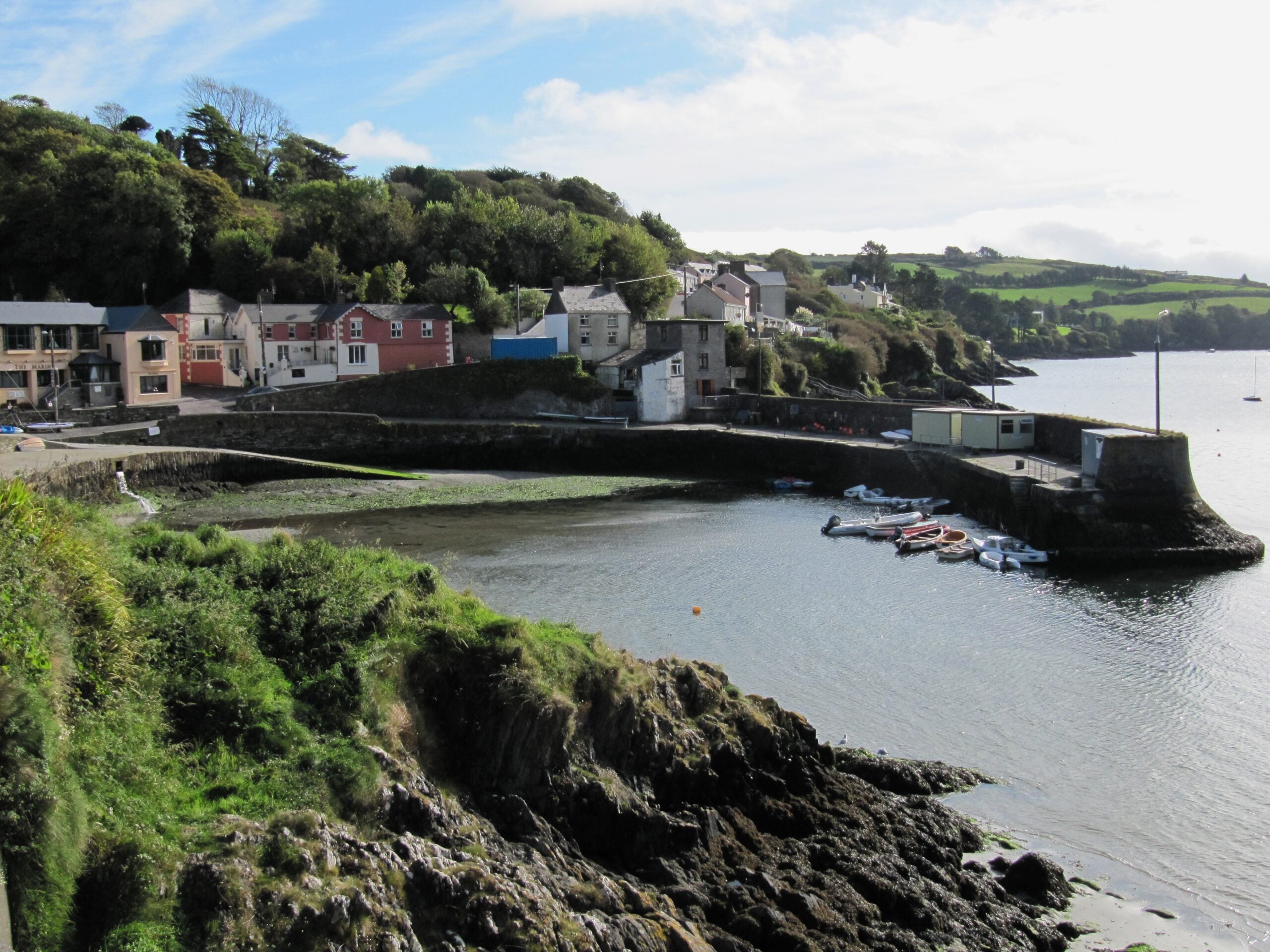
On a calm day in Baltimore harbour — a fishing village of around 400 permanent residents, where the pier smells of salt and diesel and there is always something going on at the water — you can make out three island shapes on the horizon. All three are accessible by regular ferry services. They are not interchangeable.
Sherkin Island is the closest, a short ferry crossing from Baltimore pier. Sherkin has a population of 110 (2022 census) and three sandy beaches. The most visited ruin on the island is a 15th-century Franciscan abbey built around 1460 by the local chieftain Fineen O’Driscoll. It was destroyed in 1537 by a Waterford expedition, reportedly in revenge for the O’Driscoll clan seizing a cargo of their wine. Three marked walking routes cover the island, from short family loops to more ambitious circuits. It is, by any calculation, a very manageable afternoon island — you can visit the abbey, sit on a beach, get a meal, and be back in Baltimore before evening.
Cape Clear Island — Oileán Chléire in Irish — is another matter. Thirteen kilometres off the coast, Ireland’s southernmost inhabited island is five kilometres long and two kilometres wide, with a current population of 110 people living in a Gaeltacht community where Irish is the everyday language. Before the Famine the island held over a thousand people; that number is now less than a tenth of what it was. The ferry runs year-round from Baltimore, operated by An Cailín Óir / Cape Clear Ferries, aboard the Dún an Óir II — a vessel carrying up to 94 passengers, with a heated indoor saloon and a viewing deck from which Fastnet Rock sometimes appears on the approach. A seasonal service runs separately from Schull. Cape Clear Ferries also operates dedicated Fastnet Rock Lighthouse tours from both ports, circumnavigating the rock through Roaring Water Bay for those who want to understand exactly what those emigrants were looking back at.
Cape Clear itself has a 5,000-year-old passage grave, the ruins of a 14th-century castle, and a reputation as the foremost seabird observation point in Ireland. Its remote position combined with its proximity to the continental shelf means it is often the first Irish landfall for migratory species crossing the Atlantic. Serious birdwatchers time visits to October. Everyone else mostly comes for the quiet, which is reliable.
Bere Island, reached from Castletownbere rather than Baltimore, is a working island in a way that Sherkin and Cape Clear are not quite. Two independent ferry services operate: Bere Island Ferries from the pier opposite the SuperValu in Castletownbere town, and Murphy’s Ferry Service from a pontoon about three miles further toward Glengarriff. Both carry vehicles as well as passengers, both run throughout the day without requiring advance booking. The island sits at the mouth of Bantry Bay, and the crossing back toward the Beara hills gives a view of the peninsula that you cannot get from the road.
Baltimore, Its History, and a Pirate Named Murat Reis
Baltimore’s relationship with the sea goes well beyond fishing. On 20 June 1631, a raiding party of Barbary corsairs landed in the harbour under the command of Murat Reis the Younger, a renegade Dutchman operating out of Algiers. By the time they left, they had taken 107 men, women and children into slavery in North Africa. The ruined castle on a rocky outcrop above the harbour, Dún na Séad (the Fort of the Jewels), still looks down on the village.
We mention this not as a curiosity but because it illustrates what Baltimore is: a harbour that the wider world has always found its way into, for good and ill. Today the harbour is busy with fishing vessels, charter boats, and the ferries that serve the islands. The village is the base for the southernmost RNLI lifeboat in Ireland. And it remains a serious place to eat.
Casey’s of Baltimore is one of the best-known dining addresses on this stretch of coast. Michael and Ann Casey run the family hotel and restaurant, which looks out over Roaringwater Bay. The kitchen draws on mussels from a family-owned business in the bay, and the food is grounded in what comes off the boats and out of the bay.
Schull, Bantry and the Markets That Tie It Together
In Schull — a village with a strong sailing community, a harbour that faces out toward the islands, and a Sunday market on Pier Road car park from March to September — Alaria at the Schull Harbour Hotel is the current kitchen to know about. The menu is built tightly around local sourcing. The Sunday market runs from 10am to 2pm. Organic vegetables, freshly baked bread, local honey, handmade cheeses, and local crafts. If you are on the Mizen Peninsula on a Sunday morning and you do not stop, you will be annoyed at yourself by lunchtime.
Bantry, sitting at the head of Bantry Bay and the nearest town of any size to both the Sheep’s Head and Beara peninsulas, has O’Connor’s Seafood Restaurant as its long-standing destination — a place that has featured in the Michelin Guide and is consistently recommended in Irish food guides, built on direct sourcing from the bay and its fishermen. The town also runs what is often described as the largest market in County Cork: every Friday morning, Wolfe Tone Square fills with traders from 9:30am to 1pm. Seafood, sourdough, farmhouse cheeses, organic produce. On the first Friday of each month the market expands for fair day, with bigger crowds and more stalls. If you are using Bantry as a base (see our guide to where to stay in Bantry) for walking either peninsula, building your arrival around a Friday morning is one of the easier good decisions you can make on this trip.
The Port That Most People Drive Past
Castletownbere is not on most tourist itineraries. It sits at the end of the Beara road, as far from Cork city as you can get while still being in Cork, and it has none of the polished harbour aesthetics that draw visitors to Baltimore or Kinsale. What it has is Dinish Island, connected to the town by a short causeway, and on Dinish Island is one of the most significant working fish quays in Ireland.
Castletownbere is Ireland’s largest white fishing port. In 2023, 27,065 tonnes of fish worth €96 million were landed there. The focus is demersal white fish — hake, cod, haddock, sole, monkfish, megrim — and the port handles vessels from across Ireland and from European fleets that use it as a landing point. The €48 million Dinish Wharf and breakwaters project has added substantial quay space for larger vessels.
The practical point is this: when you eat seafood in West Cork — Casey’s mussels in Baltimore, oysters at Alaria in Schull, whatever O’Connor’s is serving in Bantry — there is a very good chance you are eating something that came off a boat that docked within forty kilometres of where you are sitting. Most of the country cannot say that. Most of Europe cannot say that. It is a short supply chain, and you can taste it.
Why West Cork, Why Now
The practical case for this stretch of the Wild Atlantic Way is the combination. In a week you can walk the full Sheep’s Head Way, take the ferry to Sherkin for a morning and to Cape Clear for an afternoon, eat at two or three kitchens sourcing directly from the local fishery, and stop at the Bantry Friday market on the way back north. It is coherent in a way that longer, more dispersed itineraries rarely are. The walking, the islands, and the food all come from the same piece of water and coast — you are not assembling highlights from different places but spending time in one place until it makes sense. For a broader overview, see The Ultimate Guide to West Cork, the seafood guide to Ireland’s Wild Atlantic Way, and our earlier West Cork coastal walks, islands and seafood guide.
The Fastnet Rock sits offshore through all of it, barely visible on hazy days, clear when the light is right. For those thinking about what it means to come back to a coast their families once left, standing on the Sheep’s Head in good weather and looking south toward where it rises from the Atlantic is an experience that requires no explanation. West Cork has held that history for a long time without making a performance of it. The lighthouse still turns, the boats still go out, the markets still open on Friday mornings, and the mussels are still grown in Roaring Water Bay. Some coastlines are worth a long journey.
Tours & experiences you might love


Powered by Viator. Some links are affiliate links — we may earn a small commission at no extra cost to you.
Secure Your Dream Irish Experience Before It’s Gone!
Planning a trip to Ireland? Don’t let sold-out tours or packed attractions spoil your journey. Iconic experiences like visiting the Cliffs of Moher, exploring the Rock of Cashel, or enjoying a guided walk through Ireland’s ancient past often sell out quickly—especially during peak travel seasons.

Booking in advance guarantees your place and ensures you can fully immerse yourself in the rich culture and breathtaking scenery without stress or disappointment. You’ll also free up time to explore Ireland’s hidden gems and savour those authentic moments that make your trip truly special.
Make the most of your journey—start planning today and secure those must-do experiences before they’re gone!