

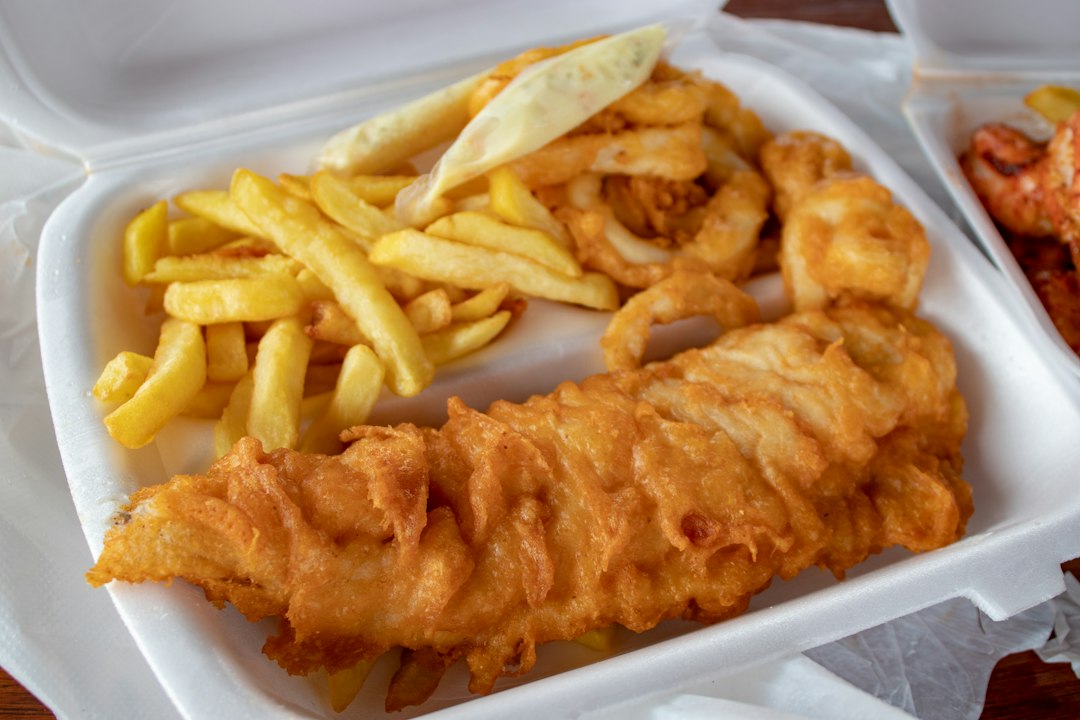
Ireland’s Best Coastal Fish and Chips: Howth, Galway, Doolin and More
In June 1905, a group of sailors aboard the Russian battleship Potemkin refused to eat rotten meat. The protest turned into a full mutiny in the Black Sea — eleven days of standoff that became one of the signal events of the early revolutionary movement and, later, the subject of a Sergei Eisenstein film that’s still shown in film schools today. Among the mutineers was a young man named Ivan Beshoff, born near Odessa in 1882. He fled to London, where he met Lenin. He came to Dublin in 1913 intending to board a ship to Canada, missed it, and stayed. Decades later, he opened a fish and chip shop on North Strand Road.
He died in Dublin on 25 October 1987, aged 103, the last known survivor of the Potemkin mutiny. His grandsons eventually brought the family name to Howth Harbour, where on a clear day the trawlers unloading the morning catch are visible from the serving window.
We mention this not as eccentric trivia but because it points at something real: the fish and chips you eat within earshot of a working harbour is a different thing from the version served three hours inland. Not just better — different in kind. The fish hasn’t been frozen. In some cases it was landed that morning. You can, at several of the places on this list, literally watch the boats come in while you eat. That gap matters, and once you’ve noticed it, you can’t un-notice it.
Here are five coastal spots where the geography of the thing genuinely counts.
Beshoff Bros, Howth, Co. Dublin
12 Harbour Road, Howth, Co. Dublin D13
The Beshoff operation at Howth runs across two establishments. Beshoffs of Howth at 17/18 West Pier is a sit-down seafood restaurant and market, with live crab, lobster and crayfish in tanks and a full shellfish counter. The takeaway — Beshoff Bros at 12 Harbour Road, directly on the water — is where the queues form. On weekends, expect fifteen to twenty minutes; on a Tuesday afternoon, you walk straight up.
Howth sits at the end of a peninsula twelve kilometres northeast of Dublin city, and the fishing village’s trawler fleet supplies the seafood here directly rather than routing through a distant wholesaler. The fish at Beshoff Bros is prepared order by order, which explains the queue but also the consistency that’s kept the place relevant across multiple generations of customers. It’s a counter takeaway — no sit-down tables — so the standard move is to carry your parcel to the harbour wall, look at the same sea that fed what you’re eating, and get on with it.
Ivan Beshoff himself ran his business on North Strand Road and later Ussher’s Quay before the family name arrived at its current Howth setting. His extraordinary backstory eventually became part of Irish pub quiz mythology, but the original motivation for his shop was entirely ordinary: a man needed income, knew how to run a business, and picked a product. He happened to have arrived in a country where good Atlantic fish was abundant and where a certain kind of fried supper would eventually become culturally load-bearing.
McDonagh’s, Galway City
22 Quay Street, Galway
In 1902, a man known locally as Cogar — his given name was Colman McDonagh — moved from the Gaeltacht village of Carraroe to Quay Street in the heart of Galway City. He set up as a coal merchant, kept a yard behind the Spanish Arch, and delivered fuel around the city by horse and cart. He raised six children in the building above the business.
The coal eventually gave way to fish. Over four generations, the McDonagh family built what is now one of Ireland’s most documented seafood businesses: a split operation with a sit-down restaurant serving Clarenbridge oysters, native scallops, hake and salmon alongside a fish and chip bar where the batter is mixed and the chips are hand-cut daily on-site. PJ McDonagh, Cogar’s great-grandson, now runs the business with his wife Mary and their four sons. It has collected recognition from the Bridgestone, Georgina Campbell and McKenna guides, though any Galway local will tell you the better measure is the length of the chip bar queue at 1pm on a Saturday.
The address matters. Quay Street runs down to the point where the River Corrib meets Galway Bay, within sight of the Spanish Arch and the original coalyard where this whole enterprise started. We’ve eaten here in every season and the chips, cut fresh each day, hold up in a way that frozen alternatives simply do not. The cod, according to the Irish Times as far back as 2006, is “uniquely and globally appreciated.” Over a century of daily practice will produce that kind of result.
Killybegs Seafood Shack, Killybegs, Co. Donegal
Shore Road, Killybegs, Co. Donegal
Killybegs is a town of roughly 1,300 people at the base of the Bluestack Mountains in southwest Donegal. It is also, by volume and by value, Ireland’s largest fishing port. The harbour handles landings worth over €110 million in an average year — in 2022 that figure was €135 million. Vessels range from small inshore boats to pelagic trawlers over 200 metres long. From autumn through spring, fleets from across Europe arrive to land mackerel, herring, horse mackerel and blue whiting. Killybegs is the largest exporter of pelagic fish in Ireland, with product travelling as far as Nigeria and Japan.
The Killybegs Seafood Shack has long been a byword for dockside freshness in the town — a small, informal takeaway built around whatever the fleet landed that day, which in a port of this scale means a remarkable range of species. The operation has had to relocate within the town in recent years as council plans reshaped the old pierside trading spot, so it’s worth checking locally for its current address and hours before you go. Wherever it’s trading from, the standard move stays the same: order what’s fresh and eat looking out over the working harbour.
The town smells like a working industrial port, which is either the best endorsement or a fair warning depending on your sensibility. Either way, the fish here has not been on a lorry.
Russell’s Fish Shop, Doolin, Co. Clare
Corner of the Fiddle & Bow Hotel, Doolin, Co. Clare
Doolin is famous for traditional Irish music — the Russell family, who gave trad sessions a permanent home here from the mid-twentieth century onwards, are a significant reason a small Clare village became a point on the international folk circuit. Russell’s Fish Shop takes its name from that family, and the philosophy is similar: local material, executed with actual care.
The shop sits on the corner of the Fiddle & Bow hotel and is marked — the owners specify this — by “a lobster pot or two” along the stone path leading in. It operates as a daytime coffee spot and evening fish and chips takeaway, with a large covered outdoor terrace that handles the considerable summer volume. The fish is sourced fresh from the Atlantic; the chips are hand-cut from Clare potatoes, a distinction that matters more than it sounds. The variety grown in this part of the west holds up better to frying than most imported equivalents, and the texture of a properly made chip is not a minor detail.
Doolin sits four miles from the Cliffs of Moher on the Wild Atlantic Way, which means it sees enormous tourist traffic, and the temptation in that situation is to coast on footfall rather than quality. Russell’s doesn’t do that. The rainbow scampi — light, crunchy, sweet — draws particular notice from visitors. The fish and chips portions are, by multiple independent accounts, generous enough for two people. The whole thing is dog-friendly, casual, and avoids the queuing infrastructure that signals a place has stopped worrying about the food.
Executive Head Chef Viv Kelly, who has over twenty years of experience cooking along the Wild Atlantic Way and in New York, runs the kitchen. The lobster rolls alone justify a detour.
Reel Dingle Fish, Dingle, Co. Kerry
Bridge Street, Dingle, Co. Kerry
The phrase “never frozen” appears in the marketing for a lot of seafood places, and in most cases it doesn’t survive examination. At Reel Dingle Fish on Bridge Street it means something specific: the fish comes from Dingle’s own harbour fleet, which works the waters of Dingle Bay directly outside town, and the menu on any given day reflects what those boats landed that morning. Hake, monkfish and cod appear regularly; what’s on Tuesday is not guaranteed to appear on Wednesday.
The physical setup is minimal — a takeaway counter with seating for three, a short wait while things are cooked to order, and a menu built around genuine availability rather than a fixed supplier list. The prices are fair for what’s on the plate, and reviews across multiple years describe the wait as something you accept without resentment because the result justifies it.
Dingle is a working harbour town at the western end of the Dingle Peninsula, which extends forty kilometres into the Atlantic at the southwest tip of Ireland. The town has a fishing industry, a cluster of restaurants that earn serious attention, and a single-track peninsula road that makes it feel further from everything than a map suggests. Reel Dingle Fish is not the most elaborate option in town — Out of the Blue on Strand Street runs a strict seafood-only menu that changes daily based purely on the catch, and it draws its own devoted following. But Reel Dingle Fish is the most direct expression of a simple idea: the boat was in this morning, and here is what it brought.
Why the Coastal Version Is Different
The difference between a coastal chipper and an urban one isn’t sentiment or scenery — it’s logistics. Fish deteriorates quickly. Every hour between landing and serving matters, and a city-centre takeaway, however carefully run, is working with product that has been through more steps and more time than anything landed at Killybegs or Howth that day.
But freshness alone doesn’t explain the best of these places. McDonagh’s has been cutting its own chips since before the Irish state existed. Beshoff Bros carries a lineage that began in a Black Sea mutiny and found its endpoint in the Irish habit of standing at a harbour wall with a paper parcel of fried fish. Russell’s in Doolin sources from the same Atlantic that produced the Clare music tradition its name borrows from. The best fish and chips, eaten at the right latitude, ends up being about more than the fish.
That said, the fish helps enormously.
These five places are spread from Howth on the east coast down to Dingle on the southwest and up to Killybegs in far northwest Donegal — a country not enormous in area but very long in coastline, with a fishing tradition that goes considerably deeper than the chip pan. If you’re travelling any part of Ireland’s coast and the question comes up, the rule is simple: eat where the boats are — for more harbour-side options beyond these five, see our wider round-up of Ireland’s best coastal fish and chips spots. The gap in quality is real, it’s consistent, and it’s one of the better arguments for taking the coastal road.
Tours & experiences you might love


Powered by Viator. Some links are affiliate links — we may earn a small commission at no extra cost to you.
Secure Your Dream Irish Experience Before It’s Gone!
Planning a trip to Ireland? Don’t let sold-out tours or packed attractions spoil your journey. Iconic experiences like visiting the Cliffs of Moher, exploring the Rock of Cashel, or enjoying a guided walk through Ireland’s ancient past often sell out quickly—especially during peak travel seasons.

Booking in advance guarantees your place and ensures you can fully immerse yourself in the rich culture and breathtaking scenery without stress or disappointment. You’ll also free up time to explore Ireland’s hidden gems and savour those authentic moments that make your trip truly special.
Make the most of your journey—start planning today and secure those must-do experiences before they’re gone!