

County Donegal is Ireland’s best-kept secret — and the locals would rather keep it that way. Tucked into the north-west corner of the Republic, cut off from the rest of the country by a border that leaves it connected to Northern Ireland more than to its own, Donegal is wild in a way that even the west coast cannot quite match.
This is the fifth article in our 32 Counties of Ireland series, following Kerry, Cork, Galway, and Clare. If those four counties are Ireland’s greatest hits, Donegal is the deep cut that the real fans know about — and it might just be the best track on the album.
Why County Donegal?
Donegal has more coastline than any other county in Ireland — over 1,100 kilometres of it, stretching from the sandy beaches of Bundoran in the south to the wave-battered headlands of Malin Head in the north. It contains some of Europe’s highest sea cliffs, one of the world’s most photographed lighthouses, a 16,000-hectare national park, and an ancient stone fort that predates Christianity.
Yet despite all of this, Donegal remains one of Ireland’s least visited counties. The roads are slower, the distances longer, and the tourist infrastructure thinner than in Kerry or Galway. That is precisely the point. Donegal rewards the traveller who makes the effort to get there with an Ireland that feels untouched, unhurried, and entirely authentic.
The Donegal Gaeltacht is one of Ireland’s largest Gaeltacht regions. Irish is still spoken as a first language in villages along the coast. Traditional music sessions happen not for tourists but because that is what people do on a Tuesday night. The tweed is still hand-woven. The fishing boats still come in to Killybegs, Ireland’s largest fishing port, with holds full of mackerel and herring.
The Must-See Attractions
Slieve League Cliffs — Europe’s Forgotten Giants
The Cliffs of Moher get all the attention. Slieve League, at nearly three times the height, gets a fraction of the visitors. Rising 601 metres above the Atlantic on the south-west coast of Donegal, these are among the highest accessible sea cliffs in Europe. The viewing point at Bunglass is a ten-minute walk from the car park, and from there you can see the cliffs drop almost vertically into water so far below it looks like a painting.
For the adventurous, the One Man’s Path continues along the cliff ridge — a narrow track with sheer drops on both sides that was once a pilgrim route. It is not for the faint-hearted, but those who walk it say it is one of the most extraordinary experiences in Ireland. There is no admission charge and no barriers. Just you, the cliff, and the Atlantic.
Fanad Head Lighthouse — Ireland’s Most Photographed Light
How many of Ireland’s 32 counties can you name? ☘️
Counties of Ireland — the geography-quiz tool. Place all 32 on the map and see if you can beat the average.
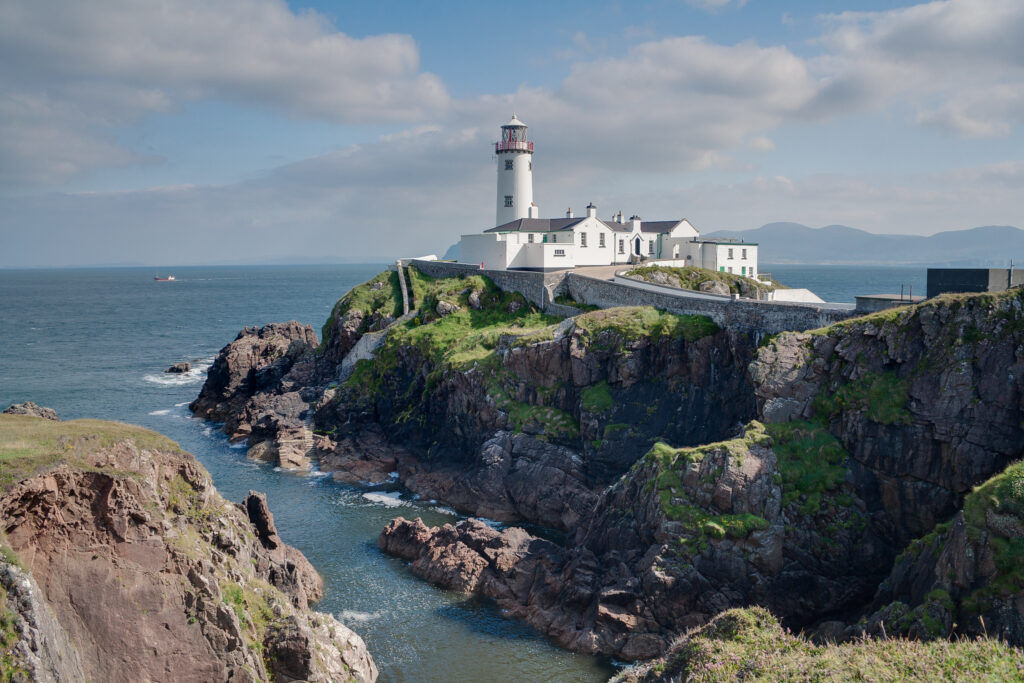
Perched on the northern tip of the Fanad Peninsula, this lighthouse has been guiding ships since 1817. It was built after the devastating wreck of HMS Saldanha in Lough Swilly in 1811, when all 253 crew were lost. Today it is one of the most photographed buildings in Ireland, its white tower standing against skies that shift from bruised purple to burning orange within minutes.
You can stay overnight in the lighthouse keeper’s cottage — one of only a handful of lighthouse stays available in Ireland. Book well in advance; it sells out months ahead.
Glenveagh National Park — 16,000 Hectares of Wilderness
Glenveagh is Donegal’s wild heart. The park covers a vast area of mountains, bogs, lakes, and native oak woodland in the centre of the county, with Glenveagh Castle — a Victorian hunting lodge — sitting at the edge of Lough Veagh like something from a fairy tale.
The castle gardens, maintained against all odds in this harsh climate, include a walled garden with Himalayan plants, Italian sculptures, and views across the lough to the Derryveagh Mountains. Free shuttle buses run from the visitor centre to the castle. The walks around the lough and up to the viewpoints are some of the finest in Ireland — and you will often have them entirely to yourself.
Grianán of Aileach — A Fort Older Than History
Sitting on top of Greenan Mountain just west of Derry, this circular stone fort is traditionally said to date back to around 1700 BC, though archaeologists place the visible structure much later — an early medieval stronghold (6th–7th century) that was substantially rebuilt in the 1870s, on a site that may have had earlier ceremonial or defensive use. It was the royal seat of the O’Neill dynasty, the Kings of Ulster, for centuries. The walls are over four metres thick, and from the top you can see five counties and both Lough Swilly and Lough Foyle.
Grianan of Aileach is free to visit and rarely crowded. On a clear day, the panoramic view is one of the finest in Ireland — a 360-degree sweep of land and water that explains exactly why the ancient kings chose this spot.
The Hidden Gems Most Tourists Miss
Malin Head — Ireland’s Most Northerly Point
Standing at Banba’s Crown on Malin Head, you are at the most northerly point on the Irish mainland — only the small, uninhabited island of Inishtrahull lies further north. The headland juts out into the Atlantic with a raw, end-of-the-world beauty that feels genuinely remote. The signal tower dates from the Napoleonic Wars, and during the Second World War, the letters EIRE were spelled out in white stones on the hillside — visible from the air to remind Allied pilots they were over neutral territory. The stones are still there.
The Poisoned Glen — Glacial Drama Without the Crowds
A glacial valley in the shadow of Mount Errigal, Donegal’s highest peak, the Poisoned Glen is one of the most dramatic landscapes in Ireland. The name comes from either a mistranslation of the Irish (Gleann Neimhe — the heavenly glen, confused with Gleann Nimhe — the poisoned glen) or from the toxic Irish spurge plant that once grew along its streams. Either way, the U-shaped valley with its sheer granite walls and eerie silence is unforgettable.
Silver Strand, Malin Beg — The Horseshoe Beach
Hidden at the bottom of a steep cliff staircase near Glencolmcille, Silver Strand is a perfect horseshoe of white sand enclosed by towering cliffs. It is not easy to reach — the steps are steep and there are no facilities — but that is what keeps it pristine. On a warm day, the turquoise water could pass for the Mediterranean. On a grey day, the dramatic cliffs make it feel like the edge of civilisation.
Assaranca Waterfall — A Ten-Minute Walk to Magic
Just outside Ardara, Assaranca is a powerful cascade that tumbles over moss-covered rocks in a gorge surrounded by native woodland. The walk from the car park takes less than ten minutes, making it accessible to almost everyone. After rain, the volume of water is extraordinary. It is one of those places that photographs well but is even better in person, when you can hear the roar and feel the spray.
Subscribe to Love Ireland — real stories, stunning photography, and the Ireland most tourists never see. Free. Weekly. Always from the heart.
☘️ Enjoying this? 64,000+ Ireland lovers get stories like this every week. Subscribe free →
☘️ Enjoying this journey through Donegal?
Join 64,000+ readers who get stories like this delivered free every morning.
Food and Drink in Donegal
Donegal’s food scene is quietly excellent. Killybegs, the largest fishing port in Ireland, means the seafood is as fresh as it gets — chowder in any Donegal pub is likely to contain fish that was swimming that morning. The award-winning Olde Castle Bar in Donegal Town serves some of the best seafood chowder in the country.
In Ardara, Nancy’s Bar is a Donegal institution — a pub that has been in the same family for seven generations, serving pints and live traditional music in a room barely bigger than a living room. Rathmullan House on the shores of Lough Swilly is one of Ireland’s finest country house restaurants, while the Rusty Mackerel near Slieve League serves hearty pub food with views of the cliffs.
Donegal is also Ireland’s tweed capital. Magee of Donegal, based in Donegal Town since 1866, still weaves tweed using traditional methods. Several smaller weavers operate in and around Ardara, which hosts an annual Weavers’ Fair every summer.
Practical Tips for Your Donegal Visit
Getting there: Donegal is about four hours from Dublin by car, or roughly one hour from Derry. There is no railway, and bus services are limited outside the main towns. Donegal Airport at Carrickfinn offers seasonal flights but is one of the smallest airports in Europe — the runway famously ends at the beach. For most visitors, driving is the only practical option.
Getting around: A car is essential. The Wild Atlantic Way runs the full length of the Donegal coast, and many of the best attractions are down narrow single-track roads. Allow more time than you think — the distances between sights are real, and the roads are slow. That said, the driving itself is part of the experience.
Where to stay: Dunfanaghy and Rathmullan are excellent bases for the north, with a good range of guesthouses and restaurants. Ardara is ideal for the south-west and Slieve League. Donegal Town itself is well-located but can feel more like a transit point than a destination. For something special, the lighthouse keeper’s cottage at Fanad Head or one of the renovated farmhouses along the coast offer an experience you will not find elsewhere.
Best time to visit: May to September, with June and July offering the longest days and the best chance of clear weather. Donegal gets more rainfall than the south-east of Ireland, but the dramatic skies are part of the appeal. Avoid August bank holiday weekend if you want the roads to yourself.
Next in the Series
We have now explored Kerry, Cork, Galway, Clare, and now Donegal — five of Ireland’s thirty-two counties, each with its own character and its own claim to being the best. Next up: County Wicklow, the Garden of Ireland, where ancient monastic ruins sit among forested valleys less than an hour from Dublin.
Join 64,000+ readers who get the best of Ireland delivered every week. Real stories. Real places. No spam. No AI filler.
☘️ Love learning about Ireland’s counties?
Join 64,000+ readers exploring Ireland — one story at a time. Free every morning.
☘️ You Might Also Love
☘️ Join 64,000+ Ireland Lovers
Every Friday, get Ireland’s hidden gems, local secrets, and travel inspiration — the kind you won’t find in any guidebook.
Free forever · · Unsubscribe anytime
☘️ Want More Hidden Ireland?
Join 64,000+ subscribers who discover Ireland’s best-kept secrets every week.
Subscribe Free — Join the Community →
Free forever · Unsubscribe anytime · No spam
📥 Free Download: Ireland Travel Planning Guide
Our most popular resource — itineraries, insider tips, and the 50 places you must not miss.
Planning a trip to Ireland?
Download our Free Ireland Travel Planner 2026 — the complete guide to planning your perfect Irish adventure. Join 170,000+ subscribers who love Ireland!
Tours & experiences you might love


Powered by Viator. Some links are affiliate links — we may earn a small commission at no extra cost to you.
Secure Your Dream Irish Experience Before It’s Gone!
Planning a trip to Ireland? Don’t let sold-out tours or packed attractions spoil your journey. Iconic experiences like visiting the Cliffs of Moher, exploring the Rock of Cashel, or enjoying a guided walk through Ireland’s ancient past often sell out quickly—especially during peak travel seasons.

Booking in advance guarantees your place and ensures you can fully immerse yourself in the rich culture and breathtaking scenery without stress or disappointment. You’ll also free up time to explore Ireland’s hidden gems and savour those authentic moments that make your trip truly special.
Make the most of your journey—start planning today and secure those must-do experiences before they’re gone!