

How an American Family’s Gift Created Ireland’s First National Park at Killarney
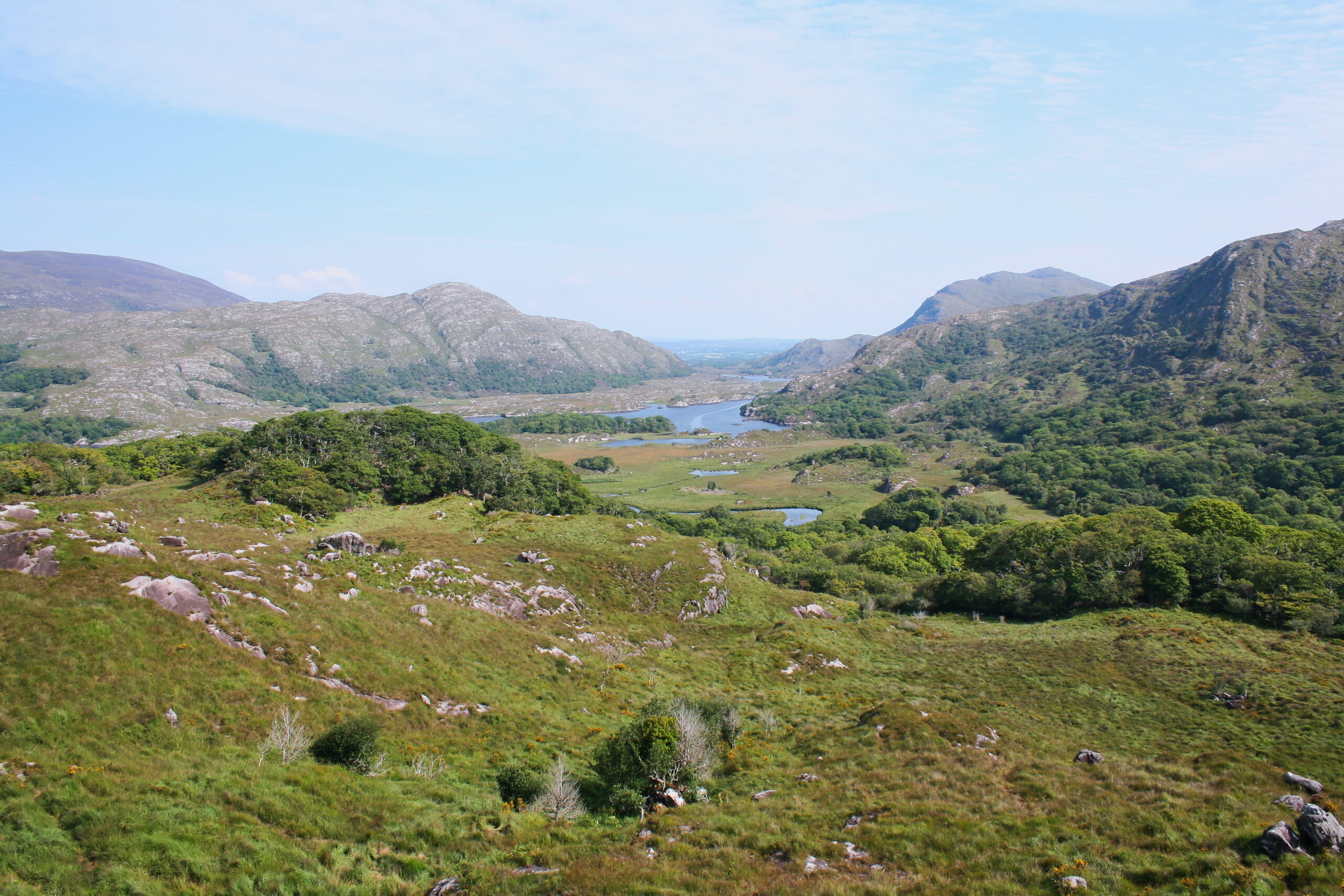
Stand at the Muckross Peninsula on a clear Kerry morning and the view makes a kind of argument. Three lakes. Mountains. Ancient oak woodland pressing down to the water. Red deer moving through the bracken at the tree line. It looks, in short, like land that has been Irish forever — land so obviously itself that protection always seems inevitable.
The true story of how it stayed intact is stranger than the landscape suggests. Ireland’s first national park was not created by an environmental movement, or a government initiative, or a grand statement of national identity. It was created by a Californian gold miner who bought a Kerry estate as a wedding present for his daughter, and then — after she died young, of pneumonia, on a ship crossing the Atlantic — chose to give it away forever rather than sell it or keep it for himself.
The park is named, in its founding legislation, the Bourn Vincent Memorial Park. Almost no one who visits calls it that today.
The Empire Mine and the Man Who Owned It
By the early twentieth century, William Bowers Bourn II was one of the wealthier men in California. His family owned the Empire Gold Mine in Grass Valley, and Bourn had interests in the Spring Valley Water Company as well. He was, by any measure, a man accustomed to making large financial gestures and making them with a certain completeness.
In 1911, he made the largest of his life. His daughter Maud was marrying Arthur Rose Vincent, and Bourn bought her the Muckross Estate in County Kerry as a wedding gift. Not a house. Not a cottage in the hills. An estate.
What he bought was Muckross House — a 65-room mansion built in the Tudor Revival style in 1843 by the architect William Burn — and the land surrounding it: approximately 11,000 acres of mountains, oak woodland, and lakeshore at the edge of the Killarney valley. The estate ran along the Muckross Peninsula, with the mountains rising beyond. It was, and remains, some of the most striking land in Ireland.
Bourn was buying for sentiment as much as spectacle. His daughter had fallen in love with Ireland. Vincent, her husband, was an Anglo-Irish figure with deep roots in the country. And the Muckross estate was exactly the kind of statement a man of Bourn’s means made when he wanted to express the scale of his feeling: permanent, enormous, unmistakable.
Twenty Years in Kerry
Maud and Arthur made Muckross their home through the 1910s and into the 1920s — years during which Ireland moved faster than almost anywhere else in Europe. The Easter Rising, the War of Independence, the Civil War, the establishment of the Irish Free State all swept through a country in fundamental transformation. The Muckross estate, sustained by Bourn money from California gold, moved at a different pace.
What emerges from that period is a picture of a household embedded in Kerry life — a large Victorian house on a peninsula, a family with roots running across the Atlantic, a stretch of land that stayed intact while most of the great Irish estates of the period were being broken up, burned out, or sold away in pieces. The Ascendancy world that had built and sustained such places was coming apart everywhere. Muckross held on.
It could not last indefinitely. What ended it was not politics or finance. It was a ship crossing the Atlantic in winter.
February 12, 1929
Maud Bourn Vincent died in Manhattan on February 12, 1929. She had contracted pneumonia during a transatlantic crossing. She was not old.
Her father, William Bowers Bourn II, was in his seventies. Her mother, Agnes Moody Bourn, survived her. Her husband Arthur was left with the 65-room mansion on the Kerry peninsula and a question that had no clean answer: what now happens to the estate?
It took three years to arrive at one. What we know of the process comes largely through the legislation that resulted from it. There was clearly a sustained conversation between the Bourn family, Arthur Vincent, and the government of the Irish Free State — but the emotional texture of those conversations is not part of the public record. What is part of the public record is the outcome: a formal gift of the entire Muckross estate to the Irish nation, made jointly by William Bowers Bourn II, Agnes Moody Bourn, and Arthur Rose Vincent.
Three people: a dead woman’s father, her mother, and her widower. Together they gave away what the father had bought as a wedding present, in the name of the woman who had received it.
The Act
The Bourn Vincent Memorial Park Act — Act No. 31 of 1932 — was enacted by the Oireachtas on December 16, 1932. It formally transferred the Muckross estate to the Irish Free State and created Ireland’s first national park. The park was named in Maud’s memory: the Bourn Vincent Memorial Park.
The National Parks and Wildlife Service records the founding area as approximately 4,300 hectares — though contemporaneous accounts and estate records speak of approximately 11,000 Irish acres, reflecting the older Irish measurement system. By any reckoning, it was an extraordinary gift: one of the largest single transfers of private land into public ownership in the history of the Irish state.
What the gift included was the full sweep of the estate — the Muckross House, the mountain land, the oak woodland, the lake shoreline, the peninsula. In a stroke of legislative pen, what had been a privately held, Californian-financed estate became a public park maintained in perpetuity by the Irish state. No entrance fee. No private owner to decide what to build or sell or fence off. Just land, kept open, in the name of a woman most visitors have never heard of.
There is something quietly radical about this, viewed from a distance of nearly a century. The major Irish estates of the nineteenth and early twentieth centuries followed a recognisable pattern: they rose, they declined, they were acquired piecemeal or burned in the Troubles or simply allowed to deteriorate until sale became the only option. Muckross followed none of those paths. It was preserved whole, at the moment of transfer, because the people giving it away chose to see it as a monument rather than a property.
What the State Made of It
The Irish government accepted the gift, named it the Bourn Vincent Memorial Park, and set about expanding it over the following decades. The National Parks and Wildlife Service records the current area of Killarney National Park at approximately 10,289 hectares — more than double the original Bourn Vincent donation, grown through land purchases by successive governments who recognised what the original act had established.
Muckross House itself is now managed as a heritage property. Visitors walk through rooms that William Burn designed in 1843 — rooms that Maud and Arthur occupied, that her father funded, that were given away along with everything else — and find them maintained with genuine care. The gardens have been kept up. A working traditional farm on the demesne gives a picture of Kerry rural life as it was lived for generations. The whole complex is among the most visited heritage sites in Ireland.
Arthur Rose Vincent, Maud’s widower, did not vanish after the donation. He stayed in Ireland and entered politics, serving in the Oireachtas. A man who had come to Kerry as a wealthy Anglo-Irish estate owner, sustained by California gold, became part of Irish public life — a detail that says something about how thoroughly the Vincent connection to Ireland ran, even as the original fortune that made it possible had been entirely given away.
What the Name Remembers
There is a version of the Killarney story that gets told at every visitor centre and on every bus tour, one that focuses on the landscape itself — the ancient sessile oak woods, the quality of light on the lakes, the mountains at the edge of the valley — without much attention to the mechanics of how that landscape ended up in public hands. The scenery does the work of making itself look inevitable. It has a permanence that makes it hard to imagine any other outcome.
But estates do not become national parks by accident. They become national parks because someone, at a particular moment, chooses to give something away rather than keep it or sell it. The choice the Bourn family and Arthur Vincent made in 1932 was not obvious and was not required. The estate could have been sold off. It could have been broken up. It could have passed through several owners and ended up in pieces, the house a hotel, the mountain land a shooting estate, the lakeshore carved up in any number of directions that seemed sensible at the time.
Instead, a grieving California family gave it to the Irish people, in the name of the woman who had loved it most.
The founding legislation still carries her name: the Bourn Vincent Memorial Park Act. Most people who visit today have never encountered it. They know the park by its modern name, which tells you nothing about where it came from. What it came from was a gold mine in the California hills, a wedding in 1911, a death at sea in 1929, and a father who decided that the best remaining use of an extraordinary gift was to pass it on again — this time to everyone, with no conditions and no end date.
Killarney National Park covers more than 10,000 hectares today. The mountains, the lakes, the woodland, the wildlife — all of it intact, all of it open. The person whose name the founding Act bears never got to see what it became. But the land she loved is still there, exactly as she left it, and the gate has been open ever since.
The next time you walk the Muckross Peninsula, or take a boat out on the lakes, or follow one of the trails into the old oak woodland, you are walking through land that somebody chose not to sell. A California father, deep in grief for his daughter, made a decision that turned out to be one of the most generous acts in Irish conservation history. We are still benefiting from it.
Tours & experiences you might love


Powered by Viator. Some links are affiliate links — we may earn a small commission at no extra cost to you.
Secure Your Dream Irish Experience Before It’s Gone!
Planning a trip to Ireland? Don’t let sold-out tours or packed attractions spoil your journey. Iconic experiences like visiting the Cliffs of Moher, exploring the Rock of Cashel, or enjoying a guided walk through Ireland’s ancient past often sell out quickly—especially during peak travel seasons.

Booking in advance guarantees your place and ensures you can fully immerse yourself in the rich culture and breathtaking scenery without stress or disappointment. You’ll also free up time to explore Ireland’s hidden gems and savour those authentic moments that make your trip truly special.
Make the most of your journey—start planning today and secure those must-do experiences before they’re gone!