

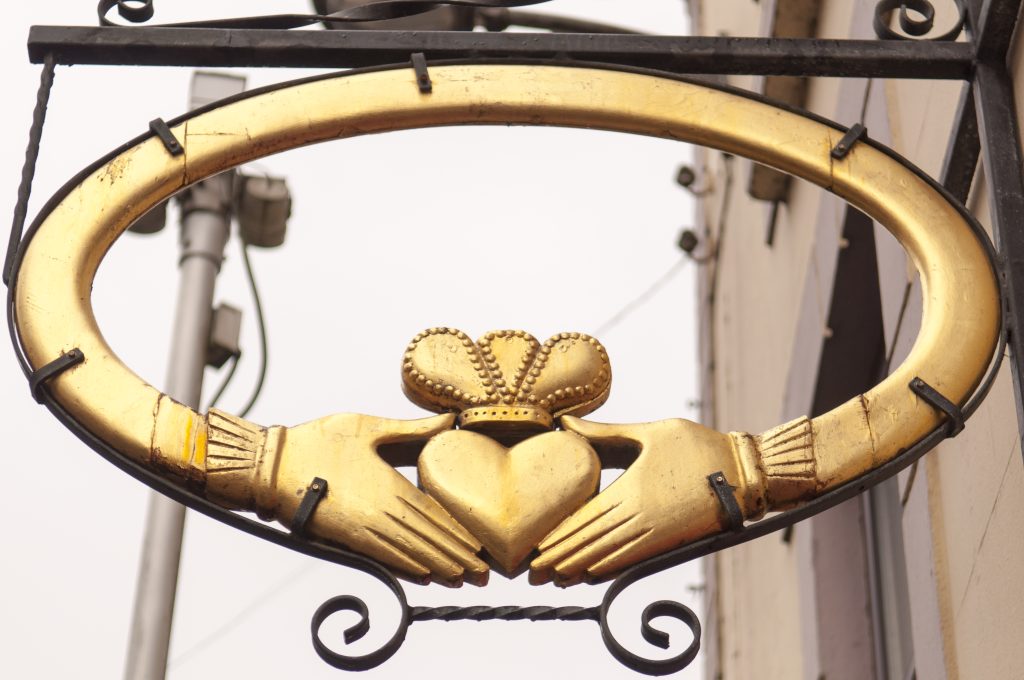
Two hands. A crowned heart. Three words anyone who owns one can recite: love, loyalty, friendship.
The Claddagh ring is worn by Irish diaspora on every continent — as a wedding band, a family inheritance, a quiet declaration of where you come from. What most people who wear it don’t know is the full story of where, exactly, it’s from. Because the place it came from doesn’t exist anymore. And the man who made the design got there by way of pirates.
The Village Outside the Walls
To understand the ring, you have to understand the Claddagh itself — and most people who’ve worn one for years have no idea what that is.
The Claddagh, in Irish An Cladach (“the shore”), is one of the oldest settlements in Ireland, believed by historians to date back to at least the fifth century. It sat where the River Corrib empties into Galway Bay, on the western edge of the city. When the Anglo-Normans under Richard de Burgh seized the area in 1232, and his son Walter began walling the town decades later, those walls were built to exclude the Claddagh. The community sat right outside — separated from the Town of the Tribes, answering to its own rules.
Those rules were enforced by a king. The Claddagh had its own monarch — not inherited, but elected from among the fishermen themselves on St. John’s Day, the 23rd of June each year. Historical records describe the king as having “absolute” power within the village: settling disputes, enforcing by-laws, and leading the fishing fleet out to sea each season. The men of the Claddagh held exclusive rights to all fish in Galway Bay, a monopoly that gave them firm control of market day near the Spanish Arch. The village spoke Irish long after most of Galway had shifted to English. They had their own boats — the Galway Hooker — and their own customs.
By the 19th century, the Claddagh had around 468 thatched cottages housing roughly 500 families, with as many as 800 fishermen and 80 boats working the bay. From the outside it looked like poverty — low stone buildings under thatch, no running water, cut off from the walled city across the water. Inside, it was a complete, functioning, centuries-old society that had been continuous longer than most of the towns around it.
The Goldsmith and the Corsairs
Somewhere in this village, around 1660, a boy named Richard Joyce was born.
We know this primarily because a historian named James Hardiman wrote it down — or a version of it — in his History of Galway, published in 1820, more than eighty years after Joyce had died. Hardiman recorded that a Galway man he called “Joyes” had been captured at sea by Algerian corsairs while sailing for the West Indies, sold into slavery in Algiers, purchased by a Turkish goldsmith, and eventually freed fourteen years later. Official records are sparse. But Hardiman’s account fits what we know about the Barbary corsairs: they were operating in the Atlantic as well as the Mediterranean throughout the 17th century, raiding European ships for enslaved labor was their trade, and a young Irishman being taken in 1675 is entirely consistent with the historical record.
According to Hardiman’s account, Joyce was around fifteen years old when his ship was seized. He was being transported as an indentured servant to the West Indies — itself a grim enough destination — when the corsairs intercepted the vessel. He and the rest of the crew were taken to a slave market in Algiers, where Joyce was purchased by a wealthy Turkish goldsmith who made him an apprentice.
For fourteen years, Joyce learned to work in gold and silver. When King William III, newly installed on the throne in 1689, sent an ambassador to Algiers demanding the release of all British subjects held in captivity, Joyce’s master made him an offer: stay, marry my daughter, take half the business. By that point Joyce was approaching thirty. He had been a goldsmith for nearly as long as he could remember. He said no.
He returned to Galway carrying a ring, legend says, that he had fashioned while still in captivity — two hands holding a crowned heart. He set up as a goldsmith near Rahoon, married, had three daughters. His maker’s mark — the initials “RJ” — can still be found stamped inside what is now the oldest surviving Claddagh ring, a gold piece dating to around 1700. That ring was sold at Sotheby’s in 2020 for £8,125 and is now in the collection of the Galway City Museum.
What the Design Means
The Claddagh ring’s symbolism has always been precise. The heart represents love. The hands — reaching in from either side to hold the heart — represent friendship. The crown above the heart represents loyalty. Three values, three elements, one design small enough to fit on a finger.
Whether Joyce made the ring for a woman he had left behind in Galway, fashioned it in captivity as a private act of devotion, or arrived at the design through sheer craft, we don’t know. What we know is that the design belonged to the Claddagh community for generations before anyone else wore it, and that the community had a complete system for reading it.
The rules are still followed today. Wear the ring on your right hand with the heart’s point facing away from you: your heart is open, you’re unattached. Flip it inward on the same hand: your heart is spoken for. Move it to the left hand with the point facing outward: you’re engaged. Left hand, point inward: you’re married. Four positions, four life stages, readable across a market stall or a pier. The women of the Claddagh could look at another woman’s hand and know exactly where she stood.
How the Ring Left Galway
For much of the 18th century, the Claddagh ring barely left Galway. It was made by local goldsmiths, worn by local people, traded within the community. Then the 19th century arrived, and two things happened that spread it around the world.
The first was Queen Victoria. When she visited Ireland in 1849, she wore a Claddagh ring — made in Waterford for the occasion — and the design’s reach immediately expanded beyond its original geography. The British upper classes took notice. Demand spread beyond the Claddagh’s tight orbit for the first time.
The second thing was the Famine, and it mattered far more.
Between 1845 and 1852, over a million people died in Ireland and at least another million emigrated in the first two years of the crisis alone. Families with almost nothing to carry out of the country carried what little they had. A Claddagh ring was small, gold, and needed no explanation. It was often the only valuable item a family possessed. Emigrants arriving in Boston, New York, Philadelphia, and Chicago brought the rings with them, handed them to their children, buried them with their dead. In the Irish neighborhoods that grew in American cities — in the parishes and the dockside pubs and the political clubs — the Claddagh ring became a kind of shorthand identity. To wear one was to announce: I am from somewhere specific. I have not forgotten where.
That meaning hardened over subsequent generations, as the original immigrants’ grandchildren and great-grandchildren wore the ring not as a memory of a lived place, but as an inherited emblem of ancestry. The further the diaspora travelled from Ireland in time, the more the ring seemed to matter as a marker.
The Village That Didn’t Survive
Here is the part of the story that tends to land as a genuine surprise.
While the ring the Claddagh had produced was travelling the world and gathering millions of wearers, becoming one of the most globally recognised symbols of Irish identity — the Claddagh itself was being demolished.
In 1927, tuberculosis swept through the village. The thatched cottages were overcrowded, sanitation was inadequate, and water supply was unreliable. The Town Commissioners formally declared the village “unhealthy.” Galway Corporation began the process of relocating residents and preparing to bring the buildings down. The Claddagh’s people protested. The decision stood. One by one, the cottages were emptied. One by one, they came down. The last one was demolished in 1934. In its place went a corporation housing scheme — solid, concrete, without a single architectural feature of the community it replaced.
The social structure didn’t survive the physical erasure. The tight fishing community that had monopolized Galway Bay for centuries, elected its own king, spoken Irish when the city had moved on, and worn its own ring as a mark of belonging — that community dissolved within a generation. The last person to hold the formal title of King of the Claddagh, Martin Oliver, died in 1972. The role is kept now in an honorary, ceremonial sense.
What remains of the Claddagh physically is the name. The area on the western bank of the Corrib is still called the Claddagh. You can stand by the river, look across at the Spanish Arch, and know roughly where the village stood. There is a small park, a memorial, a replica cottage that the council recently approved for demolition. A residential suburb of modern Galway occupies the ground where those 468 thatched cottages once stood.
The Thing That Survived Everything
The ring that Joyce made — or that the story says he made — is in a museum in Galway. The village that gave the ring its name is a housing estate. The people who wear the ring today, in Irish-American parishes and Australian cities and wherever the diaspora has scattered, are carrying a symbol from a community that was cleared off the map nearly a century ago.
There’s something in that particular irony that feels very Irish. The most durable emblem of roots comes from a place that had its roots pulled up. The ring that says I belong somewhere comes from a somewhere that no longer exists in the form that made it. The three values encoded in the design — love, friendship, loyalty — were the values of a community the 20th century couldn’t save from a health inspector’s report and a corporation housing plan.
You could read this as pure tragedy. Or you could read it the other way: the ring survived everything. The piracy, the slavery, the famine, the demolition squads, the century of diaspora, the generations who wore it without knowing any of this. Joyce’s design is still being made in Galway today, still carrying the same elements he apparently brought back from Algiers. The village is gone, but the thing it made is still out there, on millions of fingers, holding a heart in its hands.
If you want to see the oldest surviving example in person, the Galway City Museum holds Richard Joyce’s circa-1700 ring in its permanent collection — a small gold piece, slightly imperfect at the heart’s centre, with a maker’s mark inside the band and the scratched initials of its previous owners beside it. It is not much to look at. But it has been around considerably longer than the village that made it has been gone.
The Claddagh is a short walk from Galway city centre, on the western bank of the Corrib just past the Spanish Arch. Stand there on a clear morning, watch the water move, and it is not hard to imagine how a place like this — at the edge of the bay, separate from the city, governed by its own rules — could have produced something that the rest of the world has been carrying ever since.
☘️ Join 64,000+ Ireland Lovers
Every Friday, get Ireland’s hidden gems, local secrets, and travel inspiration — the kind you won’t find in any guidebook.
Already subscribed? Download your free Ireland guide (PDF)
Free forever · One email per week · Unsubscribe anytime
Tours & experiences you might love


Powered by Viator. Some links are affiliate links — we may earn a small commission at no extra cost to you.
Secure Your Dream Irish Experience Before It’s Gone!
Planning a trip to Ireland? Don’t let sold-out tours or packed attractions spoil your journey. Iconic experiences like visiting the Cliffs of Moher, exploring the Rock of Cashel, or enjoying a guided walk through Ireland’s ancient past often sell out quickly—especially during peak travel seasons.

Booking in advance guarantees your place and ensures you can fully immerse yourself in the rich culture and breathtaking scenery without stress or disappointment. You’ll also free up time to explore Ireland’s hidden gems and savour those authentic moments that make your trip truly special.
Make the most of your journey—start planning today and secure those must-do experiences before they’re gone!