

123 Passengers Boarded the Titanic at Cobh. Only 44 Made It to America.
The world’s most famous shipwreck had an Irish chapter almost nobody talks about.
At some point in the early afternoon of April 11, 1912, a 29-year-old weaver from County Westmeath named Eugene Patrick Daly walked to the third-class promenade at the stern of the RMS Titanic, pulled out his uilleann pipes, and played “Erin’s Lament.”
The two tender vessels — paddle steamers named PS America and PS Ireland — were pulling away from the ship’s hull, making the short return trip to the White Star Line pier at Queenstown, in County Cork. The people waving from the dock were getting smaller. The green hills above the harbor were getting smaller. Ireland itself was getting smaller, and for most of the 123 people who had just boarded, that was the last they would see of it.
Three days later, at 2:20 in the morning of April 15, the ship was gone.
Of the 123 passengers who climbed aboard the Titanic at Queenstown that Thursday afternoon, only 44 survived. That is the Irish chapter of this story. It has never received the attention it deserves.
The Last Emigrant Port in the World
To understand who those 123 people were, you need to understand what Queenstown was.
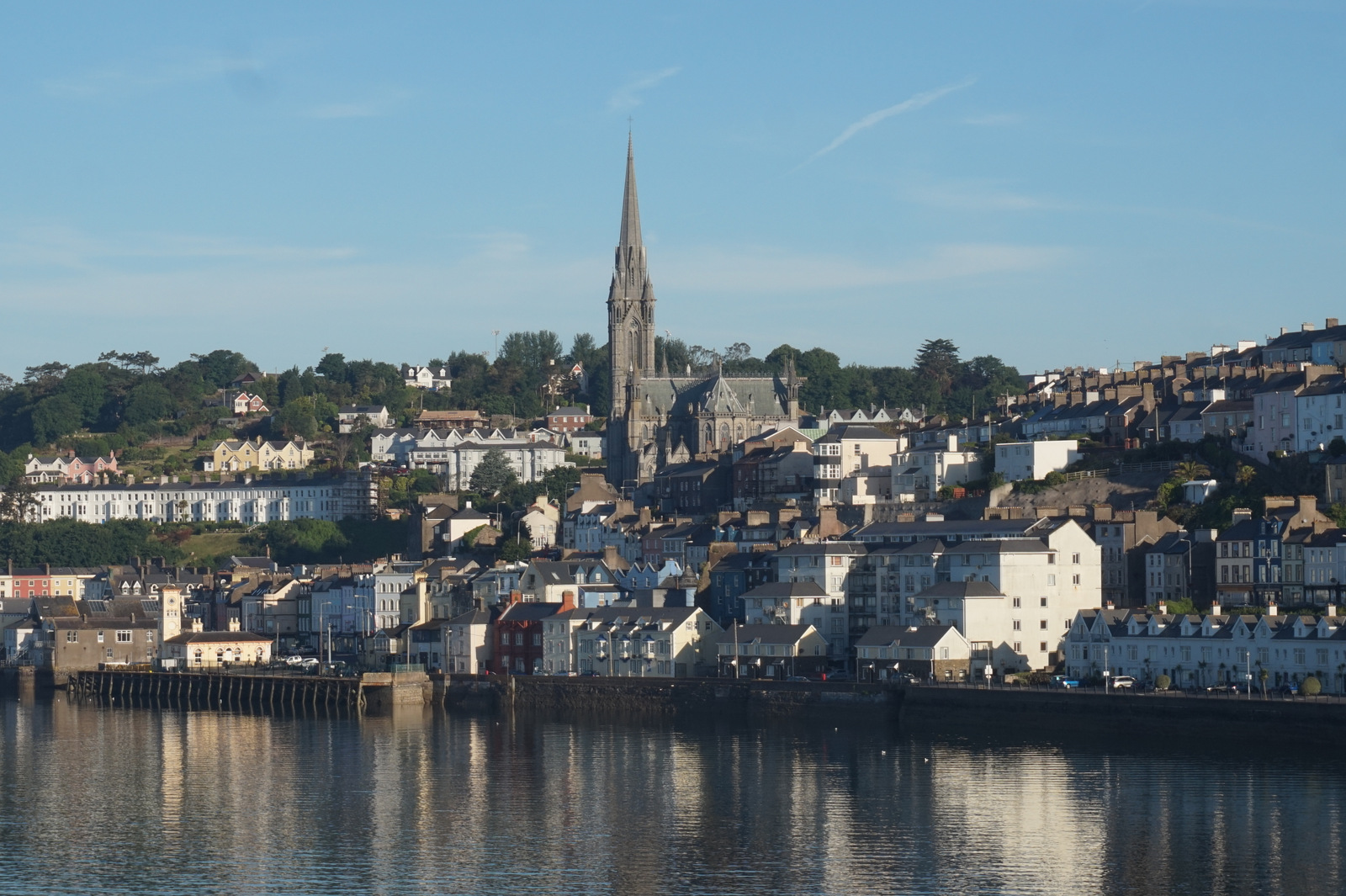
The town — today called Cobh, its Irish name restored after independence — sits on a steep island in Cork Harbour, one of the largest natural harbors in the world. Painted terraced houses stack up the hillside. The Gothic spire of St Colman’s Cathedral rises above everything. From the water, it looks almost theatrical: all color and height and ambition, a bit too dramatic for a harbor town.
By 1912, more than two and a half million Irish had departed through Queenstown’s docks across the previous century. The Famine sent the first waves in the 1840s. Poverty, land displacement, and a grinding lack of economic opportunity kept sending them afterward. By the time the Titanic arrived, emigration from the south and west of Ireland was less a catastrophe and more a fact of life — something young people planned for the way others planned a career. You worked the land, or you left. Most left.
The Titanic arrived at Roches Point outer anchorage at 11:30 that morning, too large to come into the harbor itself. Because the ship had to anchor offshore, the White Star Line’s two tenders ferried passengers, luggage, and approximately 1,385 bags of mail from the Deepwater Quay out to the waiting liner. Local vendors rowed out alongside, selling lace and handmade crafts to the passengers already aboard, making a few shillings while they still could.
The whole operation took two hours. At 1:30pm, an exchange of whistles signaled the tenders to return. Titanic raised anchor. Eugene Daly played his funeral march. Ireland receded.
The Numbers Tell the Story
Of those 123 Queenstown passengers, three traveled first class, seven traveled second class, and 113 traveled in steerage — third class, the lower decks, the bunks below the waterline.
That ratio matters enormously when you look at what came after.
Across the entire Titanic, first-class passengers survived at a rate of 62 percent. Second-class passengers: 41 percent. Third-class passengers: 25 percent. The gap was not incidental. Third-class passengers were housed in the lowest decks, were less familiar with the ship’s layout, received evacuation information later, and in several recorded instances were physically prevented from reaching the boat deck by crew members enforcing a class separation that, under the circumstances, became a death sentence.
The Queenstown group was overwhelmingly third class. Predominantly young. Many were traveling alone or in small groups assembled from the same rural parish, people who had pooled resources and courage together to make the crossing. They were not the stewards and socialites in the first-class dining saloon. They were the people Ireland could not afford to keep.
Fourteen From One Parish
The starkest example of what this meant comes from a small parish in County Mayo.
Fourteen people from Addergoole Parish — the village of Lahardane, at the foot of Nephin Mountain in north Mayo — boarded the Titanic at Queenstown. Fourteen from a single rural community, with a combined 1911 census population of fewer than 3,500 people. They had traveled south together, boarded the tenders together, found each other in the din of the ship’s third-class quarters.
Eleven of the fourteen died. The three who survived were young women: Annie Katie Kelly, Bridget Delia McDermott, and Anna Louise McGowan, all of them in their late teens or early twenties.
The eleven who did not survive included John Bourke, 42, his wife Catherine, 32, and his sister Mary, 40; Patrick Canavan, 21, and his sister Mary, 22; Bridget Donohoe, 21; Honor Fleming, 22; James Flynn, 28; Catherine McGowan, 42; Bridget Delia Mahon, 20; and Mary Mangan, 32. Some were related. Some were neighbors. Some were probably meeting the ship with a mixture of terror and excitement that none of them had language for yet.
Lahardane still commemorates them. There is a memorial in St. Patrick’s Church. The proportionate loss suffered by that single parish remains, by any measure, extraordinary.
Margaret Rice and Her Five Boys
Among the most devastating of the Queenstown stories is that of Margaret Rice.
Margaret was 39, a widow from Athlone, returning to her home in Spokane, Washington, with her five sons: Albert, 10; George, 9; Eric, 7; Arthur, 4; and Eugene, 2. Her husband had been killed in a railway accident two years earlier, and with the compensation she received for his death, she had brought the boys back to Ireland — their first trip home — to grieve among family. Now she was going back to Washington, back to the life they had built.
All six of them boarded at Queenstown on a single ticket, number 382652, which cost £29 two shillings and sixpence. That was a significant sum. It represented everything Margaret had decided to spend on the future.
None of them survived.
The accounts say Margaret was last seen on deck with all five children — her youngest son in her arms, the four older boys clutching at her skirt. Margaret’s was the only body recovered. It was identified through two small details: a box of pills from Fleming’s chemist, still in her coat pocket, and the label inside her new shoes, which read “Parson and Sons, Athlone.” Her children’s bodies were never found.
The Bottle
Jeremiah Burke was 19 years old, from Glanmire, just outside Cork city. He had boarded at Queenstown as a third-class passenger.
Before he left home, his mother pressed a small bottle of holy water into his hands. He was her son going to America. It was what mothers did.
What no one could have anticipated was what Jeremiah would do with that bottle.
Sometime during the night of April 14th or in the early hours of the 15th, as the ship foundered, Jeremiah tore off a piece of paper and wrote: “From Titanic, goodbye all, Burke of Glanmire, Cork.” He rolled the note, slipped it inside the holy water bottle, tied the stopper with one of his own shoelaces, and threw it into the North Atlantic.
He did not survive. But the bottle did.
A year later — a full year — the bottle washed ashore near Glanmire, only a few miles from his family’s home. It was found intact, the note still legible, the shoelace still tied. His family kept it for nearly a century, until 2011, when his niece donated it to the Cobh Heritage Centre, where it remains on display. It is one of the most singular objects to have come out of the disaster: a last message that actually arrived.
The Man Who Left His Photos at Queenstown
Not everyone who was on the Titanic at Queenstown was doomed to be on it when it sank. And no one who got off at Queenstown illustrates the particular lottery of that afternoon more vividly than Father Francis Browne.
Browne was a Jesuit scholastic — not yet a priest at the time — and his uncle, Robert Browne, the Bishop of Cloyne, had gifted him a ticket for the first leg of the maiden voyage, Southampton to Queenstown. He boarded in England, spent the transit photographing everything: the gymnasium, the first-class dining saloon, the Marconi wireless room, passengers strolling the boat deck, the captain on the bridge. He took around 80 photographs in two days, more than any other person aboard.
When a wealthy American couple befriended him onboard and offered to pay for his onward passage to New York, Browne sent a telegram to his Jesuit superior asking permission to stay on the ship. The reply came back: “GET OFF THAT SHIP – PROVINCIAL.” Browne kept that telegram for the rest of his life.
He disembarked at Queenstown with his film. The photographs he took became, after April 15th, the only surviving photographic record of the Titanic’s interior. They ran on front pages around the world. Kodak, in what may be history’s most unusual gesture of corporate gratitude, gave him free photographic film for the remainder of his life.
Father Browne went on to serve as a military chaplain in World War One, was wounded five times, and lived until 1960. The photographs still circulate today, the only visual evidence of what the ship looked like when it was alive.
The Man Who Walked Off Into Queenstown
John Coffey had a different reason for not being on the Titanic when it went down.
Coffey was a fireman — a stoker, a man who shoveled coal into the boiler furnaces — and he was a native of Queenstown itself. He had signed on with the crew at Southampton but had, it seems, always intended to leave the ship when it reached his home port. Before the Titanic departed, Coffey quietly slipped among the mail bags being returned by tender to shore and walked off the ship, back into the town where he had been born.
He was 23 years old. He lived until 1957. Whether he ever fully understood what had happened to the ship he abandoned is not recorded, but the math is not complicated.
Eugene Daly, After
Of the central characters of the Queenstown stop, the one who left the most detailed account was the piper.
Eugene Daly had paid £7 fifteen shillings for his third-class ticket — ticket number 382651. He was a farmer’s son and a weaver who had learned the pipes as a teenager with the Clann Uisnigh band in Athlone. He boarded at Queenstown with £98 in savings and his pipes, heading for a new life.
He survived, but barely. His account of the sinking is among the most harrowing recorded by any passenger. He reached the boat deck and witnessed an officer shoot two men who were attempting to board a lifeboat before turning the gun on himself. He jumped overboard. He was eventually pulled onto Collapsible Lifeboat B — an upturned canvas lifeboat that floated free from the deck as the ship went under — along with roughly fifteen others who clung to its hull in the North Atlantic dark.
He arrived in New York with no clothes, no money, and no pipes. The £98 was gone. One of the first things he did after surviving was file a claim with the White Star Line for $50 to replace his lost bagpipes. The claim was not paid in full.
He settled in the Bronx. He competed in a Gaelic Feis pipe competition. He married, had a daughter named Marian Joyce. He died on October 30, 1965, at the age of 82, and was buried in St. Raymond’s Cemetery in the Bronx, far from Athlone and Queenstown and the stern deck where he once played “Erin’s Lament” to a disappearing Ireland.
What Cobh Looks Like Now
In April 2012 — one hundred years after the Titanic made its final port call — the Titanic Experience Cobh opened at 20 Casement Square, in the original White Star Line building, the very office where passengers bought their tickets and gathered before boarding the tenders. The building still looks out over Cork Harbour. The hill still rises behind it. St Colman’s Cathedral still dominates the skyline.
When you enter the museum, you are given a boarding card. Not a generic replica — the card of an actual passenger who boarded at Queenstown in 1912. At the end of the tour, you find out what happened to them.
It is a quietly devastating design decision. You spend the entire visit carrying someone’s name, wondering about them, and then you find out. Given that 79 of the 123 did not survive, the odds that your card belongs to someone who made it to America are not in your favor. This is, in a small way, what those 123 people felt on the tender going out to the ship: hope, uncertainty, and a crossing they could not yet see the end of.
The harbor is still there. The painted houses are still there. The deep water that made Queenstown Ireland’s great emigrant gateway for a century is still there, and on a clear day, if you stand on the quay and look south toward Roches Point, you can see exactly where the Titanic anchored for those two hours on a Thursday afternoon in April 1912, before it raised anchor and headed into the open Atlantic, carrying 113 people from third class who had paid everything they had for a chance at a different life.
Cobh remembers them. The bottle is there. The boarding cards are there. The names on the Lahardane memorial are there. These were not supporting characters in someone else’s disaster. This was their story too.
Tours & experiences you might love


Powered by Viator. Some links are affiliate links — we may earn a small commission at no extra cost to you.
Secure Your Dream Irish Experience Before It’s Gone!
Planning a trip to Ireland? Don’t let sold-out tours or packed attractions spoil your journey. Iconic experiences like visiting the Cliffs of Moher, exploring the Rock of Cashel, or enjoying a guided walk through Ireland’s ancient past often sell out quickly—especially during peak travel seasons.

Booking in advance guarantees your place and ensures you can fully immerse yourself in the rich culture and breathtaking scenery without stress or disappointment. You’ll also free up time to explore Ireland’s hidden gems and savour those authentic moments that make your trip truly special.
Make the most of your journey—start planning today and secure those must-do experiences before they’re gone!