

The Day the Irish Free State Destroyed Its Own History
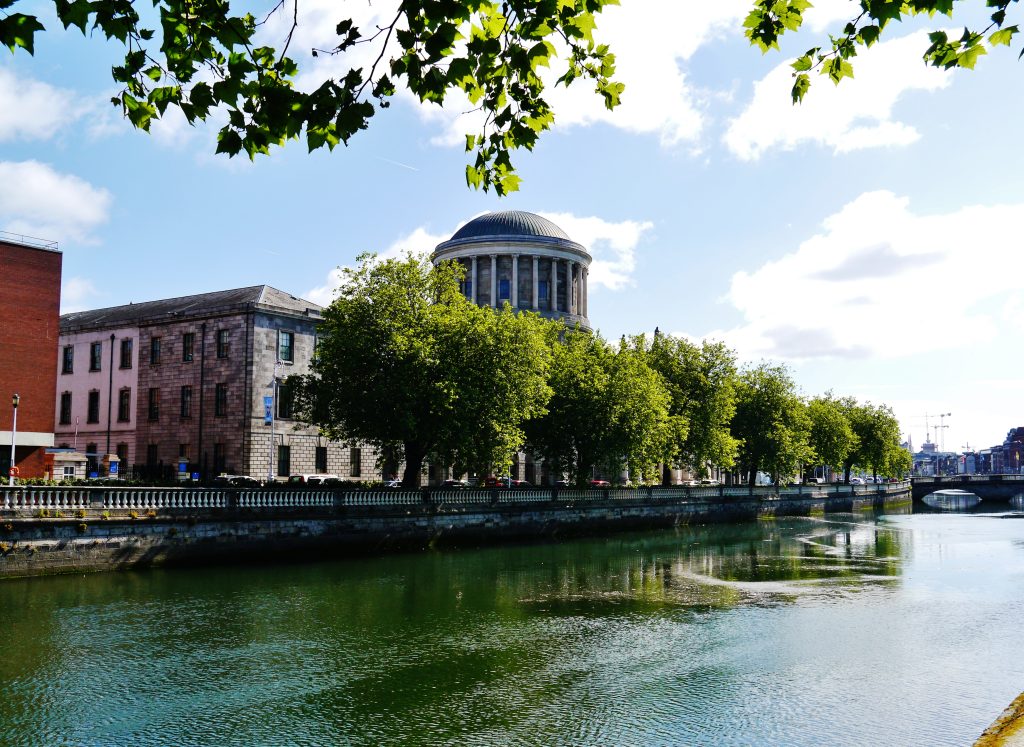
At 4:29 in the morning on 28 June 1922, two 18-pounder field guns opened fire on a large neoclassical building along the north bank of the River Liffey in Dublin. The building was the Four Courts — Ireland’s own supreme legal complex. The guns had been borrowed from the British army. The soldiers firing them were Irish. And the order had come from Michael Collins.
The Irish Civil War had begun.
What followed over the next two days was a slow catastrophe that nobody fully understood until it was over. When the smoke finally cleared on 30 June, Ireland had lost something it could never replace: seven centuries of its own recorded history, gone in a single afternoon explosion. The Public Record Office of Ireland — the archive that held the census returns, the wills, the court documents, the parish registers, the parchment scrolls stretching back to the 13th century — had been turned into a munitions factory by the men who occupied it. And then it blew up.
How Ireland Got Here
To understand what happened at the Four Courts, you have to understand the extraordinarily compressed timeline of Irish politics in the early 1920s. The Anglo-Irish Treaty, signed in December 1921, ended the War of Independence but split the Irish republican movement down the middle. Pro-Treaty figures like Collins accepted it as a stepping stone to full independence. Anti-Treaty republicans, led by figures like Rory O’Connor and Liam Mellows, saw it as a betrayal — a partitioned island, an oath to the British Crown, a Free State rather than a republic.
The split turned physical on 14 April 1922. A force of anti-Treaty IRA men from Tipperary, brought to Dublin by the veteran guerrilla commander Ernie O’Malley, seized the Four Courts complex before dawn. O’Connor’s intention was partly symbolic — occupying the center of Ireland’s legal system was a direct challenge to the Provisional Government’s authority — and partly strategic. The building offered space, sleeping quarters, and, it turned out, a practical location for manufacturing explosives. The anti-Treaty forces converted a section of the complex, specifically a large room in the record treasury block at the western end, into a munitions factory producing mines and grenades. The room they chose happened to be immediately adjacent to the Public Record Office of Ireland.
For two months, the Provisional Government did nothing. Collins had complicated reasons for hesitating. Some anti-Treaty IRA commanders were former comrades from the war against Britain. There were fragile negotiations and a general election pending. Collins genuinely hoped for reconciliation. The occupation sat there, an open wound, while the two sides talked.
The Assassination That Changed Everything
On 22 June 1922, two men shot and killed Field Marshal Sir Henry Wilson on the doorstep of his London home. Wilson was a former Chief of the Imperial General Staff and a Unionist hardliner with deep roots in Irish politics. His assassination, which the British government blamed (with some justification) on IRA networks, produced an immediate ultimatum from London: if the Provisional Government didn’t clear out the Four Courts garrison, Britain would do it themselves.
Winston Churchill applied the heaviest pressure. The British cabinet made clear that allowing an armed anti-Treaty IRA headquarters to operate openly in the heart of Dublin was a violation of the Treaty’s terms. Collins, who had spent years outmaneuvering the British, found himself cornered by them. He had been stalling on the Four Courts for strategic reasons of his own. Now he had no more room.
At 3:40 in the morning on 28 June 1922, Free State forces issued an ultimatum to the Four Courts garrison: surrender immediately. When the order was refused twenty minutes later, the guns — borrowed from British army stores — opened fire.
Three Days, One Explosion
The bombardment was conducted under Major-General Emmet Dalton, with the artillery operation commanded by Commandant General Tony Lawlor. In a city that had been at war with Britain just a year earlier, the spectacle was surreal: Irish soldiers firing British artillery at an Irish building, watched by an Irish civilian population from the surrounding streets.
The shelling continued through June 28 and 29. The British had supplied shrapnel rounds rather than high explosives, which reduced structural damage but prolonged the siege. A total of 375 shells were fired before the garrison surrendered. Three men died in the fighting: Joe Considine, Seán Cusack, and Thomas Wall.
Inside the complex, Rory O’Connor was captured early on. Ernie O’Malley took command in his place. The garrison of approximately 180 men and women held out through two full days of bombardment. What ended the siege was not the artillery. It was fire.
On the morning of June 30, flames broke out inside the headquarters block. By around half past noon, the fire had spread through the building and reached the munitions stored in the record treasury. When the temperature reached critical levels, the accumulated gelignite and improvised explosive materials deflagrated — burned explosively rather than detonating in the conventional sense — producing the massive blast that was heard across Dublin. Burning embers and flaming fragments rained down across the surrounding buildings. Forty advancing Free State soldiers were injured. Documents from the archive were carried by the wind as far as Howth, miles away on the coast. Charred fragments of medieval parchment scattered across the Dublin rooftops.
At 3:30 pm on June 30, Ernie O’Malley surrendered the position to Brigadier General Paddy Daly. The Four Courts was a shell. The dome would collapse by evening. And the Public Record Office of Ireland no longer existed.
What Burned
Three years before the destruction, the deputy keeper of the Public Record Office, Herbert Wood, had completed a meticulous catalog of the collection. It ran to 300 pages. It is now one of the most depressing documents in Irish history, because it is, in effect, a precise inventory of what no longer exists.
The records destroyed in the explosion and subsequent fire covered roughly seven centuries of Irish documented life. The census returns for 1821, 1831, 1841, and 1851 were gone — the only surviving pre-famine population data for the whole island. (The 1861, 1871, 1881, and 1891 censuses had already been destroyed earlier, pulped during wartime paper drives.) Around a thousand Church of Ireland parish registers — baptisms, marriages, burials — burned along with them. Court records dating to the 13th century. Chancery records from the 14th century documenting English administration of Ireland. Christ Church deeds stretching back to 1174. The wills of ordinary Irish people from the 16th century onward. Crown land grants. Transportation records for those sent to the Australian colonies. Military records of local yeomanry.
Herbert Wood’s initial estimate put the losses in the thousands of separate records. Later researchers, working from the catalog fragments and cross-referencing with what could be found elsewhere, revised that figure upward substantially.
No inventory of the collection had existed before Wood compiled his catalog — which meant that for years after the fire, no one even had a complete picture of what exactly had been lost. The archive had accumulated for so long, across so many political administrations, that its full extent was known only to a handful of specialists. What Ireland lost on 30 June 1922 was not just history. It was the knowledge of what history it had possessed.
The Genealogy Problem That Lasted a Century
For the estimated 70 million people around the world who claim Irish descent — in the United States alone, more than 30 million identify as Irish-American — the destruction of the Public Record Office created a research problem that has never been fully solved.
The genealogical consequences hit unevenly. Catholic parish registers — baptisms, marriages, burials maintained by individual priests in individual parishes — were largely held locally and survived. The same was true of Presbyterian and Methodist records. Civil registration, which began in 1864, also survived. Griffith’s Valuation, the exhaustive land and property survey conducted in the 1840s and 1850s, came through intact. The 1901 and 1911 census returns, the most recent before Irish independence, remained.
What was truly catastrophic was the loss of Church of Ireland records — roughly half of all the Anglican parish registers that had been deposited in the PRO following the church’s disestablishment in 1869 — and of wills. The majority of wills proved in Irish courts before 1900 were gone. What remains, for those ancestors wealthy enough to have left a will, are the abstracts compiled by Sir William Betham, the Ulster King of Arms, who had spent the early 19th century creating handwritten notes on pre-1800 testamentary records. Betham’s notebooks were stored at Dublin Castle’s Office of Arms rather than at the Four Courts, and they survived. His abstracts — summaries of summaries — became substitutes for originals that no longer exist.
The irony is compound. The building’s practical value to the anti-Treaty garrison was its space and its central location. Its archive was incidental to their purposes. Nobody decided to destroy the Public Record Office. It simply happened to be where they put the ammunition.
What a Century of Looking Has Found
Ireland has spent a hundred years in the slow archaeology of its own destroyed past. The first serious insight into what could be recovered came from a simple realization: the Public Record Office had not been the only copy of Ireland. Clerks, historians, lawyers, genealogists, and church officials across Britain, Ireland, Australia, and America had been copying, abstracting, transcribing, and photographing Irish records for generations. Those copies were scattered across the world in filing cabinets and library basements and archive rooms that nobody had systematically searched.
The Beyond 2022 project, launched in the years before the centenary of the fire and completed at virtualtreasury.ie, set out to find them all. Working with 70 archival institutions worldwide — including the UK National Archives at Kew, the Public Record Office of Northern Ireland, the Huntington Library in California, and archives in Australia and France — the project assembled what is now available as the Virtual Record Treasury of Ireland. The database contains more than 50 million searchable terms covering every Irish surname and placename, spanning seven centuries of records.
The recovery has surprised even the historians running it. Dr. Peter Crooks, the project’s director, described the scope of duplicates and transcripts found in other archives as “astounding.” The 1766 Religious Census — a survey of households by religion that had largely been considered destroyed — offers a useful measure of what patient international searching could achieve. Before the project, roughly 7 percent of its returns survived. The project recovered more than half of the returns in whole or in part, with partial coverage now extending across most of the country. Thirteen original prerogative wills from the treasury were identified in collections that had sat untouched for decades.
The recovery is incomplete and will remain so. Some things that burned on 30 June 1922 existed nowhere else. The medieval court rolls. Certain parish registers where the local church also burned or was lost. The everyday legal documents of ordinary people who left no other trace. Those are genuinely gone.
The Building Still Stands
The Four Courts itself was rebuilt. After a decade during which Ireland’s courts operated temporarily from Dublin Castle, the restored complex was reopened in 1932 — though much of James Gandon’s original 18th-century interior decoration was lost in the reconstruction. The building today houses Ireland’s Supreme Court, Court of Appeal, High Court, and Dublin Circuit Court, its copper dome still one of the defining silhouettes of the Dublin skyline. You can walk in through the main entrance and use the public areas for free; on any weekday, barristers in wigs and gowns move through the same corridors where anti-Treaty fighters dug their trenches.
Rory O’Connor, the commander of the Four Courts garrison, was executed in December 1922 alongside three other prisoners, Liam Mellows, Joe McKelvey, and Dick Barrett, in reprisal killings ordered by the Provisional Government. Michael Collins, who had ordered the bombardment under British pressure on a June morning that summer, was dead by August 22 — killed in an ambush at Béal na Bláth, County Cork, during the Civil War he had started. He was 31 years old.
The document that best captures what was lost is still Herbert Wood’s 1919 catalog, the one he completed three years before the fire. Wood had spent his career as custodian of those records, knowing their contents intimately. His catalog was, among other things, an act of care — a meticulous accounting of what Ireland had preserved about itself across 700 years. The catalog survived the fire. The records it described did not.
Ireland’s past is not gone, exactly. It is scattered — across archive boxes in California and London and Belfast and Dublin, in digitized fragments on a website anyone can search, in the handwritten notebooks of a 19th-century archivist who had no idea why his work would matter so much later. Recovering it has taken a century and it isn’t finished. But the story of how it came to need recovering — on a summer morning in 1922, when a new country turned borrowed guns on its own history — is one of the stranger and more genuinely consequential chapters in the making of modern Ireland.
The Virtual Record Treasury of Ireland is freely accessible at virtualtreasury.ie. If you have Irish ancestry and have hit the 1922 wall in your research, it is the best place to start looking — alongside the 1926 census, the first taken after independence.
☘️ Join 64,000+ Ireland Lovers
Every Friday, get Ireland’s hidden gems, local secrets, and travel inspiration — the kind you won’t find in any guidebook.
Already subscribed? Download your free Ireland guide (PDF)
Free forever · One email per week · Unsubscribe anytime
Tours & experiences you might love


Powered by Viator. Some links are affiliate links — we may earn a small commission at no extra cost to you.
Secure Your Dream Irish Experience Before It’s Gone!
Planning a trip to Ireland? Don’t let sold-out tours or packed attractions spoil your journey. Iconic experiences like visiting the Cliffs of Moher, exploring the Rock of Cashel, or enjoying a guided walk through Ireland’s ancient past often sell out quickly—especially during peak travel seasons.

Booking in advance guarantees your place and ensures you can fully immerse yourself in the rich culture and breathtaking scenery without stress or disappointment. You’ll also free up time to explore Ireland’s hidden gems and savour those authentic moments that make your trip truly special.
Make the most of your journey—start planning today and secure those must-do experiences before they’re gone!