

Blarney Stone History: Was the Kissing Tradition Actually Invented in the 1800s?
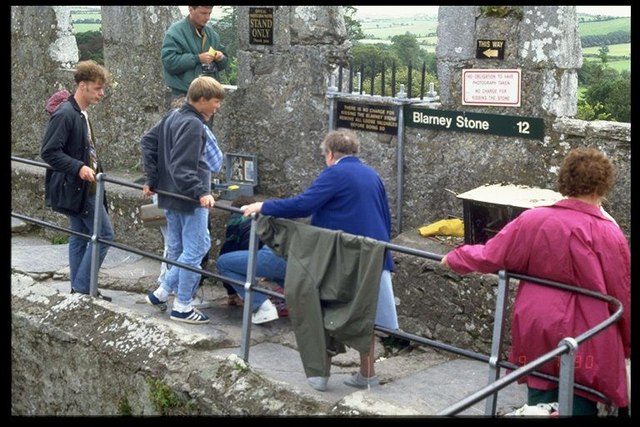
Here is what close to half a million people do every year at a medieval tower eight kilometres outside Cork city. They climb to the top. They lower themselves carefully onto a stone floor at the parapet. They grip two iron bars set into the wall. They lean backward, tilting their head out over the castle’s exterior, and press their lips to a particular piece of limestone set 85 feet above the ground in the battlements. Then they straighten up, slightly winded, and feel that something has been transferred.
The Blarney Stone, the legend holds, grants you eloquence. Not just the ability to speak well — something more specific than that. The power to talk your way into situations, to charm and persuade and perhaps deviate from strict accuracy with admirable confidence. The gift of the gab, as the Irish have it.
Blarney Castle was built in 1446. The tradition of kissing its famous stone — the documented tradition, the written-down one — is roughly 200 to 240 years old, depending on which text you consider the first reliable account. The castle stood for more than three centuries before anyone seems to have recorded the ritual. That gap is the real story here.
The Word Came First
To understand the stone, you need to start with the word “blarney,” because the word and the kissing tradition have different origin stories, and only one of them is well-documented.
The word comes from a real episode. In the late 16th century, a chieftain named Cormac Mac Dermot Mór Mac Carthy held Blarney Castle and was required, under the arrangements of the day, to formally surrender his lands to the English Crown and receive them back as a feudal title. This was the mechanism by which the Elizabethan administration was consolidating its grip on Munster. Cormac kept promising compliance and never delivering it. Each time the Crown’s representative in Munster, Sir George Carew, pressed him on the matter, Cormac produced another elaborate, courtly, honeyed response — one that said absolutely nothing while appearing to say everything.
The story goes that Queen Elizabeth I, on receiving one such dispatch, flung it aside and said: “Blarney, Blarney, I will hear no more of this Blarney.” Whether she said precisely those words is unverified — fittingly enough — but the sense of the exchange is well-documented enough that “blarney” entered English as a word for smooth, flattering, magnificently evasive talk.
What is entirely absent from this origin story is any stone. Any parapet. Any upside-down ritual at the top of a tower. Cormac’s eloquence was his own. The stone played no role in it. The kissing tradition would not enter the picture for more than two centuries after his diplomatic performances.
What the Stone Actually Is
Before examining who first wrote the tradition down, it is worth establishing what the stone itself is. It sits embedded in the external wall of Blarney Castle’s parapet, on the east face of the tower, 85 feet above the ground. To kiss it, you lean backward over the outer edge of the castle wall, hanging your head toward the stone below the parapet, above a considerable drop. A castle employee stands nearby. Two iron bars give your hands something to grip.
In 2014, geologists at the University of Glasgow’s Hunterian Museum completed an analysis of a 19th-century microscopic slide taken from the stone. Their conclusion: the Blarney Stone is local Carboniferous limestone, approximately 330 million years old, its geochemical signature matching the limestone of the Blarney area itself.
The stone is Irish. It is local. It has been part of this landscape for 330 million years, set into a castle wall for 580 of them.
This finding matters because so many of the stone’s competing legends require it to be something brought from somewhere else entirely — which means the geology quietly demolishes most of the mythology before we have even started.
The Origins, in Approximately Seven Contradictory Versions
The Blarney Stone, depending on your preferred account, is: a fragment of the Scottish Stone of Scone, presented to the MacCarthy clan by Robert the Bruce in gratitude for Irish military support at Bannockburn in 1314; a piece of the stone the patriarch Jacob used as a pillow when he dreamed of angels ascending a heavenly ladder; the rock from which Moses drew water in the desert; a relic returned from the Crusades; a stone whose power was revealed to an early MacCarthy chieftain by a witch he had pulled from drowning; or a stone identified by the fairy queen Clíodhna as a benefit for her devotion to the MacCarthy family. The geological evidence that the stone is unremarkable local limestone eliminates every version that requires a foreign or supernatural origin. It is not Scottish sandstone. It has no documented route from the Middle East. It is one piece of the Irish landscape, embedded in a wall.
The multiplicity of contradictory legends is itself a signal worth attending to. When a tradition is genuinely ancient and continuous, its origin stories tend to consolidate. One or two dominant versions survive and the alternatives fall away. When a tradition is relatively recent but wants the weight of antiquity, it generates mythology prolifically — as if sheer volume of competing stories can substitute for the documentary record that happens to be absent. The Blarney Stone has perhaps the most extravagant collection of origin myths of any single tourist attraction in Ireland, and none of them agree on anything except the punchline. For a closer look at each of those competing legends, see our deep dive on the stone’s disputed origin stories.
The Man Who Wrote It Down
Thomas Crofton Croker was born in Cork city on 15 January 1798, the son of an army major, and he developed an obsession with the south of Ireland that he would pursue for the rest of his life. Between 1812 and 1816, still a teenager, he spent his free time walking the countryside around Cork and Kerry collecting folk songs, legends, dirges for the dead, and the stories that older people told about the landscape around them. He understood, with the instinct of a natural archivist, that this material was fragile — that the forces reshaping Ireland in the early 19th century would not leave it undisturbed.
In 1824, Croker published the results of these wanderings as Researches in the South of Ireland. The book recorded what he had seen and heard: the scenery, the architectural remains, and the manners and superstitions of the peasantry, as its subtitle put it. Among his observations was a description of a stone at Blarney Castle that was pointed out to visitors, “supposed to give whoever kisses it the peculiar privilege of deviating from veracity with unblushing countenance whenever it might be convenient.”
That sentence is one of the earliest clear print accounts of the kissing tradition as an established practice — something being shown to visitors, something with a recognised story attached to it. Notice what Croker did not say: that the tradition was ancient, that it connected to the 1446 construction of the castle, or that it had roots in the Battle of Bannockburn. He described a local story, noted with a folklorist’s precise irony.
The following year, Croker published Fairy Legends and Traditions of the South of Ireland, which became a sensation. Sir Walter Scott admired it. The Brothers Grimm translated it into German. It was the first book in the British Isles claiming to have drawn on material collected from oral tradition, and it caught a moment when the Romantic movement’s appetite for Celtic heritage was enormous and largely unsatisfied. Croker had found his audience.
There is an earlier trace. In 1785, the lexicographer Francis Grose included an entry in his A Classical Dictionary of the Vulgar Tongue, his encyclopaedia of British slang and street language, containing verse lines about a stone in Cork: “‘Tis there’s the stone that whoever kisses / He never misses to grow eloquent.” This is the earliest dated print reference to the kissing tradition that has come to light — but Grose was documenting the word “blarney” in circulation, not reporting on a tourist destination. He was noting what people said. The tradition existed in some form by 1785, but it is not until Croker’s 1824 account that we get a travel writer actually describing the practice as something visitors to the castle were shown and invited to perform.
In 1888, an American journalist named William Henry Hurlbert travelled through Ireland and visited Blarney. He recorded his impression that the legend of the stone “seemed to be less than a hundred years old.” Writing from 1888, that observation pointed to the late 18th century as the moment the tradition crystallised — exactly consistent with Grose’s 1785 entry and Croker’s 1824 account. Hurlbert was making a traveller’s assessment rather than a scholarly argument, but the timing stacks up.
The Railways, the Colthursts, and the Making of an Attraction
The tradition did not achieve fame on its own. It had a great deal of institutional help, beginning with one of the most celebrated authors of the age.
In 1825, Sir Walter Scott toured Ireland and made the climb at Blarney. Scott was among the most famous writers in the English-speaking world at the time — author of the Waverley novels, the dominant figure of British Romanticism, a man whose enthusiasm for a place or a tradition could transform its reputation overnight. When Scott kissed the Blarney Stone, it was cultural endorsement on a significant scale. The kiss was reported and discussed. The story spread.
In 1846, the Colthurst family — who still own Blarney Castle today — gained ownership of the estate through marriage. They began developing it more deliberately as a visitor destination. A main line did reach the district in 1849, when the Great Southern and Western Railway’s Cork–Dublin route crossed the Blarney River on a new viaduct — but that line ran past Blarney, not into it. The real turning point came decades later, in 1887, when the narrow-gauge Cork and Muskerry Light Railway opened a dedicated station in Blarney itself, built specifically to capture the castle’s tourist traffic. What had been a journey requiring a carriage or a long walk from Cork city became, almost overnight, an accessible day trip. The arrival of a station of its own is one of the unsung catalysts in the history of Irish tourism, and Blarney Castle was among the first sites to benefit from it at scale.
By 1897, the ritual had become popular enough — and dangerous enough — that iron railings were installed on the parapet. Before this, the practice required a companion to grip the kisser by the ankles and lower them bodily over the drop. There are 19th-century photographs documenting this arrangement. It was, in every measurable sense, precarious. A 1897 photograph shows what the experience looked like: someone suspended from the battlements, their head toward the stone, held by another person who appears entirely confident in their grip.
The railings formalised the experience without entirely defusing its theatricality. You were still upside down, still over the edge. Further safety modifications came in the 20th century — horizontal bars installed across the opening below the stone, so that the worst possible outcome of a lost grip was no longer a fall. Today’s arrangement, with iron bars to hold, a rubberised rest for the neck, and a castle employee standing by to assist, is a long way from the ankle-holding original, but it preserves enough of the ritual sensation to serve the purpose.
The Numbers, the Queue, the Limestone
Close to half a million people visit Blarney Castle each year, and the majority of them are there specifically for the stone. The queue at the top of the tower moves one person at a time. When you reach the spot, you lower yourself onto the stone floor of the parapet, grip the bars, lean backward, and press your lips to the limestone. The stone is cold. It is slightly damp. A photograph is available for purchase on the way out.
The stone is still there, set into the external wall of the battlements where it has been since 1446. That part is not invented. What surrounds it — the eloquence legend, the competing origin myths, the specific claim that kissing this particular piece of limestone transfers a supernatural quality to the kisser — crystallised much later, in the late 18th and early 19th centuries, when writers began recording and repeating the story until repetition gave it the feel of antiquity.
This is, in some respects, how many traditions come into being. A local story catches the attention of someone with a notebook and an audience. A famous visitor amplifies it. Infrastructure makes it accessible to the many. The practice accumulates participants until the sheer number of people who have done it makes it feel old. The Blarney Stone’s kissing tradition followed this arc almost perfectly — local story, romantic folklorist, celebrity endorsement, railway, iron bars, half a million visitors a year.
Thomas Crofton Croker, who wrote the tradition down in precise and slightly sardonic detail in 1824, spent his career collecting Irish stories before they disappeared. He may not have realised that in Blarney’s case, he was doing something slightly different — not recording a tradition that already existed in its full form, but helping to fix and transmit one that was still finding its shape. The stone had been in the wall for centuries. The story around it was newer than it looked.
That, as it happens, is also a perfectly good description of blarney.
Tours & experiences you might love


Powered by Viator. Some links are affiliate links — we may earn a small commission at no extra cost to you.
Secure Your Dream Irish Experience Before It’s Gone!
Planning a trip to Ireland? Don’t let sold-out tours or packed attractions spoil your journey. Iconic experiences like visiting the Cliffs of Moher, exploring the Rock of Cashel, or enjoying a guided walk through Ireland’s ancient past often sell out quickly—especially during peak travel seasons.

Booking in advance guarantees your place and ensures you can fully immerse yourself in the rich culture and breathtaking scenery without stress or disappointment. You’ll also free up time to explore Ireland’s hidden gems and savour those authentic moments that make your trip truly special.
Make the most of your journey—start planning today and secure those must-do experiences before they’re gone!