

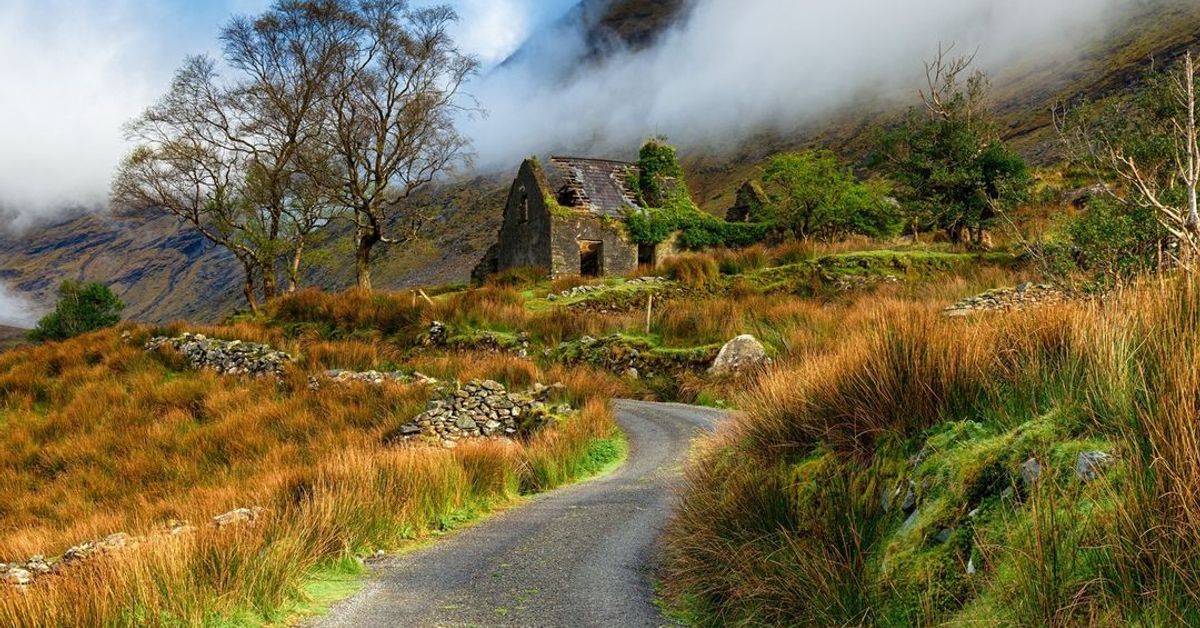
Across Ireland, ruined stone cottages stand in fields, on mountainsides, and at the edges of bogs. Most have no roof. Some have no walls above the window line. They look like they were abandoned centuries ago. Many held living families in the 1840s. These are the ruins of the Great Famine — the most catastrophic event in modern Irish history — and they are the only records many Irish families have left behind. If you have Irish ancestry, one of these ruins may have been your great-great-grandparents’ home. Here is what they can tell you, and how to find them.
What the Ruins Actually Are
The 1841 Census recorded Ireland’s population at 8.2 million people. By 1851, the number had fallen to just over 6.5 million. The Great Famine, which ran from 1845 to 1852, killed more than 1 million people and forced another 1 million to emigrate. The landlord-driven evictions that followed the worst years drove many more families off the land through the 1850s and 1860s. Whole townlands emptied. The roofless stone walls you see in the Irish landscape today are what remained.
These were real homes. Families of five, six, seven people lived in them. The walls were lime-washed white inside. A turf fire burned at the gable end, or in an open central hearth. Iron pots hung over the embers. Children slept on straw pallets near the warmth. The same families had lived in these townlands for generations, sometimes centuries, tracing their tenure back to the Gaelic chieftaincies of the medieval period.
Then, in the space of a decade, most of them were gone.
What the Ruins Tell Us — and What They Don’t
A Famine-era cottage ruin can tell you a surprising amount. The size of the structure tells you whether the family was prosperous or poor. The 1841 Census classified Irish rural housing into four grades. Class 4 — the lowest — were one-room mud cabins. Class 1 — the highest — were two-storey stone houses with five or more rooms. Many Famine ruins are Class 3 or 4 structures: one-room or two-room stone cottages of the poorest rural families.
The location tells you what the family farmed. Ruins on exposed mountainsides usually belonged to families who depended entirely on potatoes, growing them on the steep ground that nobody with better options would have taken. Ruins on bogland were often on the worst available soil, leased at extortionate rates. Ruins in valleys, closer to rivers, typically belonged to families with slightly more diverse livelihoods — fishing, small-scale dairying, or grain.
- The orientation of the doorway often tells you about the prevailing wind: most Irish cottages placed the door facing away from the Atlantic gales, giving you a rough compass bearing for which direction was most sheltered.
- A gable chimney — a chimney breast rising from the end wall — indicates a later 19th-century building. Earlier cottages had a central hearth and no chimney at all, just a hole in the roof.
- Outbuildings close to the cottage often indicate a family with livestock — a cow, a pig, a few hens — which was a mark of relative security in Famine Ireland.
☘️ Researching your Irish roots?
Our free step-by-step guide walks you through every record, database, and DNA tool to trace your Irish family — no experience needed.
The Records That Survived — and How to Use Them
For most of the rural Irish families who lived in these cottages, very few paper records survive. The 1901 and 1911 Irish Census are the two most important documents available to Irish diaspora researchers, and both you can search both for free at irishgenealogy.ie. Both record each family’s exact townland, the number of rooms and windows in their home, the floor material, and the ages and occupations of everyone living there. If your ancestors stayed in Ireland through those years, you can find them on these censuses and often pinpoint the exact location of their home.
But if your family emigrated during the Famine (1845–1852) or in the decades immediately after, the earlier records are harder to find. The following resources are the most useful for Famine-era research:
- Griffith’s Valuation (1847–1864) — A townland-by-townland survey of every property in Ireland, recording the name of the occupier, the acreage, the quality of the land, and the annual valuation. This is often the last documentary record of a family before emigration. Searchable free at askaboutireland.ie.
- The Tithe Applotment Books (1823–1837) — Pre-Famine records of landholders and their tithes, covering most of Ireland. Cross-referencing these with Griffith’s can show you whether a family was on the land before and during the Famine. Available at irishgenealogy.ie.
- Church Parish Registers — Roman Catholic, Church of Ireland, and Presbyterian registers for baptisms, marriages, and burials. Many survive from the 1780s onward, though coverage is patchy in the poorest rural areas. The Irish Genealogical Research Society catalogue lists what has survived by county.
- Famine Emigration Lists — Passenger records from ships leaving Irish ports for North America and Australia researchers have increasingly digitised. The Cobh Heritage Centre holds extensive records, and Ellis Island records cover arrivals from 1892 onward.
☘️ Enjoying this? 64,000+ Ireland lovers get stories like this every week. Subscribe free →
The Most Significant Famine Ruin Landscapes in Ireland
Several areas of Ireland are particularly dense with Famine-era ruins, and visiting them gives a tangible sense of the scale of what happened. For a closer look at what daily life was like inside one of these cottages, see our guide to what the abandoned cottages reveal about the families who left.
- The Black Valley, County Kerry — One of the last inhabited valleys in Ireland to get a road, the Black Valley remained isolated well into the 20th century. The landscape is dotted with the ruins of pre-Famine and Famine-era cottages, many still holding their walls to window height. The valley lost nearly its entire population during and after the Famine.
- The Céide Fields and North Mayo — While the stone structures here are ancient rather than Famine-era, the broader north Mayo landscape includes extensive post-Famine ruins. The Erris peninsula lost around 60% of its pre-Famine population.
- The Dingle Peninsula, County Kerry — The Blasket Islands and the mainland cliffs of the Dingle Peninsula have dense concentrations of ruined cottages, particularly in the higher ground above Dún Chaoin. The National Folklore Collection holds recorded testimonies from survivors who grew up in these houses.
- The Achill Island and Corraun Peninsula, County Mayo — Achill had one of the highest Famine mortality rates in Connacht. The ruins of Slievemore deserted village contain over 100 roofless stone cottages and is one of the largest abandoned Famine villages open to visitors.
- Connemara and South Mayo — The bogland landscape of Connemara contains thousands of roofless stone ruins. Nobody has signposted most of them. They are simply part of the landscape, sitting in the fields exactly where the families left them.
How to Find Your Ancestral Home
If you know your ancestor’s county and townland, finding the physical site of their home is often possible. The process involves three steps.
Step 1: Identify the townland. Townlands are Ireland’s smallest administrative unit — there are roughly 64,000 of them. A family recorded in Griffith’s Valuation under a specific townland name lived in a small, defined geographic area, usually covering less than 1 square kilometre. Tailte Éireann’s GeoHive historic map viewer (at geohive.ie) shows the 1837-1842 six-inch Ordnance Survey maps, which mark individual buildings, roads, and field boundaries for the pre-Famine period.
Step 2: Locate the building on a historic map. The 1837-1842 Ordnance Survey maps show individual buildings as small black rectangles. Cross-referencing the map with modern satellite imagery (you can access this free through Google Maps) often reveals whether the building’s footprint still exists as a ruin.
Step 3: Visit. You can reach many ancestral ruin sites in Ireland on foot across open mountain or bogland. Approach landowners respectfully — most Irish rural communities respond positively to diaspora visitors tracing their ancestry, especially if you explain why you are there.
What Stands When Everything Else is Gone
No documents survive from most of these homes. No diary, no letter, no photograph. The families who lived in them often had no access to writing materials, no local newspaper to record their births and deaths, and no priest who kept complete records. The 1922 Four Courts fire destroyed most pre-1900 census returns for Ireland, removing the one document that might have captured them systematically.
But stone survives. The walls stand. The hearthstone remains at the base of the gable. The threshold stone sits where it was set when the cottage the builder set. These objects are the last physical evidence of the families who lived here — the most honest archive of rural Irish life that exists.
October is Family History Month. If you have Irish ancestry and have never visited Ireland, these ruins are one of the most powerful experiences available to you — standing in the doorway of a building your great-great-grandparents walked through every day, looking out at the same mountain or sea view they looked at all their lives. Our free Irish Ancestry Guide can help you find the county, the townland, and the records that will tell you which ruin might be yours: https://lovetovisitireland.com/irish-ancestry-guide/
What do Famine ruins in Ireland look like?
Famine-era ruins are typically one or two-room stone cottages with walls standing to between 1 and 2 metres high. Most have lost their roofs — thatch deteriorates within a decade without maintenance. Some show signs of collapse at the gable walls. They often appear in clusters, reflecting the townland system of communal land use, and are most dense in the west of Ireland — Connacht, Kerry, and Donegal — where Famine mortality and emigration were highest.
How do I find out if a Famine ruin belonged to my ancestors?
Start with Griffith’s Valuation (1847–1864) at askaboutireland.ie — it records the name of the occupier of virtually every Irish holding by townland. Once you have your ancestor’s townland, use the 1837–1842 Ordnance Survey maps at Tailte Éireann’s GeoHive viewer to locate individual buildings. Cross-referencing with modern satellite imagery often reveals which ruins correspond to those building footprints. Our free Irish Ancestry Guide walks you through this process step by step.
Where are the best Famine ruin sites to visit in Ireland?
Slievemore Deserted Village on Achill Island, County Mayo, offers one of the most accessible concentrations — over 100 roofless cottages you can walk through. The Black Valley in County Kerry is among the most atmospheric. The Dingle Peninsula and north Connemara have dense concentrations of ruins across the landscape. The Famine Museum at Strokestown Park, County Roscommon, provides essential historical context alongside a visit to the grounds of the estate whose landlord oversaw mass evictions in the 1840s.
Are there records of Irish ancestors who died in the Famine rather than emigrated?
Records of Famine deaths are incomplete, but several sources can help. Church burial registers, where they survive, recorded deaths by name. The Poor Law Union records — workhouse admission and death registers — the National Archives of Ireland holds them, and researchers have partially digitised many. The Cork Famine Research group and similar county-level genealogical societies have compiled local death indexes. The National Famine Memorial in Murrisk, County Mayo, and the Cobh Heritage Centre both maintain research resources for Famine-era family research.
☘️ Join 64,000+ Ireland Lovers
Every weekday morning, get Ireland’s hidden gems, local secrets, and travel inspiration — the kind you won’t find in any guidebook.
Subscribe free — enter your email:
Already subscribed? Download your free Ireland guide (PDF)
📲 Know someone who’d love this? Share on WhatsApp →
Love more? Join 43,000 Scotland lovers → · Join 29,000 Italy lovers → · Join 7,000 France lovers →
Free forever · Unsubscribe anytime
Tours & experiences you might love


Powered by Viator. Some links are affiliate links — we may earn a small commission at no extra cost to you.
Secure Your Dream Irish Experience Before It’s Gone!
Planning a trip to Ireland? Don’t let sold-out tours or packed attractions spoil your journey. Iconic experiences like visiting the Cliffs of Moher, exploring the Rock of Cashel, or enjoying a guided walk through Ireland’s ancient past often sell out quickly—especially during peak travel seasons.

Booking in advance guarantees your place and ensures you can fully immerse yourself in the rich culture and breathtaking scenery without stress or disappointment. You’ll also free up time to explore Ireland’s hidden gems and savour those authentic moments that make your trip truly special.
Make the most of your journey—start planning today and secure those must-do experiences before they’re gone!