

Drive along almost any back road in Connemara, west Kerry, or the Achill Peninsula and you will see them — stone walls collapsing into the grass, gable ends standing in fields, doorways opening onto nothing. These are the ruins of the Famine, and they scatter across Ireland’s western landscape in their thousands. Between 1845 and 1852, Ireland lost more than a million people to starvation and disease. Another million and a half emigrated in those same seven years. The cottages they left behind are still there, dissolving slowly back into the land their families worked for generations.
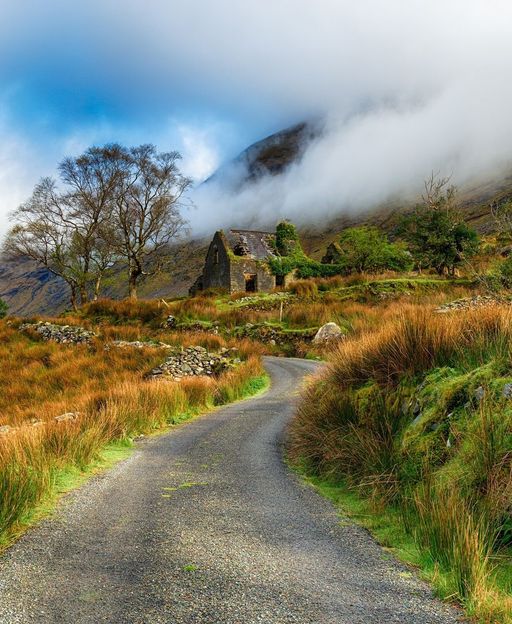
For the estimated 70 million people worldwide who claim Irish ancestry, these ruins mean more than scenery. Many represent the actual homes of actual ancestors — the specific walls between which a great-great-great-grandmother was born, ate her last meal in Ireland, and walked away from forever. Understanding what these ruins are, why they exist, and where to find them is one of the most powerful things an Irish diaspora visitor can do before they leave.
What the Ruins Are and Why They Are Everywhere
Before the Famine, Ireland had a population of approximately 8 million people. By 1900, that number had fallen to around 4 million — a loss of half the population through starvation, disease, and emigration that has no parallel in 19th-century Europe. The people who lived in these cottages belonged to a class of smallholders and landless labourers who survived almost entirely on potatoes. When the blight destroyed the potato crop for three consecutive years between 1845 and 1847, that survival system collapsed entirely.
Landlords evicted hundreds of thousands of tenants who could no longer pay rent. In some cases, they demolished the cottages immediately to prevent evicted families from returning and to avoid paying the local poor rate — a tax levied on landowners for unoccupied buildings. This practise, called “tumbling,” destroyed somewhere between 250,000 and 500,000 homes across Connacht and Munster in the decade after 1845. Many of the ruins that survive today are what the landlords did not bother to tumble — cottages so remote, so small, or so recently abandoned that demolition did not seem worth the cost.
Others fell into ruin more slowly. A family emigrated. The son who would have inherited the farm did not return. The roof rotted, then collapsed. The walls held for another century, and then another, because dry stone and lime mortar hold remarkably well when nobody maintains them but nobody tears them down either.
The Specific Places Where the Ruins Are Densest
The ruins do not spread evenly. They concentrate in the areas that had the highest populations before the Famine and the least agricultural resilience when the blight struck — the coastal and hillside communities of Connacht and Munster that depended almost entirely on a potato monoculture grown in deep lazy beds on marginal land.
- Connemara, County Galway — The area around Maam Cross, Roundstone, and the Twelve Bens contains dense concentrations of abandoned settlements. The Connemara hillsides hold some of the largest groupings of pre-Famine ruins in Ireland, many now partially covered by bog growth.
- Achill Island, County Mayo — The deserted village of Slievemore on Achill’s north slope contains around 100 stone cottage ruins arranged along a single track road, abandoned in the Famine years and never reoccupied. It is one of the most accessible and complete ghost villages in Ireland.
- West Kerry and the Dingle Peninsula — The Black Valley south of Killarney and the hillside settlements above Dingle are scattered with ruins. The Black Valley had a population of several hundred before the Famine; today fewer than 30 people live there.
- The Burren, County Clare — The limestone plateau of the Burren contains a different kind of ruin — the old field systems of medieval and pre-Famine farmers, visible as low walls and terraced strips carved into the rock by people who had nothing but their hands and their time.
- Erris, County Mayo — The northwest corner of Mayo, around Belmullet and Bangor Erris, suffered some of the worst Famine losses in Ireland. The landscape holds ruins at almost every turn, and the population never recovered to pre-Famine levels.
What Life Looked Like Inside One of These Cottages
The standard pre-Famine cottage in the west of Ireland was a single-room structure, roughly 5 metres by 10 metres, built from stone gathered off the surrounding fields, roofed with thatch over a wooden frame, and floored with beaten earth. A turf fire burned at one end or in the centre of the room. The smoke found its way out through a hole in the thatch or through the door.
A family of six to ten people lived, ate, slept, and sheltered from the rain in this space. A pig or a calf might share the cottage in winter. The few items of furniture — a table, a dresser, some stools — belonged to the household’s most valuable portable possessions. The cottage itself, the land around it, and the lazy beds of potatoes growing on the hillside constituted the entire material world of a family that had no other income, no savings, and no margin for a failed harvest.
This life was not poverty in the modern sense of the word — it was a life of near-complete dependence on a single food source in a system where the landlord held total power. When the potato failed, families had nothing to sell, nothing to trade, and nowhere to go. The workhouses filled to capacity and beyond. Soup kitchens served food to three million people at the peak of the crisis in 1847. The coffin ships carried the emigrants who could scrape together the passage money — or whose landlords paid their fares to clear the estate.
☘️ Enjoying this? 64,000+ Ireland lovers get stories like this every week. Subscribe free →
Finding the Ruin Your Family Left Behind
If your family emigrated from the west of Ireland in the 1840s or 1850s, there is a good chance the townland they left still exists and the site of their cottage is still visible — overgrown, ruined, or reduced to a low wall, but still there.
The first step is to identify the townland. Every emigrant ship manifest, every death certificate filed by an Irish-born immigrant in America, every gravestone inscription that records a county of origin may also record a townland or a parish. The civil registration records at the National Archives and the 1901 and 1911 Irish censuses can help narrow a county to a specific townland. Griffith’s Valuation (1847 to 1864) names every head of household in every townland in Ireland — searchable for free at askaboutireland.ie.
Once you have the townland name, the Logainm database will map it for you. Ireland’s townlands west of the Shannon number in the thousands and are small enough that you can walk one in under an hour. The ruins, where they survive, are often the most obvious features of the landscape — dark stone against green grass, walls still standing a metre or two above ground, doorways facing south to catch what light the Irish sky offers.
The Irish Diaspora Centre at Knock in County Mayo provides genealogy services specifically for diaspora visitors attempting to connect with townland-level records. Many county genealogy centres — the Clare Heritage and Genealogy Centre in Corofin, the Mayo North Family Heritage Centre in Crossmolina — hold local records not yet digitised, including estate records, rent rolls, and landlord maps that can identify the specific holding your family occupied.
Walking the Land
Standing in a ruined cottage in the west of Ireland is a different experience from reading about the Famine in a book. The scale is different — the rooms are always smaller than you expected. The view through the doorway is almost always beautiful — these were not bad sites, just brutal times. The silence, punctuated by wind and birds, is not emptiness but the absence of everything that was there before.
Many diaspora visitors report that standing in the townland their ancestors left is the most powerful moment of their entire trip to Ireland. The ruins don’t answer questions. They confirm them — confirming that this place existed, that these people existed, and that the distance between here and wherever the family went goes beyond geography but of a decision people made under impossible pressure, one ordinary morning in the middle of the 19th century, and never reversed.
Where are the best preserved Famine ruins in Ireland?
The most accessible and complete Famine-era ruins are at the Deserted Village of Slievemore on Achill Island, County Mayo — around 100 stone cottages along a hillside track, easily walked in under an hour. Connemara in County Galway and the hillside settlements around Dingle and the Black Valley in County Kerry also contain dense clusters of Famine-era ruins. Most are on public land or accessible via public roads and footpaths.
Can I find out if my family’s specific cottage is still standing?
Yes, in many cases. Start by identifying the townland from emigrant records, death certificates, or census returns. Then check Griffith’s Valuation (free at askaboutireland.ie) to confirm your family name at a specific address. Historic Ordnance Survey maps from the 1840s, available free via Tailte Éireann (OSi’s successor body), show buildings that existed before and during the Famine. Cross-referencing a 1840s map with a modern satellite view can often identify exactly where a pre-Famine structure stood.
How many Irish people emigrated during the Famine?
Between 1845 and 1855, approximately 2.1 million people emigrated from Ireland — the largest single decade of emigration in Irish history. The majority went to the United States, particularly to New York, Boston, and Philadelphia. Around 300,000 went to Canada, often via the less expensive route through Quebec. Many of those who arrived in Canada travelled overland to the United States within a year of landing. The emigration continued at high rates for the rest of the 19th century, reducing Ireland’s population from around 8 million in 1841 to approximately 4.4 million by 1900.
What is the Black Valley in Kerry?
The Black Valley — An Coom Dubh in Irish — is a remote glacial valley south of Killarney in County Kerry, accessible via a narrow road over Moll’s Gap or through the Gap of Dunloe. Before the Famine, several hundred people lived in the valley in small scattered settlements. Today fewer than 30 people live there permanently. The valley contains some of the most photographed ruin landscapes in Ireland — stone cottages dissolving into the hillside in a setting of remarkable beauty.
October is Family History Month — if your roots are in County Kerry, Galway, Mayo, or anywhere along Ireland’s western coast, the ruins your ancestors left behind are still findable. The free ancestry guide below walks through the records that can narrow a county to a specific townland and a townland to a specific field.
☘️ Join 64,000+ Ireland Lovers
Every weekday morning, get Ireland’s hidden gems, local secrets, and travel inspiration — the kind you won’t find in any guidebook.
Subscribe free — enter your email:
Already subscribed? Download your free Ireland guide (PDF)
📲 Know someone who’d love this? Share on WhatsApp →
Love more? Join 43,000 Scotland lovers → · Join 29,000 Italy lovers → · Join 7,000 France lovers →
Free forever · Unsubscribe anytime
Tours & experiences you might love


Powered by Viator. Some links are affiliate links — we may earn a small commission at no extra cost to you.
Secure Your Dream Irish Experience Before It’s Gone!
Planning a trip to Ireland? Don’t let sold-out tours or packed attractions spoil your journey. Iconic experiences like visiting the Cliffs of Moher, exploring the Rock of Cashel, or enjoying a guided walk through Ireland’s ancient past often sell out quickly—especially during peak travel seasons.

Booking in advance guarantees your place and ensures you can fully immerse yourself in the rich culture and breathtaking scenery without stress or disappointment. You’ll also free up time to explore Ireland’s hidden gems and savour those authentic moments that make your trip truly special.
Make the most of your journey—start planning today and secure those must-do experiences before they’re gone!