

Goibniu is the smith god of Irish mythology. He made the weapons that won the Tuatha Dé Danann their greatest battle. He also brewed an ale that kept the gods from ageing. In the old stories, a god who could do both was worth more than a king.
Most people know the Tuatha Dé Danann for their kings and warriors. Goibniu is different. He is a worker. He stands at the forge, hammer in hand, while the heroes take the credit. That makes him one of the most human gods in Irish legend.
Who Is Goibniu in Irish Mythology?
Goibniu (say it GOV-new) is the divine smith of the Tuatha Dé Danann. Medieval Irish writers recorded his story in manuscripts such as the Cath Maige Tuired, the “Second Battle of Moytura”. The name comes from the Old Irish word for smith, gobae.
He never works alone. Goibniu leads a trio of craftsmen. Each has a trade, and each trade matters in war.
- Goibniu is the smith. He forges the spearheads and swords.
- Credne is the bronze-worker. He makes the rivets and fittings.
- Luchta is the carpenter. He cuts the spear shafts and shields.
Together they are the gods’ armoury. Without them, the Tuatha Dé Danann have nothing to fight with.
The Smith Who Armed the Gods
The story starts with a wounded king. Nuada lost his arm in the first battle and had to give up the throne. The half-Fomorian Bres took his place and ruled badly. When Nuada won back the crown, the gods prepared for a second war against the Fomorians.
The young hero Lugh arrived at Tara and took charge of the plan. He called the craftsmen to him. Goibniu, Credne and Luchta set to work.
The texts describe a kind of divine production line. Goibniu hammered out the spearheads. Luchta made the shafts. Credne finished the rivets so fast that they flew from his tongs into place. Three blows from Goibniu were enough for each spearhead.
The weapons were not ordinary. In the stories, a spear from Goibniu’s forge always found its mark. A wound from it could not be healed. That put the Fomorians at a deadly disadvantage.
☘️ Enjoying this? 64,000 Ireland lovers get stories like this every week. Subscribe free →
The Healing Well and the Forge
The smith had a partner in the fight. Dian Cécht, the god of healing, kept a well that brought wounded gods back to life. Goibniu’s weapons killed. Dian Cécht’s water saved. Between them, the Tuatha Dé Danann could fight longer than their enemies.
The Fomorians learned about the well and sent a spy. Irish legend often follows this pattern. The gods win by skill and craft, not by strength alone.
Goibniu’s Feast and the Ale of Youth
Goibniu had a second gift. He hosted a famous feast, the Fled Goibnenn, or “Feast of Goibniu”. Everyone who drank his ale at the feast was safe from old age and illness.
The ale is the reason Goibniu is sometimes more than a smith. He belongs to a wider idea in Celtic belief. The craftsman who works fire and metal can also change a person. Smiths turned rough ore into tools. Goibniu turned a drink into a gift of long life.
Do not read this as a recipe or a literal belief. These are stories. Irish writers told them to explain how their ancestors saw the world. Metal, fire and drink all carried a hint of magic.
The Smith Across the Celtic World
Goibniu has cousins in other Celtic lands. Welsh tradition has Gofannon, a smith in the family of Dôn. In Roman-era Gaul, inscriptions name a god called Gobannus, a name that comes from the same root. A shared word for smith suggests a shared idea of the smith as a figure of power.
Irish folk tales keep the memory alive in a more earthly form. The Gobán Saor, or “Smith-Builder”, is a clever craftsman who outwits kings and cheats the greedy. People told his stories at firesides for centuries.
You can read more about how real smiths shaped Irish life in our piece on the village forge. Everyone in a rural parish knew the smith. He fixed the plough and shod the horse. In the stories, he armed the gods.
The Real Metalworkers Behind the Myth
Goibniu did not come from nowhere. Ireland had skilled metalworkers thousands of years before the manuscripts were written. Copper was mined in the south-west in the Bronze Age. Mount Gabriel in County Cork and Ross Island near Killarney are both known sites.
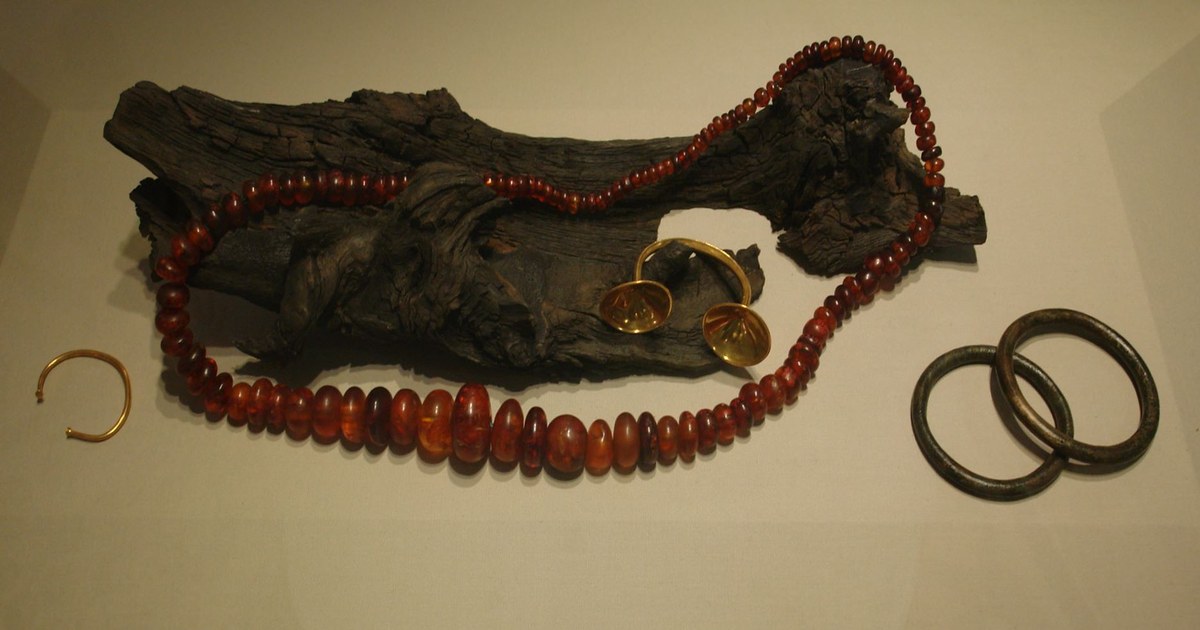
Irish smiths made gold ornaments, bronze axes and fine jewellery. The photograph above shows one example. It is a hoard found at Meenwoun in County Offaly, dated to roughly 800 to 700 BC. It holds a gold dress fastener, a gold bracelet, bronze rings and an amber necklace.
When you stand in front of pieces like these, the legend makes sense. People who could make such things looked like wizards to their neighbours. It is easy to see how a smith became a god.
Where to See Irish Bronze Age Metalwork
- The National Museum of Ireland – Archaeology on Kildare Street, Dublin, holds a large collection of Bronze Age gold and metalwork. Check the official museum site for opening details.
- The Hill of Tara in County Meath is the setting for Lugh’s call to the craftsmen in the story.
- Local heritage centres in the south-west explain the ancient copper mines.
Tara also links to the gods’ wider history. Our guide to the six mythological invasions of Ireland shows where the Tuatha Dé Danann fit in the long story. For their sacred objects, see the four treasures they left behind. The Dagda and his cauldron belong to the same world.
Why Goibniu Still Matters
The Irish diaspora carried these stories across the Atlantic. Families in Boston, Chicago and Sydney told them to children long after they left home. A god who works with his hands speaks to people who built railways, canals and cities.
Goibniu reminds us that skill is a kind of magic. Heroes need someone to make their weapons. Kings need someone to feed them. In Irish legend, the craftsman never loses his place at the table.
Frequently Asked Questions About Goibniu
Who is Goibniu in Irish mythology?
Goibniu is the smith god of the Tuatha Dé Danann. He forged the weapons they used in the Second Battle of Moytura and hosted the Feast of Goibniu, where his ale kept the gods young.
What did Goibniu make?
Goibniu made spearheads and swords. In the stories, his spears never missed, and the wounds they caused could not be healed. He worked alongside Credne the bronze-worker and Luchta the carpenter.
What was the Feast of Goibniu?
The Fled Goibnenn was a feast hosted by Goibniu. Those who drank his ale were said to be free from age and illness. It is one of the best-known tales about the smith god.
Is Goibniu related to the Welsh god Gofannon?
Scholars think so. Gofannon is the Welsh smith, and both names come from a shared Celtic word for smith. A Gaulish god called Gobannus also appears to belong to this group.
Where can I see Irish Bronze Age metalwork today?
The National Museum of Ireland – Archaeology in Dublin has the main national collection of Bronze Age gold and bronze. Smaller local museums across the country show finds from their own counties.
Next time you pass an old forge or a museum case of golden rings, think of Goibniu. The Irish told his stories because they knew that someone had to make the tools. Where did your family’s stories begin? Hit reply and tell us the legend you heard as a child.
☘️ Join 64,000+ Ireland Lovers
Every Friday, get Ireland’s lesser-known corners, local stories and secrets, straight to your inbox.
Subscribe free — enter your email:
Already subscribed? Download your free Ireland guide (PDF)
📲 Know someone who’d love this? Share on WhatsApp →
Free forever · One email per week · Unsubscribe anytime
Tours & experiences you might love


Powered by Viator. Some links are affiliate links — we may earn a small commission at no extra cost to you.
Secure Your Dream Irish Experience Before It’s Gone!
Planning a trip to Ireland? Don’t let sold-out tours or packed attractions spoil your journey. Iconic experiences like visiting the Cliffs of Moher, exploring the Rock of Cashel, or enjoying a guided walk through Ireland’s ancient past often sell out quickly—especially during peak travel seasons.

Booking in advance guarantees your place and ensures you can fully immerse yourself in the rich culture and breathtaking scenery without stress or disappointment. You’ll also free up time to explore Ireland’s hidden gems and savour those authentic moments that make your trip truly special.
Make the most of your journey—start planning today and secure those must-do experiences before they’re gone!