

County Kerry draws around 1.7 million visitors every year — and a growing number of them never want to go home. Stretching across the southwest corner of Ireland, Kerry offers the kind of life that is genuinely difficult to find elsewhere: wild Atlantic coastline, small towns where everybody knows your name, traditional music sessions on a Wednesday evening, and a pace that makes you wonder why you were ever in such a hurry. For Americans with Irish roots or simply a deep love of Ireland, Kerry has a particular pull — and once you understand what daily life here actually looks like, it is easy to see why.
What County Kerry Actually Looks Like
Kerry sits in the far southwest of Ireland, with the Shannon Estuary to the north and the Atlantic Ocean on three sides. The county covers 4,807 square kilometres — the fifth largest of Ireland’s 32 counties by area — but its population of just under 160,000 people means it never feels crowded. That contrast between dramatic scale and quiet intimacy sits at the heart of Kerry’s appeal.
The landscape comes in layers. The Ring of Kerry, a 179-kilometre circular route around the Iveragh Peninsula, takes you through some of the most photographed scenery in Ireland: glacially carved mountains, hidden beaches, stone-walled farmland, and fishing villages where boats still go out before dawn. The Dingle Peninsula to the north feels even more dramatic — a long finger of land jutting into the Atlantic, holding ancient stone forts, beehive huts over 1,400 years old, and some of Europe’s finest surfing beaches. Then there are the Skellig Islands, two rocky pinnacles 12 kilometres offshore, where early Christian monks built a monastery on the cliffs in the 6th century and lived in stone cells no bigger than a modern bathroom.
The Gulf Stream warms Kerry’s coast, giving the county a mild, damp climate that keeps the landscape an extraordinary shade of green year-round. Winters rarely turn harsh. Springs arrive early. Even February brings stretches of clear, bright days on the Dingle Peninsula — the kind of light that explains why so many artists have ended up here.
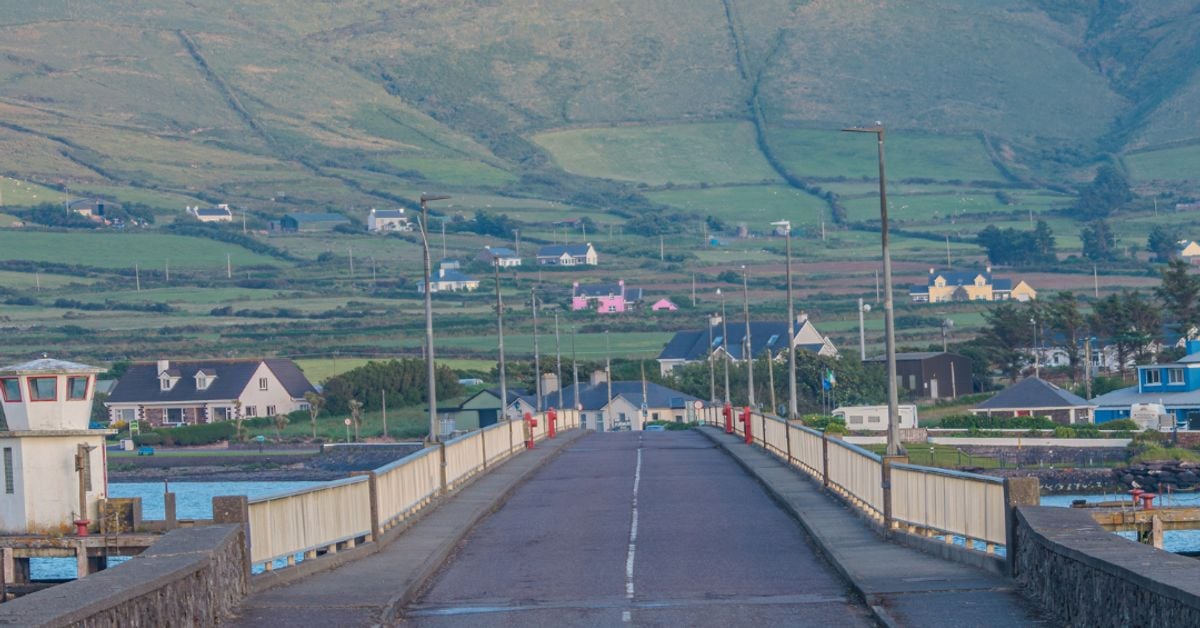
The Towns That Americans Fall For
Kerry’s towns are small, characterful, and genuinely liveable. Killarney is the county’s largest settlement, with around 15,000 people — big enough to have everything you need, small enough that a trip to the supermarket still involves running into someone you know. Three lakes border the town to the south, and Killarney National Park — Ireland’s oldest, covering around 102 square kilometres — serves as a natural back garden for the whole community.
Tralee, the county capital with around 25,000 people, has a genuine everyday Irish town feel that differs considerably from the tourist-heavy experience of Killarney. Good restaurants, a farmers’ market, a theatre, and a strong local community have drawn a steady stream of Americans here over the past two decades. Tralee also holds the Kerry County Museum, which traces the county’s history from the Stone Age to the present.
Dingle — known in Irish as An Daingean — tends to end conversations about Kerry. Around 2,000 people live here year-round, and most of them cannot imagine living anywhere else. A working fishing fleet uses the harbour, and on any given evening you can walk into Dick Mack’s pub or Foxy John’s (part hardware shop, part bar, entirely Kerry) and find a session already underway. Traditional music here is not a tourist performance — it is just how people spend their Tuesday night.
Kenmare is smaller still, a pretty market town of around 2,500 people in the south of the county. People who want access to the Ring of Kerry without the summer crowds of the larger centres often settle here. Its food scene punches well above the town’s size, and it has attracted a community of artists, craftspeople, and remote workers in recent years.
What Everyday Life in Kerry Actually Feels Like
The thing that surprises people most about life in Kerry is how self-contained the county is. It has everything: good schools, hospitals, shops, restaurants, sports facilities, and a cultural life that punches above its weight. The Kerry Writers’ Museum in Listowel celebrates one of the most remarkable literary traditions in Ireland — a county that produced John B. Keane, Bryan MacMahon, and Maurice Walsh (whose 1933 novel The Quiet Man gave John Ford one of his most beloved films). Listowel’s Writers’ Week festival, held every May, draws writers and readers from across the world to a town of 4,000 people.
Kerry’s food scene has evolved considerably over the past 15 years. Seafood — crab, lobster, Atlantic salmon, Dingle Bay prawns — arrives fresh to kitchens daily. The county’s dairy farms produce milk and butter that regularly win national awards. Farmers’ markets in Dingle, Kenmare, and Killarney run through most of the year, and the number of independent restaurants committed to local produce has grown significantly since the mid-2010s.
Sport matters enormously in Kerry. The county has won the All-Ireland Football Championship 39 times — more than any other county in Ireland — and on match days, the whole county wears green and gold. For newcomers, getting involved with GAA (playing, watching, or simply turning up to support the local club) offers one of the fastest routes into the community. The GAA club sits at the heart of social life in almost every Kerry town and village.
☘ Enjoying this? 64,000+ Ireland lovers get stories like this every week. Subscribe free
The Kerry Connection for Americans
Kerry has one of the strongest connections to the Irish diaspora in America of any county in Ireland. During the Great Famine of the 1840s, Kerry lost roughly a quarter of its population — an estimated 100,000 people left the county between 1845 and 1855, most sailing to Boston, New York, and Philadelphia. Those departure records from Cobh and Tralee make Kerry one of the most-traced counties in Irish-American genealogy research.
The surnames of Kerry — Sullivan, Moriarty, O’Connor, O’Shea, Foley, Clifford — run deep throughout the Irish-American community, particularly in New England, where many Kerry families settled together and maintained close connections between specific villages in Ireland and specific neighbourhoods in Boston or Springfield. Irish-Americans researching their heritage often find Kerry’s county archives in Tralee and the genealogy services at Kerry County Library to be their natural starting point.
This history gives Kerry a particular resonance for American visitors — and for those thinking about a longer stay. Many people describe a sense of coming back to something, even on a first visit. If you want to make that move permanent, our full guide to retiring in Ireland covers the practical and financial side of life in the country in detail.
The Outdoors Life Kerry Makes Easy
Kerry is a county built for people who want to spend time outside. The Wild Atlantic Way, the 2,500-kilometre coastal route along Ireland’s western coast, reaches some of its most spectacular sections here. Within the county, the options vary enough to sustain a lifetime of exploration: sea kayaking on Dingle Bay, hillwalking on Carrauntoohil (at 1,038 metres, Ireland’s highest mountain), surfing at Inch Beach or Banna Strand, cycling the Dingle Way, or walking the cliff paths around the Blasket Islands.
Killarney National Park covers around 102 square kilometres of woodland, lake, and mountain — all of it accessible on foot or by bicycle. Deer move freely through the oak woods. Red squirrels, otters, and white-tailed eagles appear regularly to those patient enough to look. The park itself dates to 1932, when Arthur Vincent and his American in-laws, the Bourn family, gifted the Muckross Estate to the Irish nation in memory of his late wife, Maud.
Kerry’s surf beaches rank among the best in Europe. Inch Beach stretches for 5 kilometres into Dingle Bay, and Ballybunion on the north Kerry coast draws surfers from across the continent every season. The Kerry Way walking trail, at 215 kilometres, circles the Iveragh Peninsula and takes most walkers 8 to 10 days to complete — one of the oldest and best-maintained long-distance trails in Ireland.
Why Kerry Stays With You
There is a quality to life in Kerry that people who have moved here from larger cities or from abroad consistently describe but struggle to pin down. The pace is different — not slower in any way that implies laziness, but slower in the sense that conversations have room to develop, meals have no set end time, and the weekend really does belong to you. People stop to talk. Doors stay open. Strangers help without being asked.
The landscape amplifies all of this. Living somewhere this beautiful has a daily effect that is hard to overstate. The drive from Killarney to Dingle, crossing the Conor Pass at 456 metres with views stretching out to the Blasket Islands, is not just a commute — it is a reminder, every day, of where you are. Kerry people know this and feel no embarrassment saying so. Pride in place runs deep here, and it includes newcomers who arrive with genuine respect for what they have found.
What is County Kerry best known for?
County Kerry is best known for the Ring of Kerry scenic drive (179 kilometres), the Dingle Peninsula, the UNESCO-listed Skellig Michael monastery (founded in the 6th century), Killarney National Park (around 102 square kilometres), and its traditional music scene. Kerry has also won the All-Ireland Football Championship 39 times — more than any other county in Ireland.
Is County Kerry a good place to live in Ireland?
County Kerry consistently ranks among Ireland’s most desirable places to live, particularly for those who value outdoor life, a strong sense of community, and access to exceptional natural scenery. Towns like Killarney, Dingle, Kenmare, and Tralee offer good services and an active social life while staying small enough to feel genuinely connected. The county has a population of around 160,000 and covers 4,807 square kilometres.
What is the Dingle Peninsula famous for?
The Dingle Peninsula is famous for its dramatic Atlantic scenery, its Irish-language culture (Dingle forms part of the Gaeltacht, one of Ireland’s Irish-speaking regions), its traditional music scene, and sites including the Gallarus Oratory — a dry-stone church standing since around 800 AD — the Blasket Islands, and Fungie the dolphin, who lived in Dingle Harbour for over 37 years. It also holds some of Ireland’s finest seafood restaurants.
How do I get to County Kerry from Dublin?
County Kerry lies approximately 340 kilometres from Dublin. By car on the M7 and N21 route, the journey takes around 3.5 hours. Direct trains from Dublin Heuston to Killarney run several times daily and take around 3 hours. Bus Eireann operates daily coach services from Dublin to Tralee and Killarney, taking around 4 hours. Kerry Airport near Farranfore also receives direct flights from several UK and European cities.
☘ Join 64,000+ Ireland Lovers
Every weekday morning, get Ireland’s hidden gems, local secrets, and travel inspiration — the kind you won’t find in any guidebook.
Subscribe free — enter your email:
Know someone who’d love this? Share on WhatsApp
Free forever · Unsubscribe anytime
Tours & experiences you might love


Powered by Viator. Some links are affiliate links — we may earn a small commission at no extra cost to you.
Secure Your Dream Irish Experience Before It’s Gone!
Planning a trip to Ireland? Don’t let sold-out tours or packed attractions spoil your journey. Iconic experiences like visiting the Cliffs of Moher, exploring the Rock of Cashel, or enjoying a guided walk through Ireland’s ancient past often sell out quickly—especially during peak travel seasons.

Booking in advance guarantees your place and ensures you can fully immerse yourself in the rich culture and breathtaking scenery without stress or disappointment. You’ll also free up time to explore Ireland’s hidden gems and savour those authentic moments that make your trip truly special.
Make the most of your journey—start planning today and secure those must-do experiences before they’re gone!