

The Tuatha Dé Danann were the divine race of ancient Ireland. They ruled the island for centuries before human settlers arrived. Irish mythology remembers them as gods. Scholars describe them as the remnants of pre-Christian deities. Their names still echo through Irish literature, place names, and folklore today. If you have Irish ancestry, this is the mythology that shaped your ancestors’ understanding of the world.
Who Were the Tuatha Dé Danann?
The name Tuatha Dé Danann translates as the Tribes of the Goddess Danu. They appear in the earliest written Irish mythology. Monks recorded their stories in medieval manuscripts, preserving the old traditions in Christian-era Ireland. The key text is the Lebor Gabála Érenn, or Book of Invasions, compiled around the eleventh century.
According to this tradition, the Tuatha Dé Danann came from four mystical northern cities. These were Falias, Gorias, Finias, and Murias. Each city had a wise man who taught the Tuatha their arts. From these cities, they brought four magical treasures to Ireland. These treasures became the founding objects of Irish sovereignty and power.
I find it striking that every treasure they carried has a specific purpose tied to kingship. The Irish didn’t just tell stories of gods. They told stories of gods who legitimised the right to rule. That connection between divine ancestry and earthly authority runs through Irish culture for thousands of years.
The Four Treasures of the Tuatha Dé Danann
Each of the four cities contributed one object to the Tuatha’s arrival in Ireland. These were not decorative items. They were tools of power with specific symbolic weight in Irish culture.
- The Lia Fáil — the Stone of Destiny, brought from Falias. It stood on the Hill of Tara. Legends say it cried out when the rightful High King of Ireland stood on it. A stone at Tara today is traditionally identified as the Lia Fáil.
- The Spear of Lugh — brought from Gorias. No battle could be won against whoever wielded it. It belonged to Lugh, one of the most celebrated gods of the Irish tradition.
- The Sword of Nuada — brought from Finias. Once drawn, no enemy could escape it. It belonged to Nuada, the first king of the Tuatha Dé Danann.
- The Cauldron of the Dagda — brought from Murias. This cauldron never ran empty. No one left it hungry. It belonged to the Dagda, the Father of the Gods.
These four treasures appear across later Irish legend and ritual. The cauldron of plenty echoes in the myths of the Holy Grail. The Lia Fáil connects to the real coronation stones of Ireland and Scotland alike. The treasures became part of how Irish people understood sacred kingship.
The Great Battles That Shaped Ancient Ireland
The Tuatha Dé Danann did not arrive in Ireland unchallenged. They faced two great enemies. First came the Fir Bolg, an earlier race of settlers who controlled the island. Then came the Fomorians, dark supernatural beings associated with chaos and the underworld.
The First Battle of Magh Tuireadh settled things with the Fir Bolg. The Tuatha Dé Danann won, but their king Nuada lost his arm in the fighting. Irish law required a king to be physically whole. Nuada could no longer rule. A silver prosthetic arm was made for him — a detail that gives the battle an unexpectedly human quality.
The Second Battle of Magh Tuireadh was larger and more dramatic. This one pitted the Tuatha against the Fomorians. The battle is fought mainly in County Sligo, near the hills above Lough Arrow. The warrior-god Lugh played the central role. He killed Balor of the Evil Eye, the Fomorian king, with a sling stone through the infamous eye that destroyed whatever it looked upon.
After that victory, the Tuatha ruled Ireland. Their golden age lasted until the Milesians arrived — the ancestors of the Irish people themselves. When the Milesians defeated the Tuatha, something extraordinary happened. The Tuatha did not die. They retreated beneath the earth.
☘️ Enjoying this? 64,000 Ireland lovers get stories like this every week. Subscribe free →
The Major Gods of the Tuatha Dé Danann
The Tuatha Dé Danann were not a vague collective. They had specific, named individuals with distinct roles and personalities. These figures shaped how the Irish understood the world around them — and many of their stories still circulate in Irish homes today.
The Dagda — Father of the Gods
The Dagda was the chief god and father figure of the Tuatha. His name meant the Good God — not good in a moral sense, but good at everything. He was immensely powerful and often described as enormous. He carried a great club that could kill nine men with one end and bring them back to life with the other. He also owned the cauldron of plenty and a magical harp that could control the seasons.
Lugh — The Long-Handed
Lugh was the sun god and the most celebrated warrior in the mythological cycle. His name lives on in the harvest festival Lughnasadh, celebrated on the first of August each year — a tradition that began as a festival in his honour. Lugh was said to be skilled at every craft. When he arrived at the door of the divine palace and asked to enter, they asked what trade he had. He listed every craft in turn. The doorkeeper replied that they already had a master of each. Lugh pointed out that they had no one who mastered all of them at once. He was let in.
The Morrigan — Goddess of War and Fate
The Morrigan was a triple goddess associated with war, fate, and sovereignty. She appeared to warriors before battle. If a crow circled overhead before a fight, men knew the Morrigan was watching. She could take the form of a crow or raven. She tested the courage and loyalty of heroes, including Cú Chulainn himself. She remains one of the most complex and compelling figures in Irish mythology.
Brigid — Goddess of Poetry, Healing, and Craft
Brigid was the daughter of the Dagda and one of the most beloved figures in the Irish tradition. She governed poetry, healing, and metalwork. When Christianity arrived, the Church created Saint Brigid to absorb her devotion. The feast of Imbolc — February 1st — became her day in both traditions. Brigid’s cross, woven from rushes, is still made in Irish homes each year on the first of February. My own grandmother made one every year, hanging it above the door to protect the household. What began as a ritual honouring a goddess became a family memory that lasts.
Manannán Mac Lir — Lord of the Sea
Manannán mac Lir ruled the sea and the realm of the dead. He owned a boat that steered itself and a horse that ran across water. He controlled the island paradise Tír na nÓg — the Land of Eternal Youth — where the dead and the blessed went after their lives on earth. Sailors in early Ireland would pray to Manannán before crossing the water. Tradition holds that the Isle of Man takes its name from him, though the two names likely share a common Celtic root rather than one deriving directly from the other.
How the Tuatha Dé Danann Became the Fairy Folk
When the Milesians — the ancestors of the Gaelic Irish — defeated the Tuatha Dé Danann, a settlement was reached. Ireland was divided in two. The Milesians took the world above ground. The Tuatha Dé Danann took the world below it.
The Tuatha retreated into the síde — the fairy mounds that dot the Irish landscape. Newgrange in County Meath became the home of the Dagda. Knocknarea in County Sligo held other members of the divine race. The passage tombs at Brú na Bóinne were not just burial sites. They were, in myth, the palaces of the gods themselves.
Over time, the Tuatha Dé Danann transformed in popular memory. They became the Aos Sí — the people of the mounds. Smaller. More cautious. What had been mighty gods became the fairy folk of Irish tradition. The old power remained, but the scale shrank as Christianity reshaped the culture around them.
Families in County Mayo, County Clare, and County Sligo told stories of the fairy folk as recently as the nineteenth century. Travellers avoided fairy paths. Farmers left offerings at well-known síde mounds. The distinction between mythology and lived folk belief stayed thin in rural Ireland for a very long time.
If your ancestors came from the west of Ireland, they carried these stories with them. The parents of emigrants from County Mayo and County Clare knew which hills were inhabited. That knowledge crossed the Atlantic and faded slowly. But the stories remained.
Where to Experience the World of the Tuatha Dé Danann Today
Several sites across Ireland connect directly to the mythology of the Tuatha Dé Danann. These are not just tourist attractions. They are places where the landscape and the stories converge.
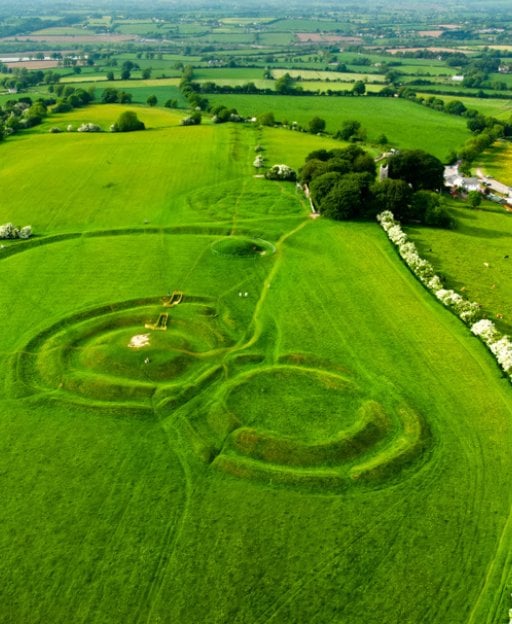
The Hill of Tara, County Meath. Tara was the ceremonial seat of the High Kings of Ireland. The Lia Fáil — the Stone of Destiny — still stands on the hill today. Walking Tara means walking the ground where Irish kingship was legitimised for over three thousand years. The Mound of the Hostages on the hill dates to around 2500 BC. The views across the Meath plain are extraordinary. You can find full details in our guide to County Meath heritage.
Brú na Bóinne, County Meath. The great passage tombs at Newgrange, Knowth, and Dowth form the Brú na Bóinne — the Palace of the Boyne. In mythology, Newgrange was the home of the Dagda and later of his son Aengus. The site predates the Egyptian pyramids by five hundred years. The winter solstice sunrise illuminates the inner chamber on the shortest day of the year. Book tours through the official visitor centre.
The Hill of Uisneach, County Westmeath. Uisneach was considered the sacred centre of Ireland. A great flat stone — the Cat Stone — marks what ancient Ireland regarded as the exact middle of the island. Assemblies and fire festivals were held here for thousands of years. It remains one of the less-visited but most significant mythological sites in Ireland. Read more in our County Westmeath heritage guide.
Knocknarea, County Sligo. The great cairn on top of Knocknarea is associated with Queen Maeve — Medb — a powerful figure linked to the mythological tradition. The surrounding area of Sligo held deep significance for the Tuatha. The Second Battle of Magh Tuireadh was fought in this landscape. W.B. Yeats found his mythology in Sligo’s hills and lakes. So too did the earliest Irish storytellers.
For practical planning, see our guide to tracing your Irish ancestry and our Irish heritage trip planning guide.
The Tuatha Dé Danann and Irish Diaspora Identity
The Irish carried these stories across the Atlantic. In the decades after the Famine, families from County Clare, County Mayo, and County Galway settled in Boston, New York, and Chicago. They brought the old stories with them. A grandmother in South Boston might tell her grandchildren about the fairy folk with the same matter-of-fact tone she would use to describe the neighbours.
The Tuatha Dé Danann represent a pre-Christian Ireland — one that existed before Viking raids, before Norman castles, before English rule. They connect Irish-American families to something older than the Famine and older than emigration itself. The mythology reaches back five thousand years to a people who built Newgrange and stood on the Hill of Tara and watched the sun rise over the Meath plain.
That is your inheritance too, if you have Irish roots. Tracing your ancestry through county records and parish registers brings you to a specific townland and a specific family. But understanding the mythology brings you to the deeper cultural world those ancestors inhabited. The two go together. Start with our Irish ancestry guide to find the records, and return to the myths to understand what those ancestors believed.
Frequently Asked Questions About the Tuatha Dé Danann
Who were the Tuatha Dé Danann in Irish mythology?
The Tuatha Dé Danann were a divine race in Irish mythology. Their name means Tribes of the Goddess Danu. They arrived in Ireland from four northern cities, bringing four magical treasures. They ruled Ireland before the arrival of the Milesians — the mythological ancestors of the Gaelic Irish. After their defeat, they retreated underground into the fairy mounds, where they became the Aos Sí or fairy folk of Irish tradition.
What treasures did the Tuatha Dé Danann bring to Ireland?
The Tuatha Dé Danann brought four treasures from their four mythical cities. From Falias came the Lia Fáil, the Stone of Destiny, which stands at the Hill of Tara today. From Gorias came the Spear of Lugh, which guaranteed victory in battle. From Finias came the Sword of Nuada, which no enemy could escape. From Murias came the Cauldron of the Dagda, which never ran empty of food.
Did the Tuatha Dé Danann become the fairies in Irish folklore?
Yes. After their defeat by the Milesians, the Tuatha Dé Danann withdrew into the síde — the fairy mounds. Over centuries, as Christianity transformed Irish culture, they diminished in popular memory from mighty gods to the fairy folk. They became known as the Aos Sí, or people of the mounds. Irish folklore preserved their stories in changed form across the midlands, the west, and the north of Ireland for over a thousand years.
Where can I visit sites connected to the Tuatha Dé Danann in Ireland?
The most important sites are the Hill of Tara in County Meath, where the Lia Fáil stands and the Tuatha held their royal seat. Brú na Bóinne — the passage tomb complex that includes Newgrange — was the mythological home of the Dagda. The Hill of Uisneach in County Westmeath was the sacred centre of Ireland. Knocknarea in County Sligo is linked to the broader mythological tradition of the same period. All four are accessible to visitors.
How are the Tuatha Dé Danann connected to modern Irish culture?
The Tuatha Dé Danann left a lasting mark on Irish culture. The goddess Brigid became Saint Brigid, and Brigid’s cross is still made in Irish homes today. The harvest festival Lughnasadh — August 1st — preserves the name of the god Lugh. Fairy traditions across the midlands and the west trace back to the mythology of the Tuatha. Place names across Ireland also carry their names. The Boyne River derives from the goddess Boann, one of the Tuatha Dé Danann.
☘️ Join 64,000+ Ireland Lovers
Every Friday, get Ireland’s hidden gems, local secrets, and travel inspiration — the kind you won’t find in any guidebook.
Subscribe free — enter your email:
📲 Know someone who’d love this? Share on WhatsApp →
Love more? Join 43,000 Scotland lovers → · Join 29,000 Italy lovers → · Join 7,000 France lovers →
Free forever · One email per week · Unsubscribe anytime
Tours & experiences you might love


Powered by Viator. Some links are affiliate links — we may earn a small commission at no extra cost to you.
Secure Your Dream Irish Experience Before It’s Gone!
Planning a trip to Ireland? Don’t let sold-out tours or packed attractions spoil your journey. Iconic experiences like visiting the Cliffs of Moher, exploring the Rock of Cashel, or enjoying a guided walk through Ireland’s ancient past often sell out quickly—especially during peak travel seasons.

Booking in advance guarantees your place and ensures you can fully immerse yourself in the rich culture and breathtaking scenery without stress or disappointment. You’ll also free up time to explore Ireland’s hidden gems and savour those authentic moments that make your trip truly special.
Make the most of your journey—start planning today and secure those must-do experiences before they’re gone!