

Clonmacnoise is a ruined monastic city on the River Shannon in County Offaly, founded around 545 AD, and it is one of the most rewarding early Christian sites to visit in Ireland. You can walk among three high crosses, a round tower, a cathedral and several small churches in about two hours. This Clonmacnoise guide covers the history, what to see, how to get there and how to fit it into a wider trip. For the latest opening times and ticket prices, check the official Heritage Ireland page for Clonmacnoise.
⚠️ Site closed (November 2026): Clonmacnoise is currently fully closed to visitors. The Office of Public Works has shut the car park for redevelopment works from 19 October 2026 until January 2027, with no safe access to the site in the meantime, and the rebuilt visitor centre is due to open in spring 2027. Check the official Heritage Ireland page for the latest status before you travel.
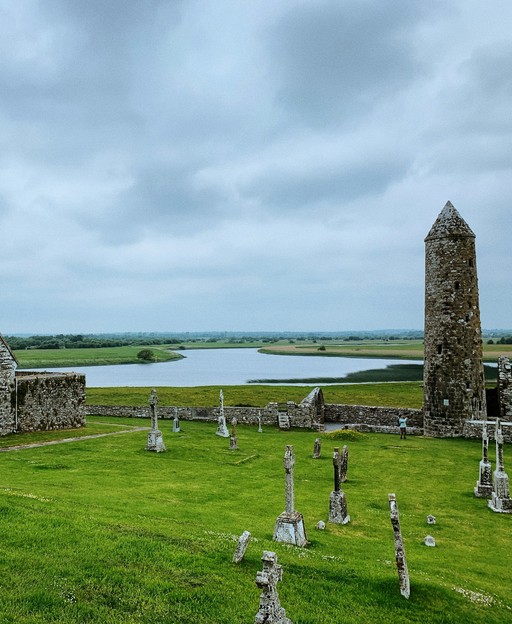
Why Clonmacnoise matters
Saint Ciarán founded Clonmacnoise around 545 AD, on the east bank of the Shannon. The river was the main road of early Ireland, and the site sat where it crossed the great ridge of glacial gravel known as the Eiscir Riada. That position made Clonmacnoise a crossroads for traders, kings and scholars.
Tradition says Ciarán died within a year of founding the settlement. The community he started kept growing anyway. Over the next six centuries it became a centre of learning, craftsmanship and pilgrimage that drew students from across Ireland and Europe.
The monks also wrote here. The Book of the Dun Cow, one of the oldest surviving manuscripts in the Irish language, was compiled at Clonmacnoise around 1100. It now belongs to the Royal Irish Academy in Dublin. It preserves early Irish tales, including parts of the great epic of the Táin.
Kings chose to be buried here too. Tradition holds that Ruaidrí Ua Conchobair, the last High King of Ireland, lies at Clonmacnoise. He died in 1198. The graveyard still draws people looking for a quiet, atmospheric place to walk.
A short history of the site
Clonmacnoise did not stay peaceful. Vikings, rival Irish kings and Anglo-Norman forces all raided it over the centuries, and fires destroyed parts of the settlement more than once. The community rebuilt each time. Visitors today see the stone remains from those later rebuilding phases.
- Around 545 AD: Saint Ciarán founds the monastery beside the Shannon.
- Around 900 AD: Carvers create the Cross of the Scriptures, the finest high cross on the site.
- 909 AD: The annals record work on the cathedral, the largest church in the complex.
- 1120s: Builders raise the round tower. The annals record lightning striking its top in 1135.
- 1167: Dervorgilla, wife of the king of Breifne, funds the Romanesque Nuns’ Church.
- 1552: English forces from the garrison at Athlone plunder the site, and the monastery never recovers.
Pilgrims kept coming after the monks left. Pope John Paul II visited Clonmacnoise in 1979, which shows how important the site remains to Irish Catholics.
What to see at Clonmacnoise
The site is compact and easy to walk. Most visitors follow a loop from the visitor centre to the graveyard, then back past the crosses. Wear shoes that cope with wet grass, because the ground can be soft after rain.
- The Cross of the Scriptures: This carved cross stands about four metres tall. Its panels show scenes from the Bible and from the life of the monastery. The original now sits in the visitor centre, and a replica stands on the old spot outside.
- The round tower: O’Rourke’s Tower rises nearly 20 metres above the graveyard. Monks used towers like this as bell towers, lookouts and safe stores for valuables. Read more in our guide to Irish round towers.
- The cathedral: This is the largest ruin on the site. Its north doorway has carved figures worth a close look.
- Temple Finghin: This small church has a round tower attached to its side. The mix of a church and a tower in one building is rare in Ireland.
- The Nuns’ Church: Its Romanesque doorway has detailed carving that survives in good condition. It sits a short walk from the main group of buildings.
- Temple Connor: This small church kept its roof and still hosts an annual service.
The visitor centre and exhibition
Normally you start at the visitor centre. The exhibition explains how the monks lived and worked, and usually lets you see the original high crosses, which staff moved indoors to protect them from the weather, plus a short film that sets the scene before you walk out among the ruins. The centre is closed for a major redevelopment until spring 2027, and the wider site is fully closed to visitors until January 2027 — see the notice above before you plan a trip.
Walking the graveyard
Take your time in the graveyard. Many of the grave slabs carry early inscriptions, and some carry the names of monks. Every walker notices the same thing: the view across the Shannon callows is wide, flat and calm. Go early or late in the day if you want the site mostly to yourself.
☘️ Enjoying this? 64,000+ Ireland lovers get stories like this every week. Subscribe free →
How to get to Clonmacnoise
Clonmacnoise sits about 125 km west of Dublin. The drive takes roughly two hours using the M6 and local roads. Athlone is the nearest large town, about 20 km to the north, and many visitors base themselves there.
- From Dublin: Take the M4 and M6 towards Athlone, then follow the signs south to Clonmacnoise.
- From Galway: Take the M6 east to Athlone, then head south. The journey takes about 90 minutes.
- By public transport: Buses and trains serve Athlone, but you will need a taxi or a tour to reach the site itself.
A car makes the trip much easier. Rural roads around the site are narrow, so allow extra time and drive carefully. If you plan to explore the wider midlands, our Ireland trip planning hub helps you decide how many days to spend.
Best time to visit
Normally, spring and early autumn work best. The light is soft, the grounds are green and the car park is less busy than in July and August. Summer afternoons can feel crowded when tour coaches arrive, and winter visits are quiet and atmospheric but daylight is short and the ground is wet. None of that applies right now: the site is fully closed to visitors during redevelopment works until January 2027, so check the official page for the current status before you set out, whatever the season.
Planning your day around Clonmacnoise
Most people spend about two hours at the site itself. That leaves plenty of time to see more of Offaly and the Shannon area in the same day.
- Athlone: Visit Athlone Castle on the Shannon for a museum and views over the river.
- Birr and Offaly: Our guide to the best things to do in County Offaly covers Birr Castle and the rest of the county.
- Rock of Cashel: Pair the trip with another great ecclesiastical site in our Rock of Cashel guide.
- Glendalough: Compare Clonmacnoise with another early monastic settlement in our Glendalough guide.
If you are building a longer route across the country, our 7-day Ireland road trip itinerary shows how Clonmacnoise fits between Dublin and the west. For wider county information, visit the Offaly County Council website. If you want to know what everyday life is like here, read about living in County Offaly.
Tips for your visit
- Bring a waterproof jacket. The site is open to the sky and the weather changes fast.
- Download or print a map. Mobile signal can be patchy near the river.
- Walk the full loop. The Nuns’ Church sits away from the main group and many people skip it.
- Take photographs from the graveyard edge. The round tower looks best with the Shannon behind it.
- Read the information panels. They explain which carvings are original and which are replicas.
Frequently asked questions
Is Clonmacnoise open right now?
No. Clonmacnoise is fully closed to visitors from 19 October 2026 until January 2027 while the Office of Public Works closes the car park for redevelopment works, and the rebuilt visitor centre is due to open in spring 2027. Check the official Heritage Ireland page for the current status before you travel.
How long do you need at Clonmacnoise?
Allow about two hours to see the visitor centre, the main ruins and the graveyard at a relaxed pace. Add extra time if you want to read every carving. This Clonmacnoise guide suggests pairing it with a stop in Athlone or Birr.
Is Clonmacnoise worth visiting?
Yes. It is one of the most important early Christian sites in Ireland, and it has high crosses, a round tower and a calm river setting. It suits history lovers, photographers and anyone tracing Irish roots.
Where is Clonmacnoise?
Clonmacnoise sits on the River Shannon in County Offaly, about 20 km south of Athlone and 125 km west of Dublin. You need a car or a tour to reach it.
Who founded Clonmacnoise?
Saint Ciarán founded the monastery around 545 AD. Over the following centuries it grew into one of the great centres of learning in early Ireland.
☘️ Join 64,000+ Ireland Lovers
Every weekday morning, get Ireland’s lesser-known corners, local stories and secrets, straight to your inbox.
Subscribe free — enter your email:
Prefer a link? Subscribe free →
Free forever · Unsubscribe anytime
Secure Your Dream Irish Experience Before It’s Gone!
Planning a trip to Ireland? Don’t let sold-out tours or packed attractions spoil your journey. Iconic experiences like visiting the Cliffs of Moher, exploring the Rock of Cashel, or enjoying a guided walk through Ireland’s ancient past often sell out quickly—especially during peak travel seasons.

Booking in advance guarantees your place and ensures you can fully immerse yourself in the rich culture and breathtaking scenery without stress or disappointment. You’ll also free up time to explore Ireland’s hidden gems and savour those authentic moments that make your trip truly special.
Make the most of your journey—start planning today and secure those must-do experiences before they’re gone!