

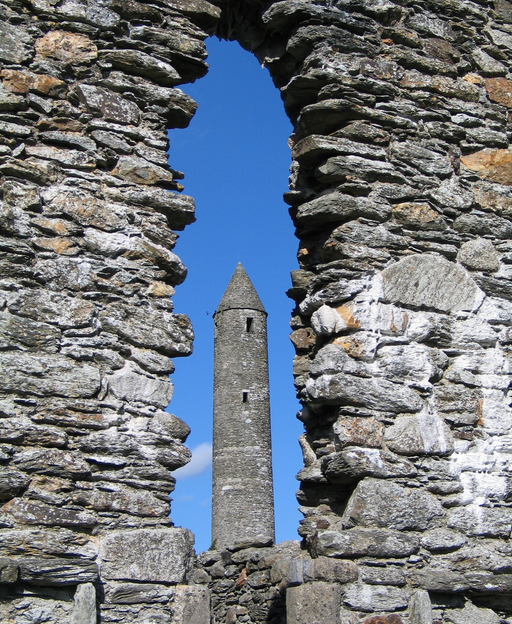
Ireland has around 65 surviving round towers. Monks and builders raised them between the 9th and 12th centuries at monastery sites across the country. Historians believe they served mainly as bell towers and places of refuge during Viking raids, though the debate about their exact function continues. These tall, tapering stone structures rank among the most distinctive monuments in Ireland. Visiting them is one of the finest ways to connect with the country’s early medieval past.
What Are Irish Round Towers?
Round towers are tall, slender stone structures that monks built at Irish monastery sites during the early medieval period. They typically stand between 20 and 40 metres tall. Their walls reach up to 1.5 metres thick at the base and taper as they rise to a conical stone cap.
The most striking feature is the doorway. On almost every surviving round tower, the entrance sits high off the ground — typically between 2 and 4 metres above the base. Monks reached it by a removable ladder. Once inside, they could pull the ladder up behind them.
The Irish name for these towers is cloigtheach, which means “bell house.” This suggests their original function was to house bells calling monks to prayer. But that high door raises an obvious question: if these were simply bell towers, why make them so hard to enter?
Why Did the Irish Build Round Towers?
Ireland’s monasteries ranked among the richest sites in Europe during the 8th and 9th centuries. They held gold chalices, illuminated manuscripts, sacred relics, and food stores. Yet they had almost no defences.
Viking longships began raiding Ireland’s coasts from around 795 AD. The Annals of Ulster record dozens of raids on Irish monasteries in the decades that followed. When raiders appeared, monks needed somewhere to shelter — fast.
A round tower solved this problem. It gave the community a safe place to shelter and store valuables. The high doorway stopped attackers from forcing their way in at ground level. Monks could pull the ladder up and wait out a raid from above.
Most historians today believe round towers served several purposes at once:
- Bell towers: Monks rang bells from inside to call the community to daily prayer. The conical cap helped project sound across the landscape.
- Watchtowers: From the top of a 30-metre tower, a monk could spot approaching raiders far out to sea or across open farmland.
- Treasuries: During raids, monks carried manuscripts, relics, and sacred objects inside for safekeeping. Monks at Kells likely took the Book of Kells into their tower during Viking attacks — which is partly why it survived.
- Boundary markers: Travellers could see these towers from miles away, signalling that a monastery lay nearby.
☘️ Planning a trip to Ireland?
Our free 7-day road trip itinerary covers the Wild Atlantic Way from Dublin to the west — day-by-day driving guide with hidden gems, practical tips, and local secrets.
Get the Free 7-Day Itinerary →How Did Builders Construct Round Towers?
Building a round tower was a major undertaking. Skilled masons shaped and laid thousands of stones over what may have been several decades of work.
Masons fitted the lower courses of stone without mortar, relying on careful shaping to hold them in place. Higher sections used lime mortar to bind the stonework as the tower rose. You can still see this two-phase approach in several surviving towers today.
Builders tapered the walls slightly as they rose, giving towers their narrow silhouette. At each floor level, they added a small window. The topmost window often pointed east, toward the rising sun — possibly for liturgical reasons, or simply to bring light into the upper chamber.
Wooden floors connected by ladders divided the interior into levels. Those floors rotted away centuries ago in most towers, leaving hollow stone cylinders open to the sky. A few examples — like the tower at Glendalough in County Wicklow — retain their original stone cap and show us how these buildings once looked.
When Did Round Tower Construction Stop?
Building peaked between 950 and 1100 AD. After the Norman invasion of 1169, monastic life in Ireland changed dramatically. Norman lords built walled fortifications around monasteries, making the standalone round tower redundant as a refuge.
By the 13th century, monks had stopped building new towers. The survivors — those not burned by Vikings, struck by lightning, or dismantled for building stone — are the towers we visit today.
☘️ Enjoying this? 64,000+ Ireland lovers get stories like this every week. Subscribe free →
The 10 Best Irish Round Towers to Visit
Around 65 round towers survive in Ireland today, from complete examples with conical caps to low stumps barely a metre tall. Here are the best to visit:
- Glendalough, County Wicklow: One of the finest in Ireland, standing 33 metres tall with its original conical cap. It sits in a stunning glacial valley with lakes and ancient stone churches nearby. About an hour’s drive from Dublin. Plan your visit: Glendalough on Heritage Ireland.
- Rock of Cashel, County Tipperary: The 28-metre round tower here is the oldest structure on this dramatic hilltop site — older than the famous Cormac’s Chapel by over two centuries. Plan your visit: The Rock of Cashel on Heritage Ireland.
- Monasterboice, County Louth: This site has two round towers, which is unusual. The taller stands over 33 metres and stands beside some of Ireland’s finest high crosses, including the 5-metre West Cross. Plan your visit: Monasterboice on Visit Louth.
- Clonmacnoise, County Offaly: Three round towers survive at this monastery on the River Shannon. The Temple Finghin tower has a well-preserved Romanesque doorway dating to around 1160 AD. Plan your visit: Clonmacnoise on Heritage Ireland.
- Ardmore, County Waterford: The 29-metre round tower stands on a dramatic headland above the sea. It dates to the 12th century and is one of the most complete in Munster. Plan your visit: Ardmore on Discover Ireland.
- St Canice’s Cathedral, Kilkenny: One of the few towers you can actually climb. Steps inside lead to the top, where the views across Kilkenny city are outstanding. Entry costs a few euros. Plan your visit: Official site.
- Devenish Island, County Fermanagh: Accessible only by boat across Lough Erne, this island monastery has one of the most atmospheric settings of any round tower in Ireland. The 25-metre tower is in remarkable condition. Plan your visit: Devenish Island on NI Department for Communities.
- Antrim Round Tower: Standing 28 metres tall in the centre of Antrim town, this is one of the finest towers in Ulster and remains almost completely intact. Plan your visit: Antrim Round Tower on NI Department for Communities.
- Kildare Round Tower: At 32 metres, this tower stands beside Kildare Cathedral in the town centre. A 19th-century restoration replaced the original top. It’s one of only two round towers in Ireland you can climb inside, alongside St Canice’s in Kilkenny. Plan your visit: Kildare Round Tower on Discover Ireland.
- Scattery Island, County Clare: A remote island in the Shannon Estuary accessible by boat from Kilrush. The tower here stands over 35 metres — among the tallest surviving in Ireland — and five early church ruins surround it. Plan your visit: Scattery Island on Heritage Ireland.
What Happened to the Towers That Were Lost?
Many round towers disappeared over the centuries. Viking raids caused the first wave of losses. Annals record monks dying inside towers that raiders set alight by piling kindling at the base.
Lightning strikes also took a toll. Several towers were struck over the centuries — Glendalough’s original cap was destroyed by a lightning strike in the 1800s and rebuilt in 1878 using stones found inside the tower’s base. Annals record at least one death this way: a student was killed at Tullaherin in 1121 when a strike brought stone down inside the tower.
By the early modern period, local people had begun to take stones from the towers for building work. Many round towers today exist only as low stumps a metre or two tall. Their upper sections became farmhouses and field walls across Connacht, Leinster, and Munster.
Practical Tips for Visiting Irish Round Towers
Most round towers allow visitors to view them from outside for free. A few stand within heritage sites that charge small entry fees. Glendalough, the Rock of Cashel, and Clonmacnoise all have visitor centres with exhibits on early monastic history.
To go inside a tower, St Canice’s Cathedral in Kilkenny and Kildare Round Tower are your only two options in Ireland. Both open mainly during the warmer months and the climb suits most visitors. Bring a torch if you want to examine the stonework closely.
For the most dramatic setting, Glendalough is hard to beat. Arrive early before coach tours reach the site and walk the full monastic circuit around the two lakes. For your wider trip planning, our Ireland trip planning guide covers everything from getting around to the best regions to base yourself.
Frequently Asked Questions About Irish Round Towers
What were Irish round towers really built for?
Monks and builders raised Irish round towers to serve as bell towers, watchtowers, and places of refuge during Viking raids. The high doorways — set 2 to 4 metres above the ground — stopped attackers from forcing their way in. Monks inside could pull the ladder up and shelter with their valuables. The Irish name cloigtheach means “bell house,” pointing to their role in calling the community to prayer, while the defensive design reflects the Viking raids that struck Irish monasteries from 795 AD onwards.
How many round towers survive in Ireland?
Around 65 round towers survive in Ireland today, ranging from complete examples with conical caps to low stumps a metre or two tall. Around 20 retain their original cap. The tallest surviving tower stands at Scattery Island in County Clare at over 35 metres. Several fine examples also survive in Ulster, including Devenish Island in County Fermanagh and Antrim Round Tower in County Antrim.
Can you go inside Irish round towers?
Very few round towers allow visitors inside. St Canice’s Cathedral in Kilkenny and Kildare Round Tower are the only two you can climb, both via internal ladders to a viewing platform near the top. Most other towers allow close external access, and many stand within heritage sites that offer guided tours and historical context.
When did builders construct the Irish round towers?
Monks had most Irish round towers built between 900 and 1100 AD, during the height of Viking raids on Ireland’s monasteries. Some earlier examples date to the 7th century. After the Norman invasion of 1169 changed the nature of Irish monastic life, builders stopped raising new towers, and by the 13th century, round tower construction had ended entirely.
Is Glendalough worth visiting for the round tower?
Absolutely. The round tower at Glendalough stands 33 metres tall with its original conical cap and is part of one of Ireland’s finest early monastic cities. The surrounding site — with two lakes, ancient stone churches, a gatehouse, and an old graveyard — makes this one of the most rewarding heritage sites in the country. It sits about an hour from Dublin.
☘️ Join 64,000+ Ireland Lovers
Every weekday morning, get Ireland’s hidden gems, local secrets, and travel inspiration — the kind you won’t find in any guidebook.
Subscribe free — enter your email:
📲 Know someone who’d love this? Share on WhatsApp →
Free forever · Unsubscribe anytime
Tours & experiences you might love


Powered by Viator. Some links are affiliate links — we may earn a small commission at no extra cost to you.
Secure Your Dream Irish Experience Before It’s Gone!
Planning a trip to Ireland? Don’t let sold-out tours or packed attractions spoil your journey. Iconic experiences like visiting the Cliffs of Moher, exploring the Rock of Cashel, or enjoying a guided walk through Ireland’s ancient past often sell out quickly—especially during peak travel seasons.

Booking in advance guarantees your place and ensures you can fully immerse yourself in the rich culture and breathtaking scenery without stress or disappointment. You’ll also free up time to explore Ireland’s hidden gems and savour those authentic moments that make your trip truly special.
Make the most of your journey—start planning today and secure those must-do experiences before they’re gone!