

At first glance, Ballysaggartmore Towers looks like a castle. It has turrets, stone walls, a bridge, and a Gothic archway that stops visitors cold. But it is not a castle. It is a gate — a grand set of gate lodges that workers built around 1850 as the entrance to an estate the owner never finished.
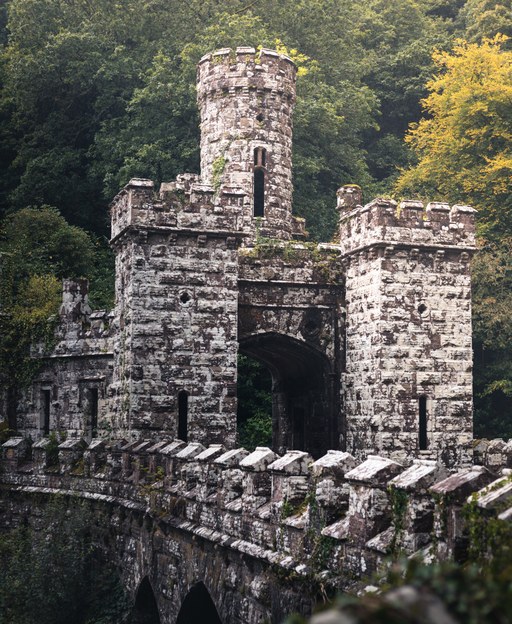
Ballysaggartmore Towers sits in the Blackwater Valley near Lismore, County Waterford. It is one of the most unusual landmarks in the south of Ireland. The site is free to visit. It sits deep in a forest, almost unknown outside Ireland. That is changing fast, and rightly so.
What Are the Ballysaggartmore Towers?
Ballysaggartmore has two gate structures. A woodland walking trail links them. The larger gatehouse is the star of the site. It has a wide stone bridge over a stream, two round turrets, and a central Gothic archway. The stonework is heavy and detailed — far grander than any private driveway needs.
The smaller gate lodge sits further along the approach road. It is less dramatic but still striking. Coillte, the Irish forestry company, manages both structures as part of a forest park. Entry is free.
Nobody has restored the towers. Ivy clings to the walls. Trees push through gaps in the stonework. The woodland is slowly swallowing the whole structure. The effect is somewhere between romantic and eerie — a grand entrance to nowhere.
The Story Behind the Towers
Arthur Kiely-Ussher built the towers. He owned the land and planned a grand country estate. The towers would mark an impressive entrance. A manor house would follow, sitting deeper in the grounds.
The problem was money. The towers cost far more than Arthur planned. By the time workers finished them, the money for the manor house was gone. Arthur never built it. The gate lodges stood alone in the forest, leading to nothing.
Local stories say it was Arthur’s wife who drove the overspending. She kept demanding grander details until the budget ran out. Whether that is true or local folklore, nobody can say for certain. What is certain is the result: one of Ireland’s most spectacular follies — an entrance to a house that never existed.
People sometimes call Ballysaggartmore a folly — a structure designed purely for show. But this folly was not planned. Arthur meant the grandeur to set the tone for something much greater. Instead, it became the whole story.
Gothic Architecture in the Irish Countryside
The style at Ballysaggartmore is Gothic Revival. This look was fashionable in Ireland and Britain in the early 1800s. Architects borrowed from medieval castles — pointed arches, battlements, round towers — and applied them to new buildings. The goal was to suggest history and high status.
Ballysaggartmore fits that tradition perfectly. The main gatehouse has every classic feature: a wide arch large enough for a carriage, turrets with arrow-slit windows, battlements along the top, and a bridge over a stream that feels like a moat.
What makes it special is the setting. Most Gothic Revival buildings stand in open parkland or on hilltops. Trees surround Ballysaggartmore on all sides. The canopy closes in overhead. Light falls through in shafts. The result is more dramatic than almost any planned landscape could achieve.
What to See and Do at Ballysaggartmore
Ballysaggartmore is a walking destination. Several marked trails run through the forest. The shortest loop is under two kilometres. Longer routes take in more of the woodland. Coillte keeps the trails in good shape, but they get muddy after rain. Wear proper footwear.
Most visitors head straight for the main gatehouse. It is the most-visited spot on the site. Stand on the bridge and look up at the arch and towers for the best view. Come early in the morning for better light and fewer crowds.
Further along the trails, look for the smaller gate lodge. It is less dramatic but gives a real sense of the original plan’s scale. The forest also holds the remains of a walled garden and several stone structures from the same period.
Wildlife fills the forest. Red squirrels live here, and birdlife is rich all year round. In spring, wild garlic and bluebells cover the forest floor. The colour makes the towers look even more atmospheric.
How to Get to Ballysaggartmore Towers
Ballysaggartmore sits about three kilometres west of Lismore in County Waterford. Fermoy in County Cork lies roughly 20 kilometres to the south-west. Lismore is well worth a visit on the same trip — it has a fine castle, a cathedral, and good cafés and pubs on the main street.
By car, take the R666 road between Lismore and Cappoquin. Follow signs for Ballysaggartmore Forest. There is a car park at the forest entrance. The drive from Cork city takes about one hour. From Waterford city, allow around 45 minutes.
There is no regular public transport to the site. Without a car, take a bus to Lismore from Waterford or Dungarvan, then hire a taxi for the short trip to the forest. Plan this in advance.
Practical Tips for Visiting
Entry is free. Coillte manages the site and keeps it open year-round during daylight hours. No booking required.
Wear waterproof boots. The trails run through woodland on ground that stays damp for much of the year. Light trainers won’t cut it after rain.
Bring a torch in autumn and winter. The forest canopy blocks a lot of light. Trails can be very dark on overcast days. Pack a small torch if you plan more than an hour on site.
Allow at least 90 minutes. The short loop to the main gate takes around 40 minutes at a relaxed pace. Add the smaller gate lodge and the walled garden and you need two hours or more.
Combine with Lismore Castle. The castle opens for garden tours in summer. It has one of the finest demesne gardens in Munster. It sits just a few minutes’ drive away. Together they make a great full day in the Blackwater Valley.
Why Ballysaggartmore Matters
Ireland has no shortage of castles, abbey ruins, and historic towers. What makes Ballysaggartmore different is its story. Most ruins represent something lost — something that once stood in full and later fell. Ballysaggartmore represents something that never came to be. The ambition was enormous. The money ran out. What remains is the entrance to a dream that never got past its own front gate.
That kind of story is genuinely rare. The physical remains are compelling too. The stonework is high quality. The Gothic design is strong. The forest gives the site an atmosphere that many more famous heritage properties cannot match. If you want the fuller story of the family behind the folly, read the story of the house that was never finished.
If you are travelling through County Waterford or the Blackwater Valley, give Ballysaggartmore Towers half a day. No entrance fee. No gift shop. No queues. Just a very strange and very beautiful structure standing in the trees, waiting for a house that never came.
Frequently Asked Questions
Is Ballysaggartmore Towers free to visit?
Yes, entry is completely free. Coillte manages the site as part of a forest park and keeps it open year-round during daylight hours. There is a free car park at the forest entrance. You do not need to book in advance. The towers, woodland trails, and all features on the site are free to access.
How do you get to Ballysaggartmore Towers?
By car, take the R666 road between Lismore and Cappoquin in County Waterford and follow signs for Ballysaggartmore Forest. Coillte provides a free car park at the entrance. From Cork city, the drive takes about an hour. From Waterford city, allow around 45 minutes. There is no public transport to the site. Take a bus to Lismore from Waterford or Dungarvan, then hire a taxi for the short final trip into the forest.
What is the best time to visit Ballysaggartmore Towers?
The site is open year-round, and every season has something to offer. Spring (April to May) is the most atmospheric — wild garlic and bluebells carpet the forest floor and the light through the canopy is beautiful. Summer gives you the longest daylight and the easiest trail conditions. Autumn brings warm colour to the woodland. Winter is quiet but the trails can be dark and muddy. For the best light on the towers, come in the morning. Weekdays are quieter than weekends.
Photo: PP Archive
Thinking about it for retirement?
If you’ve started thinking seriously about retiring there, our complete our full Retire in Ireland guide covers the visa, healthcare, cost-of-living, and the regions worth shortlisting.
Tours & experiences you might love


Powered by Viator. Some links are affiliate links — we may earn a small commission at no extra cost to you.
Secure Your Dream Irish Experience Before It’s Gone!
Planning a trip to Ireland? Don’t let sold-out tours or packed attractions spoil your journey. Iconic experiences like visiting the Cliffs of Moher, exploring the Rock of Cashel, or enjoying a guided walk through Ireland’s ancient past often sell out quickly—especially during peak travel seasons.

Booking in advance guarantees your place and ensures you can fully immerse yourself in the rich culture and breathtaking scenery without stress or disappointment. You’ll also free up time to explore Ireland’s hidden gems and savour those authentic moments that make your trip truly special.
Make the most of your journey—start planning today and secure those must-do experiences before they’re gone!