

County Carlow is not the first place most visitors think of when planning an Irish heritage trip, but it holds one of the most extraordinary prehistoric sites on the island. The Brownshill Dolmen, also known as the Kernanstown Cromlech, is home to what is reputedly the heaviest capstone in Europe — a granite slab estimated to weigh around 150 tonnes.
That is not a typo. One hundred and fifty tonnes of rock, balanced on a cluster of upright stones, has been sitting in a Carlow field for around 5,000 years — Heritage Ireland places it at 4,900 to 5,500 years old.
Love Ireland? Get it in your inbox.
Join thousands of readers who get our free weekly newsletter — packed with places to visit, hidden gems, and stories from across the island.
What Is a Dolmen?
A dolmen is a type of megalithic tomb built during the Neolithic period. The word comes from the Breton language and loosely means “stone table.” Most dolmens consist of two or more vertical standing stones with a large flat capstone resting on top.
Dolmens were burial monuments. The people who built them used these structures to inter the dead, likely with rituals and ceremony attached. Over thousands of years, the earth mounds that originally covered many dolmens eroded away, leaving the stone framework exposed to the elements.
Ireland has several notable dolmens, including the Poulnabrone Dolmen in the Burren, County Clare. Brownshill, however, holds a distinction that no other can claim: its capstone is reputedly the largest and heaviest in Europe. Estimates vary: Heritage Ireland describes it as weighing over 100 tonnes, with some sources suggesting the figure may be as high as 150 tonnes.
Where Is Brownshill Dolmen?
The dolmen stands in the townland of Kernanstown in County Carlow, roughly 3 kilometres east of Carlow town on the R726 road towards Hacketstown. The site is managed by the Office of Public Works (OPW) and is free to visit. There is a small lay-by for parking nearby, and a short walk across a field brings you to the monument.
Carlow is one of Ireland’s smaller inland counties, but it is straightforward to reach. Dublin is roughly 80 kilometres to the northeast. Kilkenny is about 30 kilometres to the west-southwest. The M9 motorway runs nearby, making the drive from Dublin manageable in under an hour in good traffic.
How Old Is Brownshill Dolmen?
Dating megalithic structures with precision is difficult, but archaeologists place the construction of Brownshill Dolmen somewhere in the range of 4,900 to 5,500 years ago — broadly within the Neolithic period, when farming communities began to settle across Ireland.
That means the dolmen predates the Egyptian pyramids. It was already ancient when Bronze Age peoples arrived in Ireland. It was already ancient when the Romans were building roads across Britain. Context like this helps you understand the scale of what you are looking at when you stand beside it.
The people who built Brownshill had no metal tools, no wheels in the modern sense, and no heavy machinery. How they moved and raised a 150-tonne capstone remains an open question. Theories include the use of timber rollers, earthen ramps, and coordinated human labour on a considerable scale. The precise method will likely never be confirmed.
Love Ireland? Get it in your inbox.
Join thousands of readers who get our free weekly newsletter — packed with places to visit, hidden gems, and stories from across the island.
What You Will See at the Site
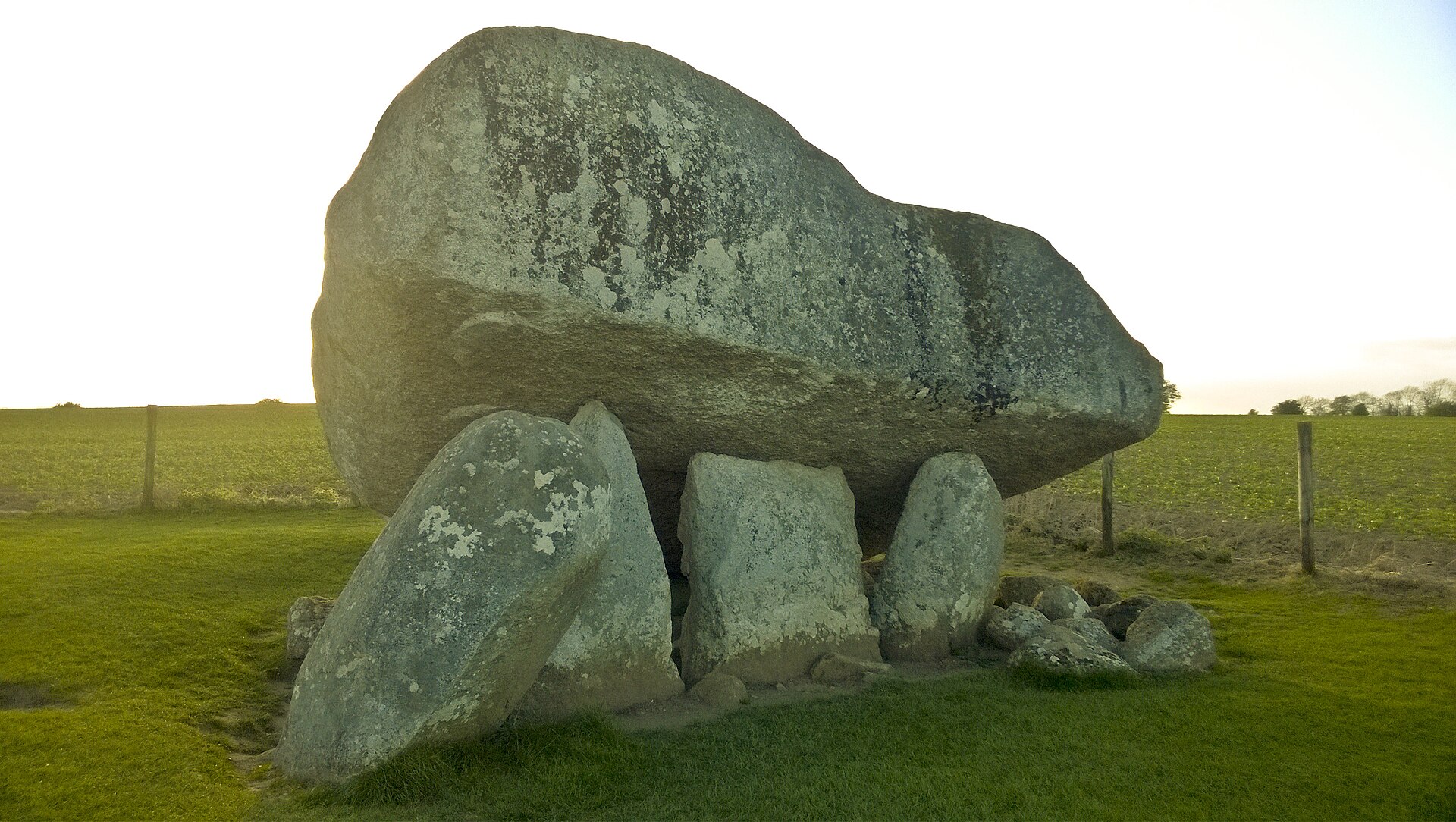
The monument consists of a massive capstone resting on two upright portal stones and a number of additional support stones. The capstone itself is enormous — roughly the size of a small lorry in footprint, but weighing far more than any lorry ever made.
One end of the capstone rests directly on the ground, having gradually sunk over the millennia. This gives the structure a tilted appearance, as though it is slowly returning to the earth. That impression is accurate in one sense: without the earthen mound that originally surrounded it, the structure has shifted over thousands of years of weathering and settlement.
The site is open to the elements and surrounded by working farmland. There are no barriers around the dolmen itself. You can walk up close, touch the stones, and stand beneath the capstone — though the ground can be soft and uneven, particularly after rain.
There are no facilities on site: no toilets, no café, no visitor centre. This is a raw prehistoric monument, and visiting it feels quite different from the managed heritage experience at a place like Newgrange or Glendalough. For many visitors, that is part of the appeal.
County Carlow’s Broader Heritage
The Brownshill Dolmen is the most prominent prehistoric monument in the county, but it is not the only reason to visit Carlow.
Carlow Town has a Norman castle built in the early 13th century. The remaining twin towers of Carlow Castle stand on the bank of the River Barrow and offer a clear sense of the county’s medieval history. The Cathedral of the Assumption nearby is a striking Gothic Revival building dating from the 19th century.
For those drawn to the natural landscape, the Barrow Way is a long-distance walking and cycling route that follows the River Barrow southward through quiet countryside. The Blackstairs Mountains form the southeastern border of the county, separating it from County Wexford. Mount Leinster, at 794 metres, is the highest peak in the range and gives panoramic views across several counties on a clear day.
The Altamont Gardens near Ballon are among the finest informal gardens in Ireland, particularly impressive in spring and autumn. They are managed by the OPW; entry to the gardens is free, though a small car park fee applies.
Practical Visitor Information
- Location: Kernanstown, Carlow, R93 H583
- Access: Free, open site year-round
- Parking: Small lay-by on the R726; limited space for a few cars
- By car: From Carlow town, take the R726 east for approximately 3km; the site is signposted
- By public transport: Bus and rail connections to Carlow town from Dublin and Kilkenny; the dolmen is not served by a bus stop
- Walking time from parking: Approximately 5–10 minutes across a field
- Facilities: None on site
- Accessibility: Uneven ground; not suitable for wheelchair users
The site can be visited at any time of year. Early morning visits tend to be quieter and the light is often better for photography in the hours after sunrise. The dolmen faces roughly east-west, and morning light can illuminate the capstone to good effect.
Why It Is Worth Making the Detour
It is easy to pass through County Carlow without stopping. Most visitors to Ireland carry a mental list of highlights — Dublin, the Ring of Kerry, the Cliffs of Moher, the Aran Islands — and Carlow does not appear on it.
That is their loss.
The Brownshill Dolmen is not a reconstructed monument or a tourist-managed experience. It is a 150-tonne piece of prehistoric engineering sitting in a field, exactly where it was placed thousands of years ago. No one fully understands how it was built. The people who built it left no written records. We know them only through what they made.
Standing next to something that large, that old, and that unexplained is a quietly grounding experience. Neolithic communities quarried, transported, and raised this structure without any of the tools we take for granted today. Whatever challenges the modern world presents, it is worth remembering that human ingenuity and collective effort have always found a way.
The dolmen is a reminder of what people can accomplish when they work together — and it has been making that point for roughly 5,000 years.
Love Ireland? Get it in your inbox.
Join thousands of readers who get our free weekly newsletter — packed with places to visit, hidden gems, and stories from across the island.
Getting to County Carlow
Carlow is one of the most accessible inland counties in Ireland. The M9 motorway from Dublin reaches the county in under an hour in reasonable traffic. Regular trains connect Carlow town with Dublin Heuston. Bus Éireann runs services from Dublin, Waterford, and Kilkenny.
If you are touring the south-east of Ireland, Carlow fits naturally into a circuit that includes Kilkenny city, the Rock of Cashel in Tipperary, and the Waterford Greenway. The dolmen adds a prehistoric dimension to what is otherwise a predominantly medieval and Georgian heritage trail in this part of the country.
Do not skip Carlow.
Featured image: Photo by VisionsofthePast / Wikimedia Commons (CC BY-SA 4.0).
☘️ Join 64,000+ Ireland Lovers
Every weekday morning, get Ireland’s hidden gems, local secrets, and travel inspiration — the kind you won’t find in any guidebook.
Subscribe free — enter your email:
📲 Know someone who’d love this? Share on WhatsApp →
Free forever · Unsubscribe anytime
Tours & experiences you might love


Powered by Viator. Some links are affiliate links — we may earn a small commission at no extra cost to you.
Secure Your Dream Irish Experience Before It’s Gone!
Planning a trip to Ireland? Don’t let sold-out tours or packed attractions spoil your journey. Iconic experiences like visiting the Cliffs of Moher, exploring the Rock of Cashel, or enjoying a guided walk through Ireland’s ancient past often sell out quickly—especially during peak travel seasons.

Booking in advance guarantees your place and ensures you can fully immerse yourself in the rich culture and breathtaking scenery without stress or disappointment. You’ll also free up time to explore Ireland’s hidden gems and savour those authentic moments that make your trip truly special.
Make the most of your journey—start planning today and secure those must-do experiences before they’re gone!