

Kerry’s castles are tower houses and ruins from the 15th and 16th centuries, and they fall into three groups. Ross Castle in Killarney and Listowel Castle open to visitors with Office of Public Works (OPW) guides. Carrigafoyle Castle is an OPW tower that a caretaker opens in season, and Gallarus Castle is for viewing from outside only. The other four, Ballycarbery, Minard, Dunloe and Ballinskelligs, are ruins to look at from outside, so keep back from the walls and heed any signs. Seasons change, so check Heritage Ireland before you go. Checked November 2026.
Most of them stand where a family once watched the water: a lake, an estuary, a bay. The O’Donoghues, FitzMaurices, FitzGeralds, MacCarthys, O’Connors and the Knight of Kerry built them to guard the ways in, and several were swept up in the wars of the 1600s. Here are the eight, with what you can really do at each. For castles elsewhere, see our complete guide to Irish castles and our top 10 castles you can go inside.
1. Ross Castle, Killarney
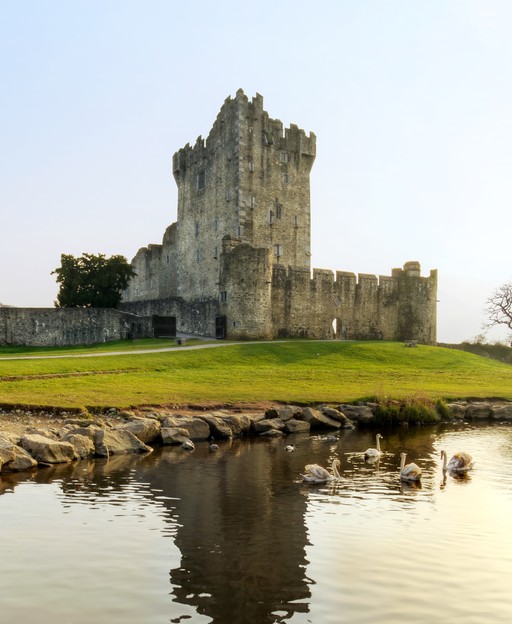
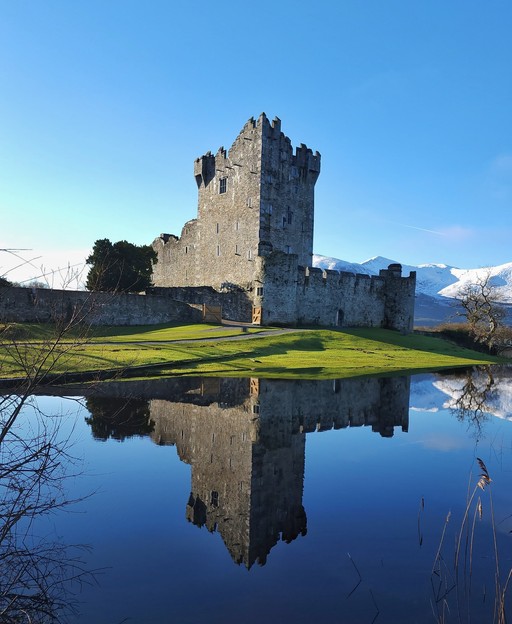
Ross Castle sits on an inlet of Lough Leane. Heritage Ireland says it was likely built in the fifteenth century by the Irish chieftain O’Donoghue Mór, and that legend has him sleeping under the lake, rising on a white horse on the first morning of May every seven years. The documented story is the last stand: Ross Castle was the last place in Munster to hold out against Cromwell, and its defenders, trusting a prophecy that it could only be taken by a ship, gave up when General Ludlow launched a large boat on the lake. The interior is open by guided tour only, on a first come, first served basis, and Discover Ireland suggests allowing up to an hour. Our Ross Castle guide has the history and the boat trips, and our Killarney guide has the rest of the town.
2. Listowel Castle
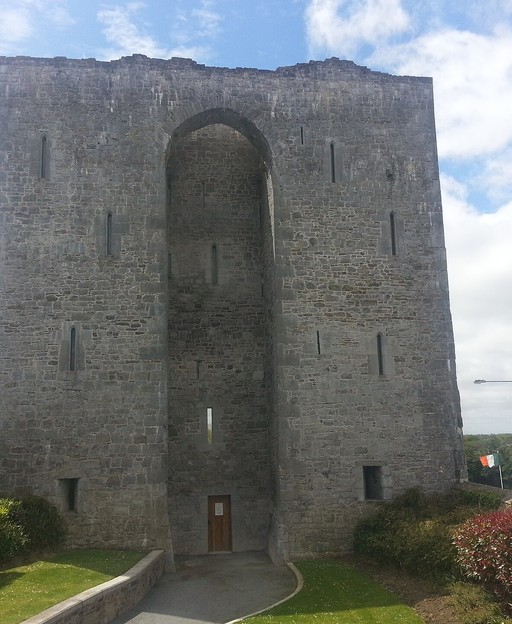
Only half of Listowel Castle survives, and Heritage Ireland calls it one of Kerry’s best examples of Anglo-Norman architecture. Two of the original four square towers remain, over 15 metres high, joined by a curtain wall and, unusually, by an arch on one side. Discover Ireland says the present castle was probably built in the 15th century by the FitzMaurices, on a bank above a ford on the River Feale. In 1600 it was the last stronghold of the Fitzmaurice rebels against Queen Elizabeth’s forces in the Nine Years War, and its garrison held out for 28 days. Access is by guided tour only, and an external staircase lets you reach the upper levels.
3. Carrigafoyle Castle, near Ballylongford
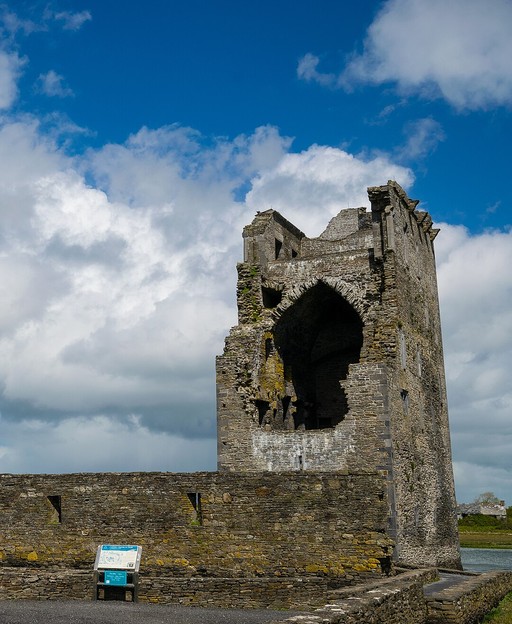
This late 15th-century tower house stands on Carrig Island at the mouth of the Shannon estuary, and Heritage Ireland says it was probably built in the 1490s by Connor Liath O’Connor. The English called it the Guardian of the Shannon because it watched the shipping lanes to Limerick. The tower is five storeys and just over 24 metres high, with a winding staircase of 104 steps to the top. The OPW lists it as an unguided site that a caretaker opens in season, so check the current dates on its page, and take care on the stairs. Discover Ireland adds that you can walk out on the dock the O’Connors used to watch passing ships.
4. Gallarus Castle, Dingle Peninsula
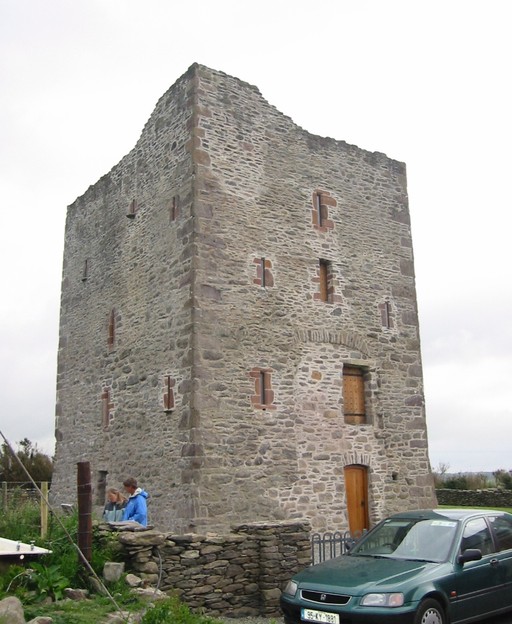
Gallarus Castle is not the stone oratory shaped like an upturned boat, which stands about a kilometre away. It is a four-storey tower house in the Gaeltacht village of Baile na nGall, built by the FitzGeralds and probably dated to the 15th century, and it is one of the few castles left on the peninsula. Heritage Ireland says it has lost its battlements but keeps its vaulted roof. The OPW lists it as viewing only, with internal access not permitted, and the Dingle Peninsula tourism site notes there is no car parking at the castle itself.
5. Minard Castle, Dingle Peninsula
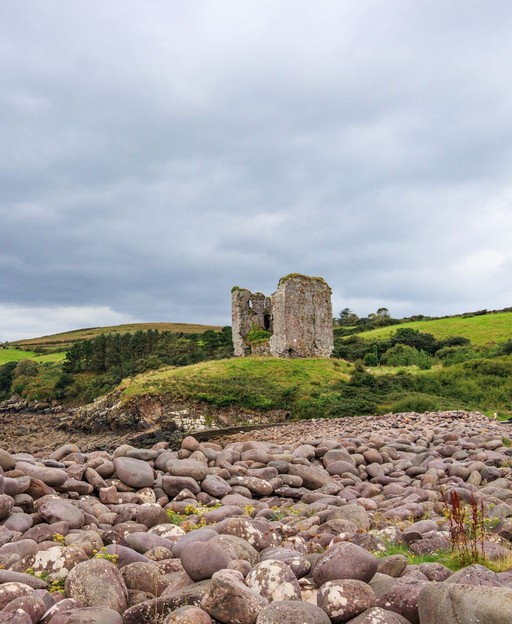
Minard Castle stands on a hill above a storm beach on the south side of the Dingle Peninsula. Discover Ireland says it is said to have been built by the Knight of Kerry and is the largest fortress on the peninsula. The Irish Times dates it to the 16th century and reports that in 1650 Cromwell’s colonels Lehunt and Sadler besieged it; the defenders, short of ammunition, were forced to use pewter bullets before a charge blew up a large section. You may know it from David Lean’s film Ryan’s Daughter. The beach below is full of large sandstone boulders that were used for ogham stones. Discover Ireland asks you to heed the warning signs on the castle, so view it from outside. The Irish Times gives directions: five kilometres southwest of Annascaul, along a gravel road from Lispole.
6. Ballycarbery Castle, Cahersiveen
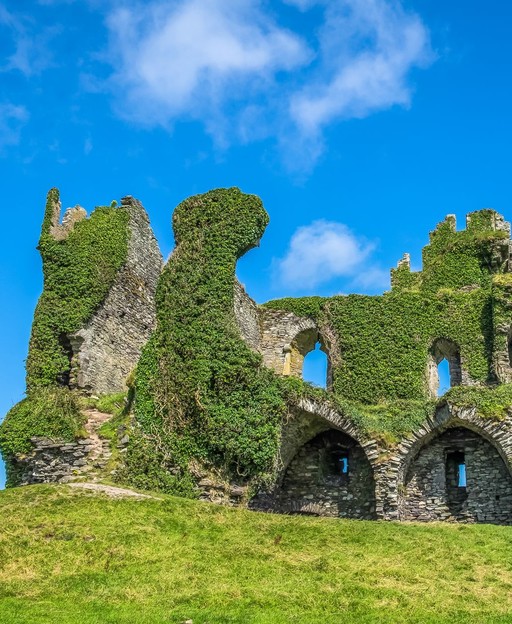
Ivy covers much of what is left of Ballycarbery Castle, which Discover Ireland describes as the ruin of a once magnificent 15th-century castle of the MacCarthy Mór. It was later held by the O’Connells, ancestors of the Liberator, until the Cromwellians took it in 1652. Wikipedia places it about three kilometres from Cahersiveen on a grassy hill facing the sea, a short distance from Cahergall and Leacanabuile forts. Sources differ on access: Discover Ireland lists it as a place to visit, while Wikipedia lists it as not open to the public. Treat it as a ruin to see from outside, and keep clear of the walls.
7. Dunloe Castle, Beaufort
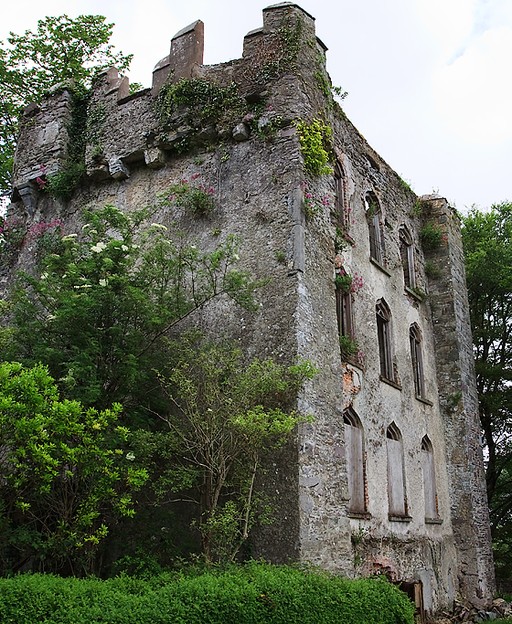
Dunloe Castle guarded the approach to the Gap of Dunloe. Discover Ireland says the Norman FitzGeralds, Earls of Desmond, built it in 1215 and that it commanded the passage across the river to the Gap; the hotel’s own listing calls the ruins 12th century, so the exact date is not settled. The ruins stand in the park of the Dunloe Castle Hotel, and the hotel’s listing on Ireland.com describes pathways through its 64-acre estate leading to the River Laune and the ruins. We found no public access terms, so ask at the hotel before you go, and respect the grounds.
8. Ballinskelligs Castle
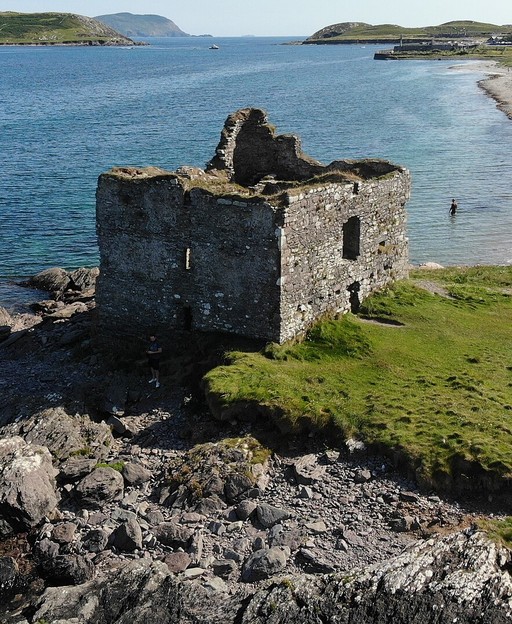
On the western shore of Ballinskelligs Bay, this small tower house was built by the MacCarthy Mórs in the 16th century to protect the bay from pirates and, possibly, to charge a tariff on incoming trade ships. It sits on a narrow promontory that is subject to heavy erosion, and a 1988 survey excavation by John Sheehan of the South West Kerry Archaeological Survey, recorded on Excavations.ie, dated the site to the post-medieval period. We found no visitor information, so treat it as a ruin to see from the shore, and stay back from the eroding edge.
Putting them together
Killarney gives you Ross and Dunloe on the same day, the Iveragh Peninsula has Ballycarbery and Ballinskelligs, and the Dingle Peninsula has Gallarus and Minard. Listowel and Carrigafoyle are in the north of the county. If you would rather leave the driving to someone else, you can book a Kerry day tour (see our tours).
☘️ Join 64,000+ Ireland Lovers
Every weekday morning, get Ireland’s hidden gems, local secrets, and travel inspiration — the kind you won’t find in any guidebook.
Subscribe free — enter your email:
Free forever · Unsubscribe anytime
Facts here were checked in November 2026 against Heritage Ireland (OPW), Discover Ireland, the Irish Times, the Dingle Peninsula tourism site, the Dunloe hotel listing on Ireland.com, Wikipedia and Excavations.ie. Opening seasons and access change, so confirm each one on the official page before you travel.
Secure Your Dream Irish Experience Before It’s Gone!
Planning a trip to Ireland? Don’t let sold-out tours or packed attractions spoil your journey. Iconic experiences like visiting the Cliffs of Moher, exploring the Rock of Cashel, or enjoying a guided walk through Ireland’s ancient past often sell out quickly—especially during peak travel seasons.

Booking in advance guarantees your place and ensures you can fully immerse yourself in the rich culture and breathtaking scenery without stress or disappointment. You’ll also free up time to explore Ireland’s hidden gems and savour those authentic moments that make your trip truly special.
Make the most of your journey—start planning today and secure those must-do experiences before they’re gone!