

The Claddagh ring is one of the most recognisable pieces of Irish jewellery. Two hands hold a heart, and a crown sits on top. It is worn by people all over the world, but its roots are in one small corner of Galway city. This guide explains where the ring comes from, what each part means, how to wear it, and where to see the real thing in Galway.
What Is a Claddagh Ring?
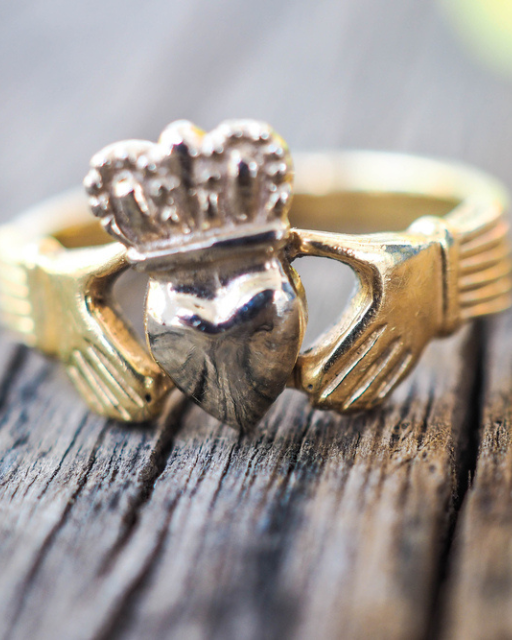
A Claddagh ring is a traditional Irish ring with a fixed design. It has three parts: two hands, a heart and a crown. Each part stands for a value:
- The hands stand for friendship.
- The heart stands for love.
- The crown stands for loyalty.
Together they are often summed up with the Irish-style saying “with my hands I give you my heart, and crown it with my love”. That is why the ring is given as a gift of friendship, a love token, an engagement ring or a wedding band.
Most Claddagh rings are made in gold or silver. Some have small gemstones set in the heart. The shape is simple, so it works as a plain everyday ring.
Where Does the Name Come From?
The ring is named after Claddagh, an old fishing village on the edge of Galway city. The name comes from the Irish An Cladach, which means “the shore” or “the stony beach”. The village stood on the west bank of the River Corrib, close to where the river meets Galway Bay.
For centuries Claddagh was a close community of fishing families. It had its own customs and its own elected “King of the Claddagh”, who settled disputes among the fishermen. The village was known for its thatched cottages, and the people there kept a strong sense of identity separate from the walled town of Galway across the water.
The old cottages were cleared in the 1930s and replaced with new housing. Today the area is a quiet residential neighbourhood with views over the water. The name lives on in the ring, the quay and the local church. For the fuller story of the village and how its ring design travelled the world, see our deep dive on how the Claddagh ring circled the world.
The Legend of Richard Joyce
The most famous story about the ring’s origin involves a man named Richard Joyce. The tale goes like this:
- Joyce was a Galway man from the Claddagh who was sailing to the West Indies in the late 1600s.
- His ship was captured by Algerian pirates, and he was sold into slavery.
- He was put to work for a goldsmith, who taught him the craft.
- In 1689, King William III asked for the release of all British subjects held in captivity, and Joyce was freed.
- He returned to Galway, and it is said he brought with him a ring he had made, using the heart, hands and crown design.
Some versions say he made the ring for the sweetheart who waited for him. Others say he simply set up as a goldsmith in Galway and used the design for his work. Historians are cautious about the details, because the story was passed down by word of mouth for a long time. What is clear is that Claddagh rings were being made in Galway by the early 1700s, and a number of old examples with a “RI” or similar maker’s mark have been linked to Joyce’s workshop.
How to Wear a Claddagh Ring
How you wear the ring is part of its charm. By tradition, the position and direction of the ring tell people about your relationship status:
- Right hand, heart pointing outward (towards your fingertips): you are single and open to love.
- Right hand, heart pointing inward (towards your wrist): you are in a relationship, or someone has captured your heart.
- Left hand, heart pointing inward: you are engaged or married.
- Left hand, heart pointing outward: some people use this for engagement, with the ring turned inward at the wedding.
You will find slightly different versions of these rules, and nobody will mind which one you follow. Many wearers pick the hand and direction that feels right for them. A ring given between friends or family is often worn however it fits best.
Who Gives a Claddagh Ring?
Claddagh rings are given for many reasons, not just romance. Common occasions include:
- Engagements and weddings. Some couples use a Claddagh as a ring for the engagement, the wedding, or both.
- Birthdays and graduations. The ring is a popular gift for a milestone.
- Friendship. The hands are a symbol of friendship, so it works well between close friends.
- Family heirlooms. A Claddagh is often handed down from mother to daughter or from parent to child. Many Irish families have one that has been in the family for generations.
- Heritage gifts. People with Irish ancestry often choose one to connect with their roots.
It is worth knowing that a Claddagh ring given to someone as a gift is traditionally seen as part of the gesture. Some people say it is lucky to be given the ring rather than to buy it for yourself, though that is a custom rather than a rule.
Where to See and Buy Claddagh Rings in Galway
If you visit Galway, you can see the ring’s home turf in a single day. A few practical ideas:
- Visit Claddagh itself. Walk from the Spanish Arch across the Wolfe Tone Bridge and along the quay. It takes about 10 to 15 minutes on foot. You get good views of the river, the swans and the bay.
- Browse the jewellers in the city centre. Galway has several long-established jewellers selling Claddagh rings. One of the best-known is on Quay Street, and it describes itself as one of the oldest makers of the ring. It also has a small display about the ring’s history.
- Check the hallmark. A genuine Irish gold or silver ring should carry a hallmark showing the metal, the maker and the assay office. In Ireland, the assay office is based at Dublin Castle, and the Irish hallmark includes a harp.
- Compare prices. A simple silver ring costs much less than a gold one. Gold rings are usually sold in 9 carat, 14 carat or 18 carat, and the price rises with weight and carat.
- Get the size right. Ask the jeweller to measure your finger. A ring that is too loose can turn on the finger, and the heart may end up facing the wrong way.
If you buy online or from a market stall, check that the seller gives clear details about the metal. Cheap plated pieces are common, and they wear off in time.
Practical Tips for a Visit to Galway
Claddagh is a short walk from the centre of Galway, so it fits easily into a city break. Here is how to plan the day:
- Getting there. Galway has a rail and bus station in Eyre Square. From there it is roughly a 20 minute walk to Claddagh.
- Best time to go. Spring and early autumn are quieter than July and August. Mornings are calmer for a walk by the water.
- What to bring. Galway weather changes fast, so pack a waterproof jacket and comfortable shoes.
- Combine it with other sights. The Spanish Arch, the Latin Quarter, Shop Street and the Galway City Museum are all within easy walking distance — see our full guide to the best things to do in Galway for more ideas.
- Eat and drink. The Latin Quarter has plenty of pubs with live traditional music, and seafood is a local speciality.
Planning a trip to Ireland? Join our free newsletter for practical tips and heritage stories.
Claddagh Rings and Irish Heritage
For many people in the Irish diaspora, the Claddagh ring is a first link to Ireland. It is common to see one on the hand of someone whose grandparents emigrated to the United States, Canada, Australia or Britain. It is a small, portable reminder of home.
The design has also spread into other jewellery, such as pendants, brooches, earrings and cufflinks. The same three symbols appear on each one. Some modern versions add Celtic knotwork or use green stones such as emerald or peridot to echo the colour of Ireland.
Whatever the style, the message stays the same: love, loyalty and friendship. That simple idea is probably why the ring has lasted for more than 300 years.
Frequently Asked Questions
What does a Claddagh ring mean?
The hands mean friendship, the heart means love and the crown means loyalty.
Which hand do you wear a Claddagh ring on?
Tradition says the right hand with the heart facing out if you are single, the right hand with the heart facing in if you are in a relationship, and the left hand with the heart facing in if you are married or engaged.
Where does the Claddagh ring come from?
It comes from the Claddagh fishing village in Galway, on the west side of the River Corrib. The best-known story links it to a goldsmith called Richard Joyce.
Is it only for people with Irish heritage?
No. Anyone can wear one. It is a symbol of friendship, love and loyalty, and many visitors to Galway buy one as a souvenir.
Final Thoughts
The Claddagh ring started as a local craft in a small fishing village and became one of Ireland’s best-loved symbols. If you are in Galway, take a walk to Claddagh, visit a jeweller and see how the ring is made. And if you are choosing one as a gift, think about who it is for: a partner, a friend or a family member. The ring suits all three.
Tours & experiences you might love


Powered by Viator. Some links are affiliate links — we may earn a small commission at no extra cost to you.
Secure Your Dream Irish Experience Before It’s Gone!
Planning a trip to Ireland? Don’t let sold-out tours or packed attractions spoil your journey. Iconic experiences like visiting the Cliffs of Moher, exploring the Rock of Cashel, or enjoying a guided walk through Ireland’s ancient past often sell out quickly—especially during peak travel seasons.

Booking in advance guarantees your place and ensures you can fully immerse yourself in the rich culture and breathtaking scenery without stress or disappointment. You’ll also free up time to explore Ireland’s hidden gems and savour those authentic moments that make your trip truly special.
Make the most of your journey—start planning today and secure those must-do experiences before they’re gone!