

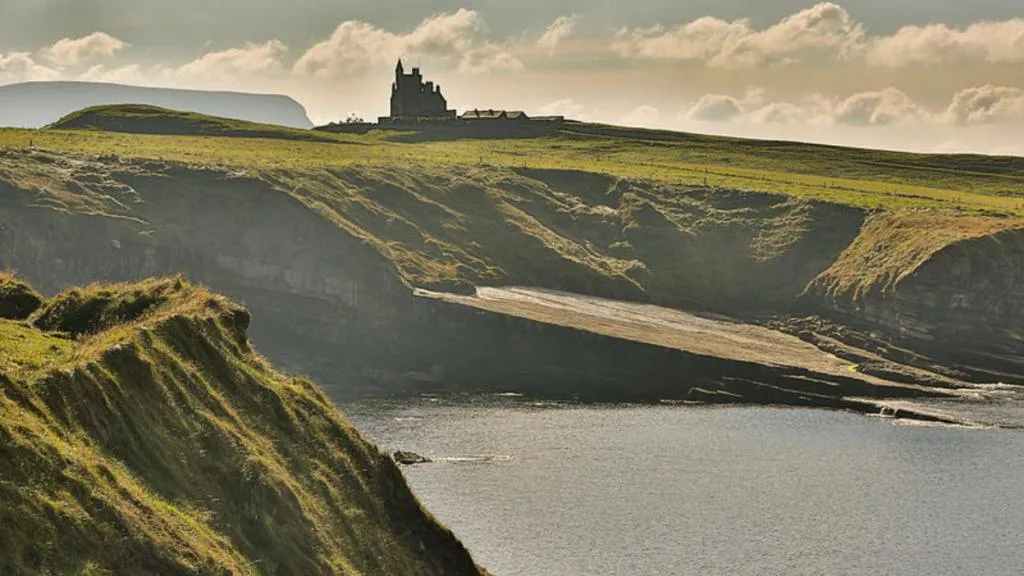
Classiebawn Castle stands on the Mullaghmore Peninsula in County Sligo. It’s one of the most photographed landmarks in the west of Ireland. The view from the shore — the Victorian Gothic tower rising above the Atlantic coastline, with the flat-topped bulk of Benbulben filling the horizon behind it — is instantly recognisable. I’ve stood on that shoreline myself, and no photograph quite prepares you for the scale of it. If you’re planning a trip to Sligo, this is a place worth knowing before you arrive.

County Sligo doesn’t always get the same attention as Kerry or Clare. But for those who make the trip, it delivers. Wild coastline, rich literary history, and landscapes that feel genuinely untouched. Classiebawn Castle is a good reason to start in the north of the county.
Want more like this? Join thousands of Ireland lovers getting the best of Irish travel, heritage, and hidden gems straight to their inbox. Subscribe to the Love Ireland newsletter here.
Where Is Classiebawn Castle?
Classiebawn Castle sits at the tip of the Mullaghmore Peninsula, about 9 kilometres north of Cliffoney village on the N15 road. Mullaghmore is a small seaside village popular with surfers and day-trippers, and the castle grounds extend along the headland to the west of the village harbour.
The castle itself is privately owned and not open to the public. You cannot enter the grounds. You can still see the exterior clearly from the coastal road. The castle silhouette set against Benbulben mountain makes it one of the most dramatic viewpoints in Sligo. The shoreline path near Mullaghmore harbour gives excellent views without any need to trespass.
Nearest town with services: Sligo town is about 32 kilometres to the south. Bundoran in County Donegal lies about 20 kilometres to the north. You’ll find parking in Mullaghmore village itself.
The History of Classiebawn Castle
Builders raised the castle between 1856 and 1874 for Henry John Temple, the 3rd Viscount Palmerston, who served twice as British Prime Minister. The architect William Henry Lynn designed it in a Victorian Gothic Revival style. This estate once spread across several hundred acres of the Mullaghmore headland, run as a working farm as well as a family home.
Palmerston died before the castle was completed. The estate passed through several generations and eventually came to the Mountbatten family in the 20th century through inheritance. For decades the Mountbatten family kept it as a summer residence, particularly Louis Mountbatten, the 1st Earl Mountbatten of Burma.
The building has four storeys and a distinctive corner tower. It uses local limestone, and the Victorian Gothic detailing — pointed arches, battlements, and tall narrow windows — gives it a stark, imposing look against the Atlantic backdrop. The surrounding landscape is largely open grassland and farmland, which adds to the sense of exposure and isolation.
Lord Mountbatten and Classiebawn Castle
The castle carries a strong link to Louis Mountbatten. He died in August 1979, when a bomb on his fishing boat, the Shadow V, exploded in Mullaghmore Harbour. The Provisional IRA carried out the attack. Mountbatten, his 14-year-old grandson Nicholas, a local teenager named Paul Maxwell, and Lady Brabourne, who was 83 years old, all died as a result.
The attack took place in full view of the shore. It was one of the most high-profile political assassinations in Ireland during the Troubles. The same day, 18 British soldiers were killed in a separate attack at Warrenpoint in County Down.
Today, a memorial plaque to those who died in the harbour attack sits near the pier in Mullaghmore. The castle and the village stay quiet now. Visitors come to surf, to walk the headland, and to take in the views. The history is known but not loudly commemorated — it sits in the background, as much a part of the landscape as the castle itself.
Benbulben: The Mountain Behind the View
Benbulben is the flat-topped mountain that forms the unmistakable backdrop to almost every photograph taken at Classiebawn Castle. It rises to 526 metres and dominates the skyline across north County Sligo. The mountain belongs to the Dartry range and consists of carboniferous limestone, which gives it the distinctive layered, table-top profile that makes it so recognisable.
On clear days you can see Benbulben from the Mullaghmore headland and from much of coastal Sligo. The contrast between the castle on the shoreline and the mountain behind it — separated by several kilometres of flat farmland — is what makes the classic photograph so striking. There’s a sense of scale I found impossible to appreciate from photographs alone.
W.B. Yeats loved this mountain, who chose the mountain’s shadow for his grave. That grave sits at Drumcliff Church, about 13 kilometres south of Classiebawn, on the N15. The gravestone carries the famous lines he wrote for himself: “Cast a cold eye / On life, on death. / Horseman, pass by!”
You can walk Benbulben, though the terrain tests you and the plateau edges drop away sharply. Most walkers start from the Gortarowey car park on the south side. Walkers need real experience and good kit — the flat summit misleads people, and conditions change quickly.
Enjoying this? We cover Ireland’s best heritage sites, hidden landscapes, and travel tips every week. Get it free in your inbox — subscribe here.
What to See Around Mullaghmore
Mullaghmore village is small but has a good café and a harbour that’s worth a walk around. The surf here ranks world-class. Mullaghmore Head is one of the top big-wave surf breaks in Europe, and it draws expert surfers when Atlantic swells arrive in autumn and winter. On a calm day, the sea is a striking blue-green that surprises most first-time visitors.
The coastal road around the headland gives views back towards Donegal as well as south towards Sligo Bay. The Mullaghmore Loop Walk runs about 7 kilometres. It takes in the castle exterior, the headland cliffs, and the harbour. It is mostly flat and suitable for most fitness levels.
Nearby Grange village has a pub and some local services. Three ships from the Spanish Armada wrecked at Streedagh Beach to the south in 1588. Today it’s a wide, flat strand with a panel explaining the history.
W.B. Yeats and County Sligo
County Sligo is deeply connected to the work of W.B. Yeats, who spent much of his childhood here and drew heavily on the landscape and mythology of the region throughout his life. The Yeats connection runs through the whole county — from Lough Gill (the inspiration for “The Lake Isle of Innisfree”) to Drumcliff Churchyard where he now lies.
Sligo town has the Yeats Building, home to the Yeats Society and a museum dedicated to his work. Rosses Point holds more links: the Yeats family spent summers there. So does Lissadell House, the grand country house near Drumcliff where Yeats visited the Gore-Booth family in the 1890s. Lissadell welcomes visitors.
For visitors with an interest in Irish literary heritage, north Sligo offers a remarkably concentrated collection of sites. Drumcliff Church, Lissadell House, and the views of Benbulben all fit into a single day from Sligo town.
Classiebawn Castle: Quick Facts for Visitors
- Location: Mullaghmore Peninsula, County Sligo, off the N15.
- Access: Exterior views only — the castle is private and closed to the public.
- Best viewpoint: The Mullaghmore harbour shoreline path.
- Best light: Morning, with the sun to the east on Benbulben.
- Nearest town: Sligo town, about 32 km south.
How to Visit Classiebawn Castle and Mullaghmore
The nearest major access point is Sligo town, which has regular bus and rail connections from Dublin. From Sligo, Mullaghmore is a 40-minute drive north on the N15. No regular public bus runs to Mullaghmore village itself, so you need a car or taxi for the last section.
In my experience the best time for the classic Classiebawn-Benbulben photograph is morning light, when the sun sits to the east and the mountain shows clearly. We’d rather arrive early and beat the wind. The headland can be very exposed in wind and rain — even in summer, bring a waterproof layer. Car parking is available at the harbour in Mullaghmore.
You cannot enter the castle itself. Do not attempt to access the grounds — the estate is private property. The coastal road and the harbour give all the views you need.
If you’re planning a wider Sligo itinerary, allow at least two days for the county. North Sligo (Mullaghmore, Drumcliff, Lissadell) and south Sligo (Carrowmore megalithic cemetery, Knocknarea mountain, Strandhill Beach) form two distinct areas that each reward separate exploration.
Where to Eat and Stay Near Mullaghmore
Near Mullaghmore you’ll find self-catering cottages in the village and B&Bs close by. For more choice, Sligo town has hotels, guesthouses, and hostels to suit most budgets. Bundoran in County Donegal, 20 kilometres to the north, is a larger seaside town with more accommodation and dining options.
In Mullaghmore itself, the Eithna’s by the Sea restaurant is well-regarded for seafood and local produce — it operates seasonally, so check ahead before visiting. The harbour area has a small café that walkers and surfers love. For a full evening meal, Sligo town has the widest range of options.
County Sligo never feels overrun the way some western counties do in high summer. Even at peak times, Mullaghmore and the north Sligo coast feel relatively quiet. That’s part of the appeal. The landscape is dramatic, the history is substantial, and the crowds are manageable.
If the view from Mullaghmore puts County Sligo on your list, there’s plenty more to discover. From the megalithic tombs at Carrowmore to the surf at Strandhill, the county rewards the visitors who take the time to go beyond the obvious stops.
Don’t miss a thing. The Love Ireland newsletter covers the best of Irish travel, heritage sites, and coastal escapes — delivered free every week. Sign up here and start exploring.
Continue Exploring County Sligo
- Things to do in Sligo — beyond the Mullaghmore headland.
- The 10 best beaches on the Wild Atlantic Way.
- Ireland’s 10 most spectacular scenic drives.
Photo: PP Archive
Thinking about it seriously?
If you’ve started actually planning a move, our complete the full Move to Ireland guide walks through every step, every cost, and the paperwork that catches most people out.
Tours & experiences you might love


Powered by Viator. Some links are affiliate links — we may earn a small commission at no extra cost to you.
Secure Your Dream Irish Experience Before It’s Gone!
Planning a trip to Ireland? Don’t let sold-out tours or packed attractions spoil your journey. Iconic experiences like visiting the Cliffs of Moher, exploring the Rock of Cashel, or enjoying a guided walk through Ireland’s ancient past often sell out quickly—especially during peak travel seasons.

Booking in advance guarantees your place and ensures you can fully immerse yourself in the rich culture and breathtaking scenery without stress or disappointment. You’ll also free up time to explore Ireland’s hidden gems and savour those authentic moments that make your trip truly special.
Make the most of your journey—start planning today and secure those must-do experiences before they’re gone!