

The Dark Hedges are a tunnel of ancient beech trees on the Bregagh Road in County Antrim, Northern Ireland — and they are real. Planted around 1775 by the Stuart family to impress visitors approaching their Georgian mansion, Gracehill House, these trees have grown for 250 years into an interlocking canopy so dramatic that millions of people now drive to see them. But the question that matters to locals is not why the trees are beautiful. It is why a woman in a grey dress walks among them after dark.
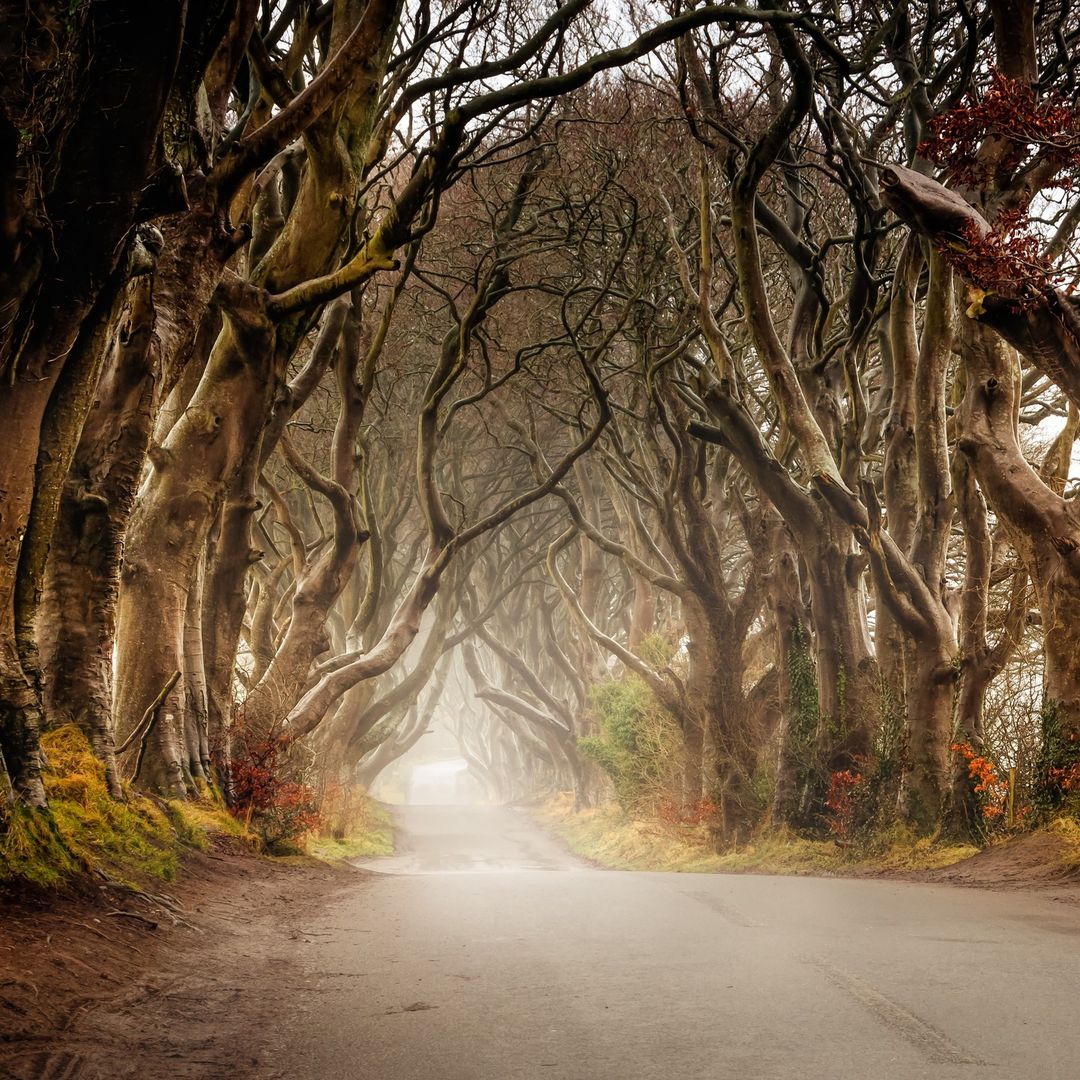
The Dark Hedges draw millions of visitors precisely because the location sits at the intersection of three things the world finds irresistible: genuine antiquity, supernatural legend, and screen fame. But the Grey Lady who haunts these trees predates Game of Thrones by roughly two centuries — and the real history of who she might be is stranger than any television script.
The Dark Hedges: What You’re Actually Looking At
The trees lining Bregagh Road are European beech — Fagus sylvatica — planted in the 1770s by James Stuart of Gracehill House. Stuart wanted an imposing entrance to his estate, and beech trees were the fashionable choice for grand Irish landowners of the Georgian period. He planted them close enough together that as they grew, their roots intertwined underground and their branches locked together overhead, creating a natural vault.
For most of the 18th and 19th centuries, the Dark Hedges functioned exactly as Stuart intended: a private approach to a private house. The road sat in obscurity, known mainly to locals in Armoy and the surrounding townlands of north Antrim. That changed slowly, then very quickly.
Today, approximately 60 kilometres north of Belfast, the Bregagh Road draws visitors from across the world. Tourism Ireland lists it among the country’s top 10 most Instagrammed locations. On peak summer mornings, cars queue along the approach roads from before dawn — because the trees look most extraordinary in early light, when ground mist softens the road and the canopy glows.
The Grey Lady — and What the Locals Actually Say
The ghost goes by the name the Grey Lady. Accounts describe her emerging from one end of the tree tunnel at dusk, gliding along the road, and vanishing before she reaches the other end. Witnesses across multiple generations of north Antrim locals have described the same figure: a woman in grey or white, moving without sound, whose feet appear not quite to touch the ground.
Who is she? The tradition offers two candidates:
- A servant girl from Gracehill House who died young and never left the estate she worked on in life — a common motif in Irish ghost folklore, where sudden or unhappy death binds the spirit to a familiar place
- A woman from the local townland who lost a loved one on the road itself — the hedges run close to the old churchyard at Armoy, and older locals sometimes name her as a mourner who never stopped grieving
Neither account has documentary evidence behind it. But in Irish folk tradition, that is rarely the point. The Grey Lady exists because people have seen her — or believe they have — and because the trees themselves create conditions that the human imagination finds impossible to leave unannotated. A road this old, this dark, this quiet, demands a story. The Grey Lady is the story this one chose.
Game of Thrones and the Kingsroad
In 2011, a television production crew arrived on Bregagh Road and filmed a sequence for the second series of HBO’s Game of Thrones. The Dark Hedges became the Kingsroad — the ancient road Arya Stark travels disguised as a boy, escaping King’s Landing. The scene lasts less than three minutes on screen. Its effect on the Dark Hedges has lasted ever since.
Game of Thrones filmed extensively across Northern Ireland between 2010 and 2019, using locations in counties Antrim, Down, and Derry/Londonderry to stand in for Westeros. The Dark Hedges proved particularly well-suited to the production because the trees required no dressing — they looked exactly like a medieval road in a fantasy kingdom, because they look like a medieval road in real life.
Tourism numbers at the Dark Hedges rose by an estimated 300% in the years following the Game of Thrones episode. By 2015, the Northern Ireland Tourist Board had added the site to its official Game of Thrones trail, alongside Ballintoy Harbour (the Iron Islands), the Cushendun Caves (where Melisandre gives birth to the shadow), and Downhill Demesne (the Dragonstone cliffs).
☘ Enjoying this? 64,000+ Ireland lovers get stories like this every week. Subscribe free →
The Real History of Gracehill House and the Stuart Family
James Stuart planted his beech trees in approximately 1775, but the Stuart family’s connection to north Antrim ran deeper than a fashionable driveway. The Stuarts were part of the Protestant Ascendancy — the landowning class that dominated Irish society in the 18th century — and Gracehill House represented the comfortable, confident prosperity of that world.
Gracehill itself is a small village near Ballymena with a history that runs counter to the sectarian geography that most outsiders associate with County Antrim. The village was founded in 1759 by the Moravian Church — a Protestant denomination originating in Bohemia, known for its pacifism and its practise of burying men and women in separate sections of the churchyard, arranged by gender rather than family. The Moravian church and its quiet cemetery still stand in the village centre today, a striking counterpoint to the supernatural drama of the hedges nearby.
Stuart himself appears in local records as a typical improving landlord of his era — planting trees, draining land, improving roads. The beech hedge was not the act of an eccentric; it was exactly what a Georgian gentleman with taste and money did with his estate. That his avenue would become one of Ireland’s great supernatural landmarks 250 years later was not part of the plan.
Practical Information: Visiting the Dark Hedges
The Dark Hedges sit on the Bregagh Road, between Armoy and Stranocum, in County Antrim. They are free to visit and open at all times, but practical realities shape when and how you go:
- Best time: Dawn or dusk on weekdays from October through March. Summer mornings draw the largest crowds; arrive before 7am for clear shots of the road
- Parking: A small car park sits at the Bregagh Road end near the Dark Hedges Hotel; arrival by bicycle or on foot from Armoy village (approximately 2 kilometres) lets you approach without the queue
- Nearby: Ballintoy Harbour (15 kilometres north), Carrick-a-Rede rope bridge (18 kilometres), and the Giants Causeway (30 kilometres) are all within easy driving distance for a full day on the north Antrim coast
- Storm damage: Several trees have come down in storms since 2016 — including Storm Gertrude (2016), Storm Arwen (2021), and Storm Isha (2024) — and the canopy now has visible gaps, though the overall tunnel effect remains dramatic
- Night visits: The road has no lighting. Night visits require a torch and care; the lane carries traffic
The Ghost Trail: Other Antrim Supernatural Sites Nearby
The Dark Hedges sits in a corner of Antrim with an unusual density of folk legend. If the Grey Lady brings you north, other locations in the vicinity reward the curious:
Dunluce Castle sits 20 kilometres west along the coast — a clifftop ruin from the 14th century, home to the McDonnell clan, and the site of its own ghost story: the banshee of the McDonnells, said to have wept the night before part of the castle collapsed into the sea in 1639. Local legend holds that it was the kitchen wing that fell during a dinner party, taking several servants with it, and that the banshee had tried to warn them — though 18th-century paintings still show the kitchen standing, so historians believe the actual collapse may have hit a different wing, or come later than the traditional date.
Bonamargy Friary, near Ballycastle, holds the tomb of Sorley Boy MacDonnell — one of the most formidable Gaelic lords of the 16th century, who outlasted three English expeditions sent to subdue him. Local tradition holds that a Black Nun haunts the friary ruins, visible only at certain phases of the moon.
Ossian’s Grave, near Cushendall, is a Neolithic court tomb — approximately 4,000 years old — named after Oisín, the legendary warrior poet of the Fianna who returned from the land of eternal youth to find Ireland changed beyond recognition. The megalithic tomb has nothing to do with Oisín historically, but Irish tradition regularly attaches ancient stones to legendary figures, as if the landscape needs stories the way it needs rain.
Why Ireland Builds Stories Around Its Trees
The Grey Lady of the Dark Hedges follows a pattern that appears throughout Irish folk tradition: the belief that ancient or unusually significant trees attract presences that ordinary spaces do not. Sacred trees — the crann bethadh, or tree of life — appear throughout early Irish mythology. Individual trees marked boundaries, graves, assembly points, and holy wells. The destruction of a sacred tree by an enemy counted as a serious act of desecration, equivalent in symbolic weight to razing a church.
Beech trees, specifically, do not appear in the oldest layers of Irish tree mythology — they are a later introduction, not native to Ireland. But two and a half centuries have given the Bregagh Road beeches enough history to earn their own legend. The Grey Lady did not arrive with the trees. She arrived when the trees had grown old enough to deserve her.
For the 70 million people worldwide who claim Irish heritage, landscapes like this carry personal weight — our free ancestry guide walks you through how to find your family’s specific place in Ireland, from townland maps to emigration records: Trace Your Irish Roots — Free Step-by-Step Guide.
☘ Join 64,000+ Ireland Lovers
Every weekday morning, get Ireland’s hidden gems, local secrets, and travel inspiration — the kind you won’t find in any guidebook.
Subscribe free — enter your email:
Know someone who’d love this? Share on WhatsApp →
Love more? Join 43,000 Scotland lovers → · Join 29,000 Italy lovers → · Join 7,000 France lovers →
Free forever · Unsubscribe anytime
Frequently Asked Questions
Where exactly are the Dark Hedges, and how do you get there?
The Dark Hedges sit on the Bregagh Road near Armoy, County Antrim, approximately 60 kilometres north of Belfast. By car, take the A26 north from Ballymena towards Ballymoney, then follow signs for the Dark Hedges through Stranocum. By public transport, take the bus from Belfast to Ballymoney (approximately 1 hour 15 minutes), then taxi or cycle the remaining 8 kilometres. The nearest train station is Ballymoney, served by Northern Rail from Belfast Central.
Is the Dark Hedges ghost story real, or a modern invention?
The Grey Lady tradition at the Dark Hedges predates the Game of Thrones filming by at least two generations, according to local accounts. It appears in collections of County Antrim folklore from the 20th century. Whether any specific sightings qualify as genuine encounters with the supernatural depends on your point of view — but the tradition itself is old enough to count as a genuine piece of north Antrim folklore rather than a tourist invention.
Which Game of Thrones scenes used the Dark Hedges?
The Dark Hedges appears in Season 2, Episode 1 of Game of Thrones (“The North Remembers”), when Arya Stark travels along the Kingsroad disguised as a boy. The production filmed on location in approximately 2011 before the show aired. Northern Ireland Tourism now runs a dedicated Game of Thrones trail that includes the Dark Hedges alongside Ballintoy Harbour, Cushendun Caves, Downhill Demesne, and Castle Ward (the model for Winterfell).
What is the best time of year to visit the Dark Hedges?
Autumn (October and November) offers the most dramatic combination of conditions: the beeches turn gold and copper, morning mist often sits low along the road, and visitor numbers drop significantly from summer peaks. Winter visits between December and February give you the starkest, most atmospheric version of the tunnel. Spring brings new leaves and good morning light. Summer draws the largest crowds but also the longest days, making early morning visits before 7am worthwhile for empty road photographs.
Tours & experiences you might love


Powered by Viator. Some links are affiliate links — we may earn a small commission at no extra cost to you.
Secure Your Dream Irish Experience Before It’s Gone!
Planning a trip to Ireland? Don’t let sold-out tours or packed attractions spoil your journey. Iconic experiences like visiting the Cliffs of Moher, exploring the Rock of Cashel, or enjoying a guided walk through Ireland’s ancient past often sell out quickly—especially during peak travel seasons.

Booking in advance guarantees your place and ensures you can fully immerse yourself in the rich culture and breathtaking scenery without stress or disappointment. You’ll also free up time to explore Ireland’s hidden gems and savour those authentic moments that make your trip truly special.
Make the most of your journey—start planning today and secure those must-do experiences before they’re gone!