

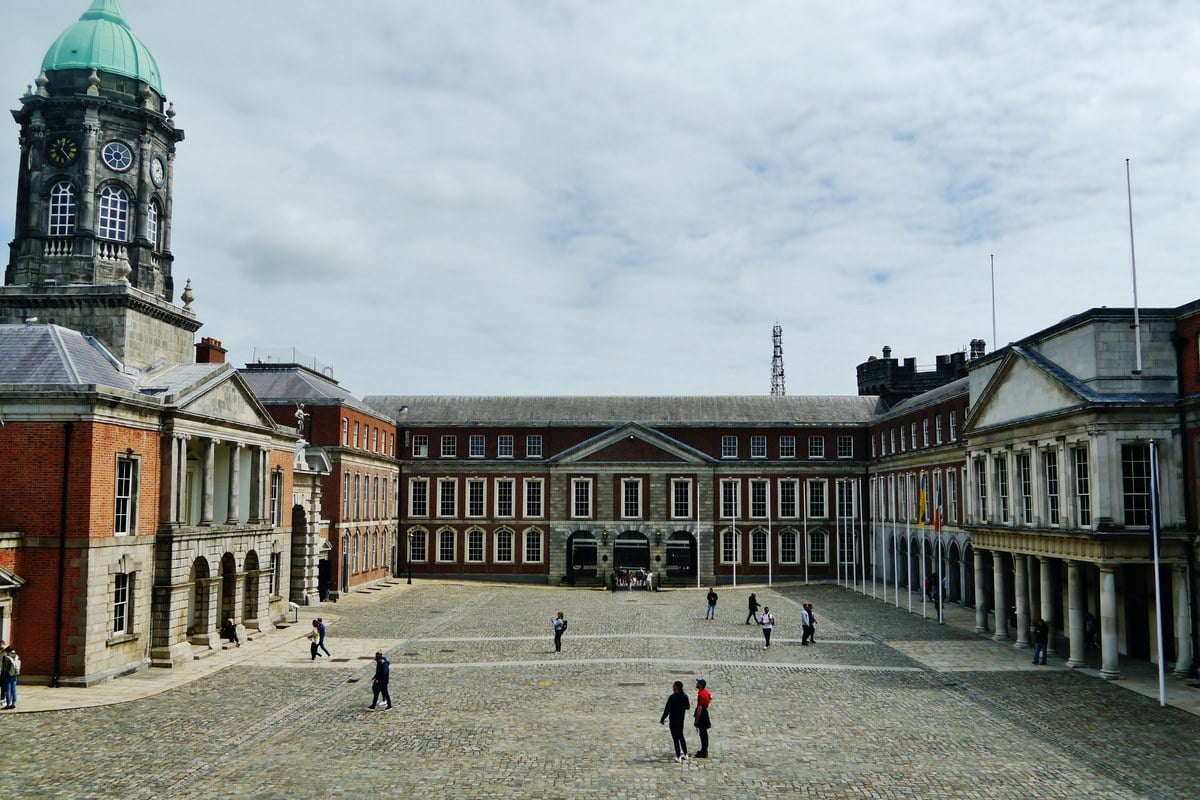
Dublin Castle has been at the centre of Ireland’s story for over 800 years — Norman fortress, British viceroy’s seat, and since 1922 the symbolic home of the Irish State. It’s one of the most historically charged square acres on the island, and one of the easiest to walk past without realising what you’re looking at. This guide covers what to see, how to visit, and the details most first-time visitors miss.
⚠️ Important for 2026 visitors
Dublin Castle is closed to the public from 5 May 2026 through 31 December 2026 to host Ireland’s EU Council Presidency. Public tours will resume in January 2027. If you’re planning a Dublin trip during that window, Chester Beatty Library (on the castle grounds) and Christ Church Cathedral next door remain open and make a strong half-day substitute.
Quick Facts
- Location: Dame Street, Dublin 2 (city centre, 5-minute walk from Trinity College)
- Opening hours: Monday–Sunday, 09:45–17:45 (last entry 17:15); closed Good Friday, 24–26 December and 1 January. These are the standard hours — the ticketed interior is closed May–December 2026 for the EU Presidency; see the notice above.
- Admission (standard 2026 rates, in effect outside the May–Dec 2026 closure):
- Self-guided — Adult €8, Senior/Student €6, Child 12–17 €4, Family (2+3) €20
- Guided tour — Adult €12, Senior/Student €10, Child 12–17 €6, Family (2+3) €30
- Under-12s free on both tickets. Book online up to 15 days in advance to skip the queue; limited walk-up tickets also available at the desk.
- Time to allow: 60–90 minutes for the main rooms; 2–3 hours if you add Chester Beatty Library and the Dubhlinn Gardens
- Best for: History buffs, anyone interested in the transition from British to Irish rule, rainy-day Dublin, families with older children
A Thousand Years of Irish Power — In One Courtyard
When Strongbow and the Normans sailed into Dublin in 1170, they landed beside a dark pool (Dubh Linn in Irish — the “black pool” that gave the city its name) where the River Poddle met the Liffey. King John ordered a stone castle built on the spot in 1204, and for the next seven centuries whoever controlled that courtyard controlled Ireland.
The medieval fortress didn’t last. Most of it burned down in a fire in 1684, and what you see today is largely an elegant 18th-century rebuild in the Georgian style — a set of palatial State Apartments designed for the British Lord Lieutenant, who governed Ireland on behalf of the Crown. For more than two hundred years, this was where Ireland’s rulers lived, entertained, and held their court, while most of the country lived in a world apart.
The most important moment in the castle’s history came on the afternoon of 16 January 1922. After the War of Independence and the signing of the Anglo-Irish Treaty, Michael Collins arrived in the Upper Yard to formally take possession of Dublin Castle on behalf of the newly recognised Irish Free State. The handover lasted minutes. The British Viceroy is said to have commented that Collins was seven minutes late. Collins reportedly replied, “We’ve been waiting 700 years — you can have the seven minutes.” Whether that exchange really happened has been debated ever since, but the symbolism of that day is not.
Every Irish President since has been inaugurated at Dublin Castle. State funerals, EU summits, and the welcome receptions for visiting heads of state still take place here. Visiting the castle is, in a very real sense, walking through the administrative memory of modern Ireland.
What to See Inside
The State Apartments
The heart of any visit. This is the suite of grand Georgian rooms where the Viceroys once held court and where Ireland’s Presidents are now inaugurated. The highlights:
- St Patrick’s Hall — the most impressive room in the castle. The painted ceiling, painted by Vincenzo Valdrè between 1788 and 1802, depicts the meeting of King Henry II with the Irish chieftains. This is where every President of Ireland is inaugurated; when you stand in it, you are standing on one of the most politically significant floors in the country.
- The Throne Room — the original gilded throne installed for George IV’s visit in 1821 still sits at the far end. British monarchs sat on it; none has since independence.
- The Portrait Gallery — formal portraits of the Viceroys who once ran Ireland from this building. Read the names, read the dates. The displacement of that power is the subtext of the entire castle.
- The Bermingham Tower — one of the surviving medieval towers. Once a prison, now an elegant state room. The walls are metres thick.
The Chapel Royal
Built in 1814 in Gothic Revival style and until 1922 the official chapel of the British administration. Look up: the elaborate plaster ceiling is a forest of ribs and bosses, carved heads of saints, and hand-painted coats of arms of every Viceroy who served here. It’s beautiful, strange, and pointedly un-Irish in design. Services are no longer held.
The Medieval Undercroft
This is the part most visitors don’t realise is there — and it’s the most atmospheric. Beneath the castle you can walk down to the remains of the original Norman and Viking-era fortifications, including a surviving section of the old city wall, the base of the Powder Tower, and the Poddle river still running beneath the stones. It’s dim, damp, and a thousand years older than the rooms above. Don’t skip it.
The Dubhlinn Gardens
Behind the castle, a circular garden laid out with Celtic knot patterns marks the approximate site of the original black pool. Free to enter, quiet, and usually empty. A good spot to sit for ten minutes if you need a break.
The Chester Beatty Library (bonus)
This isn’t technically Dublin Castle, but it’s in the castle grounds and it’s free. The Chester Beatty is one of the finest small museums in Europe — an extraordinary private collection of illuminated manuscripts, Islamic and East Asian art, religious texts, and early printed books bequeathed to the Irish state in 1968. Named European Museum of the Year. Don’t leave the castle without walking through it, especially on a rainy day.
Self-Guided vs Guided Tour
You have two ticket options:
- Self-guided (€8 adult, €6 senior/student, €4 child 12–17) — you walk through the State Apartments, Chapel Royal, and Medieval Undercroft at your own pace with interpretive panels.
- Guided tour (€12 adult, €10 senior/student, €6 child 12–17, ~70 minutes) — a live guide leads a small group through all the same areas, plus access to a couple of rooms not on the self-guided route. The guides are excellent, most of them are history graduates, and if you care about the detail of the Collins handover, the architectural story, or the Viking undercroft, the guided tour is worth the extra cost.
Book online in advance during summer and over long weekends. Walk-up is usually fine in winter and on weekdays outside school holidays.
Getting There
Dublin Castle is about as central as it gets — you can walk to it from any of the main city-centre landmarks:
- From Trinity College / Grafton Street: 5 minutes on foot west along Dame Street
- From Temple Bar: 3 minutes on foot south
- From Christ Church Cathedral: 2 minutes on foot east
- From O’Connell Street / GPO: 10 minutes on foot across O’Connell Bridge and down Dame Street
- Luas (tram): closest stops are Four Courts (Red Line) and St Stephen’s Green (Green Line), both about 10 minutes’ walk
- Bus: dozens of routes stop on Dame Street and nearby George’s Street
The main visitor entrance is via the Dame Street gates into the Upper Yard. There’s no dedicated car park on site; if you’re driving, use the public car parks on Drury Street or Christchurch Place.
Best Time to Visit
The castle is open all year and never feels as crowded as, say, the Guinness Storehouse or the Book of Kells.
- Quietest: weekday mornings in January, February, October, November
- Busiest: July and August afternoons, and any day with cruise ships in Dublin Port (check dublinport.ie)
- Best for photography: the Upper Yard looks its best in afternoon light; the Chapel Royal ceiling needs a clear, bright day for the stained glass to glow
- Worst to avoid: state occasions occasionally close parts of the castle without much notice — if you’ve travelled a long way for this, check the official site the day before
Practical Tips From Locals
- Combine it with the Chester Beatty. The library is free, extraordinary, and a five-minute walk across the castle grounds. Doing both together is the single best way to fill a rainy half-day in Dublin.
- Go first thing. First entry is 09:45. The first hour of the day is the quietest, the light in the State Apartments is softest, and the guided tours run smaller groups.
- Use the café. The Silk Road Café inside the Chester Beatty does genuinely good Middle Eastern food and is one of Dublin’s best-kept lunch secrets. You don’t need a museum ticket to eat there.
- Look up. Every Georgian room in Dublin Castle has something on the ceiling worth staring at — plasterwork, painted panels, crystal chandeliers. Most visitors miss the detail because they’re reading the information cards at waist height.
- Check for state events. If a European dignitary is in town, parts of the castle may be closed to the public with little warning. It’s rare, but it happens — check the official site the day of your visit.
- Bring a light jacket. The undercroft is cold year-round; the State Apartments on a sunny day are hot. Layers help.
Accessibility
The State Apartments and Chapel Royal are step-free via lifts. The Medieval Undercroft has some uneven stone surfaces and limited stair-free access — contact the castle in advance if you have mobility requirements and they will arrange a bespoke route. Accessible toilets are available. Assistance dogs are welcome throughout.
Pair Dublin Castle With
If you have half a day or more in the city centre, build a walking route that combines the castle with:
- Chester Beatty Library — inside the castle grounds, free, world-class collection
- Christ Church Cathedral — 2 minutes’ walk east, Dublin’s oldest cathedral (founded 1030), with a stunning medieval crypt
- Dublinia — attached to Christ Church, interactive Viking and medieval Dublin exhibition, excellent for families
- Temple Bar — 3 minutes north, for lunch or a pint afterwards
- Trinity College and the Book of Kells — 5 minutes east, easy to combine in a morning
A comfortable walking loop covering all five of these takes about 4–5 hours with food and coffee stops.
Frequently Asked Questions
Is Dublin Castle actually a castle?
Partly. The medieval fortress is mostly gone — destroyed by fire in 1684 — and the buildings you see today are 18th and 19th-century palatial replacements. Two medieval towers survive (the Record Tower and the Bermingham Tower), and you can walk through the original Viking-era foundations in the undercroft. So: no drawbridge, no moat, but real medieval stones underneath.
Can you visit without a ticket?
Yes and no. The Upper and Lower Yards (the courtyards), the Chester Beatty Library, and the Dubhlinn Gardens are all free to walk through during opening hours. To enter the State Apartments, Chapel Royal, and Medieval Undercroft you need a ticket. Note: the ticketed interiors are closed May through December 2026 for Ireland’s EU Council Presidency and reopen in January 2027.
How long should I spend there?
For the ticketed interior, allow 60 to 90 minutes (longer on a guided tour). If you add the Chester Beatty and the gardens, a comfortable total is 2.5 to 3 hours.
Is it suitable for children?
Yes, especially for curious 8–14 year olds interested in history. Younger children may find the State Apartments slow, but they usually love the undercroft with its Viking stones and running river. Under-12s are free.
Do the Irish Crown Jewels really get stolen from here?
They were — in 1907, from a safe in the Bedford Tower just metres from where you’ll buy your ticket. They’ve never been recovered, the thief was never caught, and the investigation was quietly shelved in 1908 under pressure from the British government. It remains one of the most remarkable unsolved heists in Irish history. Ask your guide about it.
Is it worth visiting in the rain?
Genuinely, yes. The castle is one of the best rainy-day attractions in Dublin — almost entirely indoors, warm, architecturally spectacular, and connected to the equally indoor Chester Beatty by a short covered walk. You could easily spend half a wet day here and not notice the weather.
The Bottom Line
Dublin Castle is the most important building in Ireland most visitors walk past without entering. It’s not the biggest, the prettiest, or the most famous — but it’s the one place in the country where you can stand in the actual room where Ireland passed from British to Irish hands, look up at the ceiling where every President has been inaugurated, and walk downstairs into the Viking and Norman foundations of the city itself.
For the price of a pint and a half, you get 800 years of Irish history, a world-class museum next door, and one of the best rainy-day itineraries in Dublin. Go early, take the guided tour, and don’t skip the undercroft.
☘️ Join 64,000+ Ireland Lovers
Every Friday, get Ireland’s hidden gems, local secrets, and travel inspiration — the kind you won’t find in any guidebook.
Subscribe free — enter your email:
Free forever · · Unsubscribe anytime
Tours & experiences you might love


Powered by Viator. Some links are affiliate links — we may earn a small commission at no extra cost to you.
Secure Your Dream Irish Experience Before It’s Gone!
Planning a trip to Ireland? Don’t let sold-out tours or packed attractions spoil your journey. Iconic experiences like visiting the Cliffs of Moher, exploring the Rock of Cashel, or enjoying a guided walk through Ireland’s ancient past often sell out quickly—especially during peak travel seasons.

Booking in advance guarantees your place and ensures you can fully immerse yourself in the rich culture and breathtaking scenery without stress or disappointment. You’ll also free up time to explore Ireland’s hidden gems and savour those authentic moments that make your trip truly special.
Make the most of your journey—start planning today and secure those must-do experiences before they’re gone!
Subscribe Free