

Dún Aonghasa sits on the southern cliffs of Inis Mór, the largest of the Aran Islands, at the edge of a sheer 100-metre drop into the Atlantic. It is one of the most dramatic prehistoric sites in Europe — a semicircular stone fort built, extended, and occupied over roughly 3,000 years, whose seaward wall was simply never needed, because the cliff itself was the barrier.
Standing here, you understand why people chose this place. There is no better-defended position in the west of Ireland.
Love Ireland? Get our free weekly newsletter — practical travel guides, hidden corners, and real stories from the island. Subscribe here →
What Is Dún Aonghasa?
Dún Aonghasa (also spelled Dún Aengus, anglicised from the Irish) is a prehistoric cliff-top fort on Inis Mór, County Galway. It is managed by the Office of Public Works (OPW) and is a designated National Monument of Ireland.
The site dates from at least 1100 BC, with evidence suggesting earlier occupation. It was built and expanded in stages over centuries. What visitors see today is a series of three concentric enclosures. The innermost is a D-shaped dry-stone wall up to 6 metres high and 4 metres thick. On the landward side, a dense band of closely packed upright limestone pillars — a chevaux de frise — was set into the ground as an obstacle against cavalry or infantry attack. These sharp stones still stand today, and walking through them gives an immediate sense of how seriously the fort’s builders took their defences.
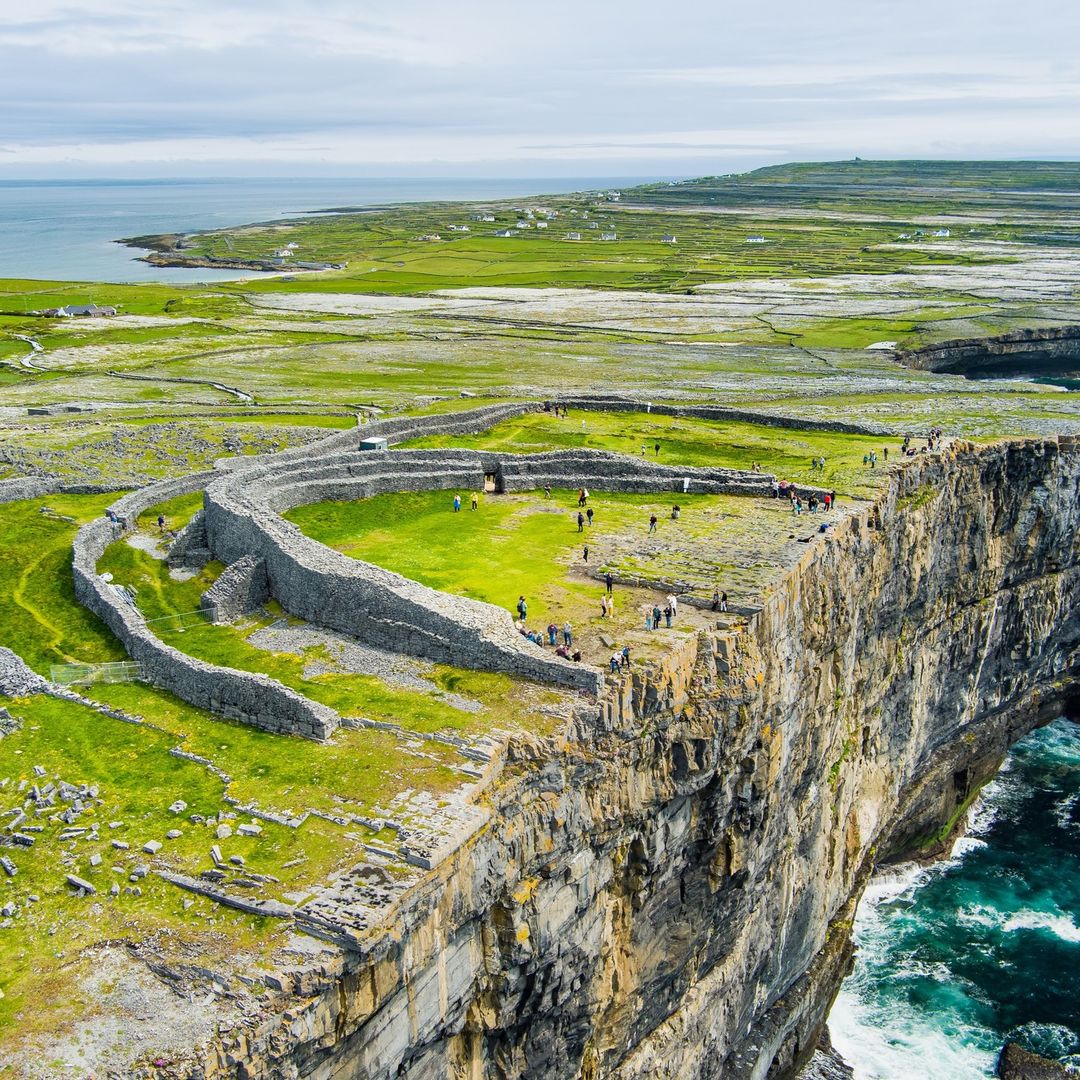
The seaward side of the fort has no wall. The 100-metre vertical cliff is the wall.
Archaeologists have found evidence of metalworking, animal husbandry, and habitation at the site. Who built it, and why a cliff that sheer was chosen as a foundation, remains only partially understood. The earliest phase, around 1100 BC, belongs to the late Bronze Age in Ireland — more than a thousand years after the pyramids at Giza were built, not before. The most substantial stone walls visible today were added later, during a phase of Iron Age building around 500 BC. What’s certain is that Dún Aonghasa was a major centre of activity for prehistoric communities on the island.
How to Get to Inis Mór
Inis Mór sits roughly 9 kilometres off the Connemara coast and is accessible by ferry or light aircraft.
By ferry: The two main operators are Aran Island Ferries and Doolin Ferry Company. Aran Island Ferries departs from Rossaveal, about 40 minutes west of Galway city, with bus connections available from Galway’s Eyre Square. The crossing takes roughly 40 minutes. Doolin Ferry Company departs from Doolin in County Clare — the express crossing takes around 35–45 minutes, or up to about 75 minutes on the standard service. Both services are weather-dependent and can be cancelled at short notice. Check conditions before travelling.
By plane: Aer Arann Islands operates daily flights from Connemara Regional Airport, near Inverin, to Inis Mór. The flight takes about 10 minutes. Several departures run each day in summer and the service is particularly useful when sea conditions make the ferry uncomfortable.
Book well in advance in July and August, when demand is high. Day-tripper capacity on ferries can sell out by mid-morning in peak season.
Getting from Kilronan to the Fort
The main ferry port on Inis Mór is Kilronan. Dún Aonghasa is about 8 kilometres to the west.
By bicycle: Kilronan has several bike-hire shops open from spring through autumn. The road to Dún Aonghasa is fully surfaced, though there is a steady climb toward the end. Most fit cyclists cover it in 30–40 minutes. This is the most practical way to see the island at your own pace, stop for views, and visit other forts on the same trip.
By minibus or taxi: Island taxi and minibus operators meet the ferries at Kilronan and offer return trips to Dún Aonghasa with time to explore the site. This suits visitors who prefer not to cycle or are short on time.
On foot: Walking the route is possible but 8 kilometres each way makes it a full day’s commitment. Most visitors combine walking sections with cycling or transport.
What to Expect at the Site
The OPW visitor centre is at the base of the hill, roughly 1 kilometre below the fort. There is a small exhibition on the history of the Aran Islands and the prehistoric context of the fort. Entry to the site costs €5 for adults, €3 for children (check the current rate at heritageireland.ie before you visit).
The path to the fort is a moderate climb over rough limestone terrain. It takes most people around 20 minutes to reach the inner enclosure. Wear shoes with a firm grip — the limestone is uneven, and wet conditions make the rock slippery. There is no handrail on the path or at the cliff edge itself.
Once inside the innermost enclosure, the cliff is directly ahead of you. A low rope marks a loose boundary, but there is nothing between you and a 100-metre drop into the Atlantic. On clear days you can see the Cliffs of Moher on the Clare coast to the south-east, and on very clear days, the Twelve Bens of Connemara to the north-east.
Visitors do lie flat and edge to the rim to look straight down. It is not compulsory. The drop is real and the wind can be strong. Keep children close and well away from the edge at all times.
Allow at least 90 minutes at the site — time to walk the outer enclosures, examine the chevaux de frise up close, and spend some time at the cliff edge without feeling hurried.
Planning a trip to Ireland? Our newsletter covers the best of the island — from ancient sites to coastal walks — delivered free each week. Join thousands of readers →
The Other Forts of Inis Mór
Dún Aonghasa is the most famous, but Inis Mór has three other significant stone forts worth knowing about.
Dún Dúchathair (The Black Fort) is south of Kilronan and similarly positioned on a cliff edge. It is less visited than Dún Aonghasa, has no entry charge, and feels considerably wilder. The approach is rougher underfoot and less clearly marked — which is part of the appeal.
Dún Eochla is the highest fort on the island, sitting on the central ridge. Free to visit, it offers panoramic views east and west across the island.
Dún Eoghanachta is in the far west of the island, a circular fort of uncertain date reached by a quiet lane. It sees very few visitors.
Together, the four forts suggest that Inis Mór held strategic and cultural importance across a long period. Whether the defences were built against mainland raiders, rival island groups, or simply as symbols of power remains debated by archaeologists.
More to See on Inis Mór
A day on Inis Mór can cover more than the forts if you have a bicycle and an early ferry.
The Wormhole (Poll na bPéist): A rectangular natural pool cut with near-perfect geometry into the flat limestone of the island’s south coast. It was used as a Red Bull Cliff Diving venue. The walk out to it crosses open karst limestone with no marked path — just the rock. Allow an hour return from the road. Wear sturdy shoes.
Teaghlach Éinne: The remains of a medieval church and round tower near the eastern tip of the island, set within a graveyard that is still in use. Quiet, well-preserved, and rarely crowded.
Kilronan harbour: A small working harbour with a pub, a café, and a shop. Joe Watty’s Bar on the edge of the village is reliable for lunch and has a traditional music session most evenings in summer.
The stone walls: The Aran Islands contain an estimated 1,600 kilometres of dry-stone walls across 120 square kilometres of land. They are built without mortar and were constructed to clear the thin soil for farming and to protect crops and animals from Atlantic gales. Looking out from Dún Aonghasa, the patchwork of walls across the limestone is one of the most distinctive landscapes in Ireland.
When to Visit
Dún Aonghasa is open year-round but ferry schedules are reduced in winter and services can be cancelled during poor weather. Summer (June–August) is the busiest period, with the site crowded from mid-morning onwards as day-trippers arrive on morning ferries.
To avoid the worst of the crowds:
- Take the first ferry of the day and head straight to Dún Aonghasa before the tours arrive.
- Stay overnight on the island — there are B&Bs in Kilronan and in the western villages — and visit early morning or in the early evening.
- May, early June, and September offer the best combination of reasonable weather and manageable visitor numbers.
The site offers no shelter from wind or rain. Atlantic weather can change quickly. Bring a waterproof layer regardless of what the forecast says.
Practical Information
- Location: Inis Mór, County Galway, H91 ND90
- Entry fee: €5 adults, €3 children (verify at heritageireland.ie)
- Opening hours: Daily 9:30–18:00 (April–October); 9:30–16:00 (November–March); closed 24–30 December
- Ferry from Galway: Aran Island Ferries — aranislandferries.com
- Ferry from Doolin: Doolin Ferry — doolinferry.com
- Flights: Aer Arann Islands — aerarannislands.ie
- Bike hire: Several operators in Kilronan, seasonal, book ahead in summer
- No café or shop at the fort — bring water and food for the site
Get more Ireland travel guides like this one. Our free weekly newsletter covers the places worth visiting — no filler, no fluff. Subscribe free →
☘️ Join 64,000+ Ireland Lovers
Every weekday morning, get Ireland’s hidden gems, local secrets, and travel inspiration — the kind you won’t find in any guidebook.
Subscribe free — enter your email:
📲 Know someone who’d love this? Share on WhatsApp →
Free forever · Unsubscribe anytime
Tours & experiences you might love


.jpg)
Powered by Viator. Some links are affiliate links — we may earn a small commission at no extra cost to you.
Secure Your Dream Irish Experience Before It’s Gone!
Planning a trip to Ireland? Don’t let sold-out tours or packed attractions spoil your journey. Iconic experiences like visiting the Cliffs of Moher, exploring the Rock of Cashel, or enjoying a guided walk through Ireland’s ancient past often sell out quickly—especially during peak travel seasons.

Booking in advance guarantees your place and ensures you can fully immerse yourself in the rich culture and breathtaking scenery without stress or disappointment. You’ll also free up time to explore Ireland’s hidden gems and savour those authentic moments that make your trip truly special.
Make the most of your journey—start planning today and secure those must-do experiences before they’re gone!