

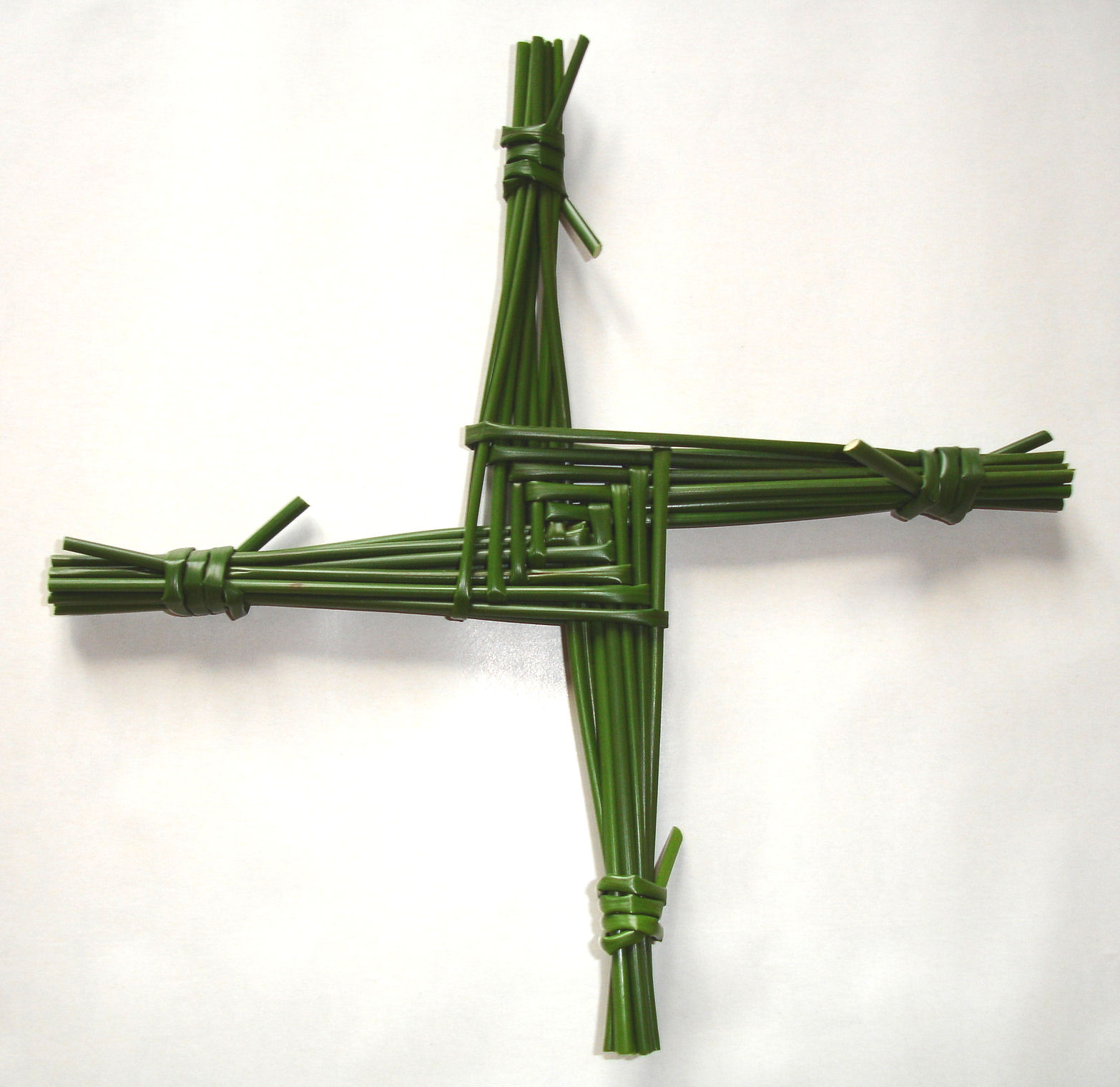
Every February, Ireland Weaves a Cross Said to Be Ancient. The Oldest Written Mention of It Is From the 1600s.
Every year on the first of February, across Ireland and in Irish homes from Boston to Brisbane, people sit down with bundles of rushes and begin to weave. They fold the stems around a central square, turning and building until a four-armed cross takes shape — the St Brigid’s Cross, hung over doors and hearths for protection through the year ahead.
The tradition feels old. Ask around and you will hear a confident explanation: February 1st was Imbolc, a pre-Christian Celtic festival marking the return of light; the cross design echoes ancient sun wheel symbols; the saint herself was a Christianised version of an older goddess. The Christian patina, the story goes, was laid over something much more ancient. It is a story we find everywhere in Irish cultural life, and it is easy to understand why it has taken hold — it makes the tradition feel deeper, more layered, more resonant with the long human presence on this island.
The complication is the evidence. When you look for it closely, the historical record around St Brigid’s Cross turns out to be considerably murkier than the confident popular version suggests. And one fact in particular has a way of stopping the conversation cold: the first written record we have of anyone making a St Brigid’s Cross dates from the 17th century.
What the Records Actually Show
Cogitosus, a monk writing in the 7th century, produced what is considered the earliest surviving biography of Saint Brigid — the Vita Sanctae Brigidae. It is a detailed hagiography of a woman who lived and died in the 5th century. It discusses her miracles, her religious community at Kildare, the fire maintained there in her name. It does not mention a cross woven from rushes.
Neither do the other early medieval sources on Brigid’s life. Ireland’s National Inventory of Intangible Cultural Heritage, which formally lists the weaving tradition as a living cultural practice, does not cite any pre-17th-century written evidence for it. Scholars who have examined the question closely have found the same gap. The tradition as we know it — the specific form of the cross, the February 1st weaving, the hanging over doorways — enters the documentary record comparatively recently in the life of a saint who has been venerated for fifteen centuries.
That alone does not prove the tradition is not older. Oral practices and folk customs often go unrecorded for centuries before anyone thinks to write them down, particularly in a culture where so much was transmitted by memory rather than manuscript. But it does mean that the claim of direct descent from pre-Christian sun wheel ritual is, at best, a modern inference rather than a documented historical fact. No confirmed archaeological evidence — no inscriptions, no votive objects, no burial goods from Bronze Age or Iron Age Ireland — has been identified that directly connects the cross design to pre-Christian Celtic sun wheel symbolism. The link is asserted repeatedly and confidently in popular accounts; in the scholarly literature, it remains unverified.
The Goddess Problem
The pre-Christian case for St Brigid’s Day rests on two connected claims: that February 1st was the ancient Celtic festival of Imbolc, and that the saint herself was a Christianised version of a pre-existing Celtic goddess also named Brigid.
The calendrical overlap is real, and this is where the story gets genuinely interesting. February 1st is both St Brigid’s feast day and the date associated with Imbolc, one of the four quarter-day festivals of the old Irish calendar — alongside Lughnasadh and Samhain — the seasonal midpoint between the winter solstice and the spring equinox — the point at which, in a northern agricultural society, the return of light begins to be felt in the soil and in the length of the day. That coincidence is acknowledged by essentially everyone who has examined it. Seán Ó Súilleabháin, who served as archivist for the Irish Folklore Commission and published his analysis in 1967, characterised St Brigid’s Day as “a Christianisation of one of the focal points of the agricultural year in Ireland.” It is a phrase that has been widely quoted in the decades since, and it captures the intuition that something older than the 5th century is being observed on February 1st, whatever we call it.
But the goddess Brigid presents a chronological problem the popular narrative tends to skip over. The earliest surviving written attestation of a Celtic goddess named Brigid comes from a text called Cormac’s Glossary, compiled around 908 CE. Saint Brigid, the historical woman venerated at Kildare, lived and died in the 5th century. The goddess as a named, documented figure in the surviving record therefore appears some four centuries or more after the saint.
This does not prove the goddess did not exist before the saint. Written attestation is not existence, and pre-Christian Irish culture was oral rather than textual — what survived did so largely because Christian monks chose to write it down, on their own terms and in their own order of priority. But it does mean the confident popular claim that “Christianity took an older goddess and renamed her a saint” is far harder to establish than it sounds. The most careful scholarly assessments reflect that difficulty. The Religion Media Centre, surveying the state of academic opinion on the question, puts it this way: “It is possible, although not certain, that St Brigid is a Christianised form of the earlier Celtic goddess.” Possible. Not certain.
What does hold up is the weight of the name itself. The goddess’s name derives from a Proto-Celtic root carrying meanings along the lines of “bright,” “high,” or “exalted.” The related British goddess Brigantia, attested through Roman-period inscriptions found in Britain, shares the same linguistic root. Some scholars argue a deity of this type was venerated across the pre-Christian Celtic world; others think Brigid and Brigantia may be distinct regional developments from a shared ancestry rather than a single unified figure. The connection is suggestive without being conclusive — which, as it turns out, describes most of this history.
The Cross You Can Hold
Whatever uncertainty surrounds its origins, the weaving tradition is very much alive. The form of the St Brigid’s Cross — a woven central square with four arms radiating outward, each arm folded from a rush and layered into the structure — is distinct enough to be instantly recognisable, and it remains in genuine everyday use rather than merely ceremonial display.
The origin story attached to it is the one most people in Ireland know from childhood: Brigid weaving at the bedside of a dying chieftain, picking up rushes from the earthen floor and folding them into a cross while she explained her faith, the chieftain converting and dying in peace. It is a story of considerable power, whatever its historical status. What is verifiable is that the cross became a widely recognised emblem across Irish communities worldwide, and that the tradition proved durable enough to cross oceans with the people who carried it.
Want to weave your own? Our step-by-step guide to the St Brigid’s Cross covers the method. Walk into an Irish cultural centre in any city with a significant diaspora and you are likely to find someone who knows how to make one. The Irish Cultural Centre in San Francisco runs St Brigid’s Cross weaving workshops as part of its annual programme. Schools across Ireland teach the technique each January. Community organisations in Britain mark the day. The practice has been sustained not by institutional mandate but by direct transmission — person to person, generation to generation — in the way that folk traditions actually persist through time.
The Holiday That Changed the Framing
In January 2022, Tánaiste Leo Varadkar made an announcement that placed the contested history of St Brigid squarely in front of the Irish public. Ireland would create a new national public holiday, to be held on February 1st, officially named “Imbolc/St Brigid’s Day.” It would be, he stated, the first Irish public holiday named after a woman.
St Brigid’s Day itself fell on Wednesday, February 1st, 2023 — but the new public holiday, which moves to the first Monday in February except in years when the 1st falls on a Friday, was actually observed four days later, on Monday, February 6th, 2023.
The decision followed a three-year campaign by herstory.ie, a feminist organisation that had been making the case since spring 2019 that Ireland — with no female public figure represented among its national holidays — needed to correct that absence. The campaign built political momentum, and the government, also noting that Ireland had a particularly sparse stretch of public holidays between January and March, moved to legislate. Multiple justifications were cited: honouring the country’s first female patron saint, marking a post-pandemic moment of national reflection, and filling the calendar gap. But the naming of the holiday was unambiguous. “Imbolc/St Brigid’s Day” placed both layers of the tradition on the official record simultaneously, with neither subordinated to the other.
This is worth pausing on. The Irish state did not wait for historians to settle the question of which came first — the saint or the goddess, the Christian feast or the pre-Christian festival. It took the contested synthesis and encoded it in law. Whatever the archival evidence may ultimately show about the 5th-century saint, the 10th-century textual goddess, and the 17th-century cross, the Irish government decided that all of it belongs to February 1st, and all of it is worth marking with a day off work.
Living With the Uncertainty
There is a version of this history that resolves cleanly. Either the cross is a genuine survival of pre-Christian practice and the doubters are too narrowly focused on written records, or it is a 17th-century folk tradition attached to an early Christian feast day and the pagan narrative is a later romanticisation. Neither version is fully supported by what we can actually verify.
What is clear is that February 1st sits at a real seasonal threshold — the midpoint of winter, the point at which the light begins to return in a way that any farming community in these latitudes would have registered over generations. Whether the pre-Christian Irish marked that threshold with a named festival called Imbolc, whether that festival involved a goddess named Brigid, whether the woven cross carries any direct continuity with pre-Christian ritual — these are genuine open questions, not matters already settled by the evidence. The scholarly caution is not cynicism or debunking for sport. It reflects the fact that the documentary record of pre-Christian Ireland is fragmentary, was largely preserved by Christian monks, and that the gap between what we can demonstrate and what we might wish to confirm is wider than popular accounts tend to acknowledge.
What Ireland did in 2023 was something different from resolving the debate. It named a public holiday after both versions of the same woman — the saint who wove rushes at a deathbed and the older figure she may or may not have replaced — and decided that the ambiguity was part of the point. Every February 1st from now on, the question of where one tradition ends and another begins will be asked again across the country and in Irish communities wherever rushes are folded and a four-armed cross takes shape on a kitchen table.
The cross hanging over your door this February may or may not descend from a ritual older than Christianity. What it carries, without question, is something that has outlasted every attempt to pin it down — a practice passed hand to hand across time and distance that has now been woven into the official calendar of a country and the lives of its people everywhere in the world. That seems worth marking regardless of which century it started in.
☘️ Join 64,000+ Ireland Lovers
Every Friday, get Ireland’s hidden gems, local secrets, and travel inspiration — the kind you won’t find in any guidebook.
Already subscribed? Download your free Ireland guide (PDF)
Free forever · One email per week · Unsubscribe anytime
Tours & experiences you might love


Powered by Viator. Some links are affiliate links — we may earn a small commission at no extra cost to you.
Secure Your Dream Irish Experience Before It’s Gone!
Planning a trip to Ireland? Don’t let sold-out tours or packed attractions spoil your journey. Iconic experiences like visiting the Cliffs of Moher, exploring the Rock of Cashel, or enjoying a guided walk through Ireland’s ancient past often sell out quickly—especially during peak travel seasons.

Booking in advance guarantees your place and ensures you can fully immerse yourself in the rich culture and breathtaking scenery without stress or disappointment. You’ll also free up time to explore Ireland’s hidden gems and savour those authentic moments that make your trip truly special.
Make the most of your journey—start planning today and secure those must-do experiences before they’re gone!