

Giant’s Causeway: Why 40,000 Perfectly Hexagonal Basalt Columns Look Man-Made (But Aren’t)
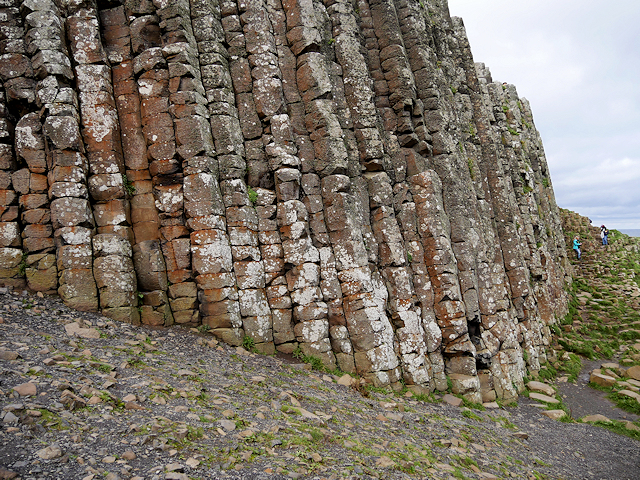
The first thing the brain does is look for a builder. Not in any mystical sense — just the straightforward, pattern-hunting reflex that makes us see faces in clouds and order in randomness. Stand on the basalt platform that stretches into the North Atlantic from the Antrim coast, surrounded by more than 40,000 hexagonal columns packed together like a vast tiled floor, and the reflex fires hard. These things are too regular. Too even. Too consistent.
When trained scientific minds from the Royal Society first documented this place in the 1690s, they had the same instinct. And it took the better part of two centuries — and a painter who wasn’t a geologist, a vicar who found the wrong fossils, and a French encyclopaedist who never set foot in Ireland — to finally work out what was actually going on.
What 60 Million Years of Cooling Looks Like
The Antrim coast sits on the edge of one of the most dramatic geological events in the Earth’s recent past. Between roughly 62 and 60 million years ago, the ancient supercontinent of Laurasia was splitting apart — the slow violent process that opened the North Atlantic Ocean. As the crust tore, magma surged upward along the weakness, and what is now the north of Ireland lay directly above the fault zone.
Successive lava flows inundated the chalk landscape. Some cooled quickly into the Upper and Lower Basalt formations that still define the Antrim plateau. But one particular flow — the formation geologists now call the Causeway Tholeiite — pooled in a river valley and built up to a depth of around 90 metres. It went nowhere. It just sat there and cooled.
And this is where the physics gets interesting.
When a deep, uniform mass of lava cools slowly and evenly, it contracts. The contraction creates stress, and the stress resolves itself into cracks — but the cracks don’t form randomly. They form at 120-degree angles to each other, the geometry of minimum stress, the same pattern that appears in drying mud or a slowly cooling glaze. The cracks propagate downward through the mass as it solidifies, creating columns. Because 120-degree intersections naturally produce hexagons, the columns tend hexagonal — though not always. About half of the roughly 40,000 columns at the Causeway have exactly six sides, but others have four, five, seven, or eight. The physics produces a strong preference, not a rule.
The columns themselves carry the history of how they formed. Many are jointed in a ball-and-socket arrangement — a slight convex dome on one end fitting into a concave cup on the other — which records the incremental, vertical progression of the cooling front working its way downward through the lava lake. The whole structure is effectively a record of a single, very slow physical process, written in stone and readable once you know the language.
Geologist S.I. Tomkeieff introduced the formal terminology in 1940: the lower, regular columns form what he called the “colonnade”; the more chaotic, fractured basalt above them is the “entablature.” Both terms are now used by geologists worldwide to describe thick basalt formations, borrowed directly from the architecture of classical buildings — which is fitting, given how architecturally the whole thing reads to the human eye.
The Painter Who Accidentally Started a Scientific Revolution
News of the Causeway reached the scientific world in 1693, when the Irish politician Sir Richard Bulkeley FRS wrote to a colleague at the Royal Society, relaying an account from a Cambridge scholar who had visited the previous summer alongside William King, Bishop of Derry. The letter was published in issue 199 of the Philosophical Transactions — the world’s oldest scientific journal — making the Giant’s Causeway one of the first Irish natural phenomena to receive formal scientific attention.
A follow-up came the next year, in issue 212, with a proper account by Samuel Foley, Bishop of Down and Conor, and accompanying commentary by Irish physician Thomas Molyneux FRS. This issue carried the first printed image of the Causeway — a schematic engraving by Christopher Cole that showed the columns but struggled to capture the scale. Molyneux was already pushing back against the idea that the columns were anything but natural. People, he wrote, “do usually ascribe whatever is strange and extraordinary, though Natural, to the working of Giants, Fairies, Daemons, and such like Imaginary Causes.” He was specifically critical of the Giant’s Causeway’s origin myth, which had been circulating in oral form for as long as anyone could remember.
But naturalistic explanations — which is to say, identifying the Causeway as natural rather than artificial — were not the same as understanding how it formed. And for that, the scientific community needed a better image.
In the late 1730s, an Irish artist named Susanna Drury travelled to Antrim and spent months making careful drawings of the Causeway from two perspectives — east and west. Her medium was gouache on vellum, and the resulting paintings were technically meticulous: the columns are rendered with genuine accuracy, the scale conveyed with care, the geological character of the formation — its regularity, its compression, the way it drops toward the sea — captured in a way that no previous image had managed.
In 1740, the Dublin Society awarded her £25 for the work, making Drury the first person to receive the Society’s new visual arts prize, and the first woman in Ireland to receive any award from that institution. The original paintings are now in the Ulster Museum in Belfast.
In 1743 and 1744, the engraver François Vivares cut prints from Drury’s watercolors, and those prints began circulating across Europe’s scientific networks. By 1765, they had reached Paris, where they appeared — alongside similar-looking rock formations in the Auvergne region of France — in the plates volume of the Encyclopédie, the great French dictionary of Enlightenment knowledge.
In the caption accompanying those plates, a French geologist named Nicolas Desmarest made a proposal that was, at the time, genuinely radical: both the Irish columns and the French ones were volcanic in origin, formed from molten rock that had cooled and contracted. This was the first time that claim appeared in print.
Desmarest had been walking the Auvergne’s lava fields since 1763, tracing old flows and recording the prismatic columns they left behind. He had made the connection between the French formations and the Causeway — which he knew only through Drury’s engravings. He never visited Ireland. His primary evidence for the volcanic origin of 40,000 Irish basalt columns was the paintings of a Dublin artist who had spent several months in Antrim in the 1730s.
The Vicar, the Fossils, and the Wrong Conclusion
Not everyone was persuaded. European geology in the late 18th century was organised around a fierce dispute between two camps — Neptunists and Vulcanists — and the Giant’s Causeway became their central battlefield.
The Neptunists, following the influential German mineralogist Abraham Gottlob Werner, held that all rocks — including basalt — had crystallised from a primeval ocean that once covered the Earth. The Vulcanists, following James Hutton in Edinburgh and Desmarest in France, held that basalt was solidified magma, produced by volcanic heat. Both sides pointed at the Causeway columns as evidence for their position, and the argument generated papers in the Philosophical Transactions and the Transactions of the Royal Irish Academy across several decades.
The last significant champion of the Neptunist position at the Causeway was the Reverend William Richardson, a Church of Ireland rector who had studied the Antrim coast more carefully than almost anyone. Around 1799, Richardson made a discovery that he believed settled the question conclusively: he found fossil ammonites embedded in basalt rocks at Portrush, a few miles from the Causeway.
To Richardson, the fossils were decisive. Marine creatures preserved in basalt proved that the basalt had been deposited from seawater — exactly as the Neptunists claimed. From 1801 through to 1817, he published a sustained series of papers making this case, in a running argument with the Vulcanists that filled the scientific correspondence of the time.
He was wrong. The ammonites had been baked into the rock not from above but from below — heated and altered by contact with an intruding igneous sill that passed beneath the sedimentary layers at Portrush. They were evidence of volcanic heat, not marine deposition. Richardson had the fossils, and he had the wrong explanation for them.
By the 1850s, the debate was effectively over. The Vulcanists had won. Looking back at the whole controversy in his 1857 geological manual, Charles Lyell — the most influential geologist of the Victorian era — wrote that “it seems difficult at first to understand how so much doubt could have prevailed.” The combination of field observation, comparative geology across multiple continents, and the steady accumulation of igneous petrology had made the volcanic origin of the Causeway not just plausible but obvious. From Bulkeley’s first paper in 1693 to Lyell’s retrospective in 1857 was 164 years.
The Giant Who Gets the Credit
Long before any of that argument, the Causeway had a different explanation — and it had the considerable advantage of being a much better story.
Fionn mac Cumhaill (anglicised as Finn McCool) is one of the oldest figures in Irish mythology. The earliest extended prose narrative about him, the Acallam na Senórach, was written around 1200 CE, and it presents Fionn as a mortal warrior-poet and captain of the Fianna — the wandering warrior band of early Irish tradition. In that text, Fionn debates Saint Patrick, roams across the Irish landscape, and embodies a certain kind of heroic wisdom. He is not a giant. He does not build roads across the sea.
The specific legend that attaches Fionn to the Giant’s Causeway — the one that every visitor guide recounts — is considerably more recent, taking its current form in the 18th and 19th centuries as an oral folk tradition that later made it into print. In the story, Fionn has a rival: a massive Scottish giant named Benandonner, who has been threatening Ireland from across the water. To settle things, Fionn tears chunks from the Antrim coastline and throws them into the sea, building a causeway across to Scotland. When he reaches the other side and gets a clear look at Benandonner, he grasps that his rival is considerably larger than expected, and retreats. His wife disguises him as an infant. Benandonner arrives at the house, sees what he takes to be Fionn’s enormous baby, calculates the probable size of the father, loses his nerve entirely, and flees back to Scotland — tearing up the causeway as he goes, so Fionn cannot follow.
The reason the legend involves Scotland is not arbitrary. On the island of Staffa in the Inner Hebrides — roughly 120 kilometres across the water from Antrim — the cliffs contain an identical formation of hexagonal basalt columns, eroded by the sea into a long sea cave. The Scots knew it as Fingal’s Cave, and Fingal is the Scottish Gaelic rendering of Fionn. Geologically, the formations are part of the same North Atlantic Igneous Province, products of the same Palaeocene volcanic episode, around the same age — though formed from different individual lava flows rather than the same continuous flow. The same process, on both sides of the water. The legend, it turns out, intuited a connection that the science took another two centuries to fully articulate.
What the Place Is Now
In 1986, UNESCO designated the Giant’s Causeway a World Heritage Site, citing it as one of the world’s outstanding examples of both volcanic geology and natural landscape. The following year, it became a national nature reserve. In October 2022, the International Union of Geological Sciences selected it as one of the first 100 IUGS Geological Heritage Sites globally, specifically recognising its “international scientific relevance and contribution to the development of geological science” — a formal acknowledgement of exactly the role the Causeway played in resolving the Neptunist-Vulcanist controversy.
In the year before the pandemic, the site drew close to one million visitors. By 2024, that figure had settled to around 684,000. It is consistently among the most-visited attractions in Northern Ireland, and the questions visitors most commonly ask — how did these form? are they really natural? — are, in a sense, the same questions the Royal Society was asking in 1693.
Susanna Drury’s original paintings hang in the Ulster Museum in Belfast. Nicolas Desmarest’s Encyclopédie entry, with its volcanic captions, is preserved in libraries across Europe. The Reverend William Richardson’s fossil-based papers are in the archives of the Royal Irish Academy, a monument to a very careful observation leading to a very confident wrong answer.
And the columns are still there, 40,000 of them, locked together on the Antrim coast, looking precisely as though someone laid them out. Which is, as it turns out, exactly what makes them remarkable.
The formation didn’t need a giant to build it. The physics of cooling lava, given enough time and enough depth and enough patience, will produce hexagons every single time. It’s just that “the physics of cooling lava” took the scientific world 160 years to arrive at, and in the meantime, a warrior-poet from a 12th-century manuscript got the credit — which, given what we know about how the story spread, seems about right.
☘️ Join 64,000+ Ireland Lovers
Every Friday, get Ireland’s hidden gems, local secrets, and travel inspiration — the kind you won’t find in any guidebook.
Already subscribed? Download your free Ireland guide (PDF)
Free forever · One email per week · Unsubscribe anytime
Tours & experiences you might love


Powered by Viator. Some links are affiliate links — we may earn a small commission at no extra cost to you.
Secure Your Dream Irish Experience Before It’s Gone!
Planning a trip to Ireland? Don’t let sold-out tours or packed attractions spoil your journey. Iconic experiences like visiting the Cliffs of Moher, exploring the Rock of Cashel, or enjoying a guided walk through Ireland’s ancient past often sell out quickly—especially during peak travel seasons.

Booking in advance guarantees your place and ensures you can fully immerse yourself in the rich culture and breathtaking scenery without stress or disappointment. You’ll also free up time to explore Ireland’s hidden gems and savour those authentic moments that make your trip truly special.
Make the most of your journey—start planning today and secure those must-do experiences before they’re gone!