

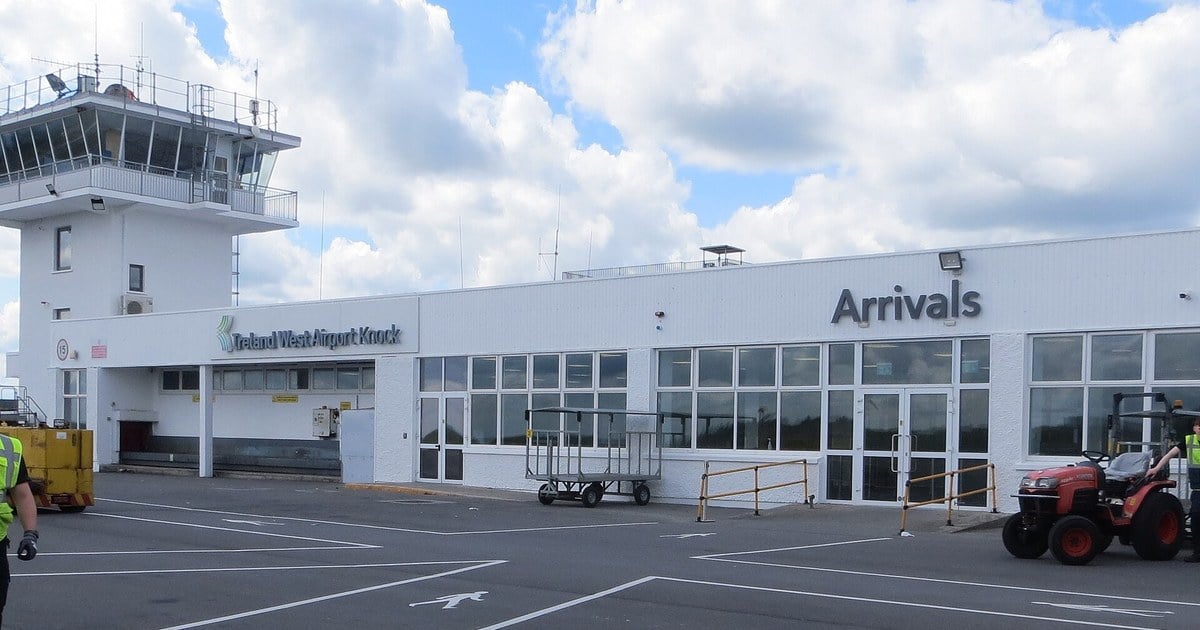
How a Catholic priest convinced the Irish government to build an international airport in a Mayo bog
In February 1981, a television reporter named Jim Fahy drove out to a boggy hillside in rural County Mayo to interview a priest who, it seemed, had lost his mind.
Monsignor James Horan, parish priest of Knock, was standing on 500 acres of wet, fog-prone high ground in the west of Ireland — land he didn’t yet fully own — overseeing what he described as the construction of an international airport. He had, by his own cheerful admission, no money to build it and possibly no planning permission to build it. When Fahy’s report aired on RTÉ’s Ireland’s Eye, the clip became one of Irish television’s enduring comic moments.
“We’re building an airport,” Horan told Fahy, “and I hope the Department of Transport doesn’t hear about it — now don’t tell them — and we’re going to have it built in a very, very short time… and we have no money.”
He wasn’t joking. He also wasn’t wrong. Within five years, Horan had built the airport. It now carries close to a million passengers a year and ranks as the fourth busiest airport in Ireland.
The Shrine and the Impossible Visit
To understand what Horan was doing, you need to understand Knock.
- 1967: Father Horan begins campaigning for a Knock airport
- 1975: First major feasibility study commissioned by the Irish government
- 1981: Construction begins after Horan’s persistence finally wins government backing
- 1985: Ireland West Airport Knock opens to its first commercial flights
- 1986: Father Horan dies — but his airport becomes a lasting legacy for Mayo
In August 1879, in a small village in County Mayo, fifteen people reported seeing an apparition on the gable wall of the parish church — the Virgin Mary, St. Joseph, and St. John the Evangelist, standing silent on the wall while rain fell around them. The Catholic Church eventually recognised the apparition, and over the following century Knock became one of Ireland’s most significant pilgrimage sites. By the time Horan arrived as parish priest in 1967, the shrine drew hundreds of thousands of visitors annually. He threw himself into developing it: a new church was dedicated in 1976, and he oversaw construction of a basilica with a capacity of fifteen thousand people.
Then came September 1979, and the moment that changed everything.
Pope John Paul II was making his first visit to Ireland, and Horan had lobbied — successfully, against considerable doubt about the logistics — to bring the Pope to Knock for the centenary of the apparition. On September 30, 1979, nearly half a million people made their way to a village in the west of Ireland that was connected to the rest of the country by a network of narrow, winding roads and absolutely nothing else.
If you have driven in Mayo, you know what that means. The crowd that descended on Knock that day did so by car, by bus, by any means available, clogging roads for miles in every direction — the same roads that the rest of western Ireland depended on for its economic life. Horan watched it happen and drew what seemed to him the obvious conclusion: what this part of Ireland needed, urgently, was an airport.
🇮🇪 Discover Your Irish Heritage
Join 64,000 people staying connected to their Irish roots. Get our free Irish Ancestry Guide — surnames, counties, parish records and emigration history — when you subscribe free.
The Foggy, Boggy Objection
Aviation experts had, in fact, agreed with the broad point. International consultants had recommended that Connacht — the western province encompassing Mayo, Galway, Sligo, Leitrim, and Roscommon — needed its own airport. What they had not recommended was that a parish priest in his seventies should go and build one himself, on an elevated, boggy, fog-prone site in north Mayo, without waiting for the normal processes of planning and finance to sort themselves out.
The criticisms were immediate and not entirely unreasonable. The site, it was widely said, was “too boggy and too foggy.” The commercial case for scheduled international services to a region of sparse population and limited tourism infrastructure struck many observers as, at best, optimistic. Urban Ireland dismissed the idea as a “preposterous notion.” Others called it a “reckless fantasy.” The kindest version was that Horan was well-intentioned but mad.
Horan was aware of the optics. In that 1981 interview, he acknowledged he was not entirely certain he had planning permission to proceed. He was, he explained, going ahead anyhow.
He had, he added, faith.
The Money, the Election, and the Lottery
He also had something more concrete to work with than faith alone. Taoiseach Charles Haughey had committed IR£10 million in government funding to the project — real money, and a substantial public investment in a region that had been watching its young people emigrate for decades. With that commitment, Horan began moving earth. Tonnes of hardcore went down across the bog, laying the foundation for a runway that had no business being there.
Then politics intervened in the way politics does.
After Fianna Fáil’s defeat in the 1982 general election, the new government reviewed its predecessor’s commitments and determined that an international airport on a boggy hill in Mayo was not among its priorities. The funding was cut. The project was, on paper, finished.
Horan did not treat it as finished. He did what any reasonable seventy-something parish priest in his position would do: he organised a lottery.
The “Jumbo Draw” — named for the transatlantic flights it offered as prizes — was Horan’s mechanism for raising what the government would not provide. The prize list was magnificently, specifically Irish: cars, houses, cattle, sites for houses, heating oil, and cash. Horan himself travelled to the Irish diaspora in America and Australia, making the case in person that the west of Ireland needed this airport and that the people who had left that west, or whose parents had left it, might want to do something about it. He raised around IR£4 million through the draw.
Combined with government grants that ultimately totalled IR£9.858 million and a conditional EU contribution of IR£1.3 million — to be released only if Horan matched it from private funds, which he proceeded to do — the money was there. Five hundred acres of boggy hillside, drained and levelled. A runway of 2,340 metres. A terminal. The whole thing constructed in one of the least commercially obvious locations in western Europe, within five years of that television interview.
The Greatest Day
On October 25, 1985, three Aer Lingus charter flights lifted off from Knock Airport bound for Rome — the first commercial flights ever to operate from the site. The official opening ceremony followed on May 30, 1986, by which point the airport had already demonstrated that it could, in fact, function.
At the opening, Horan did not understate the occasion.
“This is the greatest thing that has happened in Connacht in the last hundred years,” he said, “and this is the greatest day of my life.”
He had spent the better part of a decade on this project. He had navigated the collapse of his main government funding source and rebuilt the finances from scratch through a lottery. He had flown to America and Australia to pitch the Irish diaspora on a raffle whose prizes included cattle. He had presided over the transformation of boggy high ground into functioning aviation infrastructure. He had done all of this while also serving as parish priest of one of Ireland’s most significant religious sites, managing a basilica that held fifteen thousand people, and being, by that point, seventy-four years old. The airport was originally named Horan International Airport in his honour.
A Particular Kind of Ending
James Horan died on August 1, 1986 — less than ten weeks after the official opening. He had gone on a pilgrimage to Lourdes, the kind of journey he had organized and undertaken many times. The years of travel and fundraising, the relentless physical weight of the campaign, had left him in poor health. He was seventy-five.
His remains were flown home to Ireland. They arrived at Knock Airport — which received them as the first funeral to pass through its doors.
If that detail sounds too neat to be true, it isn’t. It is the kind of thing that happens in Mayo.
He never saw the airport fully come into its own. He never saw Ryanair make it a hub for Irish routes, or watched the passenger count climb past 100,000 in 1988, or heard it renamed Ireland West Airport Knock in 2005. He never saw the government announce a €27 million capital grant in 2007, or the terminal extension completed in 2009, or the €28 million in further public support that flowed between 2021 and 2025 — money invested in an airport that an earlier government had once tried to kill. He never saw the 40th anniversary, celebrated in May 2026, by which point the airport was handling close to 946,000 passengers a year.
What Ended Up Being Built
The passenger numbers tell a specific story. In the airport’s inaugural year of 1986, it handled around 9,200 passengers — well short of the projections, and considerably more than the critics thought possible. By 1988, the total had passed 100,000. By 2005, it was approaching 530,000. In 2019, before the pandemic hit, the figure was 805,443. By 2024 it had recovered to 834,000. In 2025, the airport carried 946,381 passengers.
Today the airport is majority-owned — 82.5% — by The Horan Airport Trust, with the remaining share split among seven local councils. It serves routes across Ireland, Britain, and continental Europe. It is, by any measure, a functioning piece of regional infrastructure that connects a part of Ireland which spent much of the twentieth century watching its population leave.
The critics were not wrong in every particular. An airport in this location has required ongoing government support to remain viable, and probably always will. Building aviation infrastructure on bog in the far west is not, and was not, a financially obvious idea. Horan knew that. He just did not think financial obviousness was the relevant metric. He thought the west of Ireland deserved the same connections to the world that everywhere else had, and he thought the diaspora who had left that west deserved a way back that didn’t involve hours on winding Mayo roads with half a million other pilgrims.
In a way that is unusual for large infrastructure projects, this airport became exactly what one person decided it would be. Not a committee. Not a transport authority. Not a government strategy document. One priest, standing on a hill with no money and possibly no permission, telling a television reporter not to tell the Department of Transport.
The boggy hillside is still there. The airport is still there too — carrying more passengers every year, connecting a corner of Ireland that has always had more ties to the wider world than its roads ever allowed. The runway sits on hardcore laid across drained bog, and on either side of it the landscape does what Mayo landscape has always done, apparently unbothered by the whole extraordinary business. Horan would have found that fitting. He was never much bothered by the things that were supposed to be obstacles either. If you’re drawn to the west of Ireland’s pilgrimage sites, Croagh Patrick, County Mayo’s other great pilgrimage mountain, is worth the trip too.
Frequently Asked Questions About Knock Airport and Father Horan
Who was Father James Horan?
Father James Horan (1911–1986) was a Roman Catholic priest and tireless community organiser from Knock, County Mayo. He is best known for two extraordinary achievements: the construction of the new Knock Shrine basilica, capable of holding 20,000 people, and his successful campaign to bring an international airport to the rural west of Ireland despite widespread scepticism. He died in 1986, just a year after the airport he built opened.
Why was Knock Airport controversial?
Critics dismissed the idea as absurd — a full international airport serving a remote part of Mayo with a population far too small to justify the infrastructure. Taoiseach Garrett FitzGerald famously called it “Horan’s Folly” before it opened. However, the airport went on to prove its sceptics wrong. Today known as Ireland West Airport Knock, it handles hundreds of thousands of passengers annually and has brought significant economic benefit to Connacht.
Is Knock Airport still operating today?
Yes. Ireland West Airport Knock — to give it its full name — remains open and operates scheduled flights to UK, European, and transatlantic destinations. It serves as a vital transport link for Connacht and parts of Ulster, significantly reducing travel times for people in the West of Ireland. The airport celebrated its 40th anniversary in 2025.
☘️ Join 64,000+ Ireland Lovers
Every weekday morning, get Ireland’s hidden gems, local secrets, and travel inspiration — the kind you won’t find in any guidebook.
Subscribe free — enter your email:
📲 Know someone who’d love this? Share on WhatsApp →
Love more? Join 43,000 Scotland lovers → · Join 29,000 Italy lovers → · Join 7,000 France lovers →
Free forever · Unsubscribe anytime
Enjoyed this story? Join 64,000+ Ireland lovers — subscribe free to the Love Ireland newsletter for weekly Irish heritage, history and hidden gems delivered to your inbox.
Tours & experiences you might love


Powered by Viator. Some links are affiliate links — we may earn a small commission at no extra cost to you.
Secure Your Dream Irish Experience Before It’s Gone!
Planning a trip to Ireland? Don’t let sold-out tours or packed attractions spoil your journey. Iconic experiences like visiting the Cliffs of Moher, exploring the Rock of Cashel, or enjoying a guided walk through Ireland’s ancient past often sell out quickly—especially during peak travel seasons.

Booking in advance guarantees your place and ensures you can fully immerse yourself in the rich culture and breathtaking scenery without stress or disappointment. You’ll also free up time to explore Ireland’s hidden gems and savour those authentic moments that make your trip truly special.
Make the most of your journey—start planning today and secure those must-do experiences before they’re gone!