

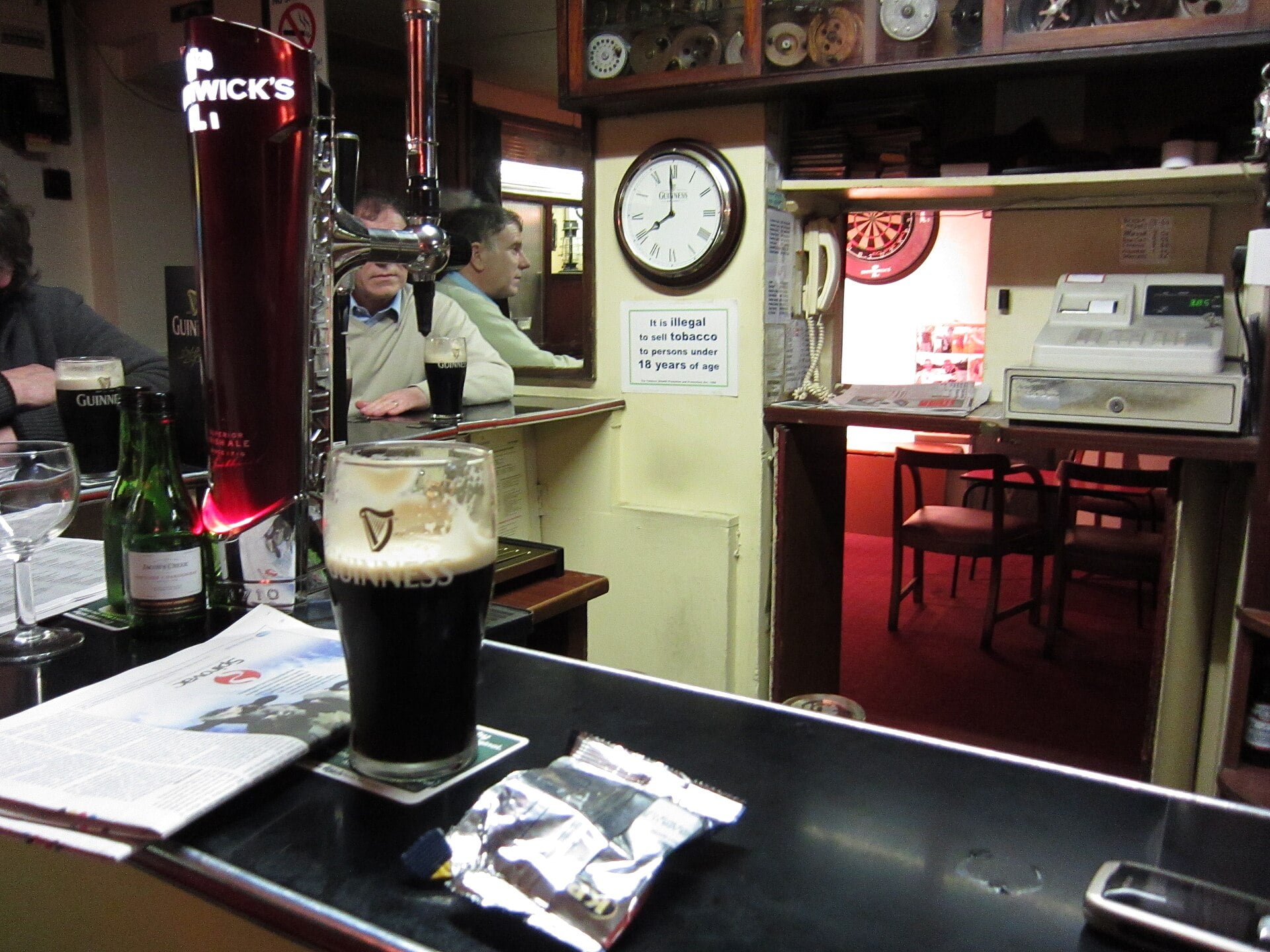
Try the Guinness Timer ⏱️
A perfect pour takes 119.5 seconds — the rest, two minutes, gives the stout time to settle. Time your own pint and see if you wait long enough.
How Ireland Manufactures and Exports Authentic Irish Pub Interiors to Bars Around the World
Somewhere in a workshop on Dublin’s Sandyford Industrial Estate, a crew of up to 30 craftsmen are building a pub. They are cutting mahogany bar tops, fitting stained glass panels, assembling leather banquettes, laying decorative floor tiles. They are curating the bric-a-brac — whisky jugs, oil paintings, postage scales — that will make this place look as though it has been absorbing cigarette smoke and spillages since the 1890s.
What is unusual is where all of this is going. Not to a street corner in Galway or a village square in Kerry. It is going into a 40-foot steel shipping container, stacked onto a freighter, and hauled to somewhere considerably further away — a hotel lobby in Dubai, a restaurant strip in Tokyo, a casino resort in Las Vegas. When it arrives, an installation crew will assemble the pieces like a very expensive, very atmospheric jigsaw puzzle, and another Irish pub will materialise in a country that has no particular geographic business containing one.
This is a real industry. It has existed for more than 35 years. And it may be one of the more quietly remarkable exports in Irish history.
The Architect Who Couldn’t Stop Measuring Pubs
The story begins in 1970s Dublin, when an architecture student named Mel McNally undertook what sounds like the finest college project ever conceived. McNally spent years visiting and cataloguing Irish pubs — over 200 of them — recording the details that made each one work. The height of the ceiling. The depth of the snug. The relationship between the bar, the booths, and the door. The way light moved across a particular surface. His research was eventually exhibited at the Mansion House in Dublin.
What McNally found, and what he would spend the next five decades refining, was that Irish pubs were not random. Their atmospheres were an architectural product — the result of specific spatial decisions, accumulated across generations, that created something a person could not quite articulate but felt the moment they walked through the door. No two pubs were identical, but they shared a set of underlying principles that could be isolated, documented, and — here was the leap — reproduced.
“We recorded the essence of what makes a pub a pub,” McNally has said. “In the scale, the architecture, the mix of details, the craftsmanship. No two are the same, but they have an essence that we carry into projects we do now.”
By the 1980s, McNally Design was creating pub interiors throughout Ireland and the UK. By 1990, McNally had formalised this into the Irish Pub Company, with a specific global mission: to build Irish pubs everywhere, properly, from Ireland, with Irish hands.
🇮🇪 Discover Your Irish Heritage
Join 64,000 people staying connected to their Irish roots. Get our free Irish Ancestry Guide — surnames, counties, parish records and emigration history — when you subscribe free.
What Guinness Had to Do With It
McNally was not alone in seeing the opportunity. Between 1985 and 1995, Guinness had been watching something interesting happen in their sales data. Wherever a genuine Irish pub opened in the world, Guinness sales in that area spiked — reliably, measurably, every time. The logic wrote itself: if the company could accelerate the spread of Irish pubs globally, it would sell considerably more stout.
The 1990 FIFA World Cup, hosted in Italy, gave them a test case. Six Guinness representatives travelled through Italy before the tournament, pitching bar owners on the idea of converting their establishments into Irish pubs. The result: 58 Irish pubs opened across Italy between January and June of 1990. It was a proof of concept that both Guinness and McNally recognised immediately.
That same year, the two joined forces to create what became known as the Guinness Irish Pub Concept — a systematic, exportable framework for building an Irish pub anywhere on earth. The Irish Pub Company became the original and official design partner of the Concept, responsible for designing, manufacturing, and installing pub fit-outs to Guinness’s specifications. The Concept extended well beyond timber and glass; it also specified Irish music, traditional food, and recommendations on staffing. Irish staff, the Concept suggested, were rather important. If you want to know why the drink itself tastes different depending where you order it, we’ve looked into why Guinness tastes better in Ireland — part of the same story that made exporting the pub around it worthwhile.
The expansion moved quickly. By the mid-1990s, the Irish Pub Company had pushed into the United States. By 2006, roughly 1,800 pubs had been installed across more than 50 countries in 15 years. By the company’s 35th anniversary in late 2025, that figure exceeded 2,000 venues in more than 100 nations — every continent except Antarctica.
Five Pubs, Each with a Backstory
One of the central design decisions that McNally’s team made early was that “Irish pub” could not mean just one thing. A Victorian bar in Dublin is architecturally nothing like a country pub in Connemara. Standardising the export first required categorising the variety that existed at home.
The Irish Pub Company eventually settled on five core design styles:
- The Country Cottage — whitewashed walls and the feel of a rural homestead that quietly doubled as a drinking establishment
- The Brewery Pub — drawing on the industrial heritage of places like St. James’s Gate, with empty casks, copper piping, and the paraphernalia of production
- The Victorian Pub — the ornate stained-glass elegance of Dublin’s grander saloon bars, rooted in the late 19th century
- The Gaelic Pub — earthier, with rough-hewn timber and murals drawn from Irish folklore, the kind of place that feels like it predates electricity
- The Traditional Irish Pub Shop — preserving a peculiarly Irish institution: the shop-front pub that, in another era, would also have served as a grocer, a draper, or an undertaker, sometimes all three simultaneously
Each style carries its own list of components and specifications. A client does not simply buy “a pub.” They choose a design direction, work with the company’s team of interior designers, master carpenters, specialist artists, and bric-a-brac curators to adapt it to their specific space, and then the whole thing gets built — in Dublin — before being dismantled and shipped.
What Actually Goes in the Container
The manufacturing process is more involved than the concept suggests. The bar counter is the load-bearing architectural element of the entire project — by the designers’ own reckoning, everything else in the space gets laid out from there. It is also one of the most demanding pieces to build. Irish timber, it turns out, is too soft for bar tops; the workshops use Scandinavian pine and mahogany for surfaces that need to withstand decades of glasses, elbows, and enthusiasm.
Around the bar come the components that do the atmospheric work: stained glass panels, handcrafted floorboards, leather banquette seating, decorative tiling, mirrors, and glasswork. Then there is the bric-a-brac — the accumulated objects of an imaginary century of occupation. Whisky jugs. Postage scales. Oil paintings. Antique-effect spinning wheels and cast-iron tools. These are not afterthoughts. They are a deliberate element of the Guinness Irish Pub Concept’s specifications, intended to communicate age and inhabitation to someone who has never set foot in Ireland.
All of it loads into 40-foot steel crates in a specific sequence — an order dictated by how the installation crews will need to unpack and assemble at the other end. From Dublin, those crates travel by truck, train, or freighter to wherever the pub is going up. The whole process, from initial consultation to a finished, open pub, takes between three and nine months. The budget typically runs between one and four million dollars.
The risks are tangible. In one of the industry’s more memorable incidents, a full consignment of pub components sank just outside Rotterdam during transit. An entire Irish pub, on its way to somewhere that wanted it, went to the bottom of the North Sea instead.
Where They End Up
The geography of the Irish Pub Company’s portfolio reads like a test of how far the concept can be stretched before it stops making sense — and then keeps going. Germany is the company’s biggest European client; Switzerland is a close second. But the list extends well past the continent: the UAE, Qatar, Bahrain, Japan, Nigeria, Mauritius, and the New York-New York Hotel and Casino in Las Vegas, where a recreation of an Irish pub sits inside a recreation of Manhattan, inside a city built in the Nevada desert.
The company maintains offices in Dublin, Atlanta (managing US operations since 1997), and the UAE. At any given point, McNally’s team has managed simultaneous projects in Liverpool, Moscow, and Malta. The installation crews that travel with the containers operate in building environments that differ sharply from anything in Ireland — different codes, different climates, different structural constraints — and the Irish Pub Company adapts each fit-out accordingly.
The commercial argument for all of this, for anyone inclined to be sceptical, is fairly clear. Sales per square foot in a well-executed Irish pub consistently outperform US averages by a factor of two. Irish pubs have proven resilient across vastly different markets — from Kurdistan to the Mauritian coast to the centre of Tokyo — in ways that comparable national drinking establishments have not managed. The Irish Pubs Global Federation estimates that at least 6,500 Irish pubs now operate outside Ireland; other counts put the figure closer to 7,000. Guinness is sold in every single one of them.
The Question Nobody Can Quite Avoid
At some point — and it is an irresistible question — one has to ask what “authentic” actually means in this context. If a pub is designed by Irish architects, built by Irish craftsmen, from materials curated to replicate specific periods of Irish pub history, and then assembled in Bahrain, is the result genuine?
McNally, whose work has touched more Irish pubs than anyone alive, offers a fairly direct answer by example. His personal favourite pub in the world is the Harbour Bar in Bray, County Wicklow — a place he had nothing to do with building, and which has been touched as little as possible by anyone since. The implication is that what matters is not age itself but the architectural decisions, accumulated over centuries, that age happens to produce. If those decisions can be isolated and replicated, the experience follows. For a look at the other end of that spectrum — a pub that was never designed for export at all — The Cobblestone in Smithfield is about as unexported an Irish pub as you can find.
There is also a deeper irony embedded in the enterprise. The bric-a-brac that fills an exported Irish pub — the spinning wheels, the flagons, the postage scales — are reproductions. Deliberately aged replicas of objects that would take decades to look the way they do. The mahogany bar top was milled in Scandinavia. The timber beams were engineered. Some of the design styles reproduce Irish pub types that no longer widely exist at home, preserved in amber by an industry that decided they were worth exporting before the originals disappeared entirely.
And yet, they work. They fill up. They generate noise and warmth and the particular quality of a room where people are genuinely glad to be in the same place. Whether that constitutes authenticity or simply a very skilled approximation of it may be a question without a useful answer — and may not be a question the customers are asking while they’re sitting in one.
Thirty-Five Years On
At the company’s 35th anniversary in late 2025 — marked by the completion of a new pub in Orleans, France — the Irish Pub Company was still headquartered in Dublin, still building pubs that will never see a street corner in Ireland, and still finding new clients. The in-house team of designers, carpenters, artists, and curators has grown with the decades of demand. Every project still involves a custom design process shaped around the client’s specific space. Nothing rolls off a production line.
“Thirty-five years ago, we set out with a simple idea,” McNally said at the milestone: “to share the spirit, craft and warmth of Irish pubs with the world.”
In more than 100 countries, across six continents, in desert hotels and mountain towns and casino resorts and city-centre streets, that idea has been assembled — piece by piece, from a workshop in Dublin — into something people keep ordering more of. The timber is Scandinavian, the whisky jugs are reproductions, and the whole thing arrived in a shipping container. But the room fills up all the same, which is exactly what a pub is supposed to do.
We find something genuinely satisfying in that — this small, damp country’s most sociable invention, turning up in the places you’d least expect it, making people want to stay a little longer wherever it lands.
☘️ Join 64,000+ Ireland Lovers
Every weekday morning, get Ireland’s hidden gems, local secrets, and travel inspiration — the kind you won’t find in any guidebook.
Subscribe free — enter your email:
📲 Know someone who’d love this? Share on WhatsApp →
Love more? Join 43,000 Scotland lovers → · Join 29,000 Italy lovers → · Join 7,000 France lovers →
Free forever · Unsubscribe anytime
Enjoyed this story? Join 64,000+ Ireland lovers — subscribe free to the Love Ireland newsletter for weekly Irish heritage, history and hidden gems delivered to your inbox.
Tours & experiences you might love


Powered by Viator. Some links are affiliate links — we may earn a small commission at no extra cost to you.
Secure Your Dream Irish Experience Before It’s Gone!
Planning a trip to Ireland? Don’t let sold-out tours or packed attractions spoil your journey. Iconic experiences like visiting the Cliffs of Moher, exploring the Rock of Cashel, or enjoying a guided walk through Ireland’s ancient past often sell out quickly—especially during peak travel seasons.

Booking in advance guarantees your place and ensures you can fully immerse yourself in the rich culture and breathtaking scenery without stress or disappointment. You’ll also free up time to explore Ireland’s hidden gems and savour those authentic moments that make your trip truly special.
Make the most of your journey—start planning today and secure those must-do experiences before they’re gone!