

There is a quiet truth known to millions of Irish emigrants, and to the children and grandchildren they raised in kitchens far from Connacht or Cork: Ireland never leaves you. You can cross the Atlantic, build a life beneath entirely different skies, speak a language that carries no Irish lilt — and still, without warning, Ireland reaches across the years and finds you. In a smell. In a rainfall. In a bar somewhere, when someone plays a tune you once heard at your grandmother’s table.
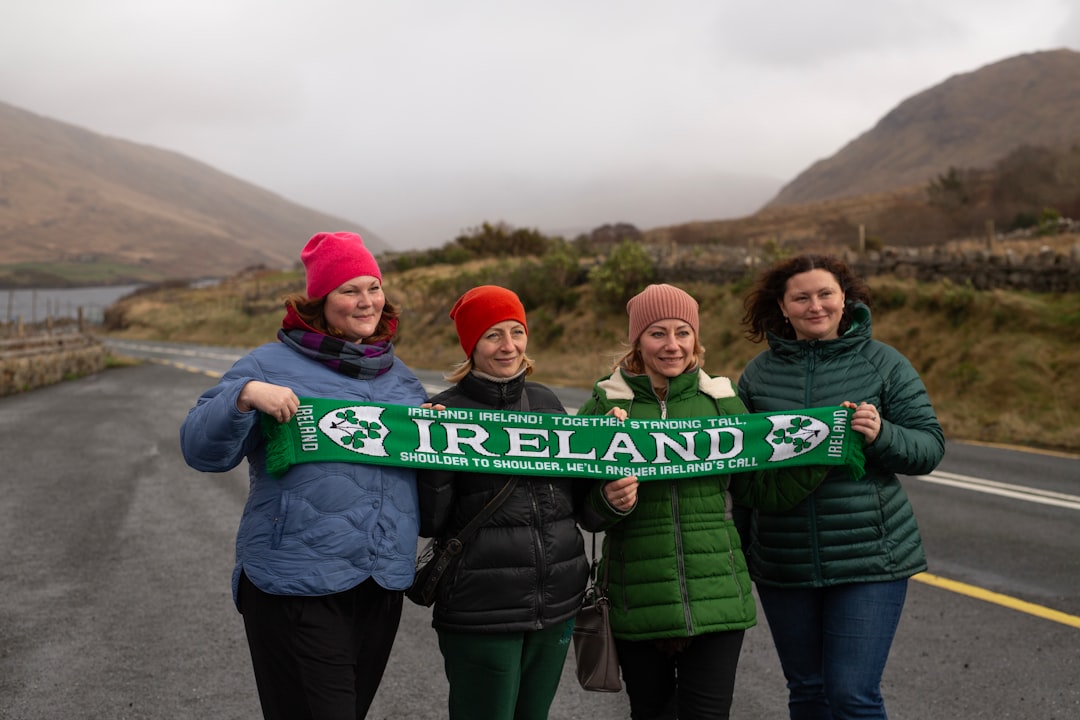
This is not mere sentiment. It is something structural in how Ireland works upon the people it shapes.
The Moment You Realise Ireland Has Never Left
It tends to arrive without ceremony. You might be walking to work in London or Boston when you catch a particular smell — damp earth after rain, with that green, peaty, almost mineral quality that doesn’t exist in quite the same way anywhere else on earth. Your chest tightens. You are eight years old again and the fields behind the house are muddy and your boots are soaking through.
Or you hear a fiddle playing from a pub as you pass. You were perfectly fine. You are no longer perfectly fine.
That is how Ireland announces itself from a distance: not loudly, but absolutely.
What Ireland Leaves Behind in You
The Land Written in Your Body
Ireland’s landscape is not merely beautiful — it is specific in a way that becomes part of how you experience the world. The quality of light on the Atlantic coast on a grey autumn afternoon is unlike any other light. The green of Irish fields after rain — that impossible, almost luminescent green — lodges itself deep in whatever part of you processes home.
People raised in Ireland carry this unconsciously. They don’t know they are measuring every landscape against the one that formed them, until they find themselves standing somewhere genuinely stunning and thinking: it’s beautiful, yes — but it’s not Ireland.
The Aran Islands. The Burren’s moon-grey limestone. The Connemara bog in the mist. The cliffs of Slieve League catching afternoon light. These places leave marks that no distance erases.
The Sound of Home
There is the matter of voices. Irish speech — the rhythm of it, the musicality of it, the warmth that runs beneath even the sharpest wit — is deeply particular. When Irish emigrants hear another Irish accent in a foreign city, something involuntary happens. The guard drops. The shoulders loosen. There is a recognition that precedes thought.
And it works the other way too. After years abroad, returning Irish people often say they had forgotten what it felt like to be completely understood — not just linguistically, but in terms of timing, irony, and what is best left unsaid.
The Music That Ambushes You
There is arguably no more reliable carrier of Irish longing than music. Traditional Irish music — a slow air, a fiddle reel, the opening bars of She Moved Through the Fair — carries extraordinary emotional freight for the diaspora. It is the sound of something ancient and continuous, something that was playing in the background of Ireland for centuries before emigration, and went on playing long after millions left.
The experience of hearing this music unexpectedly — in a distant city, through someone’s window, from another room at a party — is among the most commonly reported triggers for what Irish people tend to call homesickness, even when they haven’t lived in Ireland for thirty years. Even when they were born somewhere else entirely.
Why the Irish Diaspora Is Unlike Any Other
Seventy Million Strong — and Still Counting
The numbers are genuinely extraordinary. More than seventy million people worldwide claim Irish descent — roughly ten times the population of the island of Ireland itself. The great waves of emigration, from the Famine era through the economic emigrations of the 1980s, scattered Irish people across the English-speaking world and beyond.
What is remarkable is not just the scale, but the loyalty. Irish emigrant communities did not assimilate and vanish. They formed associations, built churches, established Irish-language newspapers. They named streets after home. They shipped Irish soil in their luggage so that their parents could be buried in something that came from Ireland, even if it wasn’t the actual hillside they’d been born upon.
The story of Irish emigration is one of the most documented of any people — and one of the most emotionally resonant. If you want to understand your own family’s part in it, our complete guide to tracing your Irish ancestry is a good place to begin.
The Irish Community Abroad
If you are Irish — or of Irish descent — and find yourself in a strange city, the Irish community has almost certainly already organised itself nearby. There will be a GAA club, or an Irish cultural centre, or at minimum a pub where someone knows someone who knows your county.
This instinct to find one another is not accidental. It is a direct expression of something that Ireland puts into people: the conviction that community matters, that no one should be entirely alone, and that everything is better when it is shared.
Ireland Never Leaves You: The Triggers That Prove It
The Irish diaspora maintain an unofficial inventory of experience triggers — things that bring the country back, unbidden and complete:
- The smell of turf burning. Nothing else smells like it. Nothing else carries the same particular emotional charge.
- Rain on a slate roof. Ireland’s relationship with rain is intimate and constant — oddly comforting when remembered from a distance.
- The colour of an Irish winter afternoon. Not grey exactly — that luminous, soft, Atlantic-filtered half-light that turns the countryside into something painted.
- Barry’s Tea in someone else’s kitchen. An Irish person you didn’t know became an immediate friend.
- The texture of brown bread, still slightly warm. Butter. Nothing added. Everything remembered.
- A stranger at a funeral making everyone laugh. The Irish genius for holding grief and humour together in the one hand.
- The word “grand.” Used to mean fine, terrible, uncertain, hopeful, and resigned — sometimes all at once.
These are not whimsical oddities. They are the sensory vocabulary of a specific place, preserved intact inside people who may not have seen Ireland in decades.
Coming Home — and Why It Feels Like You Never Left
Irish people who return after years abroad consistently report the same thing: Ireland slips back on like something that was never fully removed.
There is the smell of the airport, immediately recognisable. There is the light on the drive from Dublin that already looks like no other light. There is the first time someone says something to you in passing — in a shop, at a petrol station, in a café — with that specific warmth that is not performative, that is simply how Irish people are with one another.
And then you realise: you have been homesick for thirty years. You simply didn’t have a name for what it was.
The Cliffs of Moher, experienced by visitors as dramatic and magnificent, are experienced differently by returning diaspora. Visitors see spectacle. The Irish see memory. They see the country at its most elemental — ancient, enduring, entirely itself — and understand at last that this is what followed them.
Planning Your Return to Ireland
If reading this has stirred something in you, that feeling is worth following. Whether you are planning your first trip or returning after years away, Ireland is ready to be exactly what you remembered — and to surprise you in the ways it has changed.
Our Ireland trip planning hub is designed for exactly this moment — to help you find the route, the pace, and the places that will feel most like coming home. And perhaps, in the end, that is the only real reason any of us need to go.
Ireland has been waiting. It always has.
For the 70 million people worldwide who carry Ireland in their heritage, that feeling has a precise address — a townland, a parish, a county — not just a country. Our free Irish ancestry guide shows you exactly how to find it, from the 1901 census to Griffith’s Valuation and the 60,000 townlands of Ireland.: Trace Your Irish Roots — Free Step-by-Step Guide.
☘️ Join 64,000+ Ireland Lovers
Every weekday morning, get Ireland’s hidden gems, local secrets, and travel inspiration — the kind you won’t find in any guidebook.
Subscribe free — enter your email:
📲 Know someone who’d love this? Share on WhatsApp →
Love more? Join 43,000 Scotland lovers → · Join 29,000 Italy lovers → · Join 7,000 France lovers →
Free forever · Unsubscribe anytime
Tours & experiences you might love


Powered by Viator. Some links are affiliate links — we may earn a small commission at no extra cost to you.
Secure Your Dream Irish Experience Before It’s Gone!
Planning a trip to Ireland? Don’t let sold-out tours or packed attractions spoil your journey. Iconic experiences like visiting the Cliffs of Moher, exploring the Rock of Cashel, or enjoying a guided walk through Ireland’s ancient past often sell out quickly—especially during peak travel seasons.

Booking in advance guarantees your place and ensures you can fully immerse yourself in the rich culture and breathtaking scenery without stress or disappointment. You’ll also free up time to explore Ireland’s hidden gems and savour those authentic moments that make your trip truly special.
Make the most of your journey—start planning today and secure those must-do experiences before they’re gone!