

Most visitors driving the Loop Head Peninsula never leave the car park at Kilkee’s West End. They walk the Blue Flag beach, swim in the Pollock Holes, and move on toward Loop Head Lighthouse. A smaller number follow the Kilkee Cliff Walk out past Diamond Rocks — and from a viewpoint known as Georges Head, they get a clear look at something most people miss entirely: a flat-topped sea stack, cut off from the mainland, with the ruins of a monastery still sitting on top of it, standing since roughly the 6th century.
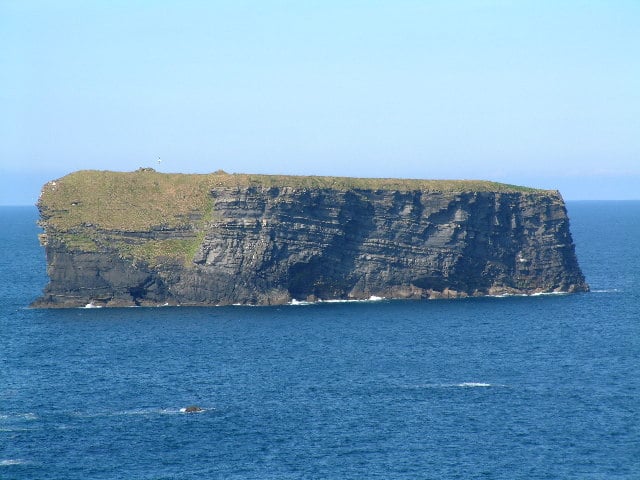
That sea stack is Bishop’s Island, known in Irish as Oileán an Easpaig Gortaigh — “the island of the hungry bishop.” According to local legend, the name comes from a bishop who rowed out to the island with food during a famine, became stranded there when the sea turned, and starved to death within sight of the mainland. It is one of the most dramatic and least-visited monastic sites in Ireland, not because it is obscure, but because it is completely unreachable. No landing is possible today. The monks who built there chose a place that guaranteed solitude, and solitude is what it still has, roughly 1,400 years later.
This article covers what Bishop’s Island is, what the ruins on it actually are, how to see it from the Kilkee Cliff Walk, and why a group of early Christian monks chose one of the most inaccessible spots on the Irish coastline to build their home.
Want stories like this in your inbox every week? Subscribe to our free Ireland newsletter — history, hidden places, and practical guides for anyone who loves Ireland.
What Is Bishop’s Island?
Bishop’s Island is a sea stack — a flat-topped column of rock cut off from the mainland cliff by a narrow but deep channel, most likely within the last thousand years as coastal erosion widened the gap. It sits roughly 3 kilometres southwest of Kilkee town, on the coastal stretch of the Loop Head Peninsula in County Clare, opposite the townland of Fuathach. The stack measures about 180 metres long by 90 metres wide and rises around 65 metres above the Atlantic — large enough on top that the early medieval monks who settled there could build a small stone church, a beehive hut, and maintain a modest enclosed community.
The ruins themselves are consistent with an early Irish monastic settlement of the 6th to 8th century, the same period that produced Skellig Michael off Kerry and the Gallarus Oratory on the Dingle Peninsula.
The island’s sheer inaccessibility means no landing has taken place in modern times, and it remains an undisturbed habitat for nesting seabirds along this stretch of the Wild Atlantic Way.
The Monastery: What the Ruins Show
The remains on Bishop’s Island include structures that follow a pattern common to early Irish monasticism. From the cliff path above, on a clear day, you can make out the following:
A dry-stone oratory. This is the most significant structure — a small rectangular church, roughly 9 square metres in area, built entirely from stacked stone without mortar. Its sloping side walls give it the upturned-boat profile typical of a Gallarus-type oratory, the same construction style as the intact Gallarus Oratory in Kerry. The Bishop’s Island oratory has partially collapsed, but its outline and much of its fabric remain.
A clochán. This is the beehive-shaped stone hut, about 35 metres in circumference, that served as living quarters for the monks. It has a domed roof built up in corbelled stages — each course of stone projecting slightly inward until the roof closes — with a lintelled doorway facing east. Like the oratory, it was built entirely without mortar.
Taken together, the site represents a complete — if small — early Christian settlement. The monks who lived there would have been largely self-sufficient, fishing, growing what little they could on the thin soil, and dedicating the majority of their time to prayer and manuscript work.
Why Did Monks Choose This Place?
The choice seems irrational from a practical standpoint. The island is cut off by a channel that the Atlantic swell makes dangerous in all but the calmest conditions. Supplies would have needed to be brought by boat. The wind at this section of the Clare coast is relentless.
But the logic of early Irish monasticism was not primarily practical. The tradition of the peregrinatio — voluntary exile and hardship for the sake of God — drove many monks to seek the most remote places they could find. Islands were particularly valued. The sea crossing itself was a form of separation from the world. The difficulty of the location was understood as a spiritual discipline, not a problem to be solved.
Bishop’s Island sits within a broader tradition of Atlantic island monasticism that includes Skellig Michael in Kerry, Caher Island in Mayo, and Inishmurray in Sligo. Each of these sites shares the same characteristics: extreme remoteness, simple stone construction, and evidence of sustained habitation despite conditions that would defeat most modern campers.
The monks at Bishop’s Island would also have had a remarkable view. From the cliff path above the stack, on a clear day, the Aran Islands are visible to the north, the Kerry coastline to the south, and Loop Head to the west. It is one of the most exposed positions on the Irish coastline, and for the people who chose to live there, that exposure was presumably the point.
If you enjoy discovering Ireland’s hidden history, join thousands of readers who get our free weekly newsletter — covering heritage sites, local stories, and travel guides.
How to See Bishop’s Island
There is really one reliable way to see Bishop’s Island: on foot, from the Kilkee Cliff Walk.
From the cliff path: The walk begins at Diamond Rocks Café at the West End of Kilkee and follows the coast past the Pollock Holes and the quartz-flecked Diamond Rocks themselves. Georges Head, a vantage point along the route, looks directly out over Bishop’s Island and the wider Loop Head Peninsula — this is the spot most visitors use to pick out the stack and its ruins. Binoculars make a real difference for spotting the oratory and clochán on top. The short loop from Diamond Rocks Café is around 4 to 4.5 kilometres; walkers who want more can continue on toward Intrinsic Bay and, eventually, Loop Head itself.
From the water: Unlike the Cliffs of Moher further north, there is no established tourist boat trip out to Bishop’s Island. Landing has never been permitted in modern times, and the stack is best appreciated from the cliff path rather than from a chartered boat.
One practical note: the cliff path is well-maintained but exposed, with sections close to unfenced cliff edges, and it can be slippery after rain. Wear appropriate footwear and take care, particularly with children.
Kilkee: What Else to Know
Kilkee is the largest town on County Clare’s Atlantic coastline and the gateway to the Loop Head Peninsula. It grew into a popular seaside resort in the 19th century, built around Moore Bay, a sheltered horseshoe-shaped bay with a 1.5-kilometre Blue Flag beach that’s regarded as one of the safest bathing spots on Ireland’s west coast. The Pollock Holes — three natural, tide-filled rock pools near Georges Head — are a local institution for sea swimming outside of the main beach.
For more on the towns along this coastline, see our guide to County Clare’s most beautiful towns and villages.
Kilkee is quieter than the Cliffs of Moher, about 40 kilometres north, which draws far larger crowds. If you’re combining the two on a Wild Atlantic Way trip, mornings are the best time to visit either site before tour coaches arrive — see our guide to the Cliffs of Moher for that leg of the journey.
Getting to Kilkee
Kilkee is in County Clare, roughly 50 kilometres southwest of Ennis via the N68 and N67, about 77 kilometres from Shannon Airport, and around 90 kilometres from Limerick. By car, the drive from Ennis takes a little under an hour, following the N68 to Kilrush and then the N67 into Kilkee.
Public transport is limited but does exist: Bus Éireann runs services connecting Ennis, Kilrush, and Kilkee. If you’re relying on public transport, check current timetables directly with Bus Éireann before planning your visit, as rural routes can change.
Once in Kilkee, the Cliff Walk starts on foot from Diamond Rocks Café at the West End of town — there’s no need for a car to reach the Bishop’s Island viewpoint from the town centre.
A Place Worth Slowing Down For
Bishop’s Island is easy to miss. It sits below a coastal path that draws far fewer crowds than the Cliffs of Moher further north, and most walkers on the Kilkee Cliff Walk are looking at the horizon rather than down at the water. But for anyone with an interest in Irish history, early Christianity, or simply in places that have stayed exactly as they are for more than a thousand years, it is worth stopping at Georges Head, finding the right angle, and taking the time to look properly.
The monks who built there left no written records that have survived. We do not know their names, or how long the monastery operated, or when it was finally abandoned. What they left behind are stones, laid carefully by hand in the same way that stones are laid across hundreds of early Christian sites scattered across the west of Ireland. On a sea stack most people never notice, from a cliff walk most people finish in an afternoon, that is enough.
For more on Ireland’s heritage sites, hidden histories, and practical travel guides, subscribe to our free weekly newsletter. New issue every week, no spam, unsubscribe any time.
☘️ Join 64,000+ Ireland Lovers
Every weekday morning, get Ireland’s hidden gems, local secrets, and travel inspiration — the kind you won’t find in any guidebook.
Subscribe free — enter your email:
📲 Know someone who’d love this? Share on WhatsApp →
Love more? Join 43,000 Scotland lovers → · Join 29,000 Italy lovers → · Join 7,000 France lovers →
Free forever · Unsubscribe anytime
Tours & experiences you might love


Powered by Viator. Some links are affiliate links — we may earn a small commission at no extra cost to you.
Secure Your Dream Irish Experience Before It’s Gone!
Planning a trip to Ireland? Don’t let sold-out tours or packed attractions spoil your journey. Iconic experiences like visiting the Cliffs of Moher, exploring the Rock of Cashel, or enjoying a guided walk through Ireland’s ancient past often sell out quickly—especially during peak travel seasons.

Booking in advance guarantees your place and ensures you can fully immerse yourself in the rich culture and breathtaking scenery without stress or disappointment. You’ll also free up time to explore Ireland’s hidden gems and savour those authentic moments that make your trip truly special.
Make the most of your journey—start planning today and secure those must-do experiences before they’re gone!